What’s actually slowing this PC down?
Pick the symptom - the matching free tool is one click away.
The fastest production motorcycle depends on how “production” and “fastest” are defined. By the broadest reasonable definition, the MTT 420RR Turbine Superbike is the current manufacturer-claimed leader at 273 mph. That figure applies to a tiny, hand-built, five-motorcycle series and has not been established here as an independently timed production-bike run.
For a closed-course benchmark, the Kawasaki Ninja H2R is the better-known reference point. For electric motorcycles, the Lightning LS-218 holds the relevant 218-mph Bonneville record claim. And if the question means a current, road-homologated superbike with a clearly published standard-road specification, the Ducati Panigale V4 R is the cleanest answer in this comparison at 197 mph.
Why there is no single uncontested answer
“Fastest production motorcycle” sounds like a simple ranking, but the category contains several fundamentally different machines. A hand-built turbine motorcycle, a track-only hypersport, an electric Bonneville record bike, and a mass-produced road superbike should not automatically share one ranking column.
The important distinctions are:
- Street legal or closed-course only: A motorcycle that cannot be ridden legally on public roads should not be presented as the fastest street motorcycle.
- Limited series or mass production: A five-unit hand-built machine meets a broad definition of production, but it is not equivalent to a motorcycle manufactured in substantial numbers.
- Manufacturer claim or independently timed speed: A specification published by a manufacturer is useful, but it is not the same as an independently verified production-bike run.
- Standard road equipment or race equipment: Slick tires, race exhausts, special oils, and aerodynamic parts can change both performance and legality.
- Current model or historical machine: Old top-speed figures should not be presented as current specifications without current supporting data.
The ranking below therefore separates the categories instead of pretending that every number has the same evidentiary status.
#1 Best Overall
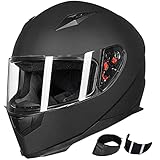
- 2 Visors Included: Clear + Smoked and 1 Neck Scarf for Winter Use
- Streamlined Aerodynamic Design Reduces Wind Noise and Drag
- Advanced and Lightweight Durable ABS Shell
- Quick Release Clasp and Strap and Removable Inner Lining Pads
- Meets or Exceeds FMVSS-218 and DOT Safety Standards
Quick answer: the leaders by category
| Category | Motorcycle | Speed | What the number means |
|---|---|---|---|
| Highest current manufacturer-claimed production speed | MTT 420RR Turbine Superbike | 273 mph claimed | Manufacturer-stated, gearing-limited speed; tiny hand-built series |
| Closed-course production benchmark | Kawasaki Ninja H2R | Commonly cited around 240 mph | Kawasaki confirms a limited-production track motorcycle capable of exceeding 300 km/h; the current official pages reviewed do not publish the exact 240-mph figure |
| Production-electric record benchmark | Lightning LS-218 | 218 mph | Lightning’s Bonneville land-speed-record claim for a production electric motorcycle |
| Current road-homologated superbike | Ducati Panigale V4 R | 197 mph standard | Ducati-published road configuration; 205 mph belongs to non-approved race equipment |
| Current mass-produced comparison | BMW M 1000 RR | 189 mph | BMW Motorrad’s published U.S. maximum-speed specification |
These figures are not directly interchangeable. The 273-mph MTT number is a manufacturer claim for an ultra-limited turbine motorcycle, while the Ducati and BMW figures are standard road-oriented specifications. The Lightning number comes from a Bonneville record context, and the H2R is explicitly not a public-road motorcycle.
1. MTT 420RR Turbine Superbike: 273 mph claimed
If a production motorcycle is defined broadly enough to include a hand-built, limited series, the MTT 420RR has the highest number in this group. Marine Turbine Technologies describes the 420RR as a street-legal, hand-built motorcycle with a gearing-limited top speed of 273 mph.
- Engine: Rolls-Royce M250-C20B turbine
- Power: 420 hp
- Torque: Approximately 500 lb-ft
- Production: Five motorcycles for the 25th-anniversary edition
- Stated price: $275,000
The turbine engine is what separates the MTT from nearly every conventional superbike. Instead of a reciprocating piston engine, it uses a Rolls-Royce-derived turbine powerplant, making the motorcycle more like a compact road-going aviation experiment than a normal showroom sportbike.
There is an important qualification: 273 mph is MTT’s claimed figure, not an independently established production-motorcycle record in the evidence reviewed for this article. It is therefore accurate to call the 420RR the manufacturer-claimed leader, not to state without qualification that it has conclusively recorded the fastest real-world speed of any production motorcycle.
MTT’s description of the 420RR as street legal also needs geographical context. A manufacturer’s street-legal designation does not guarantee registration in every country or U.S. state, and it does not make a 273-mph run lawful or safe on a public road.
2. Kawasaki Ninja H2R: the closed-course benchmark
The Kawasaki Ninja H2R is one of the most recognizable answers to any fastest-motorcycle question, but it must be labeled correctly: the H2R is a limited-production, closed-course-only motorcycle. It is not a street-legal 240-mph motorcycle in the United States.
- Engine: 998 cc supercharged inline four-cylinder
- Power: Kawasaki’s current U.S. material lists 322 horsepower; corporate technology material quotes 228 kW/310 PS
- Equipment: Carbon-fiber aerodynamic devices, slick tires, and track-focused hardware
- Legal status: Closed-course only
Kawasaki’s corporate material says the supercharged engine has a maximum speed that easily surpasses 300 km/h. The approximately 240-mph figure is widely associated with the H2R, but the current official Kawasaki pages reviewed for this comparison do not publish that exact number. It should therefore be treated as a commonly reported estimate, not as a current official top-speed specification.
The H2R’s track-only equipment matters. Slick tires and aerodynamic devices designed for a circuit are not simply details on a spec sheet; they change the motorcycle’s operating envelope and road legality. The H2R should not be used as proof that Kawasaki sells a 240-mph street motorcycle. The road-legal Ninja H2 is a separate model and belongs in a different comparison.
Do these 3 things before closing this tab:
1Scan for outdated or missing drivers - takes under a minute2Clear out junk files and repair common Windows errors3Fix the driver behind crashes, sound loss and screen glitchesRank #2
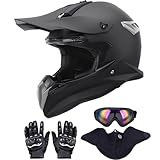
- Size - OUMURS Dirt Bike Helmet include Adult-M (570 - 580 mm / 22-1/2" - 22-7/8" ); Adult-L (590 - 600 mm / 23-1/4" - 23-5/8"); Adult-XL (610 - 620 mm / 24" - 24-3/8" ); Adult-XXL (620 - 630 mm / 24-3/8" - 24-3/4" )
- Safe and Reliable - The OUMURS Dirt Bike Helmet meets DOT FMVSS-218 Safety Standards,made of high quality ABS shell and EPS linings provide security for your driving, it’s a good choice for you as a dirt bike helmet or adult ATV helmet
- With Goggles Gloves and Mask - OUMURS Dirt Bike Helmet include the goggles, gloves and mask which you need to in driving. Put on the accessory equipment, windproof and UV resistant, can resist the interference of the sun and give you a more clear and wide vision in riding
- Multiple Air Vents Design - The adult ATV helmet have multiple air vents, make fresh air keep entering the helmet, You can have a good riding experience even in hot summer. The optimized vent reduces the wind noise and can ride more quietly with this adult ATV helmet
- Double D Ring Design - OUMURS motorcycle helmet with double D ring design, easy to wear and wear firmly. It will not fall off even if it is impacted by external forces, effectively protecting your safety
3. Lightning LS-218: the electric production benchmark
The Lightning LS-218 occupies a different category as the electric leader. Lightning says the LS-218 set a 218-mph land-speed record at Bonneville and became the world’s fastest production electric motorcycle. Lightning also says customer deliveries began in late 2015.
- Motor: 150-kW-plus liquid-cooled electric motor in current material
- Power: 244 horsepower in the current material
- Claimed or recorded speed: 218 mph, or approximately 350 km/h
- Record setting: Bonneville
The LS-218’s number should be described as a Bonneville production-electric record claim. A land-speed run is not the same thing as a routine road test or a demonstration of how quickly an ordinary customer can ride the motorcycle on public roads. Course surface, weather, preparation, gearing, battery state, tires, rider strategy, and the precise category rules all matter.
That qualification does not make the LS-218’s achievement unimportant. It establishes the motorcycle as a landmark in electric performance and gives it a strong claim to the production-electric benchmark. It simply should not be used to imply that 218 mph is a normal road-going operating speed or that the motorcycle automatically beats every combustion-powered production motorcycle in every definition of the overall category.
4. Ducati Panigale V4 R: the clearest current road-bike answer
For readers who mean a current, road-approved superbike with a clearly documented standard configuration, the 2026 Ducati Panigale V4 R is the most straightforward answer in this research set. Ducati publishes a 197-mph top speed in standard configuration.
Recommended Free Tools
- Engine: 998 cc Desmosedici Stradale R V4
- Standard U.S. power: 208.4 hp
- Standard top speed: 197 mph
- Series: Road-approved, numbered production series
Ducati also publishes a 205-mph figure, but that number requires the racing exhaust and dedicated oil configuration. Ducati identifies that exhaust as non-approved and intended for closed-course use. Public-road operation with that equipment is prohibited.
That makes 197 mph the relevant figure when comparing the V4 R with road-homologated motorcycles. The 205-mph figure belongs in a separate race-configuration note, not beside standard street specifications as though both represented the same motorcycle.
The same distinction applies to power. Ducati lists 208.4 hp for the U.S. road specification and up to 239 hp with the closed-course racing exhaust and dedicated oil. A buyer comparing legal road motorcycles should use the standard configuration, not the race-kit headline.
5. BMW M 1000 RR: the mass-produced comparison point
The BMW M 1000 RR is not the absolute speed leader in this broad field, but it provides a useful reality check because it is a current, road-oriented superbike produced at a much more conventional scale than the MTT 420RR.
Quick wins for a faster PC:
Fix the driver behind crashes, sound loss and screen glitchesFind Drivers →Clear out junk files and repair common Windows errorsFree Scan →Rank #3

- Corsair-X Motorcycle Helmets Compatible
- Signet-X Motorcycle Helmets Compatible
- Quantum-X Motorcycle Helmets Compatible
- DT-X Motorcycle Helmets Compatible
- Regent-X Motorcycle Helmets Compatible
- Power: 205 hp
- Maximum speed: 189 mph
- Status: Current road-oriented production superbike
BMW Motorrad’s U.S. technical data lists the M 1000 RR at 189 mph. That official number places it below the Ducati Panigale V4 R’s standard 197 mph, but the comparison is more meaningful for most buyers than a turbine motorcycle available in five anniversary units or a track-only Kawasaki with slick tires.
It is also a reminder that a motorcycle can be extraordinarily fast without being the fastest machine in an internet list. A mass-produced superbike must balance emissions compliance, durability, serviceability, road equipment, tire availability, rider aids, and usability in a way that a tiny limited series or race-derived machine may not.
Where the Suzuki Hayabusa fits
The Suzuki Hayabusa remains essential historical context even though the current official material reviewed does not provide a simple unrestricted maximum-speed figure.
The model became synonymous with the late-1990s and early-2000s production-bike speed contest. Its 1,340 cc engine, highly aerodynamic bodywork, electronic rider aids, and long-standing reputation made “Hayabusa” shorthand for the era when manufacturers openly competed for production-motorcycle top-speed supremacy.
Today’s Hayabusa page emphasizes the engine, aerodynamics, electronics, and an active speed limiter rather than publishing an unrestricted top-speed number. That means old 190-plus-mph figures should not be copied into a current ranking as though they were a present official specification. The Hayabusa belongs in the history section of this subject, not at the top of a current manufacturer-data table without a clear date and test method.
Why the Dodge Tomahawk should not win this ranking
The Dodge Tomahawk is frequently placed at the top of online fastest-motorcycle lists with an approximately 420-mph figure. It should be treated cautiously.
The disputed points include whether the Tomahawk was a genuine production motorcycle, whether the stated number represented a tested operational vehicle, and whether its unusual four-wheel layout fits the ordinary meaning of motorcycle. No decisive primary source confirming a current, independently tested 420-mph production Tomahawk was located for this comparison.
It is therefore not responsible to rank the Tomahawk above the MTT 420RR simply because a dramatic number has been repeated for years. A defensible ranking needs a clear production definition and evidence that the vehicle actually achieved the claimed speed.
Free tools Windows power users keep installed
One-click scans. No signup required.
Rank #4

- Ultra light weight durable aerodynamic thermoplastic alloy shell;
- 3-level top ventilation control and 5-position ventilation channel;
- Heavily cushioned and comfortable interior, Removable and washable;
- Beautiful glossy UV protective finish;
- Aerodynamic rear venturi-effect exhaust spoiler; DOT Approved; Meets Federal Motor Vehicle Safety Standard 218 (FMVSS 218);
What does not belong in a production-motorcycle ranking?
Several spectacular machines are faster than ordinary production motorcycles but answer a different question:
- Land-speed streamliners: Purpose-built vehicles designed solely for a measured speed record.
- Purpose-built racing motorcycles: Grand Prix, Superbike, drag-racing, and other competition machines that are not sold as ordinary road motorcycles.
- Heavily modified street bikes: Motorcycles with turbochargers, race fuel, altered gearing, non-road tires, or extensive engine modifications.
- Prototypes: Experimental machines that have not entered a genuine production run.
- Guinness motorcycle-speed record vehicles: The absolute motorcycle-speed record concerns a dedicated speed-record vehicle, not a normal production motorcycle.
Including these vehicles would make the headline more dramatic but the comparison less useful. The question is not “what is the fastest object that has two wheels?” It is “which production motorcycles occupy the top of their defensible categories?”
How to interpret the numbers as a buyer
Top speed is a poor substitute for a complete performance assessment. Before treating one of these motorcycles as the “best,” separate the headline number from the qualities that determine whether the motorcycle suits its intended use.
For public-road riding
Start with the standard, road-approved configuration. That means checking the legal status of the exhaust, tires, aerodynamic parts, lighting, emissions equipment, and registration requirements in your jurisdiction. A race kit may increase power or top speed while making the motorcycle illegal for public roads.
For track use
Lap time, braking stability, tire support, cooling, suspension setup, rider aids, and replacement-parts availability usually matter more than the theoretical maximum speed at the end of a long straight. The H2R’s closed-course status is a feature for its intended environment, not a reason to describe it as a street bike.
For acceleration
Peak horsepower and top speed do not tell the whole story. Gearing, traction, aerodynamic drag, rider position, launch control, battery output, and the surface determine how quickly a motorcycle reaches a given speed. A motorcycle with a lower published maximum can be quicker over a short distance.
For ownership
The MTT 420RR’s five-unit production run and $275,000 stated price place it in an entirely different ownership category from the BMW M 1000 RR or Suzuki Hayabusa. Availability, servicing, insurance, parts, tire supply, and local registration can matter more than a 20- or 30-mph difference in a manufacturer claim.
Independent reader supportYour contribution helps us test, update, and keep practical guides available for everyone.A note for readers who want the history
Historical context helps explain why these motorcycles exist, but it should not be confused with evidence for the current ranking. A motorcycle top-speed reference book can be a useful supplementary read for the evolution from the Hayabusa-era speed contest to turbine, supercharged, and electric machines. It should be treated as historical and technical background—not as the authority for the current speed figures above.
The Tool Desk
Outbyte Driver Updater FREEScan for outdated or missing drivers - takes under a minuteDriver Scan →Outbyte PC Repair FREEClear out junk files and repair common Windows errorsFree Scan →The safest final ranking
- MTT 420RR Turbine Superbike: Highest current manufacturer-claimed figure at 273 mph, but an ultra-limited, hand-built motorcycle without an independently documented 273-mph production run in the evidence reviewed.
- Kawasaki Ninja H2R: The defining closed-course production hypersport; Kawasaki confirms more than 300 km/h capability, while the approximately 240-mph figure remains a widely reported estimate rather than a current official number in the reviewed pages.
- Lightning LS-218: The production-electric benchmark based on Lightning’s 218-mph Bonneville record claim.
- Ducati Panigale V4 R: The strongest clean current road-homologated comparison at 197 mph in standard trim; 205 mph requires non-approved race equipment.
- BMW M 1000 RR: A current mass-produced road-oriented superbike with an official 189-mph maximum-speed specification.
So, the shortest accurate answer is: the MTT 420RR is the fastest by current manufacturer claim, the Kawasaki Ninja H2R is the closed-course benchmark, and the Ducati Panigale V4 R is the clearest current road-legal superbike leader in this comparison. Those are three different answers because they describe three different standards.
Best Value

- All Year Round Friendly: UPF 50+ UV Sun Protection. Whether you are hiking, cycling, motorcycling, mountains, skiing, skating or any season, this multifunctional mask is eligible for superior wind and weather protection around the head and neck.
- VERSATILITY: Our balaclava can be worn as a half mask, pirate mask, head warmer, neck gaiter, ninja hoodie or full face hood. It is versatile enough to complement your goggles, helmet and ski gear.
- MULTIPLE CHOICES AVAILABLE: Designed in a unisex minimalist aesthetic, our balaclava is suitable for both men and women. It is also available in several colors.
- COMFORTABLE TOUCH: Made of milk fiber, it provides all-day comfort keeping you warm and dry.
- EXCEPTIONAL USE PERFORMANCE: Premium material wicks moisture very well and dries quickly, providing you with all-day comfort.
None of these figures should be attempted on a public road. Street legality is a registration and equipment designation, not permission to travel at extreme speed. Any legitimate high-speed testing belongs on a properly controlled course or closed test facility with appropriate professional supervision and safety procedures.
Frequently Asked Questions
What is the fastest production motorcycle in the world?
Using the broad definition that includes a tiny hand-built production series, the MTT 420RR Turbine Superbike has the highest current manufacturer-claimed figure: 273 mph. That claim is not presented here as an independently verified production-bike record.
Is the Kawasaki Ninja H2R street legal?
No. Kawasaki identifies the current Ninja H2R as closed-course only in the United States. It should not be described as a street-legal 240-mph motorcycle.
Crashes, No Sound, or Screen Glitches?
Random freezes, missing sound and display glitches usually trace back to one bad driver. Find and replace yours safely.Free scan · under a minuteWindows Errors? Fix Them Before They Spread
Repair common Windows errors and clear accumulated junk for a smoother, more stable PC - no reinstall needed.Free scan · no reinstallWhat is the fastest road-legal production motorcycle in this comparison?
The Ducati Panigale V4 R has the clearest current road-homologated specification in the research set, with Ducati publishing 197 mph in standard configuration. Its 205-mph figure requires a non-approved racing exhaust and belongs to closed-course use.
What is the fastest production electric motorcycle?
The Lightning LS-218 is the production-electric benchmark in this comparison, based on Lightning’s claim of a 218-mph Bonneville land-speed record. That record context is different from a routine public-road top-speed test.
Why is the Dodge Tomahawk not ranked first?
Its often-repeated approximately 420-mph figure is disputed, as are its production status and whether the number represents a tested operational motorcycle. Without stronger primary evidence, it should not outrank better-documented category leaders.
The Bottom Line
Bottom line: The MTT 420RR is the fastest production motorcycle by current manufacturer claim at 273 mph, but it is a five-unit turbine-powered series. The Kawasaki Ninja H2R is the closed-course benchmark, the Lightning LS-218 leads the production-electric category, and the Ducati Panigale V4 R provides the clearest current road-homologated answer at 197 mph in standard trim. Comparing these motorcycles responsibly requires separating manufacturer claims, record runs, road legality, production scale, and race configuration.




