Some links on this page are affiliate links: if you buy through them we may earn a commission, at no extra cost to you.
Yes—beginners can drive on dunes when they choose a legal area, use a suitable vehicle, learn the local rules and treat every crest, soft patch and changing surface as a hazard. Dunes are not one uniform kind of off-road terrain: access, permits, flags, vehicle requirements and even whether motorized travel is allowed can change from one site to the next.
What dune driving is—and why the location matters
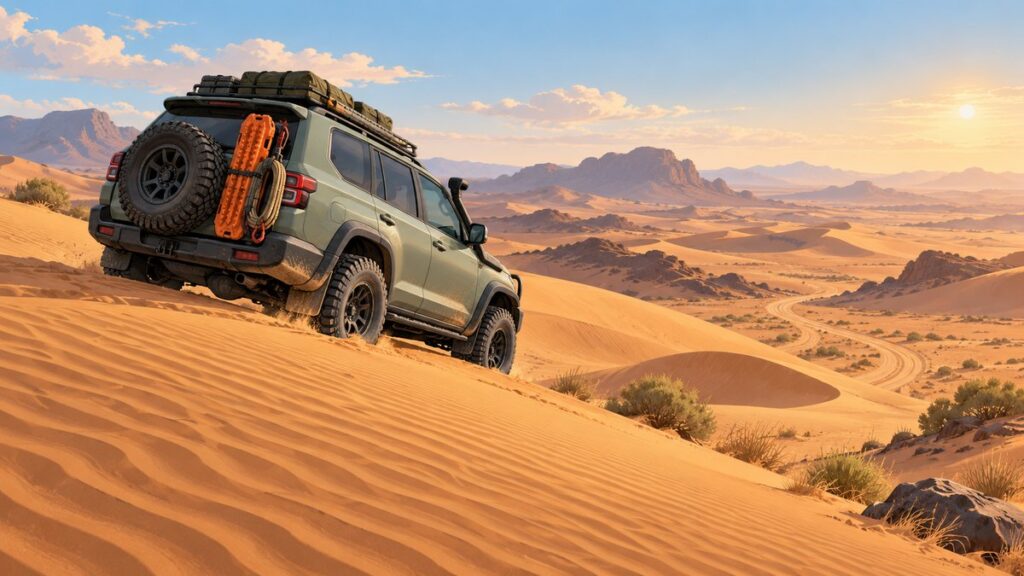
Dune driving means operating an off-highway vehicle, four-wheel-drive vehicle or other permitted vehicle across naturally shifting sand. The challenge comes from low traction, steep approaches, blind crests, wind-shaped ruts and transitions between dry and damp sand. A route that feels firm in the morning can become soft, tracked or impassable later in the day.
As an Amazon Associate I earn from qualifying purchases.
The Tool Desk
Outbyte PC Repair FREERepair Windows errors before they cause bigger problemsFix Now →Outbyte Driver Updater FREEScan for outdated or missing drivers - takes under a minuteDriver Scan →The word “dunes” covers very different places. A managed OHV park may have marked routes, staging areas and patrols. A coastal forest riding area may require a state permit and a tall safety flag. A wilderness designation may prohibit motorized travel entirely. Treat the destination’s current map and rules as the starting point, not as paperwork to handle after you arrive.
The Bureau of Land Management’s overview of dune recreation explains why requirements are set locally: terrain, wildlife protection, traffic patterns and nearby roads all affect how an area can be used. Read The Line in the Sand alongside the specific land manager’s rules.
Popular on Amazon

- Equipped with a 208cc, 7.5 HP horizontal OHV Engine
- Torque converter CVT transmission which allows this beast to take off with ease
- Heavy Duty Frame, Add the dramatic body panels
- Electric Start
- 3-point automotive style retractable seat belts, parking brake, fenders, canopy top and cargo rack
Can a beginner drive on sand dunes?
A prepared beginner can make a first outing manageable. The safest learning curve is to start with a guided experience or an established riding area, go with an experienced companion, and avoid making the steepest or busiest dune the first objective. You do not need to master every sand technique before arriving, but you do need to know the vehicle’s limits, understand the local traffic pattern and be willing to turn around.
Confidence should come from preparation rather than speed. Sand rewards smooth inputs and punishes abrupt steering, braking or throttle changes. A conservative driver who stops to inspect a crest is better prepared than a fast driver who assumes the surface is consistent.
Do these 3 things before closing this tab:
1Repair Windows errors before they cause bigger problems2Fix the driver behind crashes, sound loss and screen glitches3Clear out junk files and repair common Windows errorsChoose a legal, suitable destination before you travel
Check the map and land designation
Use the current map from the managing agency to confirm which tracks are open to motorized vehicles. At Oregon’s Lost Forest/Dunes/Fossil Area of Critical Environmental Concern, motorized use is confined by designated boundaries around the Christmas Valley dunes. The fact that sand is visible does not itself create permission to drive there.
The Juniper Dunes Wilderness Area is a useful warning example: the wilderness area prohibits motorized use, while the approach road can contain loose sand and may require high clearance, preferably four-wheel drive. Do not generalize that road condition to every dune site; verify the exact route you intend to use.
Confirm seasonal and access restrictions
Check closures, fire restrictions, wildlife protections, weather-related access alerts and seasonal riding dates immediately before departure. A printed map can be useful where service is unreliable, but it does not replace the current online notice or a call to the land manager when conditions are unclear.
Also popular on Amazon

- 🏎️ 【18" All-Terrain Tires & Two-Seater Drift Fun】 Built with a heavy-duty steel tubular frame, this 122cc two-seater drift cart is engineered to handle demanding outdoor adventures. The 18-inch all-terrain tires provide outstanding traction on grass, sand, mud, and rough trails, while the spacious dual-seat design supports up to 440 lbs, making it ideal for adults, friends, or family members seeking exciting off-road experiences together. The hydraulic disc brake system delivers responsive stopping power for enhanced control and confidence on any terrain.
- ⚡ 【2000W Engine with Electric Start】 Powered by a reliable Electric Go Kart, this gas-powered go kart reaches speeds of up to 25 MPH, delivering the perfect balance of performance and control. The integrated 12V 9AH battery provides instant electric starting with dependable ignition, ensuring smooth startups and stable power whenever your next adventure begins.
- ⛽ 【Up to 30 Miles of Riding Range】 Designed for extended outdoor fun, the efficient fuel system delivers an impressive 30-mile (50 km) range per tank. Whether you're exploring beaches, campgrounds, dirt trails, or open fields, you can spend more time riding and less time refueling. Quick and convenient fuel replenishment keeps the adventure going without interruption.
- 🎮 【User-Friendly Controls for Easy Operation】 Featuring an intuitive control panel, this off-road drift cart is easy to operate for a smooth riding experience. Convenient controls include a horn switch, headlight switch, electric start button, responsive accelerator pedal, and sensitive brake pedal, allowing drivers to confidently master vehicle operation while enhancing comfort and safety.
- 🌄 【Conquer Any Terrain with Confidence】 From sandy dunes and muddy trails to grassy meadows and rugged backroads, this all-terrain go kart is built to take on diverse outdoor environments. The shock-absorbing tires help smooth out bumps, while the reinforced steel frame withstands uneven terrain and outdoor impacts. Whether you're exploring campgrounds, coastal areas, farms, or countryside trails, every ride becomes an unforgettable off-road adventure.
Match the vehicle class to the route
Confirm whether the area admits ATVs, side-by-sides, motorcycles, four-wheel-drive cars or only a particular class of registered OHV. Ask about width limits, street-legal requirements, trailer access and the condition of the final access road. A capable vehicle can still be unsuitable if its dimensions, registration or ground clearance do not meet the site’s rules.
Permits, education, flags and passenger rules
Requirements can apply to the driver, the vehicle, the route or all three. Oregon’s public-land ATV guidance directs riders to state education and permit rules, while individual Forest Service areas publish additional conditions. Review the Siuslaw National Forest OHV page for Oregon Dunes and Sand Lake access information, riding areas and local regulations.
- Safety education: Oregon requires safety education for ATV operation on public land. Check whether your vehicle type and visitors from another state are covered by the current rule.
- Vehicle and rider permits: Some destinations require an OHV permit, entrance fee, oversand permit or proof of registration. Carry the required documents as the site specifies.
- Flags: Imperial Sand Dunes requires a whip-mounted flag on every vehicle. Oregon Dunes and Sand Lake rules require flags displayed 9 feet above the ground. The color, dimensions, mounting method and height are not universal; use the destination’s current specification.
- Helmets and passengers: Age, helmet, seat-belt and passenger rules vary by vehicle class and jurisdiction. Never assume that a rule for a side-by-side also applies to a car or motorcycle.
The Oregon ATV Guide 2026–2027 is the current reference for the named Oregon areas, but rules can change; check for updates before setting out.
Vehicle preparation for a first dune trip
Use a vehicle that the destination permits and that you can control comfortably. Four-wheel drive or high clearance may be important on a particular access road, but neither is a blanket requirement for every dune. Read the route description and ask the land manager about current sand conditions rather than relying on a generic “dune vehicle” label.
Before loading the vehicle, inspect tires, recovery points, fluids, cooling system, battery, lights and spare-wheel equipment. Secure loose cargo so it cannot interfere with pedals, steering or passengers. If the vehicle uses selectable four-wheel drive, understand the manufacturer’s engagement procedure on firm ground before entering sand.
Recommended Free Tools
Also popular on Amazon

- 【Brand 110cc Engine】Reliable Yinxiang 110cc engine, delivering robust performance for a thrilling ride. It features an automatic transmission for easy gear shifts, making it ideal for both beginners and experienced riders. Plus, with the reverse gear, you’ll have greater control when maneuvering in tight spaces or reversing out of tricky situations.
- 【Larger Wheels for Improved Stability and Handling】Equipped with 16×6-8 front wheels and 16×7-8 rear wheels, the X-PRO 110 offers larger tires than most standard 110cc models. This larger wheel size enhances the stability and handling, providing a smoother and more controlled ride, whether you're on rugged trails or smooth tracks.
- 【Fuel Tank with Fuel Level Display】Stay prepared for your next adventure with the fuel tank featuring a fuel level display. This convenient feature allows you to easily monitor fuel levels, ensuring you won’t run out unexpectedly during your ride.
- 【Bright LED Front Headlight】The LED front headlight provides superior brightness, allowing for better visibility during nighttime rides or low-light conditions. It’s energy-efficient, durable, and ensures you can enjoy your go-karting experience day or night, with added safety and clarity.
- 【Adjustable 2-Seat Bench with 4-Point Safety Harness】The X-PRO 110 Go Kart features an adjustable 2-seat bench that allows both the driver and passenger to customize their seating position for optimal comfort. Coupled with the 2-seat 4-point safety harness, riders are securely strapped in, ensuring a safe and stable ride even during high-speed or rough terrain. Enjoy a perfect balance of comfort and safety on every adventure.
Do not copy a tire-pressure number from another destination. Sand depth, vehicle weight, tire construction and manufacturer limits determine an appropriate setting, and no single pressure is established for all dunes. If you air down, use a gauge and reinflate to the vehicle maker’s road specification before returning to pavement.
What to bring: sensible preparation versus site-specific requirements
Think in two categories: equipment that helps a prepared group manage an ordinary delay, and equipment that a particular regulation explicitly requires. The federal oversand rule for covered vehicles at Assateague names a specific set of recovery items; that list should not be presented as a universal dune law.
| Item or preparation | How to treat it |
|---|---|
| Water, food, sun protection and suitable clothing | Sensible personal preparation for heat, wind and an unplanned wait. Quantities depend on the group and forecast. |
| Communication and navigation | Carry a charged phone, an offline map and a backup way to contact help where coverage is weak. Tell someone your route and return plan. |
| Flag and whip mast | Required specifications are destination-specific. Imperial Sand Dunes requires a whip-mounted flag on every vehicle; Oregon examples require 9-foot display height. |
| Shovel, jack, tow rope or chain, jack-support board and low-pressure tire gauge | Named for covered oversand vehicles in 36 CFR § 7.65 (2024) at Assateague. Verify the current park rule and carry compatible equipment. |
| Tire-repair kit | Oregon Parks lists one as preparation advice. Select tools that match your tires and learn how to use them before the trip. |
| Helmet, eye protection, seat belts and protective clothing | Use the protection required for your vehicle and location; additional protection is prudent for exposed OHV riding. |
A companion is one of the most useful safety measures. Travel with at least one other vehicle when the area and your experience warrant it, and agree on meeting points before entering a trail network.
How to drive on sand dunes
1. Observe before you commit
At the staging area, watch how other vehicles approach the terrain and identify marked one-way routes, crossing points and no-entry zones. Look for the safest line, not the most dramatic one. If you cannot see over a crest, assume another vehicle, person or obstacle may be hidden beyond it.
What’s actually slowing this PC down?
Pick the symptom - the matching free tool is one click away.
2. Use smooth, predictable control inputs
Maintain a steady pace appropriate to visibility and traffic. Avoid sudden steering, hard braking and abrupt throttle changes that can break traction or make the vehicle slide. Keep both hands positioned for control and leave enough space that you can stop without relying on the vehicle ahead to clear an obstacle.
Also popular on Amazon

- Equipped with a 208cc, 7.5 HP horizontal OHV Engine
- Torque converter CVT transmission which allows this beast to take off with ease
- Heavy Duty Frame, Add the dramatic body panels
- Electric Start
- 4-point automotive style retractable seat belts, parking brake, fenders, canopy top and cargo rack
3. Treat crests as blind intersections
Approach a dune top slowly enough to stop on your side of the crest. Where the route and local practice allow, use a spotter who can see the far side and communicate clearly. Oregon Parks specifically advises a spotter at a dune top; follow its Ride ATVs safety guidance and any site-specific traffic rules.
4. Watch the dry-to-wet transition
Changes between dry and wet sand can alter grip and steering response. Oregon Parks identifies these transitions as a control hazard. Slow before the surface changes, keep your line uncomplicated and avoid crossing diagonally if doing so would expose the vehicle to an unexpected rut or side slope.
5. Give other users room
Stay on designated routes, respect posted speed limits and yield according to the area’s rule. Keep clear of pedestrians, camps, wildlife closures and parked vehicles. A tall flag helps others see you, but it does not make a crest or crossing safe by itself.
What to do if you get stuck
Stop spinning the tires. Continued wheelspin digs a deeper hole, heats the drivetrain and can turn a minor delay into a recovery problem. Set the parking brake when appropriate, assess traffic and identify the safest direction out.
- Warn approaching drivers and move people to a safe position away from the vehicle and traffic line.
- Clear sand from in front of the drive tires and beneath the chassis with a shovel.
- Use the vehicle’s approved recovery points and compatible tow equipment; never attach a strap to a steering, suspension or bumper component that is not rated for recovery.
- Place a support board under a jack on soft sand and follow the jack manufacturer’s instructions. Keep everyone clear of the vehicle while it is lifted.
- If self-recovery is unsafe or unsuccessful, contact the land manager or the area’s recovery service. Provide your map location, vehicle description and any medical or mechanical emergency information.
Do not block a designated route while experimenting with recovery. If the vehicle is leaking fuel, overheating, damaged or in danger of rolling, leave it and move people to safety before seeking help.
Also popular on Amazon

- Heavy Duty Frame!
- Light Kit Package!
- Dual Seats!
- Cargo Rack!
- Disc Brake
Guided experience or self-directed driving?
Both approaches can work for a first outing. The right choice depends on how much responsibility you want to handle and whether you already have a compliant vehicle.
| Consideration | Guided outing | Self-directed trip |
|---|---|---|
| Instruction | An instructor can demonstrate local lines, crest awareness and recovery judgment in real time. | You must learn the techniques, read the map and make every route decision yourself. |
| Vehicle and equipment | The provider may supply a suitable vehicle, safety gear and required flag; confirm exactly what is included. | You provide a vehicle that meets the site’s class, registration and equipment rules. |
| Access and permits | Ask whether the operator handles entry, permits and area-specific compliance. | You are responsible for current permits, education, flags, maps and seasonal restrictions. |
| Passenger and age rules | Confirm minimum age, passenger limits and required protective equipment before booking. | Check the land manager’s rules for your exact vehicle and every passenger. |
| Total cost | No operator or price was verified here; request a complete quote, including entry and equipment fees. | Budget for permits, fuel, vehicle preparation, recovery equipment and possible access fees; exact amounts depend on the destination. |
A guided outing is often the simpler first step when you are unfamiliar with sand or do not own a compliant vehicle. Self-directed driving becomes more practical after you understand the area, have the right equipment and can manage a recovery without improvising.
A practical first-trip checklist
- Choose a destination where motorized use is explicitly allowed.
- Read the current map, closures, seasonal notices and access-road description.
- Confirm vehicle class, clearance, width, registration and passenger rules.
- Complete required safety education and obtain permits before arrival.
- Buy or fit the exact flag and whip specification for that area.
- Inspect the vehicle and pack water, communication, navigation and recovery equipment.
- Tell a reliable person your route, group and expected return time.
- Drive conservatively, leave space, slow at crests and use a spotter where appropriate.
- Stop if visibility, weather, traffic or vehicle condition makes the route uncertain.
Authoritative places to verify the rules
Start with the land manager rather than a generic sand-driving checklist. For California’s Imperial Sand Dunes, read the BLM rules and regulations. For Oregon Dunes and Sand Lake, use the Siuslaw National Forest OHV information and the current Oregon ATV Guide 2026–2027. For Assateague oversand access, verify the park’s current instructions alongside 36 CFR § 7.65. For Oregon driving technique and preparation, consult Oregon Parks’ ATV guidance.
The essential habit is simple: confirm the local rule, prepare for a stop and drive only as fast as your visibility and traction allow. That turns dune driving from an intimidating stunt into a demanding but approachable off-road skill.