Chevrolet Corvette history breaks into eight generations, from the fiberglass C1 of 1953 to the mid-engine C8 family sold today. The major eras are C1 (1953–1962), C2 (1963–1967), C3 (1968–1982), C4 (1984–1996), C5 (1997–2004), C6 (2005–2013), C7 (2014–2019), and C8 (2020–present).
The generation names are enthusiast shorthand, not separate Chevrolet nameplates. This guide separates generations from individual models, packages, special editions, and race cars so badges such as Z06, ZR1, Stingray, Grand Sport, and 427 are not treated as if they meant the same thing in every era.
As an Amazon Associate I earn from qualifying purchases.
How Corvette generations and models fit together
The Corvette has eight generations: C1 (1953–1962), C2 (1963–1967), C3 (1968–1982), C4 (1984–1996), C5 (1997–2004), C6 (2005–2013), C7 (2014–2019), and C8 (2020–present). Chevrolet’s current historical overview runs the C8 through 2027, but the generation is still in production, so its final year remains open.
Free tools Windows power users keep installed
One-click scans. No signup required.
C1 through C8 are generation labels, not separate Chevrolet nameplates. Inside each generation, Chevrolet used model names, packages, and performance badges such as Sting Ray, Stingray, Z06, ZR-1/ZR1, Grand Sport, and 427. Those badges evolved significantly. A C2 Z06 was a competition-oriented package, for example, while a C8 Z06 is a distinct model with its own engine, bodywork, brakes, and chassis tuning.
#1 Best Overall

- Doors Open
- Pullback Action
- Die Cast Metal Body
- PULL BACK ACTION WITH FREE ROLLING WHEELS
The simplest way to understand the entire lineage is to follow the component that changed most dramatically: C1 needed a V8 to become a serious sports car; C2 established the iconic shape and chassis; C4 modernized the engineering; C5 introduced the LS1 and rear transaxle; C7 perfected the front-engine formula; and C8 moved the engine behind the driver.
Corvette generations at a glance
| Generation | Years | Defining character | Important models and milestones |
|---|---|---|---|
| C1 | 1953–1962 | Fiberglass two-seat roadster that matured into a V8 sports car | 1953 launch car, 1955 small-block V8, 1957 fuel injection, 1961–1962 four round taillights |
| C2 | 1963–1967 | Sting Ray styling, independent rear suspension, major big-block performance | 1963 split-window coupe, first Z06, 1965 disc brakes and big block, 1967 427/435 |
| C3 | 1968–1982 | Long-running curvaceous body over a changing mechanical package | Stingray, 1970 ZR1 package, 1978 Indy pace car, 1982 Collector Edition |
| C4 | 1984–1996 | Technology reset with a new architecture | 1985 Tuned Port Injection, returning convertible, ZR-1, 1996 Grand Sport |
| C5 | 1997–2004 | LS1 V8, rear transaxle, modern weight distribution | 2001 Z06 with LS6, 50th Anniversary Edition, C5-R racing program |
| C6 | 2005–2013 | Compact proportions and a rapidly expanding power range | LS7 Z06, LS3, supercharged LS9 ZR1, Grand Sport, 427 Convertible |
| C7 | 2014–2019 | Final and highly developed front-engine Corvette generation | Stingray, supercharged Z06, Grand Sport, 755-hp ZR1 |
| C8 | 2020–present | Mid-engine architecture and a broader supercar-oriented family | Stingray, E-Ray, Z06, ZR1, ZR1X, plus the announced 2027 Grand Sport family |
C1 Corvette: 1953–1962
The fiberglass roadster becomes a real sports car
The first Corvette began as a lightweight two-seat roadster with a fiberglass body. Its launch was important, but the earliest car was not yet the performance icon that the Corvette name would become. The turning point was Chevrolet’s small-block V8 in 1955.
Key C1 models and milestones
- 1953 Corvette: The inaugural production model. Chevrolet built just 300 hand-assembled cars in Flint, Michigan. Every one had a Polo White exterior, red interior, black soft top, Blue-Flame six-cylinder engine, and Powerglide automatic transmission.
- 1955 Corvette: Chevrolet introduced the small-block V8. That engine transformed the Corvette from a stylish but underpowered roadster into a credible American performance car.
- 1956–1960 Corvette: Styling and performance continued to develop as the V8 became central to the car’s identity.
- 1957 fuel-injected Corvette: Fuel injection arrived as a significant performance technology and strengthened the Corvette’s competition image.
- 1960 Corvette: The Corvette’s racing story reached an important early milestone with its debut at Le Mans.
- 1961–1962 Corvette: Four round taillights appeared at the rear, creating one of the most enduring visual signatures in Corvette history.
The C1 is therefore best understood as a fast transformation rather than a single uniform model. The 1953 car was a low-volume fiberglass roadster built around a six-cylinder engine; the later V8 and fuel-injected cars established the performance formula that subsequent generations expanded.
PC Slower Than It Used to Be?
A free scan shows the junk files, broken settings and background clutter dragging Windows down - then fixes them in one click.Free scan · Windows 10 & 11Outdated Drivers Are Slowing You Down
One free scan finds every outdated or missing driver and matches the right update for your exact hardware.Free scan · exact hardware matchC2 Corvette: 1963–1967
Sting Ray, independent rear suspension, and the first Z06
The C2 made Corvette globally recognizable. Introduced for 1963, it combined dramatic Sting Ray styling with a more sophisticated chassis and a much wider performance envelope. Its independent rear suspension was a major engineering step, while the available big-block engines made the Corvette a serious high-performance car.
Key C2 models and milestones
- 1963 Sting Ray coupe and convertible: The coupe introduced the famous split rear window. The design became one of the most recognizable forms in sports-car history and influenced later Corvette styling.
- 1963 Z06: The first Z06 was a competition-oriented performance package. It should not be treated as mechanically equivalent to the modern Z06 model simply because the badge survived.
- 1965 big-block Corvette: Chevrolet added big-block power and four-wheel disc brakes, expanding the Corvette’s capability for both road and track use.
- 1965–1967 396/427 models: Big-block Corvettes became the most sought-after C2 performance cars, culminating in the 1967 427/435 model.
- 1967 L88: The competition-focused L88 is one of the generation’s most important collector and racing subjects. Exact production totals and detailed specifications should be checked against a dedicated model-year reference rather than generalized across all 1967 Corvettes.
The C2 changed more than the Corvette’s appearance. It established a recurring formula: an expressive body, serious chassis development, and a range of engines and performance packages capable of moving the car from grand touring to competition use.
C3 Corvette: 1968–1982
The long-lived, curvaceous Corvette
The C3 lasted nearly 15 years, making it one of the longest-running Corvette generations. Its curving, Mako Shark II-inspired body remained familiar throughout the era, but the mechanical story changed considerably underneath. A 1968 big-block Corvette and a late-1970s or 1982 car may share the same broad silhouette while differing substantially in engines, output, emissions equipment, and trim.
Key C3 models and milestones
- 1968 Corvette: The new generation arrived with radically different bodywork while carrying forward some C2-era mechanical ideas.
- Stingray: Chevrolet used the name as one word during the C3 period. This differs from the two-word Sting Ray styling used with the C2.
- 1970 ZR1: The ZR1 performance package debuted during the C3 generation. It was a specialized package, not a badge with the same meaning as the later C4, C6, C7, or C8 ZR1.
- Early big-block C3s: Large-displacement V8s were part of the early C3 performance story, before emissions and fuel-economy pressures reduced output and changed the model mix.
- 1977 Corvette: Chevrolet built the 500,000th Corvette during the C3 era.
- 1978 Indy 500 Pace Car: The special edition helped turn the C3 into a broader cultural object as well as a sports car.
- 1982 Collector Edition: The final C3 year brought a Collector Edition with a new rear hatch design and electronic fuel injection.
C3 is the generation of visual continuity and mechanical change. It preserved a recognizable Corvette identity while the industry dealt with emissions regulations, fuel shortages, safety requirements, and a changing definition of performance.
The Tool Desk
Outbyte Driver Updater FREEFix the driver behind crashes, sound loss and screen glitchesFind Drivers →Outbyte PC Repair FREEClear out junk files and repair common Windows errorsFree Scan →C4 Corvette: 1984–1996
The technology reset
There was no regular-production 1983 Corvette. Chevrolet’s C4 history begins with the 1984 production car; the 1983 Corvette commonly discussed by enthusiasts is a prototype and bridge between C3 and C4, not a normal model year.
Key C4 models and milestones
- 1984 Corvette: The C4 introduced an all-new architecture and stronger body structure, resetting the Corvette’s design and chassis direction.
- 1985 Corvette: Tuned Port Injection brought an important technology and drivability update.
- 1986 convertible: The convertible returned to the Corvette lineup during the C4 period.
- 1988 35th Anniversary Edition: This special edition is especially significant to collectors.
- 1990–1995 ZR-1: The Lotus-developed, four-cam V8 ZR-1 became the C4 flagship. Chevrolet promoted the 1990 car with the nickname “King of the Hill,” reflecting its technologically exotic position at the top of the range.
- 1991–1995 model-year packages: Base equipment, performance packages such as Z07, engines, and trim changed by year. A C4 should be identified by its specific model year before its equipment is described.
- 1992 one-millionth Corvette: The milestone car was a white convertible with a red interior, 5.7-liter LT1 V8, automatic transmission, and saw-blade wheels.
- 1996 Grand Sport: The final C4 year included a limited Grand Sport run of 1,000 cars: 810 coupes and 190 convertibles.
C4 established the technology and chassis template that made the later LS-era Corvettes possible. It also made the ZR-1 name synonymous with a highly engineered flagship, even though Chevrolet would use a different formula for the badge in later generations.
C5 Corvette: 1997–2004
The LS1 and rear-transaxle era
The C5 was a complete redesign and one of the most consequential Corvette generations. It introduced the all-aluminum LS1 5.7-liter V8 and moved the transmission to the rear transaxle, improving weight distribution and handling balance.
Key C5 models and milestones
- 1997 Corvette: The new generation launched with the LS1 and rear-mounted transmission.
- 1998 convertible: The convertible returned as a regular C5 body style.
- 1998 Indy 500 Pace Car: A notable special edition based on the new generation.
- 2001 Z06: The Z06 returned as a hardtop performance model powered by the LS6. The modern Z06 was now a distinct performance model rather than simply the competition package used in 1963.
- 2002–2004 Z06: Later versions became particularly respected for combining low mass, naturally aspirated power, and track capability.
- 2003 50th Anniversary Edition: A commemorative model marking 50 years of Corvette production.
- 2004 Commemorative Edition: The final C5 year included commemorative variants connected to Corvette Racing.
The C5 also made the connection between road car and race program impossible to ignore. Chevrolet’s C5-R achieved class victories at Daytona, Sebring, and Le Mans, including Le Mans wins in 2001, 2002, and 2004. The C5-R was a race car, however, not a street trim level.
C6 Corvette: 2005–2013
Compact proportions and escalating power
The C6 evolved the C5 rather than completely reinventing it. It used shorter, more compact proportions and replaced the C5’s pop-up headlights with fixed units. The generation also pushed the spread between a standard Corvette and its flagships farther than before.
Key C6 models and milestones
- 2005 Corvette: The C6 arrived with the compact redesign and fixed headlights. Chevrolet identified 400 horsepower as the standard-car benchmark for the generation.
- 2006 Z06: The Z06 used the naturally aspirated 7.0-liter LS7 V8, also known as a 427-cubic-inch production engine, and an aluminum-intensive chassis.
- 2008 base Corvette: The LS3 6.2-liter V8 raised standard output to 430 horsepower, or 436 horsepower with the available exhaust system, according to period Chevrolet performance material.
- 2009 ZR1: The supercharged LS9-powered ZR1 became the C6 flagship. Chevrolet rated the 6.2-liter engine at 638 horsepower.
- 2010 Grand Sport: The name returned on a wider-body, track-oriented model or package that bridged the base Corvette and Z06.
- 2011–2013 special editions: These included the Centennial Edition and the 427 Convertible Collector Edition.
The C6’s racing counterpart, the C6.R, competed across GT1 and later GTE Pro eras. It should be kept separate from road-car trims when comparing models, even though its competition success strongly influenced the generation’s identity.
Rank #2
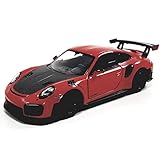
- PREMIUM QUALITY: Constructed with durable die-cast metal body, featuring clear windows, detailed interior, and precision-engineered components
- Pullback Action
- FUNCTIONAL FEATURES: Opening doors and pull-back motor action provide interactive play experience while maintaining collector-grade detail
- PERFECT DISPLAY SIZE: Compact 5-inch length makes it ideal for showcasing, with proportionate dimensions that capture the iconic sports car's essence
- COLLECTIBLE VALUE: Meticulously crafted replica perfect for die-cast car enthusiasts and Porsche fans, suitable for ages 3 and up
C7 Corvette: 2014–2019
The return of Stingray and the end of the front-engine era
The C7 brought back the Stingray name, introduced the LT engine generation, improved the cabin and electronics, and ended with one of the most powerful production Corvettes ever built at that point. It was the final front-engine generation before Chevrolet made the mid-engine leap.
Key C7 models and milestones
- 2014 Stingray: The base C7 launched with the LT1 6.2-liter small-block V8, direct injection, and a new exterior and interior design.
- 2015 Z06: The supercharged LT4-powered Z06 expanded the Corvette’s track capability and was available as both a coupe and convertible.
- 2016 Grand Sport: The naturally aspirated Grand Sport combined a wide-body performance chassis and aerodynamic themes associated with the Z06 with the Stingray’s engine family.
- 2017 Grand Sport: The model continued as one of the central C7 performance variants.
- 2018 Carbon 65: This special edition commemorated 65 years of Corvette.
- 2019 ZR1: The final C7 flagship used the supercharged LT5 and produced 755 horsepower.
The C7.R also carried the Corvette name into international competition and won the 2015 Le Mans GTE Pro class. On the road, the C7 represented the most developed version of the traditional front-engine Corvette formula: a naturally aspirated Stingray, a supercharged Z06, a naturally aspirated Grand Sport, and a supercharged ZR1 at the top.
C8 Corvette: 2020–present
The mid-engine Corvette family
The C8 is the defining architectural break in Corvette history. For the first time in regular production, the V8 sits behind the occupants and ahead of the rear axle. A dual-clutch transmission became part of the platform’s identity, and Chevrolet expanded the range from one principal sports-car model into a family that includes electrification, a flat-plane-crankshaft engine, twin-turbo power, and hybrid all-wheel drive.
As of August 12, 2026, Chevrolet lists five C8 models: Stingray, E-Ray, Z06, ZR1, and ZR1X. Chevrolet describes Stingray, E-Ray, and Z06 as available in three trim levels and as coupes or convertibles; ZR1 and ZR1X use two trim levels and are also offered in coupe or convertible form. These availability details are market- and model-year-specific, so buyers should confirm the configuration for their region.
C8 Stingray
The Stingray is the entry point to the mid-engine Corvette family and the model positioned for the broadest everyday use. For 2026, Chevrolet lists a 6.2-liter V8 with up to 495 horsepower and an available 0–60-mph time of 2.9 seconds. Those acceleration and output figures are Chevrolet claims, not independent test results.
The coupe has a removable roof panel. The convertible uses a retractable hardtop, giving the two body styles different roof mechanisms while retaining the same mid-engine concept.
Do these 3 things before closing this tab:
1Scan for outdated or missing drivers - takes under a minute2Repair Windows errors before they cause bigger problems3Fix the driver behind crashes, sound loss and screen glitchesC8 E-Ray
The E-Ray is the first electrified, all-wheel-drive Corvette. It combines the V8-powered rear drivetrain with a front electric drive unit. Chevrolet positions it around all-season capability as well as acceleration.
For 2026, Chevrolet lists up to 655 combined horsepower and an available 0–60-mph time of 2.5 seconds. The combined-output and acceleration numbers are manufacturer-published claims.
C8 Z06
The C8 Z06 is a distinct high-performance model, not an appearance package for the Stingray. Its naturally aspirated 5.5-liter DOHC V8 uses a flat-plane crankshaft and has an 8,600-rpm redline. Chevrolet rates it at 670 horsepower.
The available Z07 Performance Package adds track-focused equipment, including available carbon-ceramic brakes. The C8 Z06’s engine architecture is therefore fundamentally different from the naturally aspirated small-block V8s associated with earlier Z06 generations.
C8 ZR1
The C8 ZR1 uses a twin-turbocharged 5.5-liter V8. Chevrolet lists 1,064 horsepower, an available 0–60-mph time of 2.3 seconds, and a claimed 9.6-second quarter-mile at 150 mph. These are Chevrolet-published performance claims and should not be presented as independent testing.
C8 ZR1X
The ZR1X adds hybrid all-wheel-drive technology to the ZR1 concept. It pairs a turbocharged 5.5-liter LT7 V8 with an electric front-drive unit. Chevrolet lists 1,250 combined horsepower, an available 0–60-mph time of 1.89 seconds, and a claimed 8.99-second quarter-mile at 157 mph.
The ZR1X is a 2026 model-year C8 variant, not a ninth generation. It belongs within the C8 family because generations describe the underlying Corvette architecture, not the number of performance models Chevrolet offers.
Rank #3

- 【Exquisitely Replicated in 1:24 Scale, Highly Restored Racing Livery & Aerodynamic Details】 Our 1/24 scale M4 GT3 replica captures the essence of the real race car with remarkable accuracy. From the racing livery and sponsor-style markings to the aggressive aerodynamic contours – including front splitter, rear diffuser, and adjustable wing – every detail reflects authentic GT3 race car design. The precision-engineered body proportions deliver realism that serious collectors appreciate
- 【Solid Full Alloy Body, Sturdy & Durable, Fade Resistant for Long-Term Collection】 Built from solid die-cast alloy with a premium anti-rust and wear-resistant finish, this M4 GT3 model is designed to last. Unlike plastic alternatives that may fade or warp over time, our alloy body maintains its shape and paint integrity for years. The smooth, burr-free edges ensure safe handling, while the high-gloss clear coat protects the racing livery from daily wear and fingerprints
- 【Openable Doors with Linked Light & Sound, Blending Static Display and Interactive Experience】 Open the doors and bring your GT3 model to life. Our light and sound activation system triggers sound effects and bright LED lighting the moment you lift the door. Unlike ordinary static display models that just sit on a shelf, this interactive feature adds engagement that hobbyists and diorama builders love. Perfect for creating dynamic track scene displays or surprising a racing fan with an interactive gift
- 【1:24 Optimal Scale with Display Base & Premium Gift Box, Perfect for Collection and Gifting】 The popular 1:24 scale strikes the perfect balance between presence and space efficiency – detailed enough to impress, compact enough to fit on a desk, bookshelf, or display cabinet. Each model comes with a matching display base for premium presentation, plus an upscale gift box for safe storage and impressive unwrapping. Whether for yourself or as a gift, this complete package delivers a premium unboxing experience
- 【All-Purpose for Collection, Gifting & Diorama DIY Projects】 Versatile by design, this M4 GT3 diecast fits multiple use cases. For collectors: a must-have for any GT3 racing lineup. For gift-givers: a premium motorsport-themed present for birthdays, holidays, or Father's Day. For DIY creators: the perfect centerpiece for custom track dioramas or garage scenes. From club displays to home office decor, this model celebrates the thrill of GT3 racing in any setting
C8 racing derivatives
The C8.R and later Corvette GT3.R are racing derivatives, not street trims. They belong in Corvette’s motorsport history, but they should not be mixed into a road-car model comparison.
Quick wins for a faster PC:
Repair Windows errors before they cause bigger problemsFix Now →Fix the driver behind crashes, sound loss and screen glitchesFind Drivers →Clear out junk files and repair common Windows errorsFree Scan →Every major Corvette badge, decoded
Sting Ray and Stingray
Sting Ray was associated with the C2 era, while Stingray became the one-word form used during C3 and later revived for the C7 and C8. The spelling is historically useful, but the name does not identify one fixed specification across all generations.
Z06
The first Z06 appeared in 1963 as a competition-oriented performance package. The badge returned as a major performance model for the C5, C6, C7, and C8. Its meaning changed from era to era: the C6 Z06 is known for its naturally aspirated 7.0-liter LS7, the C7 Z06 for its supercharged LT4, and the C8 Z06 for its naturally aspirated 5.5-liter flat-plane V8.
ZR-1 and ZR1
Chevrolet used the name for specialized high-performance Corvettes in the C3, C4, C6, C7, and C8 generations. The C3 version was a performance package, the C4 ZR-1 used a Lotus-developed four-cam V8, the C6 ZR1 used a supercharged LS9, the C7 ZR1 used a supercharged LT5, and the C8 ZR1 uses twin-turbocharged 5.5-liter power. The hyphen also changed: ZR-1 is commonly associated with the C4, while later cars generally use ZR1.
Grand Sport
Grand Sport has racing roots and has appeared in several different forms: the original C2 racing car, the limited C4 final-year model, the C6 Grand Sport, and the C7 Grand Sport. Chevrolet’s current information describes a 2027 C8-era Grand Sport and Grand Sport X family. Those announced 2027 models should not be described as part of the 2026 lineup.
427
427 can refer to a displacement-linked designation, especially in the C2 big-block era, or to a later heritage and commemorative model. It is not a universal trim level. Always attach the designation to its model year and engine before comparing it with another 427 Corvette.
Road cars versus racing Corvettes
Corvette history is full of race cars whose names resemble production models. The C5-R, C6.R, C7.R, C8.R, and Corvette GT3.R are competition machines, not road-going trims. Their victories matter because they reinforce Chevrolet’s engineering and marketing story, but a race car’s engine, bodywork, suspension, and equipment cannot be assumed to match a similarly named street Corvette.
- C5-R: Recorded class victories at Daytona, Sebring, and Le Mans, including Le Mans wins in 2001, 2002, and 2004.
- C6.R: Competed across GT1 and GTE Pro eras and helped define the C6’s racing identity.
- C7.R: Won the 2015 Le Mans GTE Pro class.
- C8.R and GT3.R: Racing derivatives of the mid-engine C8 concept, separate from Stingray, E-Ray, Z06, ZR1, and ZR1X road models.
Which Corvette generation matters most?
That depends on what you mean by “best.” The generations solve different problems:
| If you value… | Start with… | Why |
|---|---|---|
| Originality and historical importance | C1 | It is the fiberglass roadster that established the Corvette name and gained credibility with the V8. |
| Iconic styling and early big-block performance | C2 | Sting Ray design, independent rear suspension, the first Z06, and 427-era power define the generation. |
| Classic Corvette visual presence | C3 | Its curvaceous body lasted through a period of major mechanical and regulatory change. |
| Engineering modernization | C4 | The all-new architecture, Tuned Port Injection, convertible return, and ZR-1 flagship make it the technology reset. |
| Modern Corvette value and LS-era character | C5 | LS1 power, rear-transaxle balance, and the return of the Z06 created the modern template. |
| Naturally aspirated V8 performance | C6 | The LS7 Z06 and compact body made the C6 unusually focused, while the ZR1 expanded the power ceiling. |
| Front-engine Corvette development | C7 | It combines the Stingray, supercharged Z06, Grand Sport, and 755-hp ZR1 before the architecture changed. |
| Mid-engine performance and technology | C8 | It introduces the broadest family yet, from Stingray and E-Ray to the Z06, ZR1, and ZR1X. |
Common Corvette-generation mistakes
- Calling 1983 a normal Corvette model year: There was no regular-production 1983 Corvette. Treat the surviving 1983 car as a prototype or transition artifact.
- Using C1 as 1953–1963: The first generation ended in 1962; C2 began in 1963.
- Assuming every Z06 is the same kind of car: The C2 Z06 began as a package, while later Z06s became distinct performance models with different engines and chassis hardware.
- Assuming every ZR1 or Grand Sport shares one formula: The badges recur, but their engines, bodywork, production roles, and equipment vary widely.
- Mixing race cars with road trims: C5-R, C6.R, C7.R, C8.R, and GT3.R are competition derivatives, not ordinary production models.
- Presenting factory performance figures as test results: Horsepower, acceleration, and quarter-mile times in the C8 section are Chevrolet claims unless an independent test source is named.
- Calling the 2027 Grand Sport a 2026 model: Chevrolet presents the Grand Sport and Grand Sport X as a 2027 C8-era family, separate from the five-model 2026 lineup.
The Corvette story in one sentence per generation
- C1 established the name: A fiberglass roadster became credible when Chevrolet gave it a small-block V8.
- C2 made it iconic: Sting Ray styling, independent rear suspension, Z06 hardware, and big-block power changed Corvette’s status.
- C3 made it durable: The curvaceous body survived nearly 15 years while the mechanical package adapted to a changing industry.
- C4 modernized it: A new architecture and the exotic ZR-1 reset expectations for Corvette technology.
- C5 made it modern: The LS1 and rear transaxle produced a cleaner, more balanced sports-car foundation.
- C6 expanded its power: LS3, LS7, and supercharged LS9 versions stretched the Corvette from everyday sports car to supercar challenger.
- C7 perfected the front-engine formula: Stingray, Z06, Grand Sport, and ZR1 formed a remarkably complete final chapter.
- C8 changed the architecture: The mid-engine platform created a family that now includes electrification, flat-plane-crankshaft power, twin turbos, and hybrid all-wheel drive.
Frequently Asked Questions
How many Corvette generations are there?
There are eight Corvette generations. C1 covers 1953–1962, C2 1963–1967, C3 1968–1982, C4 1984–1996, C5 1997–2004, C6 2005–2013, C7 2014–2019, and C8 2020–present. Chevrolet’s current historical page extends the C8 timeline through 2027, but the generation remains in production.
Was there a 1983 Corvette?
No. There was no regular-production 1983 Corvette. The 1983 car associated with Corvette history is a prototype and transition artifact between the C3 and C4 generations.
Does every Corvette Z06 mean the same thing?
No. Z06 is a recurring performance designation, not one standardized specification. The C2 Z06 began as a competition-oriented package, while the C8 Z06 is a separate model with a naturally aspirated 5.5-liter flat-plane-crankshaft V8 and 670 horsepower.
What’s actually slowing this PC down?
Pick the symptom - the matching free tool is one click away.
Which Corvette generation is mid-engine?
The C8 is the first regular-production mid-engine Corvette generation. Its road-car family includes Stingray, E-Ray, Z06, ZR1, and ZR1X as of August 12, 2026.
The Bottom Line
The Corvette is not one continuous specification with eight cosmetic updates. It is eight distinct engineering chapters. C1 created the car, C2 made it famous, C3 kept it culturally relevant, C4 rebuilt its technology, C5 established the modern platform, C6 escalated factory performance, C7 completed the front-engine formula, and C8 transformed Corvette into a mid-engine performance family.
Quick Recap
Product prices and availability are accurate as of the date/time indicated and are subject to change. Any price and availability information displayed on Amazon at the time of purchase will apply.




