Recommended Free Tools
Rain reduces the grip available between your tires and the road. When water depth, speed, tread condition, inflation, tire design or vehicle load exceed the tire’s ability to clear water, the tire can lose much of its road contact and may hydroplane. A slippery feeling alone does not prove hydroplaning, so treat it as a warning: slow down, increase your following distance, make every steering and speed change smoothly, then inspect the tires when you can park safely.
Why tires can feel slippery on a wet road
A tire grips by pressing its tread against the road surface. Rain places a film of water between those surfaces. Tread grooves are designed to channel water away from the contact area, but they have a finite capacity. More water, higher speed, worn tread, incorrect pressure, a heavy load or a tire design that is less suited to the conditions can reduce the remaining grip.
As an Amazon Associate I earn from qualifying purchases.
Hydroplaning occurs when a tire rides on water rather than maintaining enough contact with the pavement. Steering, braking and acceleration can all feel less effective because the tire cannot transmit normal forces to the road. It can affect one tire, an axle or the whole vehicle, and the sensation can disappear as quickly as the vehicle leaves the water.
Free tools Windows power users keep installed
One-click scans. No signup required.
There is no universal speed at which hydroplaning begins. NHTSA guidance identifies speed, tire design, tread depth, water depth, vehicle load and inflation pressure as influencing factors. A speed that feels manageable on a lightly wet, textured road may be inappropriate in deeper standing water. Conversely, a vehicle can feel vague on a wet road without being fully hydroplaning. Your sensation is a reason to reduce risk, not a diagnosis of a particular failure.
#1 Best Overall

- Accurate, Dependable Readings: Factory‑calibrated to ±1 PSI, so you can confidently match your vehicle’s recommended PSI (check the door jamb sticker). Ideal for monthly checks and road trips — consistent results every time, cold or warm.
- Bright Backlit Display & Nozzle Light: The illuminated nozzle helps you find the valve stem in the dark, while the backlit LCD makes readings crystal clear in dim garages or at night. No more squinting or holding a flashlight.
- 4 Measurement Units, One Button: Quickly switch among PSI, Bar, Kgf/cm², and KPA with a single press. No complex settings — just press and cycle to your preferred unit. Perfect for drivers who need multiple scales.
- Broad Compatibility for Everyday Vehicles: 0–150 PSI covers cars, SUVs, motorcycles, and spare tires (often 60 PSI). Fits standard Schrader valves; just press on for a reading.
- Auto‑Off to Extend Battery Life: The gauge automatically powers down after 30 seconds of inactivity, so the included 2*AAA batteries last longer. Always ready for your monthly checks without surprise dead batteries.
Other tire or chassis problems can make wet handling feel worse. Low pressure, uneven wear, a damaged sidewall, an alignment problem or tires with very little tread may reduce stability in both wet and dry conditions. Only an inspection of your vehicle can identify which, if any, is present.
Could you be hydroplaning?
Possible clues include a sudden light or floating steering feel, the vehicle drifting in a direction, delayed response when you turn the wheel, or the engine speed changing while the vehicle does not accelerate normally. These signs are not unique to hydroplaning; ruts, crosswinds, uneven pavement and mechanical problems can produce similar sensations.
Rank #2

- PROCESS LEVEL ACCURACY: Each ETENWOLF’s digital tire pressure gauge is calibrated manually to ANSI B40.7 Grade 2A(plus-minus 1 PSI).Presta valve adapter not included, if used for bicycles, it must be purchased separately
- ACCURACY IN EXTREME PRESSURE RANGE: Whether tire pressure is below 12 PSI or above 140 PSI, ETENWOLF’s digital tire gauge is accurate as well
- ACCURACY IN EXTREME WEATHER: Built-in AI chip with thermal compensation inside, ETENWOLF’s tire gauge works normally even in extreme cold or hot weather(-4°F-130°F/-20°C-54°C)
- PRESSURE RANGE 3-200 PSI : ETENWOLF’s digital tire pressure gauge can measure pressure of all types of vehicles
- REPLACEABLE AAA BATTERIES: Batteries are easy to replace and helps to extend the tire pressure gauge’s life span, with LED light to illuminate dark areas for easy tire pressure reading
Standing water and speed raise the risk, but do not wait for a dramatic loss of control before reacting. If the car begins to feel as though it is riding on water, the safest immediate response is to ease off the accelerator and keep the steering pointed in the intended direction. Do not make a sudden lane change, slam on the brakes or turn sharply. Let the tires regain contact as the vehicle slows and leaves the water. If the vehicle still feels unsafe, move to a safe location and arrange an inspection.
What to do while you are driving in rain
- Reduce speed for the conditions. Slow before you reach puddles, standing water, ramps or curves. NHTSA’s practical advice is that there is no hard-and-fast hydroplaning rule; the best advice is to slow down when the road is wet.
- Increase following distance. A wet road requires more room to respond. Leave enough space to brake and maneuver without abrupt inputs.
- Turn off cruise control. Control speed yourself so you can immediately ease off the accelerator if traction changes.
- Keep inputs smooth. Feed in steering, braking and acceleration gradually. Avoid sudden lane changes and aggressive passing, especially where water has collected.
- Cross water cautiously. Slow before the water rather than braking or swerving in it. Keep the vehicle’s path steady and avoid driving through water whose depth you cannot judge.
- Respond to a floating sensation. Ease off the accelerator, hold a steady course and wait for grip to return. Do not jerk the wheel or apply a sudden maneuver.
- Stop if the vehicle remains unstable. Pull over only where it is safe and legal, then call for assistance or arrange a tire and vehicle inspection.
How to check tire pressure after parking safely
Pressure is one of the first checks because both underinflation and an incorrect setting can affect handling. Check with a tire gauge when the tires are cold: the vehicle should have been parked for at least three hours. Measure every tire, including the spare if your vehicle has one, at least monthly and before a long trip, carrying a heavy load or towing.
Rank #3

- PRO ACCURACY - mechanic recommended, performance tested, & calibrated accurate to professional ANSI 2A standards - with dual pressure sensors certified to ±0.50% FS (0.50 PSI), offering reliable readings up to 100 PSI w/ precise readout resolution of 0.10 PSI - so you can now maintain your tires with a shop-grade mechanic trusted tool
- STRONG & RUGGED - feels solid in the hand & built to last from 100% solid brass & steel parts shielded by our shock-resistant gear-style protective guard to protect against drops & impact. Features ultra soft & strong 10" fully rotational, leak-proof HybridFlex air hose w/ 360 swivel angled air chuck that can be swapped out w/ any 1/4" NPT chuck
- ADVANCED ENGINEERING - all readings lock-on to the display until the "ON" button is pressed once to reset to zero. Features built-in air bleeder valve that bleeds pressure in real time without needing to reset the display - ideal for cars, trucks, motorcycles, bikes, RV & trailers, spare tires, and much more
- SMART DISPLAY - features high-resolution digital 2.5 inch LCD display screen w/ battery life indicator & bright LED backlight for high visibility in the dark. Gauge is programmed to auto shut-off after 150 seconds of inactivity to save battery (2x AAA batteries included)
- 100% Lifetime Warranty by JACO - serving the automotive industry for 35+ years. Enjoy longer-lasting tires, improved fuel economy, and superior vehicle performance & handling with properly inflated tires.
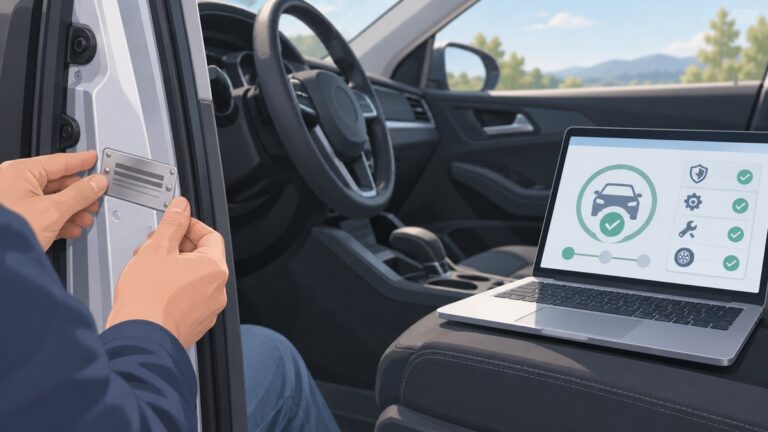
- Find the recommended pressure on the label inside the driver’s door or in the owner’s manual.
- Remove the valve cap and press the gauge squarely onto the valve stem.
- Compare the reading with the vehicle specification and add or release air as needed.
- Replace the valve cap and repeat for every tire.
Use the vehicle’s specified pressure, not the maximum pressure molded on the tire sidewall. The sidewall number is a tire limit, not the setting selected for your particular vehicle. A tire-pressure monitoring system can warn you after pressure has fallen substantially, but it is not a substitute for monthly gauge checks and may not warn early enough to prevent damage.
How to inspect tread, sidewalls and visible damage
Perform the inspection with the vehicle parked safely and the tires cool enough to touch. Look across the entire tread and both sidewalls. Check for cuts, punctures, bulges, cracks, scrapes, bumps, unusually smooth areas and wear that is heavier on one edge than the other.
Rank #4

- Enhanced Visibility in Low Light: Features a green backlit LCD screen and integrated flashlight, allowing for clear reading of tire pressure even in dark or dimly light conditions.
- Durable & Heavy-Duty Design: Constructed from robust stainless steel, specially engineered for RV and truck use. Helps maintain proper tire pressure to reduce wear and extend tire lifespan.
- Nozzle easily forms a seal with the valve stem giving quick and accurate readings in 0.1 increments; 4 settings with longer range: 0-230 PSI / 0-16 Bar / 0-16 Kg/cm² / 0-1585 Kpa
- Wide Pressure Range & Easy Operation: Covers 0-230 PSI / 0-16 Bar / 0-16 Kg/cm² / 0-1585 Kpa. Simply press the “ON/UNIT/OFF” button to turn on, select your unit, and it auto-shuts off after 30-40 seconds to conserve battery.
- User-Friendly & Versatile: Ergonomic non-slip texture ensures a firm grip. Includes batteries and comes with a 1-year warranty. Suitable for cars, trucks, motorcycles, bicycles, and more.
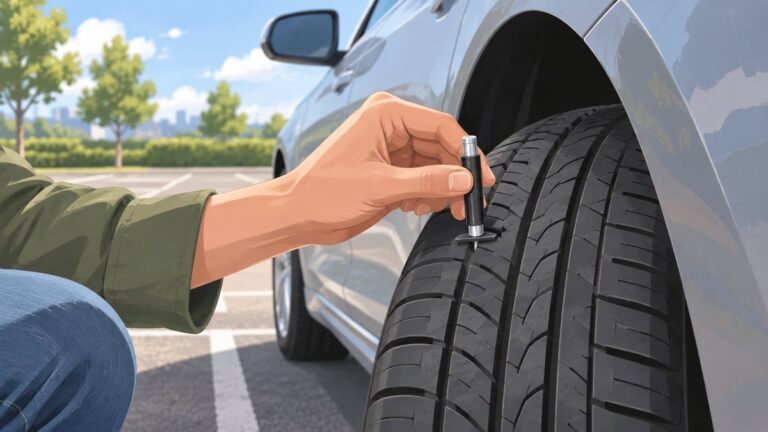
Every tire has tread-wear indicators molded into the grooves. When the tops of those bars are flush with the surrounding tread, the tire has reached its replacement point. USTMA and NHTSA identify 2/32 inch as the minimum tread threshold; at that depth, visit a tire shop rather than continuing to rely on the tire in wet conditions. A tread-depth gauge gives a numerical reading, while a penny check and the built-in wear bars provide source-supported ways to screen tread without specialized equipment. Any visible sidewall damage, bulge or suspected puncture should be evaluated by a tire professional rather than patched or ignored at home.
| Finding | What it means for a rainy-drive complaint | Next action |
|---|---|---|
| Tread at or below 2/32 inch, or wear bars flush | The tire has reached the recognized minimum tread threshold and has less water-clearing reserve. | Arrange replacement through a qualified tire service. |
| Uneven or rapid wear | May indicate incorrect pressure, missed rotation, alignment trouble or a road impact. | Have the tires and alignment inspected before relying on the vehicle in rain. |
| Cut, puncture, bulge, crack or sidewall scrape | Visible damage can compromise the tire’s structure and cannot be diagnosed safely from appearance alone. | Keep driving to a minimum and obtain a professional evaluation. |
| Healthy-looking tread but persistent slippery handling | The cause may involve pressure, road conditions, alignment, suspension or a tire-specific issue. | Request a complete tire and vehicle inspection. |
What uneven wear, pulling or repeated symptoms can indicate
Compare the left and right tires on the same axle and inspect the inner edges, which are easy to miss. Feathered edges, a smooth strip, cupping or one-sided wear can point to pressure, rotation, alignment or suspension concerns. A pothole or other road hazard can disturb alignment; misalignment can then produce rapid, uneven wear. Pulling to one side is one reason to have alignment checked.
Best Value

- Digital Tire Pressure Gauge 2 Pack, Industrial Tire Gauge 3-200 PSI, Calibrated to ANSI B40.7 Grade 2A(plus-minus 0.5%), Air Pressure Gauge with Replaceable AAA Batteries
- ACCURACY IN EXTREME PRESSURE RANGE: Whether tire pressure is below 12 PSI or above 140 PSI, ETENWOLF’s digital tire gauge is accurate as well
- ACCURACY IN EXTREME WEATHER: Built-in AI chip with thermal compensation inside, ETENWOLF’s tire gauge works normally even in extreme cold or hot weather(-4°F-130°F/-20°C-54°C)
- PRESSURE RANGE 3-200 PSI : ETENWOLF’s digital tire pressure gauge can measure pressure of all types of vehicles
- REPLACEABLE AAA BATTERIES: Batteries are easy to replace and helps to extend the tire pressure gauge’s life span, with LED light to illuminate dark areas for easy tire pressure reading
Do not try to diagnose a persistent handling complaint solely from a tread photograph or a single pressure reading. If the vehicle pulls, wanders, vibrates, repeatedly loses pressure or feels slippery in ordinary rain after you have slowed down, stop treating the symptom as normal wet-road behavior. A tire professional can inspect the casing, measure tread, verify pressure and assess alignment and related components.
Do you need new tires?
Replacement is warranted when tread reaches 2/32 inch, wear indicators are flush, the tire has unacceptable damage, or a professional finds a condition that makes continued use unsafe. If the tires still meet those checks, a slippery sensation does not automatically mean all four must be replaced; the cause may instead be speed, water depth, pressure, load, alignment or another vehicle issue.
When selecting replacements, start with the vehicle or tire manufacturer’s specified size, load index and speed rating. Those specifications determine whether the tire is suitable for the vehicle; wet-weather preference comes after correct fit and condition. Consider the weather and roads you normally drive, but do not substitute a different size or rating simply because it is marketed for rain.
The Tool Desk
Outbyte Driver Updater FREEFix the driver behind crashes, sound loss and screen glitchesFind Drivers →Outbyte PC Repair FREERepair Windows errors before they cause bigger problemsFix Now →| Replacement situation | USTMA guidance | Why axle placement matters |
|---|---|---|
| Replacing all four tires | Recommended for optimal overall performance. | The vehicle receives a matched set of tread condition and characteristics. |
| Replacing only two | Install the newer tires on the rear axle. | More wet-road grip at the rear can help reduce oversteer and loss of stability. |
| Replacing only one when unavoidable | Pair it with the tire having the deepest remaining tread, then install that pair on the rear axle. | A mismatched single tire can affect suspension, transmission and tire wear; pairing limits the imbalance. |
Ask a tire professional to confirm the vehicle-specific choice, especially for all-wheel-drive vehicles or when tread depths differ significantly. Some vehicle manufacturers recommend replacing tires at six years regardless of how much they have been driven. That is a manufacturer-specific recommendation, not a universal age rule for every vehicle, so follow your own vehicle and tire documentation.
How to prevent a repeat slippery feeling
- Check cold pressure monthly and before trips, heavy loads or towing.
- Inspect tread and sidewalls regularly, including the inner edges of the tires.
- Rotate tires according to the vehicle or tire maker’s schedule and investigate uneven wear promptly.
- Have alignment checked after a significant pothole or road impact, or whenever the vehicle pulls.
- Drive below your normal dry-road speed in rain and leave additional following distance.
- Keep cruise control off on wet roads and use smooth steering, braking and throttle inputs.
- Replace tires by the vehicle’s required size, load index and speed rating, with newer tires on the rear when only two are replaced.
When to stop driving and seek help
Stop and arrange professional assistance if a tire has a bulge, deep cut, exposed material, a suspected puncture that is losing air, or tread at the wear bars. Do the same if the vehicle pulls strongly, vibrates, repeatedly feels unstable in ordinary rain, or cannot maintain a predictable course after you reduce speed. These sources establish safe inspection and maintenance steps, but they cannot determine the condition of your specific vehicle without its pressure readings, tread measurements and an in-person examination.
Quick Recap
Product prices and availability are accurate as of the date/time indicated and are subject to change. Any price and availability information displayed on Amazon at the time of purchase will apply.