Some links on this page are affiliate links: if you buy through them we may earn a commission, at no extra cost to you.
Spring lines are dock lines led diagonally to stop a boat surging forward or backward along a berth. An aft spring runs from the bow toward a dock point behind the boat; a forward spring runs from the stern toward a point ahead. Together with bow, stern and breast lines, they keep the hull in position when wakes, wind, current and tide apply force. Spring lines also let a skipper pivot the bow or stern away from an obstacle during a slow, controlled departure. Without them, a boat can ride into a neighboring hull, piling or dock edge even when its bow and stern lines are attached.
What is a spring line on a boat?
A spring line is a diagonal mooring line that limits fore-and-aft movement. The U.S. Coast Guard Auxiliary’s Boat Crew Handbook – Seamanship Fundamentals (BCH 16114.4, 2017) identifies the forward spring (#2) and aft spring (#3) as the lines that keep a vessel from surging forward or aft at the dock.
As an Amazon Associate I earn from qualifying purchases.
Recommended Free Tools
Aft spring
An aft spring leads from the bow area to a cleat or piling behind the boat. It resists movement aft. With controlled reverse power, it can hold the stern near the dock while the bow swings away.
Forward spring
A forward spring leads from the stern area to a cleat or piling ahead of the boat. It resists movement forward. Controlled ahead power, together with suitable rudder angle, can swing the stern away from the dock.
Popular on Amazon
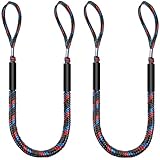
- GREAT GIFT IDEA FOR MEN: These bungee dock lines are designed for quick and easy docking, perfect for temporary docking. What's more, they can protect boats from waves and tie boats together when party time, therefore, they will be great gifts for the boat owners who have everything.
- QUICK AND EASY TO DOCK: This is perfect for a quick tie up to a cleat, piling or dock post and so on. Not Knots Any More!! Not everyone is an Eagle scout and can tie perfect knots, but with these bungee dock lines, you are able to dock your boat within 10 seconds, even a 7 years old kids can help to dock with our dock lines.
- SUPER CONVENIENCE: Perfect length keep the boat nice and snug against the dock, makes it a breeze to jump on and off boat without having to pull the boat in. Perfect for temporary docking when you docking a restaurant, getting gas at the lake, tying up to other boats or loading/unloading. If you docking your boat frequently, buy these dock lines, it is life saving.
- MORE SECURE TO DOCK: Our bungee dock lines can absorb shock to boats, cleats, docks, pylons and other hardware. Boats will easy run away or beat up against the dock when use the regular rope, because waves would bump them around until the rope came loose. But our our bungee dock lines have a lot of elastic and can bump around but stay attached. They stretch enough to keep from breaking loose but not enough to hit the dock.
- HAVE DUTY: Tensile strength is 2150 pounds that is able to dock boats and PWC's up to 4000 pounds, no problem keeping a 23ft boat secure to dock. A must have for boat and PWC owner. Best idea for Bass Boat, Pontoon Boat, Jon Boat, Yacht, Dinghy, Kayak, Jet Ski, Wave Runner, Seadoo ans so on.
How the lines differ
| Line | Primary job | Typical lead |
|---|---|---|
| Bow line | Secures the bow and helps limit movement in several directions | From the bow toward a point forward |
| Stern line | Secures the stern and helps limit movement in several directions | From the stern toward a point aft |
| Aft spring | Stops aft surge and can pivot the bow out | Bow area to a point behind the boat |
| Forward spring | Stops forward surge and can pivot the stern out | Stern area to a point ahead of the boat |
| Breast line | Holds the hull’s distance from the dock | Closer to perpendicular to the hull |
California’s state boating course summarizes the direction as “aft from the bow and forward from the stern.” Breast lines and fenders control side-to-side contact, but they do little to stop longitudinal surge compared with springs.
Why are spring lines important at a berth?
They oppose the repeated forward-and-aft loads created by wakes, wind, current and changing tide. That restraint keeps the boat from riding into neighboring boats, pilings or sharp dock edges.
Quick wins for a faster PC:
Fix the driver behind crashes, sound loss and screen glitchesFind Drivers →Repair Windows errors before they cause bigger problemsFix Now →Scan for outdated or missing drivers - takes under a minuteDriver Scan →- Surge control: Forward and aft springs counter movement along the dock.
- Collision and chafe reduction: Keeping the hull from traveling reduces impacts; correctly positioned fenders protect the contact points that remain.
- Load absorption: Nylon stretches and absorbs intermittent wave and sea forces better than natural-fiber line, according to the Coast Guard handbook.
- Controlled maneuvering: A spring can hold one end alongside while low engine power and rudder angle move the other end clear.
- Tidal accommodation: A properly arranged set keeps the boat near its berth while allowing the water level to rise and fall instead of locking the hull rigidly to the dock.
What is a normal spring-line setup?
A typical alongside berth uses a bow line, stern line, forward spring and aft spring. Add breast lines when weather or exposure increases the side load, but do not treat them as a substitute for springs when surge is the problem.
Also popular on Amazon

- Added Tensile Strength & Heavy Load Capacity: 3/8 inch lines Pre-spliced with a 12-inch eye, available in multiple lengths to suit different boat sizes. With a tensile strength of 4,150 lbs and a recommended maximum working load of 830 lbs, these boat dock ropes with loop are ideal for anchor lines, dock tie-offs, towing, boat bow lines, boat-to-boat docking, and survival use
- Durable & Dependable Premium NYLON Line: Constructed from 16-strand double-braided 100% marine-grade nylon yarn, these dock lines are pre-spliced with a 12-inch soft loop for easy handling and knotting. Maintains flexibility and strength under extended, high-intensity use, withstanding harsh marine conditions such as storms, saltwater, UV exposure, acids, oils, and extreme weather
- Effective Shock-Absorbent & Boat-Safe: Designed with a smooth braided surface that reduce tangling, the boat docking lines cushions sudden shocks caused by waves, reducing load on the boat during rough waters or docking.Balanced stretch design ensures safe and steady docking while preventing scratches or abrasions on the vessel’s finish.Suitable for securing boats to ramps, wharves, marinas, and piles
- Professionally Whipped & Heat-Sealed Ends: Both the loop splice and bitter end of each dock lines are tightly finished and heat-sealed for enhanced strength and durability. Reinforced treatment prevent fraying, prolongs the rope’s lifespan, and maintain integrity during heavy use, even in demanding waters
- Versatile & Multi-Purpose: Beyond docking, these marine rope dock lines are perfect for camping, hiking, bundling, hanging fenders or even pulling carts. A must-have for boaters, outdoor enthusiasts, and DIYers who need a a strong and dependable rope for various tasks both on land and at sea.For any questions about HOKINETY marine docking lines, please contact us, and we will provide support as quickly as possible
- Position adequate fenders between the hull and dock at the points most likely to touch.
- Lead the aft spring from the bow area to a sound cleat or piling astern.
- Lead the forward spring from the stern area to a sound cleat or piling ahead.
- Check that each lead is clear of the rudder, propeller, dock hardware and neighboring boats.
- Adjust tension so the boat is restrained without preventing normal vertical movement from tide.
There is no universally safe line length or diameter. Boat and marina guidance, the distance to usable cleats or pilings, expected loads and chafe exposure determine the arrangement. BoatUS advises that spring lines should be considerably longer than ordinary dock lines and recommends a bow line, stern line and at least two springs for most boats.
How do I use a spring line to leave a dock?
Use a spring as a temporary pivot, not as a license for high power. The Coast Guard describes spring lines as useful with an off-dock set when mooring and with an on-dock set when unmooring.
Before applying power
- Brief everyone: one person handles lines while the helmsperson controls the engine and rudder.
- Place fenders before the line takes a heavy strain.
- Confirm the line cannot foul the propeller or rudder and that no one is standing in its bight or snap-back area.
Pivoting the bow or stern
To move the bow clear, an aft spring can hold the stern while brief reverse power and appropriate helm input swing the bow out. To move the stern clear, a forward spring can hold the bow while brief ahead power and rudder input swing the stern out. Use the setup that clears the obstacle on your boat and at your berth; geometry, wind and current determine which end will move.
Windows Errors? Fix Them Before They Spread
Repair common Windows errors and clear accumulated junk for a smoother, more stable PC - no reinstall needed.Free scan · no reinstallCrashes, No Sound, or Screen Glitches?
Random freezes, missing sound and display glitches usually trace back to one bad driver. Find and replace yours safely.Free scan · under a minuteAlso popular on Amazon
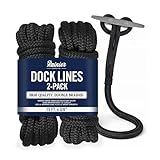
- Top-Quality Dock Line You Can Trust: Keep your boat safe and secure with our durable, double braided nylon dock line. This boat dock lines value pack comes with two 50' x 3/4" boat ropes for docking with loop, which work perfectly with boats up to 55 feet long. Each dock rope has a tensile strength of 10,503 lbs and a recommended maximum working load of up to 2,430 lbs.
- Made To Last: Each nylon rope is professionally whipped, spliced with a 18” eyelet, and heat-treated at the throat and bitter end to prevent fraying. The super durable boat dock lines and double-braided structure of our boat ropes ensures durability — at a great value!
- Soft On Your Hands And On Your Boat: Protect your investment with high-quality boat dock supplies! Much softer than other marine rope, our boat tie downs for dock feels smooth in your hands and limits scratching to your boat’s finish.
- Strong & Shock-Absorbent: Our double-braided nylon boat lines for docking are ultra strong, with a higher tensile strength than other materials. By design, these boat dock lines & rope allow for controlled stretch and increased shock absorption. Each one stands up against saltwater, sun, storms, oil, and rot for a long life!
- Made For Boaters, By Boaters: From anchor lines to boat ropes for docking, Rainier believes in making top-notch boat dock accessories accessible to all boaters. Our goal is to deliver affordable, high quality marine supplies boats — and their owners — can depend on.
Releasing
Release the spring only after the bow or stern has cleared the obstacle and the helmsperson is ready to control the boat. Once free, retrieve the line so it cannot fall into the propeller.
How should spring lines be handled safely?
- Keep speed low and use short power bursts. Never stop a moving boat with hands, feet or a body; use fenders.
- Watch every loaded line. A parted synthetic line can recoil violently, so stay outside the bight and snap-back zone.
- Do not let a spring lie where it can catch on dock fittings, the rudder or the propeller.
- Inspect before use for chafe, cuts, damaged eye splices and worn cleats or pilings.
- Coordinate every release and tensioning action with the helmsperson. Oregon boating guidance documents serious hand and fall injuries caused by uncoordinated line handling.
When approaching in an off-dock wind, the Coast Guard handbook advises a sharp approach angle of 45 degrees or more. That guidance concerns the approach, not a universal angle for every berth or wind condition.
What line material and size should I choose?
Double-braided nylon is a defensible default for a load-bearing dock or spring line. Nylon combines strength with elasticity, which helps absorb intermittent loads. Select diameter and length from the boat manufacturer or marina guidance, available attachment points and expected chafe and weather exposure.
Also popular on Amazon
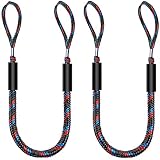
- GREAT GIFT IDEA FOR MEN: These bungee dock lines are designed for quick and easy docking, perfect for temporary docking. What's more, they can protect boats from waves and tie boats together when party time, therefore, they will be great gifts for the boat owners who have everything.
- QUICK AND EASY TO DOCK: This is perfect for a quick tie up to a cleat, piling or dock post and so on. Not Knots Any More!! Not everyone is an Eagle scout and can tie perfect knots, but with these bungee dock lines, you are able to dock your boat within 10 seconds, even a 7 years old kids can help to dock with our dock lines.
- SUPER CONVENIENCE: Perfect length keep the boat nice and snug against the dock, makes it a breeze to jump on and off boat without having to pull the boat in. Perfect for temporary docking when you docking a restaurant, getting gas at the lake, tying up to other boats or loading/unloading. If you docking your boat frequently, buy these dock lines, it is life saving.
- MORE SECURE TO DOCK: Our bungee dock lines can absorb shock to boats, cleats, docks, pylons and other hardware. Boats will easy run away or beat up against the dock when use the regular rope, because waves would bump them around until the rope came loose. But our our bungee dock lines have a lot of elastic and can bump around but stay attached. They stretch enough to keep from breaking loose but not enough to hit the dock.
- HAVE DUTY: Tensile strength is 2150 pounds that is able to dock boats and PWC's up to 4000 pounds, no problem keeping a 23ft boat secure to dock. A must have for boat and PWC owner. Best idea for Bass Boat, Pontoon Boat, Jon Boat, Yacht, Dinghy, Kayak, Jet Ski, Wave Runner, Seadoo ans so on.
Polypropylene should not be treated as equivalent simply because it floats. The Coast Guard handbook warns that polypropylene can lose up to 40% of its strength after three months of continuous sunlight. That figure is a warning for polypropylene, not a claim about nylon; cover, inspect and replace exposed line as needed.
Fenders are essential equipment, not an optional extra. Put them between the hull and dock before maneuvering, and reposition them if the contact point changes.
Independent reader supportYour contribution helps us test, update, and keep practical guides available for everyone.Which setup fits the conditions?
| Condition or requirement | Emphasize | Reason |
|---|---|---|
| Wakes or strong longitudinal current | Both forward and aft springs | Opposes surge in either direction |
| Wind pushing the hull off the dock | Springs plus adequate fenders | Springs restrain travel while fenders protect contact points |
| High side load or rough weather | Additional breast lines | Improves side-to-side holding; does not replace springs |
| Limited or offset cleats | Longer, carefully led springs | Line geometry determines whether the spring can restrain or pivot effectively |
| Heavy chafe exposure | Chafe protection and frequent inspection | Wear can weaken a loaded line even when the rope looks serviceable elsewhere |
The correct arrangement depends on the boat, berth and conditions. No single line length, diameter or tension is safe for every vessel.
Also popular on Amazon

- 【SHOCK ABSORBER FOR ANCHOR LINE】This boat mooring spring connects between your anchor line and the boat’s attachment point, absorbing sudden jerks caused by light wind, current, or boat movement. Reduces stress on cleats and anchor points, helping to protect your boat, dock, and mooring hardware from impact damage.
- 【DURABLE 304 STAINLESS STEEL CONSTRUCTION】Made from 304 stainless steel with surface electrolytic treatment for corrosion resistance in marine environments. Spring dimensions: 250 mm (9.84 in) free length, 30 mm (1.18 in) outside diameter, 3 mm wire diameter, 4 mm rod diameter. Includes a stainless steel carabiner for easy connection.
- 【SAFE WORKING LOAD 250 LBS】Minimum pull force to start stretch: 20 lbs; maximum safe working load: 250 lbs (approx. 113 kgf). Exceeding 250 lbs of pull may cause permanent deformation or breakage. Do NOT use on large or heavy vessels, nor as a lifting or towing device.
- 【IDEAL FOR SMALL WATERCRAFT】Perfect for temporary anchoring of kayaks, PWCs (personal watercraft), inflatable boats, and small fishing boats. Best used in sheltered waters such as lakes, rivers, protected bays, sandbars, and shallow water areas.
- 【PACKAGE INCLUDES & IMPORTANT SAFETY NOTES】Comes with 1 mooring spring, 1 stainless steel carabiner, and 1 product manual. This product is a shock-absorbing accessory and is NOT a substitute for a proper anchor or anchor line. Inspect before each use; discontinue use if wear, cracks, deformation, rust, or permanent stretching is found.
Frequently Asked Questions
Are spring lines used on both powerboats and sailboats?
Yes. The term describes the line’s job and lead, not a particular propulsion system. Any vessel moored alongside can use forward and aft springs to control surge.
Can I use only one spring line temporarily?
A single spring may be useful for a specific maneuver, but a normal alongside berth commonly uses both a forward and an aft spring. Whether one line is adequate depends on the berth geometry, weather and the direction of the expected load.
What’s actually slowing this PC down?
Pick the symptom - the matching free tool is one click away.
What is the snap-back zone on a dock line?
It is the area a tensioned rope may cross if it parts and recoils. Keep every crew member clear of the rope’s bight and line of recoil whenever a spring is under load.
Why do spring lines sometimes rub through even when they are the right size?
Strength does not prevent abrasion. A line can fail at a sharp cleat, piling or chock, so inspect the contact points and use suitable chafe protection wherever the lead moves or bears heavily.




