Some links on this page are affiliate links: if you buy through them we may earn a commission, at no extra cost to you.
Yes, a car has been made to run on reclaimed disposable-vape cells, but this is a one-off engineering project rather than a new production EV. HotHardware reported on March 9, 2026 that UK engineer and YouTuber Chris Doel converted an early-2000s Reva G-Wiz, screening 500 discarded cells before assembling them into a monitored battery pack. The finished microcar reportedly reached nearly 40 mph, covered an urban-use range of 18 miles, and accepted charging through a USB-C port.
Those results show what careful cell selection and battery controls can achieve in a very light vehicle. They do not establish that random used vape batteries are suitable for cars, that the conversion is independently certified, or that the design can be reproduced safely without specialist electrical knowledge.
As an Amazon Associate I earn from qualifying purchases.
The Tool Desk
Outbyte Driver Updater FREEScan for outdated or missing drivers - takes under a minuteDriver Scan →Outbyte PC Repair FREEClear out junk files and repair common Windows errorsFree Scan →What exactly is the vape-powered EV?
The vehicle is a converted Reva G-Wiz, a small electric car sold in the early 2000s. HotHardware describes the donor as weighing about 900 pounds and fitting the European heavy-quadricycle category. Its modest mass and urban-focused design make it a far less demanding platform than a modern full-size passenger car.
Who built it?
Chris Doel, identified by HotHardware as a UK-based engineer and YouTuber who also works as a software and electronics engineer at Jaguar-Land Rover, carried out the conversion. The report presents it as an individual project, not as a vehicle developed or supported by an automaker.
Popular on Amazon

- ☑Digital LCD display, easy to read the measurement result. With backlight, it makes it easy to read in low light areas.
- ☑ Adopt 4-wire method which helps to ensure the accuracy of the measured value.
- ☑Handmade, rightExcessive appearanceCautious shooting.2017 high voltage battery internal resistance tester. True four line 1Khz AC sinusoidal battery internal resistance instrument 0.00001 ohm ---200 range
- ☑Test range up to 200 ohms with a minimum resolution of 0.01 milliohms and less than 5 milliohms. Press HOLD to enable the ZR function to measure internal resistance as low as 0.30--0.50 milliohms.
- ☑It is applicable for measurement of internal resistances of Lithium-ion, nickel-hydroxide, lithium-manganese cells or assembled battery.
What was unusual about the battery source?
The replacement pack used 500 cells recovered from discarded disposable vapes. HotHardware says these devices commonly contain lithium-ion or lithium-polymer cells with a typical nominal voltage of 3.7 volts. A cell being discarded does not necessarily mean it is electrically empty; it may still hold charge, while its condition, history and remaining capacity can vary considerably.
That variation is the central engineering problem. Cells from different devices can have different ages, internal resistance, capacities and damage histories. Connecting them without sorting and protection can cause some cells to charge or discharge differently from others.
Free tools Windows power users keep installed
One-click scans. No signup required.
How were 500 reclaimed cells made into a usable pack?
The project depended on cell-level screening and active protection rather than simply wiring together whatever batteries were available. The report identifies three safeguards: individual electrical tests, a custom battery-management system and temperature monitoring across the assembled pack.
Each cell was screened before assembly
Doel reportedly tested every cell for internal resistance and voltage sag. Internal resistance indicates how strongly a cell resists current flow, while voltage sag shows how far its voltage falls when current is demanded. Those checks help identify cells that behave differently under load, although the report does not publish pass/fail thresholds, measured capacities or the final series-and-parallel layout.
For a reclaimed-cell project, screening is not a cosmetic step. A weak or damaged cell can limit a group of otherwise stronger cells, and mismatched behavior can make balancing and heat management more difficult. Anyone considering similar work should treat an appropriate lithium-ion internal-resistance tester as task-specific electrical equipment, not as a substitute for training. Reclaimed cells can be hazardous if they are shorted, punctured, overcharged or assembled with unsuitable protection.
Also popular on Amazon

- 【Voltage Internal Resistance Battery Tester】FNIRSI battery tester can automatically test internal resistance and voltage value at the same time. The measured value can be used to determine whether the battery quality has decreased
- 【TFT HD Color Display】The display adopts advanced color HD technology and excellent layout. Compared with traditional monochrome displays, it can present test results more clearly and vividly, greatly enhancing the user's measurement experience
- 【Accurate Measurement】Adopts customized Kelvin four-wire connection method to avoid wire and contact resistance and improve measurement accuracy. Users can also manually adjust the voltage and resistance range
- 【Wide Battery Applications & Batch Sorting】 Suitable for various batteries, including car and household batteries. Compare up to 8 sets of voltage and internal resistance readings for efficient battery sorting
- 【LED Display Handheld Meter】The resistance measurement range is up to 200Ω and the voltage measurement range is up to 100 V. The device must not be used with a DC voltage higher than 100V. Do not apply AC voltage under any circumstances
A custom battery-management system controlled charging
HotHardware says the conversion included a custom battery-management system, or BMS, designed to keep individual cells charging evenly and to address the volatility associated with mismatched cells. A BMS normally monitors cell voltages and pack conditions and can disconnect the load or charger when limits are reached. The report does not provide the BMS schematic, firmware, current limits or balancing strategy, so its exact operation cannot be independently evaluated from the published account.
Quick wins for a faster PC:
Scan for outdated or missing drivers - takes under a minuteDriver Scan →Repair Windows errors before they cause bigger problemsFix Now →Fix the driver behind crashes, sound loss and screen glitchesFind Drivers →Thermal monitoring watched the array in use
Temperature sensors were installed to monitor the 500-cell array during discharge. That matters because electrical losses and a damaged cell can produce heat, while heat can further change cell behavior. Monitoring can provide an early warning and allow a control system to reduce or stop current, but it is not a guarantee that a pack is safe. The report gives no sensor locations, alarm thresholds or shutdown temperatures.
How fast and how far does the converted G-Wiz go?
HotHardware reported the following project figures. They are results attributed to this single conversion, not laboratory-certified specifications for every G-Wiz or every reclaimed-vape battery pack.
| Specification | Reported figure | Qualification |
|---|---|---|
| Reclaimed cells | 500 | Cells recovered from discarded disposable vapes |
| Typical cell voltage | 3.7 volts | Typical value cited for the vape cells by HotHardware |
| Top speed | Almost 40 mph | Reported road-test result for this conversion |
| Driving range | 18 miles | Reported project range; no standardized test cycle was given |
| Vehicle mass | About 900 pounds | Approximate figure reported for the G-Wiz |
What does that range mean in practice?
The report portrays the range as sufficient for an average dense-city commute. That is a use-case description, not a universal promise: traffic, temperature, payload, tire condition, speed and terrain can all change how much energy a small EV needs. Because no independent laboratory cycle or repeatability data was provided, the 18-mile figure should be read as the result reported for this particular build.
Why were hills a problem?
Initial road driving reportedly found the car capable in urban environments, but hills exposed a clear limitation. The G-Wiz reached the top of each hill, yet it did so slowly while the electrical system approached its maximum available power. A vehicle can have enough energy for a useful flat-road range and still lack the power reserve needed to climb grades quickly. That distinction is important when judging a lightweight conversion for a route with sustained slopes.
Crashes, No Sound, or Screen Glitches?
Random freezes, missing sound and display glitches usually trace back to one bad driver. Find and replace yours safely.Free scan · under a minutePC Slower Than It Used to Be?
A free scan shows the junk files, broken settings and background clutter dragging Windows down - then fixes them in one click.Free scan · Windows 10 & 11Also popular on Amazon
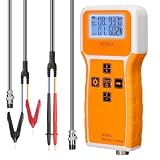
- 【Internal resistance & Voltage measurement】The battery tester can measure the battery internal resistance and voltage at the same time, this tool using four-wire test clamp, can better avert the influence of contact resistance and wire resistance, can carry out more accurate measurement.
- 【Clear & Backlight LCD Display】The digital battery tester features a Large LCD display screen that showcases the internal resistance, voltage and battery level of the tested battery, easy to read; The battery level is presented in battery level bar display, providing clear and precise information about the battery's status.
- 【Kalman Filter Mathematical Algorithm】This product adopts intelligent control, implanting Kalman filter mathematical algorithm, with high efficiency. It can also be used to measure the AC resistance of resistors and low-resistance high-precision resistance.
- 【Port Communication & Computer Analysis 】This product supports serial ports, and the measuring ranges of resistance is 1μΩ~200Ω, and the measuring ranges of voltage is 0.0001V~±100V direct current. Added serial port communication computer analysis software. Serial port needs to be opened in the machine to be able to communicate with the computer, the default is closed, the baud rate is 115200.
- 【Light Weight & Energy Saving】This tester built-in 1000mAh lithium battery to provide long service time, you can use the USB cable to charge in time. Portable size and easy to carry, you can take it with you to anywhere you want to use.
What EV charges over USB-C?
The converted Reva G-Wiz is the project described as charging through USB-C. HotHardware called the port a notable feature and said it might be the world’s first EV chargeable via USB-C, retaining the word might because no verified world-record certification was presented.
The port is an interface choice, not a published charging specification. The report does not state the USB-C power level, charging time, cable requirements, connector configuration, or whether an ordinary laptop or phone charger can be used. USB-C equipment varies widely in the power it can deliver, so the presence of the connector alone is not evidence that every USB-C power supply is compatible.
Can disposable-vape batteries really be reused in a car?
Technically, this project demonstrates that screened reclaimed cells can be assembled into a functioning vehicle pack. It does not show that cells taken at random from used vapes are safe to install. The difference is the inspection, matching, protection and monitoring work between collection and road use.
- Provenance: The prior use, age and storage conditions of each cell may be unknown.
- Physical condition: A dented, swollen, leaking or punctured cell should not be incorporated into a pack.
- Electrical matching: Cells need comparable behavior under charge and load; voltage alone does not establish that match.
- Protection: A suitable BMS and correctly designed fusing, wiring and enclosure are essential parts of the system.
- Heat control: The project used thermal monitoring because temperature behavior must be watched during operation.
- Qualified handling: Building a high-current lithium pack requires appropriate electrical and fire-safety expertise.
These points explain why the conversion is an engineering demonstration rather than a consumer retrofit recipe. The published report does not include enough electrical detail to reproduce the pack safely, and attempting to infer a wiring plan from the cell count would be unsafe.
Is the vape-powered G-Wiz a real production car?
No. It is a one-off Reva G-Wiz conversion reported by HotHardware. There is no indication in the account that an automaker sells this battery configuration, supports it with replacement parts or warranties, or offers the USB-C system as an option.
Also popular on Amazon

- 【WIDE APPLICATION BATTERY TESTER】The FNIRSI HRM-10 battery tester is not only able to test car batteries, but also other types of batteries such as AA, AAA batteries, button batteries, lithuim batteries, lead-acid batteries,etc. The range of DC voltage is 0 - ±100V and resistance 0 - 200Ω. NOTE: The device must not be used with a DC voltage higher than 100V. Do not apply AC voltage under any circumstances.
- 【 KELVIN FOUR-TERMINAL SENSING】The FNIRSI HRM-10 comes with a kelvin clip test line. With Kelvin four terminal sensing, it can be possible to accurately measure resistance values less than 0.1 Ω while eliminating the inherent resistance of the lead wires connecting the measurement instrument to the component being measured. It will provide you accurate values and help you identify the problematic batteries.
- 【 DATA PRESET FUNCTION】The FNIRSI HRM-10 battery tester has auto mode.Voltage gears is: Automatic, 1V, 10V, 100V and the resistance gear is :Automatic, 20mΩ, 200mΩ, 2Ω, 20Ω, 200Ω. You could preset 8 sets of data and check if the batteries can meet the standard you set and help you quickly find out the problematic batteries.
- 【NO DATA WOULD BE MISSED】The FNIRSI HRM-10 internal resistance tester can automatically save all the test records. And you could connect the tester to your PC and transfer all the data to PC via EXCEL. It would be convenient for you to analyze.
- 【FASHIONABLE DESIGN AND COLORFUL DISPLAY SCREEN】Testing euipment need to be more cooler and user-friendly. This is the principle we live up to when we design the product. The display of FNIRSI battery tester adopts advanced color HD technology and was designed with excellent layout. Compared with traditional monochrome displays, it can present test results more clearly and vividly, greatly enhancing the user's measurement experience.
The report also provides no independent certification, laboratory range test, lifecycle analysis, quantified cost comparison or production-safety assessment. Those omissions do not invalidate the project; they define what can reasonably be concluded from it. The result is evidence that one carefully managed build worked under the reported conditions, not evidence of a ready-made vehicle category.
How should a reclaimed-cell conversion be judged against a conventional replacement pack?
A fair comparison needs more than the number of cells or the connector on the outside. The following questions identify the information a buyer, engineer or fleet operator would need before treating a reclaimed pack as an alternative to a conventional automotive battery.
- Cell provenance and condition: Are the cells new, reclaimed or mixed, and is their prior history documented?
- Screening method: Were internal resistance, voltage sag and capacity measured for every cell, or only sampled?
- Balancing and protection: What BMS functions, current limits, fuses and shutdown behavior are specified?
- Thermal design: How are temperatures sensed, and what happens when a limit is exceeded?
- Charging system: What charger rating and protocol are approved, and how long does a full charge take?
- Usable range: Is the figure measured on a repeatable test cycle or observed during ordinary driving?
- Grade performance: Can the vehicle maintain speed on the hills that matter on its intended route?
- Support and accountability: Is there a manufacturer, service network and documented remedy if the pack fails?
The G-Wiz project supplies some answers for its own build, especially the 500-cell count, individual screening, BMS and thermal monitoring. It does not supply the controlled head-to-head measurements needed to compare it with a conventional replacement battery.
Do these 3 things before closing this tab:
1Scan for outdated or missing drivers - takes under a minute2Repair Windows errors before they cause bigger problems3Fix the driver behind crashes, sound loss and screen glitchesWhat environmental benefit does reusing vape cells provide?
The immediate environmental idea is straightforward: cells that might otherwise be discarded were given a second use in a vehicle. That is a legitimate feature of the project, but the published report does not quantify the benefit.
There is no waste-volume estimate, lifecycle analysis, energy-return calculation or comparison with manufacturing a new automotive battery. Reuse also creates a future responsibility: the cells will eventually need safe end-of-life handling, and a complex mixed pack may be harder to service or recycle than a purpose-built battery. The project therefore illustrates reuse potential without proving a particular environmental advantage in numerical terms.
Also popular on Amazon

- The battery internal resistance tester can measure internal resistance and voltage of the battery at the same time.The Kelvin four-wire test clamp is adapted in order to better avoid the influence of contact resistance and wire resistance, and more accurate measurement can be performed;
- It adopts intelligent control, liquid crystal display, and simultaneous insertion of Kalman filter mathematical algorithm, which has the advantages of high precision, high efficiency, low cost, light weight, energy saving and environmental protection.
- It is Built-in 1000mAh lithium battery, 5V charging, Android mobile phone charger can be used, which is very convenient.
- It is widely used in various battery production, maintenance, testing, scientific research laboratories and other occasions.
- It can also be used to measure AC resistance of capacitors and resistors with low resistance and high precision.
What would someone need to replicate the concept?
The safest way to understand replication is as a high-level engineering workflow, not a garage wiring guide. The report supports the following sequence but does not publish the electrical specifications required to complete it.
- Choose a suitable donor: Start with a lightweight EV whose motor, controller and enclosure can accommodate the intended pack.
- Collect cells lawfully and inspect them: Separate damaged, swollen or suspect cells before any electrical connection.
- Measure each cell: Record voltage, internal resistance and voltage sag under a controlled test, as the project reportedly did.
- Group compatible cells: Match cells using measured behavior rather than appearance or nominal voltage alone.
- Design the protection system: Specify the BMS, balancing method, fusing, isolation and current limits for the actual motor and charger.
- Add thermal monitoring: Place sensors where heat could develop and define a shutdown response.
- Validate gradually: Check the pack under controlled loads before road use, then evaluate flat roads, hills, charging and fault behavior.
Critical details such as cell capacity, series count, parallel count, charger output, enclosure design and BMS thresholds are not stated in the report. Without them, there is no responsible plug-and-play build plan for readers to follow.
What is the bottom-line significance of the project?
The vape-powered G-Wiz is significant because it combines an unusual waste stream with a practical demonstration: a very light EV reportedly reached nearly 40 mph, delivered an 18-mile range and accepted USB-C charging after extensive cell screening and monitoring. Its limitations are equally instructive. Hills reduced performance, the pack required custom controls, and the result remains a single conversion without independent certification or production support.
For readers, the useful lesson is not that any disposable vape can become a car battery. It is that reclaimed lithium cells can be considered only within a disciplined system of testing, matching, protection and thermal supervision. The project proves a carefully engineered possibility, not a consumer shortcut.
Frequently Asked Questions
Can I charge this car with any USB-C laptop or phone charger?
No such compatibility is established by the published account. It does not state the port’s power rating, charging protocol or approved charger, so a generic USB-C supply should not be assumed safe or adequate.
Why can a small EV have enough range but still struggle on hills?
Range measures how much energy the pack contains over a trip, while hill climbing depends on delivering high power at that moment. A lightweight car may cover flat urban roads efficiently yet slow dramatically when the motor and battery approach their power limits on a grade.
What’s actually slowing this PC down?
Pick the symptom - the matching free tool is one click away.
Are discarded vape batteries available for a similar conversion?
Availability, collection rules and cell condition vary by location, and the project report does not document a supply program. Cells should be obtained and transported through lawful battery-handling channels rather than removed casually from waste.
What evidence would make a reclaimed-cell EV suitable for wider production?
A production case would require repeatable range and durability data, documented electrical and thermal safety limits, independent certification, service procedures and a controlled end-of-life plan. None of those broader production qualifications is established by this single reported conversion.




