Do these 3 things before closing this tab:
1Fix the driver behind crashes, sound loss and screen glitches2Repair Windows errors before they cause bigger problems3Scan for outdated or missing drivers - takes under a minuteSome links on this page are affiliate links: if you buy through them we may earn a commission, at no extra cost to you.
Yes—a roof rack can lower fuel economy, and a rooftop cargo box can reduce highway MPG far more than most drivers expect. The main culprit is aerodynamic drag: a box or crossbar sits in fast-moving air, and the penalty rises sharply with speed. Published tests have found reductions ranging from a few percent for some rear carriers to roughly 25% or more for rooftop boxes at interstate speeds. Removing unused crossbars is the simplest fix. If you need external cargo space regularly, a properly rated hitch-mounted carrier often uses less fuel than a roof box, although hitch, lighting, clearance and tongue-weight limits still determine whether it is safe for your vehicle.
How much does a roof rack reduce MPG?
There is no single penalty for every vehicle or accessory. Shape, speed, crosswinds, vehicle height, powertrain, cargo mass and the rack’s frontal area all matter. The U.S. Environmental Protection Agency sums up the uncertainty with the warning, “Actually, your mileage WILL vary.”
As an Amazon Associate I earn from qualifying purchases.
Outdated Drivers Are Slowing You Down
One free scan finds every outdated or missing driver and matches the right update for your exact hardware.Free scan · exact hardware matchPC Slower Than It Used to Be?
A free scan shows the junk files, broken settings and background clutter dragging Windows down - then fixes them in one click.Free scan · Windows 10 & 11| Accessory or test | Measured fuel-economy effect | Conditions and source |
|---|---|---|
| Blunt rooftop cargo box | 2–8% lower in city driving; 6–17% lower on highways; 10–25% lower at interstate speeds | U.S. Department of Energy project summary, 2015 |
| Rooftop cargo box | Up to 25–27% lower at higher speeds | Oak Ridge National Laboratory SAE-based coastdown and dynamometer testing, 2014, compact sedan |
| Empty roof rack | Nearly 11% lower | Consumer Reports test of a 2019 Nissan Altima at 65 mph, 2020 |
| Rack plus rooftop carrier | About 19% lower | Consumer Reports test of the same 2019 Nissan Altima at 65 mph, 2020 |
| Factory crossbars removed | 25 mpg with bars versus 28 mpg without them | Car and Driver test of a 2022 Kia Carnival, 2025 |
These are measured examples, not a promise that your car will lose the same percentage. A tall SUV, a small sedan, a hybrid and an electric vehicle can respond differently to identical hardware.
Why do roof bars and cargo boxes hurt highway gas mileage?
At speed, aerodynamic drag becomes the dominant cost. Crossbars disturb airflow even when empty, while a cargo box presents a larger, blunt surface above the roof. The engine must produce more power to maintain the same speed, so fuel consumption rises.
Popular on Amazon
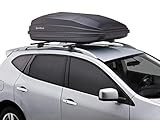
- 18 cubic foot (510 L) internal cargo capacity
- Made from durable UV-resistant ABS material
- Rear opening for easy access away from traffic
- Tool-free mounting hardware for easy installation and removal
- Includes key and lock to secure contents in the box, and the box to your rack
The effect accelerates rather than increasing in a simple straight line. Driving at 75 mph exposes the accessory to substantially more air resistance than driving at 55 mph. Crosswinds can increase the effective frontal area, and a box mounted too far forward, backward or at an incorrect angle can create additional turbulence.
Added weight matters too, especially in stop-and-go traffic, but the highway penalty in published tests was primarily aerodynamic. That is why an empty rack can still cost MPG and why removing it between trips is worthwhile.
Recommended Free Tools
Is a rooftop cargo box worse for MPG than a hitch carrier?
Usually, yes, when both carry a similar load and the vehicle can use either system. A rear-mounted tray or cargo box sits in the vehicle’s wake, where airflow is slower and less energetic than the air striking a rooftop box.
Also popular on Amazon

- Secure Travel Solution with Locking Rooftop Cargo Box: Travel confidently knowing your gear is safe! Our rooftop cargo box features a secure locking system (includes two keys) and robust straps, providing peace of mind against theft during weekend getaways or long road trips.
- Effortless Rooftop Cargo Box Installation: Enjoy a quick and hassle-free setup! This rooftop cargo box comes complete with all necessary components and clear instructions, allowing you to spend less time installing and more time adventuring. Experience ultimate convenience without compromising quality.
- Aerodynamic Rooftop Cargo Box Design: Experience a smoother, quieter ride! Engineered with an aerodynamic shape, this rooftop cargo box significantly cuts wind resistance and noise. The result? Improved fuel efficiency and a more enjoyable journey for you and your passengers.
- Spacious 17 cu ft Rooftop Cargo Box Capacity: Maximize your storage! Offering a generous 17 cubic feet of space and a 165 lbs weight capacity, this rooftop cargo box provides ample room for all your travel essentials, luggage, or outdoor gear – perfect for families and adventure seekers.
- Universal Fit Rooftop Cargo Box for Cars & SUVs: The ultimate travel companion for most vehicles! Designed for versatile compatibility, this rooftop cargo box fits a wide range of cars and SUVs. Simply check your roof rack compatibility before purchase to enjoy secure, added storage on any drive.
The DOE summary estimated a 1–2% city and 1–5% highway reduction for rear-mounted boxes or trays, compared with 2–8% city, 6–17% highway and 10–25% interstate reductions for a blunt rooftop box. A Car and Driver comparison illustrates the difference without making it universal: the same Toyota Grand Highlander Hybrid returned 25 mpg with a Yakima EXO SwingBase/GearLocker hitch carrier and 21 mpg with a Thule rooftop box.
A hitch carrier is not automatically the right choice. It can reduce rear visibility, extend the vehicle’s length, affect departure angle and block license plates or lamps unless the setup has the required lighting and plate provisions. The vehicle’s hitch rating, tongue-weight limit and the carrier’s own load rating must all be met; use the lowest applicable limit.
Should I remove my roof rack when I am not using it?
Yes, if the bars or towers are designed for removal and you do not need them. Taking off unused hardware eliminates its drag and can recover a measurable amount of fuel economy. In Car and Driver’s 2022 Kia Carnival comparison, removal improved the observed result from 25 to 28 mpg. Consumer Reports found an almost 11% loss from an empty rack on a 2019 Nissan Altima at 65 mph.
Also popular on Amazon

- Secure Travel Solution with Locking Rooftop Cargo Box: Travel confidently knowing your gear is safe! Our rooftop cargo box features a secure locking system (includes two keys) and robust straps, providing peace of mind against theft during weekend getaways or long road trips.
- Effortless Rooftop Cargo Box Installation: Enjoy a quick and hassle-free setup! This rooftop cargo box comes complete with all necessary components and clear instructions, allowing you to spend less time installing and more time adventuring. Experience ultimate convenience without compromising quality.
- Aerodynamic Rooftop Cargo Box Design: Experience a smoother, quieter ride! Engineered with an aerodynamic shape, this rooftop cargo box significantly cuts wind resistance and noise. The result? Improved fuel efficiency and a more enjoyable journey for you and your passengers.
- Spacious 19.4 cu ft Rooftop Cargo Box Capacity: Maximize your storage! Offering a generous 19.4 cubic feet of space and a 165 lbs weight capacity, this rooftop cargo box provides ample room for all your travel essentials, luggage, or outdoor gear – perfect for families and adventure seekers.
- Universal Fit Rooftop Cargo Box for Cars & SUVs: The ultimate travel companion for most vehicles! Designed for versatile compatibility, this rooftop cargo box fits a wide range of cars and SUVs. Simply check your roof rack compatibility before purchase to enjoy secure, added storage on any drive.
Removal checklist
- Follow the rack maker’s removal instructions rather than forcing clamps or leaving loose fasteners.
- Store keys, end caps and torque tools with the bars so reinstallation is complete and even.
- Clean and protect the roof contact points before reinstalling.
- After refitting, check the specified clamp position and torque before loading anything.
How large is the effect across the entire U.S. vehicle fleet?
Lawrence Berkeley National Laboratory estimated that roof racks accounted for 0.8 per mille of U.S. light-duty-vehicle fuel consumption in 2015—about 100 million gallons of gasoline per year. That is a fleet model, not a prediction for one driver. It shows that a small average penalty becomes substantial when millions of vehicles carry racks year-round.
What changes the MPG penalty on your vehicle?
- Speed: The interstate-speed range produces the largest losses; slowing down reduces drag from the accessory and the vehicle itself.
- Vehicle shape and ride height: A box on a low sedan can have a different relative effect than the same box on a tall crossover.
- Box design and fit: A narrow, streamlined box generally disturbs airflow less than a blunt, oversized one, but published percentages should not be transferred between models.
- Crosswinds: Gusts change the airflow angle and can increase both drag and steering demands.
- Powertrain: Hybrids may mask some changes at low speed through electric operation, then show a clearer penalty during sustained highway travel.
- Load: Heavy cargo increases rolling and acceleration energy use regardless of where it is mounted.
How can I measure the real MPG cost on my own car?
Use repeatable conditions rather than comparing one trip with a rack to a different trip without it.
- Check tire pressures cold and keep the same pressure, fuel grade and vehicle load for both runs.
- Measure several fill-to-fill tanks without the accessory, using the same route and similar weather where possible.
- Install the rack or box exactly as directed, then repeat the route at the same steady speeds.
- Compare fuel used over multiple runs; one windy or congested trip is not enough to establish a percentage.
- Record speed, temperature, wind, passengers and cargo so an unusual result has an explanation.
Do not treat the vehicle’s dashboard estimate as laboratory data. It is useful for spotting a consistent change, but the fuel-pump calculation over several tanks is a stronger practical check.
Also popular on Amazon

- 【HIGH-QUALITY MATERIAL】Constructed from premium ABS material, this rooftop cargo box delivers exceptional durability and reliable protection against harsh weather. Its rugged design safeguards your belongings while extending product life, making it a dependable choice for road trips, camping, and everyday travel.
- 【GENEROUS STORAGE SPACE】With a 12/14 cubic feet of storage capacity and a load limit of to 165 lbs, this cargo carrier easily holds luggage, sports equipment, or camping gear—so you can bring more without compromising on space.
- 【UNIVERSAL-FIT COMPATIBILITY】Designed for universal fit, this cargo box is compatible with a wide range of vehicles equipped with a roof rack, including cars and SUVs. Before purchasing, please check your vehicle’s roof rack specifications to ensure a perfect fit and hassle-free installation.
- 【EASY ACCESS DESIGN】The innovative dual-sided opening allows effortless loading and unloading from either side. Secure locking mechanisms and included keys keep your belongings safe and easy to access whenever you need them, making every trip more convenient.
- 【PEACE OF MIND WARRANTY】Backed by a one-year warranty, this rooftop cargo box reflects our commitment to quality and gives you confidence in your purchase. If you have any questions or concerns, our dedicated customer service team is ready to assist you promptly and ensure your satisfaction.
What did laboratory testing find about other external cargo?
Roof boxes are not the only source of drag. Oak Ridge National Laboratory reported a 30% city-cycle to 50% loss at 80 mph for an SUV towing a 3,500-pound enclosed trailer in 2014. That result describes a heavy trailer, not a roof rack, but it demonstrates why accessory type and frontal area must be kept separate when comparing MPG claims.
What is the most fuel-efficient way to carry extra cargo?
First, carry items inside the vehicle if passenger and safety requirements allow. If external capacity is necessary, remove roof hardware when idle, pack the smallest suitable roof box, keep its load within the vehicle and box limits, and drive at moderate speeds. Choose a hitch-mounted tray or box when it meets the vehicle’s hitch, tongue-weight, clearance and lighting requirements. Fuel savings never justify exceeding a rated load or obstructing lamps, plates or the driver’s view.
Independent reader supportYour contribution helps us test, update, and keep practical guides available for everyone.Frequently Asked Questions
Does a roof rack affect an electric vehicle’s range too?
Yes. The same aerodynamic drag that raises gasoline use requires more electrical energy from an EV at speed, so range can fall. The percentage depends on the vehicle, rack and driving conditions, and should be checked with repeatable trips rather than a single dashboard estimate.
Also popular on Amazon

- Secure Travel Solution with Locking Rooftop Cargo Box: Travel confidently knowing your gear is safe! Our rooftop cargo box features a secure locking system (includes two keys) and robust straps, providing peace of mind against theft during weekend getaways or long road trips.
- Effortless Rooftop Cargo Box Installation: Enjoy a quick and hassle-free setup! This rooftop cargo box comes complete with all necessary components and clear instructions, allowing you to spend less time installing and more time adventuring. Experience ultimate convenience without compromising quality.
- Aerodynamic Rooftop Cargo Box Design: Experience a smoother, quieter ride! Engineered with an aerodynamic shape, this rooftop cargo box significantly cuts wind resistance and noise. The result? Improved fuel efficiency and a more enjoyable trip for you and your passengers.
- Spacious 21 cu ft Rooftop Cargo Box Capacity: Maximize your storage! Offering a generous 21 cubic feet of space and a 165 lbs weight capacity, this rooftop cargo box provides ample room for all your travel essentials, luggage, or outdoor gear – perfect for families and adventure seekers.
- Universal Fit Rooftop Cargo Box for Cars & SUVs: The ultimate travel companion for most vehicles! Designed for versatile compatibility, this rooftop cargo box fits a wide range of cars and SUVs. Simply check your roof rack compatibility before purchase to enjoy secure, added storage on any drive.
Can I leave a rooftop box mounted all winter?
You can if it remains within the manufacturer’s temperature, load and mounting requirements, but leaving it installed continuously preserves its aerodynamic penalty. Remove it for periods when you do not need the capacity, and inspect seals, mounts and fasteners before the next use.
Will a fairing make empty crossbars fuel-efficient?
A fairing may change airflow noise and drag, but the evidence provided does not establish a universal MPG improvement for every bar and vehicle combination. Treat it as an accessory-specific change and verify the result with controlled, repeated fuel-use comparisons.
How do I know whether my hitch can support a cargo carrier?
Read the vehicle owner’s manual and hitch label for maximum tongue weight and receiver class, then check the carrier’s rated load and any distance-from-receiver limits. Account for the carrier’s own weight and keep the combined load below the lowest rating; add required lighting or a plate relocation solution if the carrier blocks them.




