Do these 3 things before closing this tab:
1Fix the driver behind crashes, sound loss and screen glitches2Clear out junk files and repair common Windows errors3Scan for outdated or missing drivers - takes under a minuteSome links on this page are affiliate links: if you buy through them we may earn a commission, at no extra cost to you.
There was no customer-sale 1983 Chevrolet Corvette. Chevrolet delayed the all-new C4 and introduced it as a 1984 model instead. The white car often called “the 1983 Corvette” is genuine, but it is a preproduction pilot car built for validation, not a regular model-year vehicle that escaped into a showroom. It was built on June 28, 1982, identified as RBV098 (VIN 1G1AY0783D5110023 in the NCRS account), and is now displayed at the National Corvette Museum in Bowling Green, Kentucky.
That distinction explains the apparent contradiction: an authentic car exists, while Chevrolet sold zero 1983 Corvettes to the public. The car survived only because the normal destruction process for pilot vehicles was interrupted.
As an Amazon Associate I earn from qualifying purchases.
What’s actually slowing this PC down?
Pick the symptom - the matching free tool is one click away.
Why was there no retail 1983 Corvette?
Chevrolet planned the fourth-generation Corvette, known as the C4, as a major changeover from the C3. Development and production were not ready for a normal 1983 launch, so Chevrolet skipped retail production and began sales with the 1984 model year. The National Corvette Museum describes the decision as no public 1983 production, followed by the redesigned Corvette’s 1984 debut.
This was not a simple marketing-year adjustment. The Bowling Green plant had to change over to a substantially different car, while structural work, components, emissions certification and quality validation were still unfinished. Dave McLellan, Corvette chief engineer at the time, later described it as a major plant changeover in which important components would not be available until after the beginning of the following year. Plant quality manager Ralph Montileone recalled that the problems were serious enough that the cars could not responsibly be released.
Popular on Amazon

- Never Let a Dead Battery Ruin Your Drive. The LISEN 4 in 1 Retractable Car Charger delivers reliable power for your entire journey. Compatible with standard 12V cigarette lighter sockets, it keeps phones, tablets, and devices charged during daily commutes, road trips, and long drives — the perfect practical gift for dads, truck drivers, and anyone who lives on the road.
- Daily Driver Essential: Always Ready When You Need It. Featuring two retractable cables ( USB C & Old iPhone Charging Cable ) that extend up to 31.5 inches and dual USB ports, this charger solves cable clutter while charging up to 4 devices simultaneously. Ideal for busy fathers, commuters, and families who want a tidy car and never worry about low battery again.
- Deliver full-speed PD fast charging for iPhone 18 Pro Max & iPhone 18 Pro Max & iPhone 18 Pro right inside your car. The built-in 45W PD USB-C port hits the peak charging speed for these latest iPhone models, juicing up your phone to 50% power in just 15 minutes while you drive.(Note: Maximum 45W PD output is available under 24V vehicle power supply. When used with standard 12V car sockets, the peak output is limited to 36W.)
- Standard 12V Power Solution: Designed as a dedicated USB power supply for charging devices. Note: Does NOT support CarPlay, Bluetooth, or data transfer. Compatible with most phones, tablets, and small electronics. This retractable charger is a core car organization tool, keeping your vehicle tidy. Not compatible with Micro-USB devices.
- Clutter-Free Tech Organization: Featuring dual USB ports and retractable cables, the LISEN 4 in 1 charger provides a clean car storage solution. Perfect for truck enthusiasts or as a thoughtful gift for drivers, it supports fast USB-C charging for devices like the iPhone 18Pro & iPhone 18 ProMax. Keep your vehicle organized while ensuring efficient power delivery for all your tech on the road.
What changed from the C3 to the C4?
The C4 was developed as a ground-up redesign rather than a cosmetic update. HISTORY reports that it was 8.5 inches shorter, two inches wider, about 150 pounds lighter and used a wheelbase two inches shorter than the C3. Engineers were also pursuing improved aerodynamics, greater rigidity, sharper handling, digital instrumentation and a new suspension approach.
The roof decision created a particularly difficult engineering problem. The original plan called for a two-piece T-top, but the production design adopted a single removable roof panel. That change required taller structural side rails and forced substantial work on the body and chassis. The resulting structure, tooling and component integration needed more time than the original schedule allowed.
The Tool Desk
Outbyte Driver Updater FREEScan for outdated or missing drivers - takes under a minuteDriver Scan →Outbyte PC Repair FREEClear out junk files and repair common Windows errorsFree Scan →Is the one 1983 Corvette real?
Yes. It is an authentic General Motors preproduction pilot or validation car, not a replica and not a customer-delivered 1983 model. HISTORY identifies the surviving car as RBV098, built June 28, 1982, and the same account says it was the fourth of 43 pilot assembly cars. General Motors heritage material likewise describes dozens of pilot cars built for testing while confirming that no 1983 Corvettes were produced for public sale.
Why do published counts say 43, 44 or more?
The numbers describe different stages or categories of preproduction vehicles. HISTORY and General Motors heritage material refer to 43 pilot assembly cars. Corvette Magazine describes a validation build that stopped at 44 cars, while the NCRS account distinguishes 18 prototypes from 43 pilot-line cars. Those figures should not be treated as a single, universally defined production total.
The safest description is “one surviving car from dozens of C4 preproduction vehicles.” If a source-specific figure matters, identify the source and its category rather than presenting 43 and 44 as a contradiction that changes the car’s identity.
Also popular on Amazon

- ✅【Designed for Magsafe】 - The most fashionable iphone car mount in 2026 Magsafe is designed for iPhone 18 Pro Max/17/16/15/14/13/12 Pro Max Mini and official Magsafe cases and other magnetic phone cases and can be fixed directly to these phones without the need to affix metal plates. All Android Phones Will Work: Metal rings are provided; they fit cases and other phones without magsafe. Based on Unique Grandmaster Design (Protected by US Design Patent No. US D1,112,194 S)
- ✅【STRONG MAGNETIC MagSafe Car Mount】 - This powerful magnetic phone holder can create a powerful attraction that firmly supports your device while allowing you to drive without distraction. it easily and securely holds your phone through bumps, sharp turns or even sudden stops, no worrying of dropping your phone.
- ✅【SUPER STICK FORCE】 - VHB Dash Mounted Holders adhesive provides strong stick force between the dashboard and the car phone holder, which can firmly stick to any plane in the car, fix your device, adapt to a variety of road conditions such as sudden braking, speed bump, and rugged mountain road.
- ✅【SAFE DRIVING VIEW】 - Mini-size, not taking up space, it is placed in the dashboard without blocking the view at all, and does not need to look down at the device to ensure your safe driving. Cell Phone Car Mount is suitable for most cars, pickups, SUV, taxi; It is the best assistant for Uber and Lyft drivers
- ✅【360° FREE ROTATION】 - With an adjustable swivel ball joint, you can rotate your smartphone or device at your own will, providing the best viewing angle. Quickly pick and place with one hand, free your hands and make calls and GPS navigation more convenient
What are the surviving car’s documented specifications?
The displayed pilot has the familiar white exterior and a medium-blue interior. The NCRS account gives its VIN as 1G1AY0783D5110023. Classic Motorsports describes its engine as a 350-cubic-inch L83 V8 rated at 205 horsepower, paired with a four-speed automatic transmission.
| Item | Documented detail | Source or qualification |
|---|---|---|
| Build date | June 28, 1982 | HISTORY, 2019 account updated 2025 |
| Internal identity | RBV098; fourth of 43 pilot assembly cars | HISTORY |
| VIN | 1G1AY0783D5110023 | NCRS account |
| Exterior and interior | White body with medium-blue interior | Classic Motorsports description |
| Engine | 350-cubic-inch L83 V8 | Classic Motorsports |
| Rated output | 205 horsepower | Classic Motorsports; specification of the displayed car |
| Transmission | Four-speed automatic | Classic Motorsports description |
These are identification details for a particular pilot car. They should not be read as a complete specification for a retail 1983 model, because Chevrolet did not offer one and preproduction hardware can differ from certified customer cars.
How did the only surviving 1983 Corvette avoid destruction?
General Motors normally destroyed preproduction vehicles after testing. Corvette Magazine’s account describes a process in which identification plates were removed, paperwork was completed and a portable crusher was used. The pilot cars were not intended to become private collectibles.
The interrupted crushing operation
The last white car was sitting in rainwater when the destruction operation stopped. When the crew returned, the portable crusher had been removed. The car was moved and eventually forgotten behind the Bowling Green plant instead of being processed with the others. HISTORY reports that 42 of the 43 pilot cars were destroyed, leaving this neglected vehicle as the exception in the commonly cited count.
From neglected shell to museum exhibit
A later Bowling Green plant manager discovered the car, arranged for it to be cleaned and put it on display. At one point it received an American-flag paint treatment. It was later restored to its solid white appearance, which is the presentation associated with the museum exhibit today.
Outdated Drivers Are Slowing You Down
One free scan finds every outdated or missing driver and matches the right update for your exact hardware.Free scan · exact hardware matchPC Slower Than It Used to Be?
A free scan shows the junk files, broken settings and background clutter dragging Windows down - then fixes them in one click.Free scan · Windows 10 & 11Also popular on Amazon

- High Quality Material: The coaster is made of environmentally friendly silicone, safe, non-toxic and odorless. Soft with toughness, easily embedded in the cup holder. Very durable, wear-resistant, long service life. High temperature resistance, can withstand 100 ℃ high temperature water cups.
- Wide Compatibility: The coaster has a diameter of 3.15 inches and a height of 1.18 inches, which is widely used in most vehicles, such as SUV, sedan, MPV, etc., as long as the size fits your car cup holder.
- Protection Function: Our car cup holder coaster has a carry handle design and a stand-up ring edge on its edge to effectively prevent food crumbs, drinks and water from leaking out and preventing the car cup holder from getting dirty.Meanwhile,Thickened design effectively prevents the cup holder from being scratched by the cup when driving on bumpy roads and eliminates the annoying thumping sound, making your journey more enjoyable.
- Easy to Use and Clean: With embedded installation, you just need to put it flat on the car cupholder. It is also very quick to remove, there is a small bump on the coaster, pinch it and you can easily remove the coaster. It is very easy to clean, rinse with water or wipe with a wet towel (be careful not to clean with sharp tools).
- 100% Satisfaction: Our products have quality assurance, if you have questions or are not satisfied after receiving the product, don't worry, please contact us as soon as possible, we provide after-sales service.
The survival story is therefore less a planned preservation effort than an administrative and logistical accident: the crusher left, the car remained, and a later manager recognized its historical value.
What did the delayed launch produce in 1984?
Waiting until the car was ready gave Chevrolet time to complete certification and resolve the quality issues that had blocked a 1983 release. HISTORY reports that Chevrolet built 51,547 1984 Corvettes over an extended 18-month model year. The listed MSRP was $21,800, and Motor Trend named the 1984 Corvette its Car of the Year.
| 1984 C4 launch figure | Published value | Qualification |
|---|---|---|
| Production | 51,547 cars | HISTORY; extended 18-month model year |
| MSRP | $21,800 | HISTORY; period model-year price |
| Acceleration | Sub-seven-second 0–60 mph | HISTORY; reported performance figure |
| Cornering | 0.90 g | HISTORY; reported performance figure |
| Top speed | 140 mph | HISTORY; reported performance figure |
| Recognition | Motor Trend Car of the Year | HISTORY |
The C4 continued for 13 model years with later upgrades. In that context, the missing 1983 retail year marks a deliberate pause before a successful generational launch, not a canceled Corvette program.
How is the pilot different from a 1984 customer Corvette?
The most important difference is status: the white car was built to validate tooling, structure, systems and assembly, whereas a 1984 Corvette was a certified production vehicle sold through dealers. A comparison must therefore separate engineering purpose from appearance.
| Comparison point | Surviving pilot | 1984 retail C4 |
|---|---|---|
| Production status | Preproduction pilot/validation vehicle | Customer-sale production model |
| Model-year sale | Not sold as a 1983 Corvette | Introduced as the 1984 model |
| Certification | Built for development and validation | Completed production, emissions and market certification |
| Documentation | RBV098; VIN cited by NCRS | Normal retail VIN and production records |
| Powertrain detail | L83 350 V8, 205 hp, four-speed automatic as described by Classic Motorsports | Retail specifications varied by documented production configuration |
| Custody | Preserved museum exhibit | Distributed to customers and collectors |
Photographs can make the pilot look like an early 1984, but its historical value comes from its role in the development process and its survival, not from being a hidden retail model year.
Also popular on Amazon
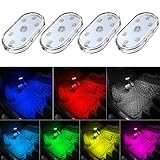
- 7 Colors Car Light: The led interior car lights are built-in 6 RGB LED lamp beads, which can be changed 7 different colors by touching, such as white, red, green, blue, yellow, pink purple, ice blue. The colors are bright and vivid, but not dazzling.Attention: Please charge before use.
- Touch Switch Design: Our led lights for car interior features touch control, one-key perspective lighting. Long touch to turn on/off, touch once to change the colors.
- Easy to Use: Stick the the iron plate in one place with double-sided tape, then put the light on it to complete the installation and fixation. Due to magnetic design, quickly install and remove, you also can attach the interior car lights to other metals.
- Portable & USB Rechargeable: Compact size, easy to carry, does not take up space. The wireless car led lights interior is charged by the USB cable, only need takes 40 minutes to fully charge the lights at a time, and keep lighting for about 2 hours.
- Wide Application: LED touch lights can be installed in dark places, such as storage boxes, armrest boxes, seat corners, etc. It's also suitable for bedside lights, wardrobe lights, reading lights, backpack lights, place it anywhere in the room, any dark place can be illuminated by it.
Where can you see the 1983 Corvette?
The authoritative public display location is the National Corvette Museum in Bowling Green, Kentucky. The museum received the car when it opened in 1994, and it remains the place associated with public viewing of the surviving pilot.
Display arrangements can change, so visitors should check the museum’s current exhibit information before traveling. The car’s presence there is the reliable answer to “where can I see it?”; claims that it is regularly available at dealerships or private shows confuse this unique museum-held vehicle with ordinary Corvettes.
Independent reader supportYour contribution helps us test, update, and keep practical guides available for everyone.Does General Motors still own the car?
Ownership wording requires care because published accounts differ. Corvette Magazine’s 2023 account says General Motors still owns the car under a renewable permanent loan to the museum. HISTORY’s updated account says General Motors eventually donated it. Both accounts agree on the practical point for visitors: the National Corvette Museum has custody and displays the car publicly.
Recommended Free Tools
Unless a current museum or General Motors statement settles the legal status, describe the museum as the display institution and avoid claiming a definitive transfer of title.
What should you check when someone advertises a “1983 Corvette”?
A seller may use “1983 Corvette” as shorthand for an early C4, a registration year, a replica or a pilot-car story. The title alone does not establish that a vehicle is the surviving museum car.
Also popular on Amazon

- Creative DIY Mode: Choose from 16 million available colors or customize car led light effects to your liking in DIY mode via Govee Home app. Make your car stand out in unique style with creative freedom and outdoor decorations.
- Dynamic Music Mode: Built-in mic helps interior car lights sync with any music type. Liven up your road trips, weekend getaways or evening commute with colors that dance vibrantly to your favorite songs.
- Smart App Control: Manage the colors and brightness of car lights or choose music mode by one simple tap with Govee Home app. Enjoy a comfortable and vibrant driving experience with convenient control.
- 2 Lines Design: 2 lines design connect the 4 car led strip lights, attaching the inside car lights easily to any car model without worrying about exposed wiring or an untidy look.
- Simple Installation: Before you install, make sure the installation surface is clean and dry. Then attach the led lights for car to your vehicle with adhesive and support clips. Rubber tubing outside protects lights from water spills.
- Ask for the complete VIN and compare it with the documented pilot VIN 1G1AY0783D5110023.
- Distinguish a preproduction pilot from a 1984 Corvette titled or registered during a different calendar year.
- Look for provenance linking the vehicle to RBV098 and the Bowling Green plant, not merely photographs of a white C4.
- Treat claims of another surviving retail 1983 as incorrect unless supported by authoritative factory records.
- Remember that the museum car’s documented white body, blue interior and L83/four-speed combination identify one historically specific vehicle, not every early C4.
Why does the story matter to Corvette history?
The car demonstrates how model years can conceal the real timing of an engineering program. Chevrolet’s public calendar jumps from 1982 to 1984, but the pilot car shows the development work taking place between those labels. Its existence also preserves evidence of the decisions that shaped the C4: the removable roof, structural redesign, digital instrumentation, lighter dimensions and the quality hurdles that delayed release.
It is also a rare survivor of a process designed to erase preproduction hardware. Most pilot cars fulfilled their purpose and were crushed. This one remained because the disposal operation failed to finish, making it a physical link between an unfinished development program and the production Corvette that followed.
Frequently Asked Questions
Can a 1983 Corvette have a normal Chevrolet title?
A vehicle registered in calendar year 1983 may be titled under another model year, but Chevrolet did not sell a normal retail 1983 Corvette. A title or registration date alone cannot prove that a car is the historic pilot.
What does RBV098 mean on the surviving car?
RBV098 is the internal identity used for the surviving pilot in the HISTORY account. It is a development-program identifier, not a retail trim level or an indication that Chevrolet offered an RBV model.
Why was the C4 called a 1984 if its pilot was built in 1982?
Automakers assign model years for planned retail production, not simply the calendar year when prototypes are assembled. The pilot’s 1982 build date reflects development timing; the certified customer car launched as the 1984 model after the delay.
Are all early white C4s replicas of the museum car?
No. White was an available appearance, and many legitimate production Corvettes can resemble the exhibit. Authenticity depends on VIN, factory records and continuous provenance, not paint color or body shape.
Free tools Windows power users keep installed
One-click scans. No signup required.




