Crashes, No Sound, or Screen Glitches?
Random freezes, missing sound and display glitches usually trace back to one bad driver. Find and replace yours safely.Free scan · under a minutePC Slower Than It Used to Be?
A free scan shows the junk files, broken settings and background clutter dragging Windows down - then fixes them in one click.Free scan · Windows 10 & 11Some links on this page are affiliate links: if you buy through them we may earn a commission, at no extra cost to you.
Tesla’s power is not one acceleration figure or battery-size headline. It is an integrated system linking electric vehicles, battery cells and packs, power electronics, charging hardware, software, home storage and grid-scale batteries. That integration is genuinely powerful: Tesla produced about 1.66 million consumer vehicles and delivered 1.64 million in 2025, while its energy-storage deployments reached 46.7 GWh. It is also frustrating because the ownership experience depends on conditions Tesla’s laboratory numbers do not capture—highway speed, weather, terrain, installation work, service access, reliability, supply chains and changing incentives.
The practical verdict is straightforward: Tesla can deliver excellent efficiency, a mature charging-and-software ecosystem and unusually broad battery products, but its advertised range is not a promise of highway miles, and its technical capability does not eliminate the ordinary problems of owning complex hardware.
As an Amazon Associate I earn from qualifying purchases.
What does Tesla’s “power” actually include?
Tesla’s advantage is the way several businesses reinforce one another. The company treats battery-cell, battery-pack and powertrain engineering as core competencies, with dual- and three-motor configurations available in selected vehicles. The same battery and power-electronics expertise is applied to residential Powerwall systems and commercial Megapack installations, while software can monitor and dispatch storage remotely.
| Part of the system | What Tesla reports | Why it matters to an owner or operator |
|---|---|---|
| Consumer vehicles | Approximately 1.66 million produced and 1.64 million delivered in 2025 | Large production creates a broad installed base, but scale does not guarantee identical reliability or service access in every region. |
| Energy storage | 46.7 GWh deployed in 2025 | Tesla’s battery business extends beyond cars into homes, businesses and utilities. |
| Powerwall | The one-millionth unit was installed in 2025 | A substantial installed base supports backup, solar self-consumption and time-of-use strategies where utility rules allow. |
| Software control | Powerhub and Autobidder can remotely control and dispatch storage | Storage can respond to grid conditions instead of operating as a passive battery. |
Tesla’s stated mission is “to accelerate the world’s transition to sustainable energy.” The company’s 2025 filing also says it began manufacturing a new residential retrofit solar panel in 2025, with initial deliveries in January 2026. In the third quarter of 2026, Tesla said a Houston Megafactory began production and that the first Megapack using Nevada-made lithium-iron-phosphate cells shipped during that quarter.
Popular on Amazon

- Dual Voltage Level 1 & 2: Charge at 120V/12A (1.44kW, 2-5 miles/hr) with the included NEMA 5-15 adapter or at 240V/16A (3.84kW, 9-12 miles/hr) with the NEMA 6-20 plug. One SEGUMA portable tesla charger gives you two charging options for everyday home charging, backup charging, and travel
- EV Charger for Tesla Vehicle-Seguma 16A mobile ev charger for tesla is specifically designed for Tesla vehicles, engineered with standardized North American Charging Standard (NACS) connector, works flawlessly with Tesla Model-Y/X/3/S/Cybe truck
- Wireless Charging Door Control-The portable mobile car charger for tesla has a button on the connector that wirelessly opens the charging port door, eliminating the need for physical keys or buttons and making charging more convenient
- Intelligent Charging-The Seguma level 1 charger offers protection against leaks, grounding, voltage issues, overcharging, and overheating. It automatically shuts off when your Tesla is fully charged. Tip: Install a home circuit breaker for extra safety
- Extended 25FT Cable-The 25-foot cable allows easy tesla charging at home or public stations. The included portable storage bag lets you take the tesla home charger anywhere, making it ideal for travel, road trips, or visits. Perfect accessory for Model Y
Why does a Tesla lose range faster on the highway?
Because the dashboard range is a regulatory estimate, not a live promise of distance under your exact conditions. Tesla says the displayed figure is based on certification data and that actual consumption changes with speed, driving style, weather, terrain and other factors.
At 70 mph, there is no single “real Tesla range” number. The result varies by model, wheel and tire choice, temperature, wind, elevation, traffic and cabin heating or cooling. A steady highway trip generally uses more energy per mile than the test cycle behind the EPA figure.
Independent evidence shows why the distinction matters. Consumer Reports’ 2026 steady-highway testing covered 26 EVs; half failed to reach their EPA estimates, with some vehicles as much as 50 miles short and others exceeding their ratings. That is a cross-brand test, not a Tesla-specific failure rate, but it is a useful warning against treating any EV’s sticker number as a highway guarantee.
The U.S. Environmental Protection Agency’s 2025 Automotive Trends Report put the average range of a new battery-electric vehicle at 292 miles for model year 2024. That is a fleet average, not a Tesla specification. Consumer Reports’ director Alex Knizek summarized the buying implication: “When comparing cars, buyers need to know what range they are getting for their money.”
How to plan a long trip without overtrusting the display
- Use the route planner for the specific car and destination, then keep a charging reserve for weather, detours and congestion.
- Expect a larger penalty from sustained high speed, cold weather, headwinds, steep grades and a heavily loaded vehicle.
- Compare cars using measured highway energy use and charging time, not only EPA miles.
- Check whether the route has reliable fast-charging stops before committing to a model or trim.
What is the difference between a Tesla Mobile Connector and Wall Connector?
The Wall Connector is a fixed, higher-power home installation. The Mobile Connector is a portable cable that trades charging speed for flexibility.
| Characteristic | Wall Connector | Mobile Connector |
|---|---|---|
| Use case | Dedicated home charging | Portable charging at compatible outlets |
| Published charging rate | Up to 44 miles of range per hour at 11.5 kW/48 A, depending on vehicle | Up to 3 miles per hour from a standard 120-volt outlet, or up to 30 miles per hour from a 240-volt NEMA 14-50 outlet, depending on model |
| Installation | Qualified-electrician installation is required | Uses an existing outlet, although the circuit and adapter must be suitable for the load |
| Controls | Wi-Fi connectivity and app controls | Portable, with charging governed by the connected outlet and vehicle |
| Warranty | Four-year residential warranty | Not stated in the supplied product information |
| Availability and price | The Tesla Shop listed $585 retail on October 27, 2026, but showed it out of stock and required Tesla-owner verification | Price and stock vary by market and configuration |
A Wall Connector is most useful when the car parks at home for predictable overnight charging and the electrical panel can support the installation. The Mobile Connector is the better fallback for renters, travel or occasional charging, but a household 120-volt outlet adds energy slowly enough that it may not replace daily driving needs.
Quick wins for a faster PC:
Scan for outdated or missing drivers - takes under a minuteDriver Scan →Clear out junk files and repair common Windows errorsFree Scan →Fix the driver behind crashes, sound loss and screen glitchesFind Drivers →When comparing charging systems, use miles added per hour or minute, circuit and panel requirements, electrician cost, public-route coverage and your normal parking pattern. ISO/SAE 12906:2024 defines procedures for comparing AC, DC and wireless charging performance, which is more meaningful than quoting a peak power figure without the conditions behind it.
How reliable is Tesla power in everyday ownership?
Reliability and service are part of the power equation because a sophisticated battery, motor or software system is only useful when the vehicle can be diagnosed and repaired promptly.
An Associated Press account of Consumer Reports’ 2024 owner survey said EVs had 42% more reported problems than gasoline vehicles on average, based on responses from about 300,000 owners. Tesla ranked 17th among 22 brands in that survey. These are owner-reported problems across vehicle systems, not a failure rate for every Tesla, so the result is best treated as a broad reliability signal.
Tesla’s own filings identify battery-cell supply, tariffs, incentives, charging access, service capacity and regulation as risks that can affect demand, costs and profitability. For a buyer, those risks can appear as changing prices or incentives, delayed parts, limited appointment availability or regional differences in charging and repair support.
Do these 3 things before closing this tab:
1Scan for outdated or missing drivers - takes under a minute2Repair Windows errors before they cause bigger problems3Fix the driver behind crashes, sound loss and screen glitchesQuestions to answer before buying
- How far is the nearest authorized service location, and how long are appointments typically scheduled out?
- Can your home panel accept the charging equipment, and what will an electrician charge?
- Which incentives apply in your state or utility territory, and can they change before delivery?
- What public charging options cover your regular long-distance routes?
- What battery warranty and degradation terms apply to the exact model and market?
Can a Powerwall keep a house running during an outage?
Powerwall stores electricity from solar or the grid and can supply a home when grid power fails. It can also shift consumption toward cheaper periods and, with participating utilities, support energy-market sales. The duration of backup depends on household load, which circuits are operating, whether solar can recharge the battery and the utility or installation configuration.
Also popular on Amazon
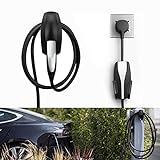
- COMPATIBLE WITH TESLA MODEL 3/MODEL Y/MODEL X/MODEL S CHARGER: Seven Sparta Charging Cable holder is a perfect holder to hang your charging cable from in the garage.
- KEEP YOUR CHARGING CABLE NEATLY AND SECURE: The cable organizer is much better than a normal hook. It does a good job of keeping the cable off of the ground, and protect your cable from falling down accidentally.
- SAFE ABS MATERIAL: The charger cable organizer is made from high quality ABS plastic, pass fireproofing grade testing. The bearing capacity can reach above 30KG at least. Prior to purchasing, we recommend confirming the product's size and material.
- EASY & SECURE INSTALLATION: The charging cable holder takes just minutes to install. The charger head fits snugly into the slot, with a notch to prevent it from sliding out.
Tesla says a compatible Model 3, Model Y or Cybertruck can extend home backup in supported configurations. That capability is configuration-dependent; it should not be read as a promise that every vehicle, Powerwall installation or home electrical system can provide the same backup behavior.
Independent reader supportYour contribution helps us test, update, and keep practical guides available for everyone.What is a Megapack, and why does it matter?
Megapack is Tesla’s grid-scale storage product for commercial, industrial, utility and generation customers. Multiple units can be combined into installations measured in gigawatt-hours. Tesla describes the system as able to inject or absorb power quickly, while Powerhub and Autobidder software coordinate dispatch.
This is a different product from a home battery. A homeowner evaluates outage coverage, installation and household load; a utility evaluates power, energy duration, interconnection, market rules and dispatch economics. Tesla’s 2026 Houston production start and Nevada-made LFP-cell shipment show the company is expanding manufacturing, but they do not remove exposure to raw-material supply, tariffs, incentives or permitting.
What’s actually slowing this PC down?
Pick the symptom - the matching free tool is one click away.
What can the original Roadster battery teach us about Tesla’s engineering?
The early Roadster service manual provides a useful historical anchor, not a current-model specification. It describes a sealed battery containing 6,831 lithium-ion cells, capable of up to 180 kW at up to 420 volts, with approximately 200 miles of range depending on conditions.
The lesson is that Tesla’s battery story has always involved system engineering: thousands of cells, thermal and electrical management, power electronics and software working together. Modern vehicle and storage products use different designs and specifications, so the Roadster figures should not be used to estimate a current Tesla’s range, charging rate or battery capacity.
Is Tesla’s power worth the trade-offs?
It is most compelling when your use case benefits from integrated software, convenient home charging, access to a dependable public-charging route and the ability to use battery storage at home or at grid scale. It is less compelling when your driving is dominated by high-speed winter travel, local service is sparse, electrical upgrades are expensive or incentives are uncertain.
| Decision factor | What to verify | Why it can change the verdict |
|---|---|---|
| Real-world range | Highway consumption for the exact model, weather and route | EPA miles can overstate what a fast, cold or hilly trip delivers. |
| Charging | Home circuit, installation quote, public coverage and charging time | A technically efficient car is inconvenient if charging is slow or unavailable where you park and travel. |
| Reliability and service | Local repair access, appointment lead times and owner-reported history | Downtime can outweigh software or acceleration advantages. |
| Energy products | Outage goals, solar design, utility participation and installer capability | Powerwall and Megapack benefits depend on the electrical and market context around them. |
| Policy and supply | Current incentives, tariffs, delivery timing and battery sourcing | Purchase economics and availability can change after you place an order. |
Tesla’s power is therefore real but conditional. The company has built an unusually broad battery-and-software platform, yet the value you experience is determined by the distance you drive, the charger you can install, the service network you can reach and the rules governing your electricity.
Frequently Asked Questions
Does Tesla manufacture every battery cell used in its products?
No single global sourcing model is established by the available company disclosures. Tesla identifies battery-cell supply as a business risk, while its 2026 filing specifically notes Nevada-made LFP cells for the first Megapack shipped from the Houston operation.
Is a Wall Connector required to own or charge a Tesla?
No. A Tesla can use the portable Mobile Connector, compatible public chargers and other approved charging equipment. The fixed unit is a convenience and speed choice for a suitable home circuit, not a prerequisite for ownership.
Can one Powerwall back up every appliance in a house?
Not automatically. Backup duration and which loads can operate depend on the home’s electrical design, simultaneous demand, battery state of charge and whether solar can recharge during the outage; an installer must size the system for the intended circuits.
How should I compare Tesla charging claims with another EV’s claims?
Compare energy added over a defined time and test method, rather than peak kilowatts alone. ISO/SAE 12906:2024 is intended to standardize comparisons across AC, DC and wireless charging, helping separate repeatable performance from a short-lived maximum.
Free tools Windows power users keep installed
One-click scans. No signup required.




