What’s actually slowing this PC down?
Pick the symptom - the matching free tool is one click away.
Neither layout is automatically better. A supercharged V8 can produce substantially more air and power from a given displacement, and its engine-driven compressor can deliver boost without the exhaust-turbine spool-up associated with a turbocharger. A naturally aspirated (NA) V8 has a simpler airflow path and does not need to build compressor boost. Which feels faster, uses less fuel, costs less to maintain, or lasts longer depends on the complete engine, calibration, transmission, vehicle mass, traction, fuel requirement, service plan, and—if it is a conversion—the quality of the parts and installation.
The most useful comparison is therefore not “boosted versus unboosted” in isolation. Compare equivalent vehicles or engine families at the same rpm, gear, fuel grade, rating standard, and service condition. The sections below separate peak output, pedal response, acceleration, fuel use, maintenance, reliability exposure, and purchase or conversion cost so you can make that comparison without relying on a universal winner.
As an Amazon Associate I earn from qualifying purchases.
What a supercharged V8 changes
A naturally aspirated V8 draws air into its cylinders at approximately atmospheric pressure. A supercharged V8 uses a compressor driven mechanically from the engine—normally through a belt, pulleys, and a dedicated drive system—to raise intake pressure and increase the mass of air available for combustion. With enough fuel, ignition control, cooling capacity, and mechanical strength, that extra air can support more torque and horsepower.
The Tool Desk
Outbyte PC Repair FREERepair Windows errors before they cause bigger problemsFix Now →Outbyte Driver Updater FREEFix the driver behind crashes, sound loss and screen glitchesFind Drivers →The compressor is only one part of the system. The engine needs suitable injectors and fuel delivery, ignition and knock control, intercooling or other charge-temperature management, a calibration matched to the hardware, and a short block and valvetrain able to tolerate the higher cylinder pressure and heat. A factory-engineered supercharged version may therefore have stronger or differently specified components rather than being a naturally aspirated engine with a compressor simply bolted on. SAE’s discussion of GM’s supercharged Northstar V8 describes upgrades made for the structural and thermal loads of supercharging, an example of why the surrounding architecture matters.
#1 Best Overall

- 【Realistic V8 Engine Model】This exquisitely designed V8 engine model features realistic details like a transparent cylinder head, simulated piston movement, and a turbocharger. Its compact design accurately mimics the inner workings of a real V8 engine, making it a unique and engaging mini engine toy
- 【USB Charging Motor Design】This V8 engine kit includes a motor (No Battery Required) and a USB charging cable, enabling the model toy to be electrically driven. You can watch the movement of the internal pistons through the transparent cylinder heads on both sides and get a sense of how the V8 engine powers the car
- 【Safe High Quality Material】This V8 engine kit is made of ABS material, non-toxic and odor-free, and is tested by ASTM and CPSIA to ensure a safe and building experience. If you have any questions, please feel free to contact us so that we can provide you with the best service
- 【STEM Educational Toys】Our MOC engine toys provide hours of building fun that will not only spark your interest in mechanics and engineering, but also help expand your creativity, logical thinking and problem solving skills. The perfect STEM project for everyone's family to build and play with teens and boys
- 【Perfect Gift for Car Fans】This V8 engine model, designed for people who like car and mechanical engineering, is suitable for adults, teens and boys 8-14+. Its practicality and collectibility make it the perfect gift for any special occasion, such as Christmas, Birthdays, STEM educational events, etc
An NA V8 avoids the compressor’s mechanical drive and the additional pressurized-air hardware. That can simplify the engine bay and service plan, but it does not by itself guarantee lower fuel use, quicker acceleration, lower repair cost, or greater durability. Those outcomes are system-level results.
Power: what the numbers do—and do not—tell you
A documented supercharged example
GM lists its 6.2-liter LT4 supercharged V8 for the specified Camaro application at 650 hp (485 kW) at 6,400 rpm and 650 lb-ft (861 Nm) at 3,600 rpm. These are manufacturer ratings for that application, not an independent comparison with an NA engine; GM notes that actual output can vary with OEM calibration and application. See the GM Powered Solutions LT4 specification.
That figure demonstrates the potential of a supercharger, not a universal “supercharger gain.” Comparing the LT4 with an unrelated naturally aspirated V8 of different displacement, generation, compression ratio, camshaft, vehicle, or rating standard would attribute too much of the difference to the compressor.
Quick wins for a faster PC:
Repair Windows errors before they cause bigger problemsFix Now →Fix the driver behind crashes, sound loss and screen glitchesFind Drivers →How to make an apples-to-apples output comparison
Use the same engine family, or engines with closely matched displacement and design goals, and record the complete torque and power curves rather than only peak horsepower. The rpm at which torque arrives often matters more in everyday driving than the highest number near the redline. Also verify whether the figures are gross or net ratings, which fuel was used, and which vehicle calibration produced them.
| Comparison item | Supercharged V8 | Naturally aspirated V8 | How to interpret it |
|---|---|---|---|
| Air supply | Mechanically compressed intake air | Atmospheric intake pressure | The compressor can increase cylinder air mass, but the engine must provide the fuel, cooling, calibration, and mechanical capacity to use it. |
| Peak output | Example: LT4 Camaro application, 650 hp at 6,400 rpm and 650 lb-ft at 3,600 rpm (GM specification) | No universal value; depends on displacement, design, and calibration | Do not call the LT4 figure the gain over every NA V8. |
| Torque delivery | Can produce a large torque increase when the calibration and compressor are matched to the engine | Determined by displacement, breathing, valve timing, intake tuning, and calibration | Compare torque at the same rpm and in the same gear, not just peak figures. |
| Rating context | Application-specific manufacturer rating | Must be taken from the matching application | Vehicle, fuel, emissions equipment, and software can change the result. |
Why displacement and gearing can obscure the result
A large NA V8 can make more low-rpm torque than a smaller supercharged engine at a particular operating point, while a smaller boosted engine may exceed it higher in the rev range. Transmission ratios, final-drive gearing, and shift strategy then multiply or mask those differences at the tires. For a meaningful road comparison, record the gear, engine speed, vehicle mass, tire condition, and traction-control state alongside the engine ratings.
Rank #2

- 【Authentic V8 Engine Replica】This highly detailed model kit accurately reproduces a classic 8-cylinder engine, complete with moving pistons, a working valve train, a turbocharger, and an exhaust system. It dynamically reveals the intricate internal mechanics and fundamental principles of a real internal combustion engine, making it a centerpiece for any mechanical enthusiast or model collector
- 【Battery-Free Realistic Motion】Powered by a two-speed USB rechargeable motor, this V8 model simulates genuine engine operation without the need for batteries. Watch the engine fan spin and the pistons move in rhythmic motion, delivering an eco-friendly and captivating immersive experience for every car lover
- 【STEM Learning Adventure】An ideal educational toy for ages 14 and up, this V8 engine enhances creativity, strengthens hands-on abilities, and develops problem-solving skills through assembly and adjustment. Perfect for STEM classrooms, tech clubs, or as an engaging family project that makes learning fun
- 【Premium & Durable Construction】Crafted from high-quality materials, the BseSparklion V8 model consists of 1176 precision pieces. Designed for seamless assembly, it provides a satisfying and rewarding building process while ensuring the finished model is sturdy and long-lasting, reflecting true automotive excellence
- 【Ideal Gift for Car Mechanic Enthusiasts】The ideal gifts for any occasion, this V8 engine model is a must-have for car fanatics, model builders, and admirers of fine craftsmanship. It serves as a striking conversation piece that proudly showcases a passion for mechanical engineering
Throttle response, boost response, and acceleration are different
What the driver means by “response”
Three sensations are often blended together:
- Pedal response: how quickly the engine changes torque after the accelerator moves.
- Torque delivery: how that torque builds through the rpm range once the throttle is open.
- Vehicle acceleration: how quickly the car or truck gains speed after gearing, traction, mass, and shift behavior are included.
An NA engine does not wait for a compressor to build pressure, so its airflow path can feel direct at small pedal openings. A supercharger is mechanically driven and can supply boost without an exhaust turbine waiting to accelerate. That does not mean every supercharged V8 responds faster than every NA V8: throttle mapping, electronic torque limits, compressor size, bypass-valve strategy, cam timing, gearing, and traction all affect the result.
What the SAE evidence actually supports
An SAE vehicle-application paper on superchargers and turbochargers reports superior low-speed boost response for the supercharger in the evaluated context and says that this response can reproduce the power characteristics of a larger naturally aspirated engine. The paper is a supercharger-versus-turbocharger analysis, not a controlled consumer test of supercharged versus naturally aspirated V8s. Read the scope in SAE’s 1987 paper.
Free tools Windows power users keep installed
One-click scans. No signup required.
The practical conclusion is narrow: an engine-driven compressor can provide prompt boost relative to a turbocharger system, but “instant” does not mean zero delay under every condition, and it does not establish a universal response advantage over an NA engine. A well-calibrated NA V8 may feel more linear at light load, while a well-calibrated supercharged V8 may deliver a much larger torque step as the throttle opens.
Why acceleration tests can reverse a subjective impression
A driver may prefer an NA engine’s linear pedal feel yet record quicker acceleration in a heavier supercharged vehicle if the boosted engine has more torque and the transmission keeps it in the useful range. Conversely, an NA vehicle with less mass, shorter gearing, better tires, or more effective traction control can be quicker than a more powerful supercharged vehicle. Treat acceleration claims as vehicle results, not engine-layout laws.
Fuel economy and fuel grade
Why there is no universal mpg penalty
A supercharger consumes some engine power through its mechanical drive, and making more power generally requires more fuel. At the same time, a boosted engine can be operated at a light load with a favorable calibration, and the vehicle’s gearing, mass, aerodynamics, and driving cycle determine how often the compressor is working hard. The balance changes with speed, throttle position, ambient temperature, and the driver’s use of boost.
Rank #3

- GET HANDS ON with Playz V8 engine model kit that works for adults and kids alike. Engage young minds into STEM with a working replica of a classic 8-cylinder internal combustion car engine, while adults enjoy the rewarding experience of building their own mini V8 engine kit that runs like a dream.
- REALISTIC MODEL THAT WORKS: Deliver the action of a classic car engine with powerful pistons and interactive cables! Watch the motor fans turn on with real engine sounds from your visible V8 engine model kit, making it a perfect STEM toy for curious minds seeking a fun blend of education and entertainment.
- FUEL THE FUN: Our complete toy V8 engine assembly kit provides hours of fun as you tinker with cranks, pulleys, belts, and exhaust valves, bringing this miniature engine kit to life before your very eyes! Conquer long boring days with a small V8 engine kit that runs. (Requires 3x AA Batteries not included)
- CHALLENGE ACCEPTED: Supercharge your critical thinking skills with our mini engine build kit! Expand your creativity, think logically, and refine your motor skills as you build a model V8 engine kit all while having fun. Get ready for a brain-boosting build challenge that works wonders!
- POPULAR GIFT THAT INSPIRES: Make the world of STEM amazing with our DIY engine kits for adults, teens, young boys and girls! Whether it's for birthdays, holidays, or any special occasion, Playz V8 model engine kit will keep them captivated as they build and operate their own engine from start to finish.
SAE’s 2015 study of variable supercharger systems evaluated parasitic losses, fuel consumption at selected operating points, and time-to-torque using engine-dynamometer and vehicle analysis. It demonstrates why fuel use must be treated as an operating-point and complete-powertrain question, not assigned a single percentage for every V8. The study is available at SAE International.
Premium fuel requirements are application-specific
The LT4 specification calls for premium gasoline for its application. The Ford Performance instructions for the covered 2021-and-newer F-150 5.0-liter supercharger kits require 91-octane-or-higher fuel. Those requirements cannot be generalized to every factory-supercharged or modified V8. Use the exact owner’s manual, calibration documentation, or kit instructions for the vehicle you are considering.
How to compare real fuel use
- Compare the same official test cycle and region; an EPA result and a different-market cycle are not interchangeable.
- Use the same vehicle body, transmission, axle ratio, tire specification, and curb-weight configuration where possible.
- Record the required fuel grade and its local price separately from consumption.
- For a modified vehicle, ask whether the calibration was validated for the stated fuel and whether the owner’s records show mixed-grade use.
- Budget for the driver effect: frequent high-load operation can erase any light-load efficiency advantage.
Maintenance: factory supercharged versus an aftermarket conversion
What remains common to both layouts
Both types still require ordinary engine-oil, coolant, belt, ignition, air-filter, transmission, brake, and tire service on the vehicle manufacturer’s schedule. A supercharger does not replace those intervals. It adds or changes service only where the hardware and calibration require it.
Concrete intervals from one Ford Performance/Whipple kit
The following schedule applies to the specific instructions for the M-6066-F150SCA/M-6066-F150SCB kits for 2021-and-newer F-150 5.0-liter applications. It is an illustration of aftermarket upkeep, not a universal prescription for factory engines or other kits. Confirm the current application guide before buying parts or setting reminders. The complete document is the Ford Performance instruction sheet.
| Item | Instruction for the covered kit | Why it matters |
|---|---|---|
| Fuel | Use 91-octane-or-higher gasoline | The calibration and knock margin are based on the specified fuel grade. |
| Supercharger oil level | Check at every engine-oil change | The supercharger has its own lubricant and should not be assumed to share engine oil. |
| Supercharger oil replacement | Replace at 100,000 miles unless a pulley change shortens the interval | Changed pulley ratios or other modifications can alter the required service timing. |
| High-flow air filter | Service or replace every 10,000 miles | Restricted or poorly serviced filtration can reduce airflow and affect calibration margins. |
| Spark plugs | Replace every 20,000 miles | Higher cylinder pressure can make plug condition and gap especially important. |
| Drive belt | Inspect and replace on the guide’s schedule; the instructions identify replacement every 25,000 miles or sooner | The belt transmits compressor load, so wear can disable boost or cause collateral damage. |
The guide also directs owners to retain the factory service intervals for ordinary maintenance. A vehicle with a different kit, pulley, fuel system, intercooler, or calibration may have different requirements. Ask for the exact parts list, service schedule, and revision of the installation documentation rather than assuming that one kit’s intervals apply to another.
Rank #4
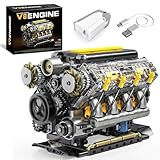
- 【Classic V8 Engine Model】This meticulously detailed model kit faithfully replicates a classic 8-cylinder car engine. It features moving pistons, a functional valve train, a turbocharger, and an exhaust system, dynamically demonstrating the complex inner workings and fundamental principles of a real internal combustion engine. A must-have for mechanical enthusiasts and model collectors
- 【Simulate Real Operation】Say goodbye to the battery! This V8 engine model is powered by a two-speed USB rechargeable motor. It simulates the real engine functions, allowing you to watch the roar of the engine fan rotating and the rhythmic movement mechanism of the pistons, providing any car enthusiast or collector with a more environmentally friendly and relaxed immersive experience
- 【High-Quality Durable Kit】The BseSparklion V8 engine model kit is meticulously crafted from high-quality materials and consists of 905 pieces. These kits are seamlessly assembled together to achieve a satisfactory and beneficial building experience, ensuring that your carefully assembled model is both robust and durable, demonstrating the excellence of the car
- 【 Excellent STEM Educational Toy 】 This V8 engine is an excellent educational toy for teenagers aged 8 and above. It enhances creativity, improves hands-on skills and develops problem-solving abilities through assembly and debugging. It is very suitable for STEM classrooms, technology clubs or as a challenging family project
- 【Ultimate Gift for Car Enthusiasts】 Our V8 engine model is the ultimate gift for any occasion. Whether you are a die-hard car enthusiast, a model lover, or someone who appreciates exquisite craftsmanship, this V8 engine kit is a must-have conversation starter that showcases your passion for mechanical engineering
Factory integration versus conversion risk
A factory supercharged V8 is calibrated, emissions-certified, cooled, and warrantied as a complete vehicle configuration. That does not make it maintenance-free, but the service information and parts support are usually integrated with the model. An aftermarket conversion adds installer quality, belt alignment, wiring, calibration, intercooler plumbing, fuel-system capacity, and warranty interpretation to the ownership equation. A poorly matched pulley or tune can increase heat and detonation risk even when the compressor itself is sound.
Reliability and heat: what to inspect
Do not treat “supercharged” or “naturally aspirated” as a reliability verdict. Additional cylinder pressure and charge temperature create more thermal and mechanical work, while the factory may compensate with stronger components, better cooling, and conservative torque management. An NA engine has fewer boost-specific components but can still suffer from cooling, lubrication, valvetrain, or calibration problems.
For a used supercharged vehicle or conversion, inspect:
- Service records showing correct fuel, oil, filter, plug, and belt intervals.
- Evidence of pulley changes, aftermarket calibration files, or repeated over-temperature events.
- Belt dust, cracking, misalignment, bearing noise, or oil leakage around the supercharger.
- Intercooler-pump operation, coolant condition, and signs of heat-soak-related power reduction where the design uses charge cooling.
- Cold-start behavior, idle quality, diagnostic codes, knock-retard history if available, and compression or leak-down results when warranted.
- Warranty language covering the compressor, calibration, engine, transmission, and emissions equipment.
A clean inspection cannot guarantee future repair cost, but it can reveal whether the vehicle has been maintained as an engineered system rather than driven as a series of maximum-boost runs.
Ownership cost: build the comparison instead of guessing a dollar average
No matched lifetime-cost study establishes a single average cost for otherwise equivalent supercharged and naturally aspirated V8 vehicles. Any precise dollar figure would depend on the exact model year, trim, mileage, fuel prices, insurance market, labor rates, warranty, and repair history. Use a vehicle-specific worksheet with these categories:
Best Value

- EXPOSED DOHC V8 ARCHITECTURE: This model presents a V8 layout with two angled cylinder banks, four exposed overhead camshafts, dual timing-chain drives, a central intake section, and outward-facing exhaust headers. The open arrangement makes the major mechanical structures easy to identify before and during operation.
- PRECISION METAL CONSTRUCTION: Built from precision-cast and machined components in anodized aluminum and stainless steel. Defined surfaces, exposed fasteners, timing assemblies, and front pulleys reflect key structures found in modern V8 engine architecture while giving the completed model a detailed industrial finish.
- 500+ COMPONENT ASSEMBLY: Build the model from more than 500 labeled components, including precision metal parts, screws, and assembly hardware. Custom foam trays help organize and protect the parts, while the included tool set and full-color manual guide the approximately five-hour assembly process.
- MOTORIZED FOUR-STROKE MOTION: An electric motor concealed inside the starter housing drives the crankshaft, connecting rods, pistons, and valvetrain through a four-stroke mechanical sequence. Viewing openings reveal the internal movement, while the exposed camshafts, timing chains, and belt-driven pulleys show how motion is transferred across the assembled engine.
- MECHANICAL DISPLAY FOR HOME OR OFFICE: Measuring approximately 7.80 × 6.69 × 7.09 inches when assembled, the DM118 combines visible mechanical motion with detailed metal construction. Intended for ages 14 and above, it is suited to model builders, automotive enthusiasts, engineering fans, and hobbyists for display in a home, office, study, studio, or workshop. A metal gift box is included.
| Cost category | Questions to answer | Evidence to request |
|---|---|---|
| Acquisition or conversion | Is the supercharger factory-installed, dealer-installed, or an aftermarket conversion? What hardware and calibration are included? | Window sticker, invoice, kit part number, installation record, and calibration documentation. |
| Fuel | What octane is required, and what economy is recorded for the same driving pattern? | Owner’s manual, manufacturer specification, and consistent fuel logs. |
| Routine service | Are there separate supercharger-oil, plug, filter, belt, or charge-cooler intervals? | Current service schedule and kit instructions. |
| Warranty | Which parts remain covered after a conversion or tune? | Written factory and installer warranty terms. |
| Labor | Can ordinary shops service the system, or will specialist diagnostic and calibration time be needed? | Local labor quotes and the installer’s support policy. |
| Repair exposure | What are the compressor, intercooler, belt-drive, fuel-system, and engine repair provisions? | Documented repair history and parts availability for the exact application. |
| Insurance and registration | Does the power increase or modification change premiums, inspection, or emissions compliance? | Insurer and local authority confirmation before purchase. |
For a factory vehicle, compare the manufacturer’s schedule and warranty for the exact VIN or trim. For a conversion, add the cost of professional installation and periodic specialist diagnosis even if the kit price appears attractive. A lower purchase price can be offset by fuel-grade requirements, shortened plug or belt intervals, or loss of factory warranty coverage.
How to choose between the two layouts
Choose a supercharged V8 when these priorities dominate
- You want substantially more torque and power from a given displacement and accept the associated fuel, heat, and hardware demands.
- You value strong low-speed boost response relative to a turbocharged setup, while understanding that response is still calibration- and vehicle-dependent.
- You are buying a factory-engineered package or have access to a documented installer, correct calibration, and appropriate cooling and fuel support.
- You are prepared to use the required octane and follow additional belt, plug, filter, and supercharger-oil service where specified.
Choose a naturally aspirated V8 when these priorities dominate
- You prefer a linear torque build and a simpler intake and drive system.
- Your driving is mostly light-load commuting and you do not need the extra output of forced induction.
- You want to minimize conversion-specific warranty, calibration, and specialist-labor questions.
- You have found a particular NA vehicle with better mass, gearing, traction, condition, or documented maintenance than the available supercharged alternative.
If you are considering modifying an NA V8
- Identify the engine’s compression ratio, rods, pistons, cooling system, fuel-system capacity, and transmission torque limit.
- Select a complete, application-specific kit rather than mixing a compressor, injectors, pulley, intercooler, and calibration from unrelated systems.
- Confirm the required fuel grade and emissions or inspection status before installation.
- Obtain written warranty terms from both the vehicle manufacturer and installer.
- Set a maintenance log for supercharger oil, engine oil, air filter, spark plugs, belts, and any charge-cooler service.
- Have the finished system checked for belt alignment, leaks, safe air-fuel ratio, ignition control, and abnormal knock under load.
A practical test-drive and comparison checklist
When two real vehicles are available, use the same route and conditions rather than relying on a badge. Perform the following checks:
- Start both engines cold and note idle stability, warning lights, belt noise, and coolant or oil odors.
- Drive gently at low rpm to judge pedal linearity and transmission behavior before using heavy throttle.
- Repeat a roll-on in the same gear and speed, recording whether torque arrives smoothly or in a noticeable step.
- Observe traction-control intervention and wheelspin; a power number that cannot reach the road is not useful acceleration.
- After a fully warmed drive, check for heat-soak symptoms, reduced output, unusual odors, or cooling-fan behavior.
- Review service records against the exact factory or kit intervals, including fuel grade and any pulley or calibration changes.
- Price insurance, fuel, specialist labor, and warranty exposure for the specific vehicle before treating a lower purchase price as a lower ownership cost.
What the technical literature says about paired V8 designs
SAE’s paper on the Jaguar AJ-V8 family describes both naturally aspirated and supercharged derivatives, but the abstract does not provide a directly comparable output table or a controlled same-vehicle test. It says of the naturally aspirated derivative: “The naturally aspirated derivative employs both two stage inlet valve lift control and two stage inlet manifold tuning to provide excellent low speed torque.” The same abstract describes the supercharged derivative as follows: “The supercharged derivative uses Twin Vortex supercharging technology in combination with the optimized high pressure die cast, deep skirt block structure to deliver a class leading balance of performance and refinement.” These are the manufacturer-authored engineering descriptions in the 2009 SAE AJV8 paper, not independent consumer-test conclusions.
Do these 3 things before closing this tab:
1Repair Windows errors before they cause bigger problems2Fix the driver behind crashes, sound loss and screen glitches3Clear out junk files and repair common Windows errorsThe significance is methodological: even within one V8 family, the derivatives can use different airflow, structural, and calibration solutions. A fair comparison must therefore examine the actual engine and vehicle specifications, not assume that the compressor alone explains every difference.
Bottom line for buyers and modifiers
A supercharged V8 is the better fit when its extra torque and power justify premium fuel, additional hardware, heat management, and application-specific service. An NA V8 is the better fit when linear response, simpler ownership, or a particular vehicle’s lower mass and better condition matter more than peak output. There is no evidence-based universal fuel-economy percentage, repair-cost average, or response winner that applies to every pair. Compare the exact vehicles, require complete service and warranty records, and treat any conversion as a whole-engineering project rather than a compressor purchase.
Quick Recap
Product prices and availability are accurate as of the date/time indicated and are subject to change. Any price and availability information displayed on Amazon at the time of purchase will apply.