Some links on this page are affiliate links: if you buy through them we may earn a commission, at no extra cost to you.
A Kawasaki Z300 is relatively inexpensive to fuel, but its real annual cost depends on where it is registered, how far it is ridden and whether a valve-clearance service falls due. Independent road reports put practical consumption at about 57–58.4 mpg, while Kawasaki’s 17-litre tank can deliver roughly 200 miles between fill-ups in one road report. Routine servicing is commonly described as every 3,750 miles or 12 months, with a substantially more expensive valve-clearance visit around 7,500 miles in one UK maintenance guide; another model listing gives 15,000 miles, so the owner’s market-specific manual must decide. Insurance, registration and taxes cannot be reduced to one global figure: 2026 Indian examples range from ₹358,441 to ₹369,167 on the road, while historical UK figures are not current quotations.
What does it cost to run a Kawasaki Z300?
Budget for five separate lines: fuel, scheduled labour, wear parts, insurance and registration or road tax. The Z300 is a 296 cm³ liquid-cooled parallel twin producing 39 PS and 27.0 N·m, with a 170 kg curb mass and 17-litre tank. Those specifications help explain why fuel use is usually manageable, but they do not determine your premium or annual tax.
As an Amazon Associate I earn from qualifying purchases.
Free tools Windows power users keep installed
One-click scans. No signup required.
- Fuel: use your planned mileage, a conservative real-world mpg figure and your local pump price.
- Servicing: allow for annual or mileage-based visits and reserve extra money for valve clearance when the interval arrives.
- Wear items: oil and air filters, spark plugs, brake pads, chain and sprockets, coolant and tyres are condition-dependent rather than included in every routine visit.
- Insurance: price is driven by country, postcode, rider profile, cover level, annual mileage and security arrangements.
- On-road charges: registration, road tax, compulsory insurance and dealer or documentation fees vary by jurisdiction.
A useful budget therefore has a predictable monthly amount plus a separate reserve for infrequent repairs and major services. Do not treat a low purchase price or a low fuel bill as the complete ownership cost.
What is the Kawasaki Z300’s real fuel economy?
Published road accounts support a planning range of about 57–58.4 mpg in ordinary use. Honest John reported 57 mpg and about 200 miles between fill-ups, while Visordown calculated 58.4 mpg from fuel receipts. Bennetts’ 2015–2018 model guide lists 66 mpg as a claimed average, and Honest John presents 70 mpg as an efficient-riding estimate rather than a normal promise.
Popular on Amazon

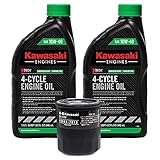
- New OEM Original Oil Filter
- Manufactured by Kawasaki for Kawasaki
- Item only fits specific models listed; The picture could be generic
- New OEM Kawasaki Filter Assembly Oil
| Figure | How it was presented | How to use it in a budget |
|---|---|---|
| 57 mpg | Honest John real-world report, 2015 | Conservative starting point for mixed riding |
| 58.4 mpg | Visordown calculation from fuel receipts, 2015 | Reasonable observed-use estimate |
| 66 mpg | Bennetts claimed average for 2015–2018 models | Optimistic planning case, not a guarantee |
| 70 mpg | Honest John efficient-riding estimate | Best-case sensitivity check only |
Throttle position, traffic, gearing, tyre pressures, luggage and maintenance can move consumption materially. For an annual fuel allowance, calculate planned miles ÷ assumed mpg × local price per gallon. Run the calculation at both 57 mpg and your optimistic figure, and use the higher-cost result for cash-flow planning. Keep the fuel-price unit consistent with the mpg unit quoted by your source; do not silently mix imperial and US gallons.
The 17-litre tank gives useful range, but range is not the same as an exact refill interval. Honest John’s approximately 200-mile observation is a practical reference, not a fixed distance for every rider. Commuters in stop-start traffic should expect fewer miles per tank than a rider travelling steadily on open roads.
Recommended Free Tools
How often does a Kawasaki Z300 need servicing?
The commonly cited rhythm is every 3,750 miles or 12 months, whichever comes first. Bennetts describes a larger valve-clearance service at about 7,500 miles, while a separate 2016 model listing states 15,000 miles for valve clearance. This difference is a warning to verify the schedule for the motorcycle’s exact year and market rather than copying an interval from another country.
| Maintenance reference | Interval or timing | Qualification |
|---|---|---|
| Routine service | 3,750 miles or 12 months | Commonly cited by Bennetts and a model listing |
| Valve-clearance check | About 7,500 miles in Bennetts’ guide | Indicative UK guidance for the covered model range |
| Valve-clearance check | 15,000 miles in a 2016 listing | Shows that year and market schedules differ |
| Kawasaki Thailand package visits | 1,000, 6,000, 12,000, 18,000 and 24,000 km | 2025 package schedule; not a universal replacement for your manual |
Kawasaki’s warranty guidance says servicing should be performed by an authorised dealer according to the schedules in the owner’s manual. That manual is the controlling document for the motorcycle’s market, model year and specification. Keep invoices and date-and-mileage records, particularly if a warranty, resale inspection or insurance claim could depend on maintenance history.
Also popular on Amazon

- 【Applicable Models】: Replacement for Kawasaki for Ninja 300 400 500 650 750 1000 ZX-4R ZX-4RR ZX-6R ZX-7R ZX-7RR ZX-9R ZX-10R ZX-10RR ZX-14R Z300 Z400 Z500 Z750 Z800 Z1000 Z1000 SX. Please Refer the Product Description.
- 【Applicable Models】: Replacement for Kawasaki for Versys-X 300 500 for Versys 650 for Eliminator 450 W800 for Vulcan-S 650 for Vulcan 500 750 800 900 1500 1600 1700 2000. Please Refer the Product Description.
- 【Replacement Part Number】:Fit for Kawasaki 16097-0008, 16097-0011, 16097-1059, 16097-1061, 16097-1063, 16097-1064, 16097-1066, 16097-1067.
- 【Product Features】: The Oil Filter Material Made by Mixing Fibers and Resin can Capture more than 90% of Dirt Particles that may be Harmful to Engine Wear,Achieving Higher Capacity and Better Filtration Effect. Use Rubber Coated Safety Valves to Achieve Sealing and Compatibility with Most Types of Oil;
- 【Packaging List】: 2 Pcs External Engine Oil Filters.
What do Z300 servicing and wear items cost?
Bennetts describes a small UK service as costing under £100 and the approximately 7,500-mile valve-clearance service as about £400. These are indicative workshop figures, not guaranteed prices: labour rates, parts availability, VAT, seized fasteners and additional faults can all change the invoice.
Routine visit
A routine visit normally covers the checks and replacements specified for that interval. Ask the workshop to separate scheduled work from advisories so you can see what is mandatory now and what can safely be planned for a later date.
Valve-clearance visit
Valve inspection requires substantially more labour than an oil change. It may be due at 7,500 or 15,000 miles depending on the applicable schedule, so a rider covering 1,000 miles a year may encounter it by time or age before reaching the mileage shown in another market’s guide.
Condition-based replacements
Kawasaki’s Thailand service-package document identifies engine oil, oil filters, spark plugs, air-cleaner elements, brake pads, chain and sprocket sets, coolant and related items as additional or condition-based replacements. They should be held in a separate reserve because they do not all occur at every scheduled visit. A neglected chain, contaminated brake fluid or worn tyres can turn a routine appointment into an unexpectedly large bill.
Also popular on Amazon

- Will Fit select Kawasaki 22-24 HP engines, 2009 and later models
- Replaces Kawasaki 49065-7007
- Replaces Kawasaki 49065-7007
When requesting estimates, provide the model year, mileage, service history and any warning symptoms. Ask whether the quoted price includes parts, consumables, disposal fees and tax, and whether valve clearances are measured and recorded or merely listed as a recommendation.
How much is Kawasaki Z300 insurance?
There is no meaningful worldwide average premium. A defensible quote requires at least the country and postcode, rider age, licence history, claims and convictions, annual mileage, overnight security, declared use and the chosen cover level. Comprehensive, third-party-fire-and-theft and third-party-only policies can differ by much more than a small change in fuel consumption.
Do these 3 things before closing this tab:
1Scan for outdated or missing drivers - takes under a minute2Repair Windows errors before they cause bigger problems3Fix the driver behind crashes, sound loss and screen glitchesTwo 2026 Indian calculators illustrate the geographic effect without acting as universal prices:
| Location and source | Indicative on-road total | Insurance component | Registration or road-tax component |
|---|---|---|---|
| Chandigarh estimate | ₹358,441 | ₹21,221 | ₹10,220 RTO/road tax |
| Dehradun estimate | ₹369,167 | ₹14,507 | ₹30,660 RTO charges |
The Chandigarh page says actual prices can vary by 3–8% with dealer offers and city updates; the Dehradun figure is labelled indicative. They demonstrate how insurance and registration are bundled differently, not what every Indian Z300 owner will pay. Obtain quotes using the same declared mileage and coverage so that the comparison is valid.
Also popular on Amazon

- Official Kawasaki Product.
- Part Number: 49065-0724 (replaces 49065-7010) Oil Filter
- High Quality Factory Filter
- OEM Filter
- See Description for model fit chart.
For historical UK context only, Honest John listed a £42 VED figure and a £4,349 price, while Visordown listed £4,359 plus on-road charges in 2015. Those period figures should not be used as current purchase prices, tax rates or insurance quotes.
What are the Kawasaki Z300’s on-road costs?
“On-road” usually combines the motorcycle’s selling price with registration, road tax or RTO charges, insurance and documentation or handling fees. The bundle differs by country and sometimes by city, so request an itemised quotation rather than comparing only the headline total.
| Cost element | Why it varies | What to verify |
|---|---|---|
| Registration/RTO | State, city, engine category and tax rules | Whether lifetime or recurring charges are included |
| Insurance | Rider risk, postcode, cover and declared use | Policy limits, deductibles and add-ons |
| Dealer/document fees | Dealer policy and current offers | Exact fee names and whether they are optional |
| Road tax or VED | National rules and vehicle classification | Current rate for the registration year |
Use the two Indian estimates above only as examples of structure. A UK, Australian, European or North American owner must substitute the local registration and tax rules; the figures do not transfer across borders.
Independent reader supportYour contribution helps us test, update, and keep practical guides available for everyone.How do I build a personal Z300 annual budget?
- Set annual mileage. Use commuting, weekend trips and planned touring rather than a round number chosen after the calculation.
- Choose two fuel assumptions. Use roughly 57–58.4 mpg as the practical range and keep 66 mpg as an optimistic comparison, not the core promise.
- Price scheduled labour locally. Ask for the routine-service price and separately ask when the next valve-clearance inspection is due under your manual.
- Add a wear reserve. Include oil and air filters, spark plugs, brake pads, chain and sprockets, coolant and tyres according to their condition and age.
- Obtain insurance quotes with fixed inputs. Keep cover type, mileage, security and rider details identical when comparing insurers.
- List recurring legal charges. Add registration renewal, road tax, inspection fees and breakdown cover where applicable.
- Separate one-time and annual costs. A purchase transfer or initial registration should not be mistaken for a recurring running cost, while a major service should be spread into a reserve before it arrives.
A spreadsheet with one row per cost and columns for “expected,” “high case” and “due date” makes the result more useful than a single annual headline. The high case should use lower mpg, the next valve service and a realistic wear-item replacement, not an arbitrary contingency percentage.
Also popular on Amazon
Which riders face the highest ownership cost?
| Rider pattern | Main cost pressure | Budget response |
|---|---|---|
| Low-mileage, occasional use | Insurance, registration and age-related consumables dominate | Do not omit annual service requirements merely because mileage is low |
| Daily urban commuter | Lower fuel economy, frequent chain and brake wear, more traffic exposure | Use the conservative mpg case and inspect wear items often |
| Long-distance rider | Fuel volume and mileage-triggered services arrive sooner | Reserve for the valve check and schedule maintenance before trips |
| New or higher-risk rider | Insurance can outweigh fuel and routine servicing | Quote several coverage levels while preserving essential protection |
The same motorcycle can therefore produce very different annual totals. Mileage changes fuel and service frequency, while location and rider profile can dominate insurance and on-road charges.
What mistakes make a Z300 budget inaccurate?
- Using the brochure or claimed mpg as a promise: 66–70 mpg belongs in an optimistic scenario; observed reports are closer to 57–58.4 mpg.
- Ignoring the valve-clearance interval: a £400 indicative UK figure is a materially different reserve from a sub-£100 small service.
- Assuming one country’s schedule applies everywhere: the 7,500-mile and 15,000-mile references show why the manual for your market matters.
- Bundling wear parts into “servicing”: filters, pads, chain and sprockets may be due between scheduled visits.
- Comparing on-road totals without itemisation: different insurance and RTO components can make two totals look inconsistent when each includes different charges.
- Forgetting time-based maintenance: a 12-month service can be due before a low-mileage rider reaches the mileage threshold.
Is the Kawasaki Z300 affordable to own?
It can be, especially for a rider who keeps mileage moderate and receives the practical fuel economy reported by road sources. The budget becomes less predictable when a valve-clearance service, tyres or a chain-and-sprocket replacement coincides with renewal of insurance and registration. Build the plan around conservative fuel use, the exact manual schedule and local quotes rather than relying on a single claimed mpg or an imported on-road price.
The Tool Desk
Outbyte PC Repair FREERepair Windows errors before they cause bigger problemsFix Now →Outbyte Driver Updater FREEScan for outdated or missing drivers - takes under a minuteDriver Scan →Frequently Asked Questions
Can I budget fuel using the Z300’s 66 mpg claimed average?
Use 66 mpg only as an optimistic comparison. The road reports cited for the motorcycle are about 57–58.4 mpg, so basing your cash reserve on that lower range reduces the risk of coming up short in traffic or winter conditions.
Why do some Z300 schedules list valve checks at 7,500 miles and others at 15,000?
Maintenance intervals can change with model year, market and the specific schedule used by a listing. Check the owner’s manual and, if necessary, confirm the chassis and market specification with a Kawasaki dealer before postponing the inspection.
Does riding fewer miles always make Z300 ownership cheaper?
Lower mileage usually reduces fuel and mileage-triggered wear, but insurance, registration and time-based servicing still apply. Long periods parked can also make battery, tyre and fluid condition more important than the odometer alone.
Should a chain and sprocket kit be replaced as separate parts?
They are commonly treated as a set because worn sprockets accelerate chain wear. Confirm model year, chain specification and tooth count before ordering; an apparently compatible kit can have the wrong gearing or fitment.
Crashes, No Sound, or Screen Glitches?
Random freezes, missing sound and display glitches usually trace back to one bad driver. Find and replace yours safely.Free scan · under a minutePC Slower Than It Used to Be?
A free scan shows the junk files, broken settings and background clutter dragging Windows down - then fixes them in one click.Free scan · Windows 10 & 11Are the Indian on-road estimates suitable for another city or country?
No. The Chandigarh and Dehradun figures are 2026 illustrative estimates with different insurance and registration components. Obtain a local itemised quote using your own address, rider details and current tax rules.




