Yes, a Ford Model A can handle carefully chosen dirt roads, gravel lanes and smooth two-track trails, but it must be treated as a vintage road car rather than a modern four-wheel-drive vehicle. Prepare it for low-speed travel, inspect every system that controls direction or stopping, and turn around before mud, water, ruts or slopes exceed the car’s condition and equipment.
The safest approach is a repeatable process: establish the car’s mechanical baseline, check tires and wheels, steering and springs, brakes, clutch, fluids, cooling and six-volt electrical connections, then choose a route with firm surfaces and nearby recovery options. Carry tools and communication equipment, drive in a low gear with gentle inputs, and inspect the car again as soon as you return.
As an Amazon Associate I earn from qualifying purchases.
What “off-road” should mean for a Model A
For a Model A, occasional off-road driving should mean a maintained dirt road, firm gravel, a mown field track or a lightly rutted two-track route. These surfaces can be suitable when they are dry enough to support the car and when you have checked the route in advance. The objective is access and enjoyment at walking or moderate road speed, not trail competition.
What’s actually slowing this PC down?
Pick the symptom - the matching free tool is one click away.
The car’s design sets the boundaries. Its water-cooled 3.3-liter (200.5-cubic-inch) inline four is rated at approximately 40 horsepower and feeds through a gravity carburetor. A three-speed sliding-gear transmission has no synchronizers, so gear changes require deliberate timing. The six-volt, positive-ground electrical system is dependable when maintained but less tolerant of poor connections than a modern charging system. Together, these characteristics favor planning, low engine and road speeds, and selecting the correct gear before a hill rather than trying to recover momentum halfway up it.
#1 Best Overall

- Never Let a Dead Battery Ruin Your Drive. The LISEN 4 in 1 Retractable Car Charger delivers reliable power for your entire journey. Compatible with standard 12V cigarette lighter sockets, it keeps phones, tablets, and devices charged during daily commutes, road trips, and long drives — the perfect practical gift for dads, truck drivers, and anyone who lives on the road.
- Daily Driver Essential: Always Ready When You Need It. Featuring two retractable cables ( USB C & Old iPhone Charging Cable ) that extend up to 31.5 inches and dual USB ports, this charger solves cable clutter while charging up to 4 devices simultaneously. Ideal for busy fathers, commuters, and families who want a tidy car and never worry about low battery again.
- Deliver full-speed PD fast charging for iPhone 18 Pro Max & iPhone 18 Pro Max & iPhone 18 Pro right inside your car. The built-in 45W PD USB-C port hits the peak charging speed for these latest iPhone models, juicing up your phone to 50% power in just 15 minutes while you drive.(Note: Maximum 45W PD output is available under 24V vehicle power supply. When used with standard 12V car sockets, the peak output is limited to 36W.)
- Standard 12V Power Solution: Designed as a dedicated USB power supply for charging devices. Note: Does NOT support CarPlay, Bluetooth, or data transfer. Compatible with most phones, tablets, and small electronics. This retractable charger is a core car organization tool, keeping your vehicle tidy. Not compatible with Micro-USB devices.
- Clutter-Free Tech Organization: Featuring dual USB ports and retractable cables, the LISEN 4 in 1 charger provides a clean car storage solution. Perfect for truck enthusiasts or as a thoughtful gift for drivers, it supports fast USB-C charging for devices like the iPhone 18Pro & iPhone 18 ProMax. Keep your vehicle organized while ensuring efficient power delivery for all your tech on the road.
- Choose firm ground with room to turn around and a route that another vehicle can reach.
- Walk unknown sections first, especially washouts, deep ruts, water crossings and side slopes.
- Stop whenever steering play, brake performance, tire condition, engine temperature or ground clearance becomes uncertain.
- Do not use a Model A’s ability to move across a lawn or gravel driveway as evidence that it can safely negotiate a modern four-wheel-drive trail.
No single slope angle, water depth, payload or ground-clearance number applies to every Model A. Body styles, axle and wheel combinations, tire sizes, spring condition and later modifications differ substantially. Use the car’s actual condition and the route’s consequences as your limits.
Establish the car’s baseline
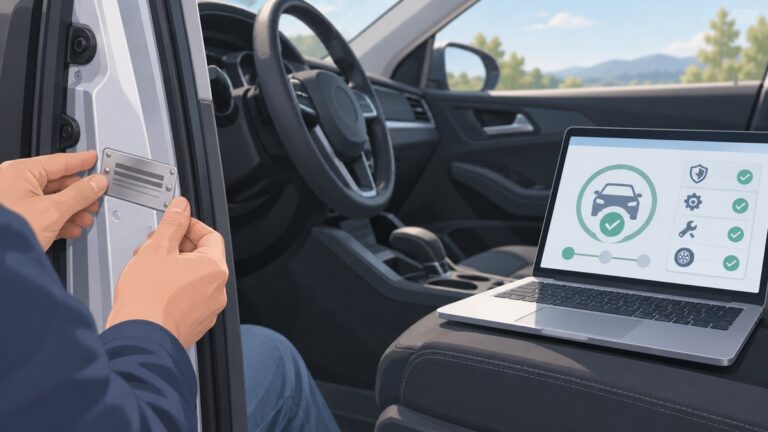
Before changing anything, document what you have. A Model A that is original, recently rebuilt or fitted with replacement brakes and shocks needs a different inspection emphasis from a parade car that has accumulated years of deferred maintenance. Record the following in a notebook or on your phone, and photograph existing leaks, damaged paint, loose fasteners and wiring repairs. Those images give you a reference after the outing.
| Baseline item | Record before the trip | Why it matters off pavement |
|---|---|---|
| Body and model year | Body style, approximate load and any body repairs | Weight distribution and body clearance vary; sheet metal is not a recovery point. |
| Axles and wheels | Axle type, wheel size, tire size and tube or tubeless construction | These determine pressure, spare parts and the amount of sidewall protection available. |
| Non-original components | Brakes, shocks, springs, steering parts, radiator, fan or electrical conversions | Replacement components may have their own adjustment and service specifications. |
| Recent work | Date and details of repairs, lubrication and fluid changes | Fresh work can reveal loose fasteners or bedding-in issues during the first rough-road trip. |
| Known symptoms | Existing drips, noises, vibration, temperature behavior and charging indication | A post-drive check is useful only when you know what was already present. |
Complete the pre-trip inspection
Tires, tubes and wheels
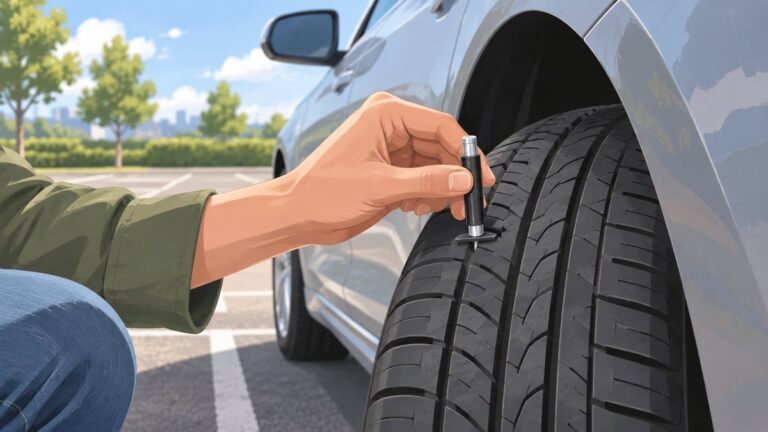
Start with cold tires. Examine tread for exposed fabric, embedded stones, cracking or uneven wear. Inspect both sidewalls and the area around each valve stem; old tubes can fail even when the tread looks healthy. Look for rim damage, missing valve caps and wheel nuts that do not seat correctly. Spin each wheel if it is safely raised and feel for bearing roughness or excessive movement.
The 1928 Ford Model A Instruction Book states: “Keep both front and rear tires inflated to 35 lbs. and check the pressure once a week.” The same tire-care guidance warns that a partially inflated tire can bend its sidewalls and suffer rim cutting, and it says never to run on a flat tire. Treat that figure as period guidance, not an automatic setting for every surviving car. Many Model As now use replacement tires, different tube materials or wheels assembled by a later builder. The pressure printed by the tire manufacturer and specified by the wheel-and-tire builder controls for the equipment actually fitted.
Measure with a reliable gauge before loading the car and again after the tires have cooled. Write the readings down so a slow leak is visible. Carry a usable spare or a correctly sized tube, a means of removing the wheel, and the tools needed to inflate it. A spare that is dry-rotted or has the wrong valve stem is not a recovery plan.
Rank #2

- High Quality Material: The coaster is made of environmentally friendly silicone, safe, non-toxic and odorless. Soft with toughness, easily embedded in the cup holder. Very durable, wear-resistant, long service life. High temperature resistance, can withstand 100 ℃ high temperature water cups.
- Wide Compatibility: The coaster has a diameter of 3.15 inches and a height of 1.18 inches, which is widely used in most vehicles, such as SUV, sedan, MPV, etc., as long as the size fits your car cup holder.
- Protection Function: Our car cup holder coaster has a carry handle design and a stand-up ring edge on its edge to effectively prevent food crumbs, drinks and water from leaking out and preventing the car cup holder from getting dirty.Meanwhile,Thickened design effectively prevents the cup holder from being scratched by the cup when driving on bumpy roads and eliminates the annoying thumping sound, making your journey more enjoyable.
- Easy to Use and Clean: With embedded installation, you just need to put it flat on the car cupholder. It is also very quick to remove, there is a small bump on the coaster, pinch it and you can easily remove the coaster. It is very easy to clean, rinse with water or wipe with a wet towel (be careful not to clean with sharp tools).
- 100% Satisfaction: Our products have quality assurance, if you have questions or are not satisfied after receiving the product, don't worry, please contact us as soon as possible, we provide after-sales service.
Steering, suspension and springs
Check the steering wheel for excessive free play, then inspect the drag link, steering gear and universal joint for looseness, damaged threads or missing cotter pins. Have an assistant move the steering wheel slightly while you watch each joint; movement at the wheel before the linkage responds is a warning, not a minor vintage-car characteristic.
Inspect the front and rear main leaf springs for cracked or shifted leaves. Examine spring shackles and U-bolts for movement, stretched threads, missing retainers or shiny marks where parts have been rubbing. Check shock absorbers for leaks and verify that their fluid level and lubrication match the component maker’s instructions. A wheel bearing should turn smoothly without a gritty feel; play that seems tolerable on a parade route can let a wheel steer itself when it drops into a rut.
The Tool Desk
Outbyte PC Repair FREEClear out junk files and repair common Windows errorsFree Scan →Outbyte Driver Updater FREEScan for outdated or missing drivers - takes under a minuteDriver Scan →Service brakes and parking brake
The Model A uses four internal-expanding service brakes, one at each wheel. It also has a separate emergency or parking-brake system acting on the rear wheels. Both systems must work: the emergency brake is not a substitute for properly adjusted service brakes.
Inspect drums, linings, return springs, rods and clevises. Brake linings and drums must be dry and free of grease, gear oil and water contamination. Verify that the pedal feels firm, that the car stops without pulling to one side and that the brakes release fully after a short test. On a safe incline, apply the parking brake and confirm that it holds the stationary car before you leave pavement. Any dragging wheel, uneven pull, soft pedal or uncertain holding ability requires repair and adjustment before an off-road trip.
Clutch, transmission and driveline
Check clutch free play and confirm that the pedal returns smoothly. Because the sliding-gear transmission has no synchronizers, practice selecting first, second and reverse while stationary and use a deliberate double-clutch technique if that is how your car is set up. A gear that jumps out under load, a clutch that slips or a shifter that refuses to engage is a mechanical fault, not a technique challenge.
Rank #3

- ✅【Designed for Magsafe】 - The most fashionable iphone car mount in 2026 Magsafe is designed for iPhone 18 Pro Max/17/16/15/14/13/12 Pro Max Mini and official Magsafe cases and other magnetic phone cases and can be fixed directly to these phones without the need to affix metal plates. All Android Phones Will Work: Metal rings are provided; they fit cases and other phones without magsafe. Based on Unique Grandmaster Design (Protected by US Design Patent No. US D1,112,194 S)
- ✅【STRONG MAGNETIC MagSafe Car Mount】 - This powerful magnetic phone holder can create a powerful attraction that firmly supports your device while allowing you to drive without distraction. it easily and securely holds your phone through bumps, sharp turns or even sudden stops, no worrying of dropping your phone.
- ✅【SUPER STICK FORCE】 - VHB Dash Mounted Holders adhesive provides strong stick force between the dashboard and the car phone holder, which can firmly stick to any plane in the car, fix your device, adapt to a variety of road conditions such as sudden braking, speed bump, and rugged mountain road.
- ✅【SAFE DRIVING VIEW】 - Mini-size, not taking up space, it is placed in the dashboard without blocking the view at all, and does not need to look down at the device to ensure your safe driving. Cell Phone Car Mount is suitable for most cars, pickups, SUV, taxi; It is the best assistant for Uber and Lyft drivers
- ✅【360° FREE ROTATION】 - With an adjustable swivel ball joint, you can rotate your smartphone or device at your own will, providing the best viewing angle. Quickly pick and place with one hand, free your hands and make calls and GPS navigation more convenient
Inspect the driveshaft, universal joints and differential for loose fasteners and leaks. Confirm lubricant levels in the transmission, differential and steering gear using the correct period or replacement lubricant for your components. Do not assume that a modern fluid is compatible with original bushings or seals.
Quick wins for a faster PC:
Scan for outdated or missing drivers - takes under a minuteDriver Scan →Clear out junk files and repair common Windows errorsFree Scan →Fix the driver behind crashes, sound loss and screen glitchesFind Drivers →Engine oil, fuel and lubrication
Check the engine oil level on level ground and inspect for fresh leaks around the pan, drain plug, valve cover and rear of the engine. A Ford Model A engine reference lists a five-quart oil capacity and a historically cited 500-mile oil-change interval. Those figures are useful historical context, but the rebuild, bearing clearances, oil type, filter arrangement and service history of an individual engine should determine its maintenance schedule. Keep a written record rather than relying on an interval copied from an unrestored car.
Clean the air cleaner and inspect the fuel sediment bowl and carburetor screen for rust or water. Verify that fuel lines are supported and dry at every connection. Lubricate the generator, distributor and other points called for by your car’s maintenance instructions. Over-lubrication can be as harmful as neglect when grease reaches brake linings or attracts abrasive grit.
Cooling system
Inspect the radiator core for blocked passages, mud and bent fins. Check the fan belt for correct tension and cracking, and examine the fan, water-pump bearings, hoses and clamps. Look for dried coolant traces that indicate a small leak. The cooling system is simple, but a restricted radiator or slipping belt can turn a gentle climb into an overheating stop.
Confirm the radiator is filled to the level appropriate for your radiator design; do not fill a hot system abruptly. Carry water suitable for an emergency top-up, but treat that as a way to reach a safe stopping point, not as a replacement for repairing a leak or flushing a contaminated system. If temperature rises unexpectedly, stop, allow the engine to cool and find the cause before continuing.
Do these 3 things before closing this tab:
1Clear out junk files and repair common Windows errors2Fix the driver behind crashes, sound loss and screen glitches3Repair Windows errors before they cause bigger problemsRank #4

- Buyer's Guide: The seat guard for car seat between seat & console measures 15.75*2.7*1.53", suitable for gaps of 1.43-1.53" in width, please double-check carefully the distance between your seat and the center console before placing an order
- Storage and Filling in One: Differ from traditional single-function gap fillers, gap filler for car incorporates storage function, offers you the convenience of storing phones and various other items, so that you can access them at any time while driving
- Avoid Items Slipping: With the bumps and vibrations of the car, phones, keys may fall into the seat crevices, which is difficult to pick up, and distracts the driver's attention. Car gap seat filler fills gaps seamlessly to create an effective barrier
- Easy to Install: Car side seat gap filler is easy to install, simply insert it into the gap between the seat and the center console, gap seat filler for car can fit tightly without affecting the normal adjustment of the seat and the use of the seat belt
- Premium Material: Crafted from premium EVA material, our car seat side gap filler boasts a combination of wear-resistant, softness&durability. Maintenance is effortless, simply rinse and wipe to quickly clean the dust and debris in corners and crevices
Six-volt electrical and visibility checks
Clean and tighten battery clamps, ground connections and the main electrical terminals. Confirm that the six-volt system is charging and that the ammeter behaves as expected when the engine speed changes. Inspect ignition wiring, distributor connections and generator leads for chafing or loose terminals. Positive-ground polarity matters when installing a replacement battery, accessory or jump lead; connect equipment according to the car’s actual wiring, not a generic negative-ground diagram.
Test headlamps, tail and stop lamps, the horn and any turn signals fitted to the car. Dirt roads can become dark unexpectedly under trees or weather, and a working horn is useful when visibility is limited by dust. Secure loose wires away from the exhaust and moving linkages.
Set tire pressure and load for the route
Pressure is a safety setting, not a traction shortcut. Lowering pressure without confirming the tire’s construction can bend the sidewall, unseat a bead or cut the tube against the rim. Begin with the tire maker’s specification for the exact size and load range, then account for the car’s load and the surface. If the fitted tire documentation is unavailable, obtain the builder’s recommendation before experimenting.
- Check all tires cold, including the spare, with the same gauge.
- Compare the reading with the specification printed on the tire or supplied by the wheel-and-tire builder.
- Inspect sidewall bulge and valve-stem position after loading passengers or luggage; an unusual change can indicate underinflation or a damaged tube.
- Recheck pressure after the drive when the tires are cool and record any change.
Keep luggage low and secured. Do not overload a rear-mounted rack or place loose tools where they can interfere with pedals, steering or brake rods. A passenger should know that sudden stops and side-to-side movement on a rut are possible in a vintage car without modern restraint systems.
Choose a route with condition-based limits
Walk or drive the route in another vehicle when possible. Check for recent rain, fallen branches, washouts, locked gates and a turnaround point. The most useful route decision is not a claimed maximum depth or angle; it is whether you can stop safely and recover the car if conditions worsen.
Best Value

- 🔰 UPGRADED SIDE STORAGE DESIGN - Our console cover is thinner than the old one, universal for all seasons. There is an 8.66*5.12 inch storage pocket design on each left and right side, expanding the storage space, convenient and practical. Meet the storage needs of the main passenger seat, you can store your cell phone, keys, tissues, ID and some other small daily items.
- 🔰 PREMIUM MICROFIBER LEATHER MATERIAL - This car center console cover is made of quality microfiber leather material, soft and skin-friendly touch. Exquisite and fashionable diamond shaped stitching, every detail is in place. Inside the car center console cover is made of thickened memory foam, even after squeezing, it can slowly recover to its original shape.
- 🔰 RELIEVE DRIVING FATIGUE - The arm rest cover for car adopts ergonomic design, giving just the right amount of arm support, effectively dispersing elbow pressure and relieving driving fatigue. Protect your car's center console from getting dirty or scratched. Especially suitable for long time driving or long distance traveling, bringing you a new experience of relaxation and comfort!
- 🔰 NON-DESTRUCTIVE INSTALLATION - This car console cover is designed with an elastic band for a firm fit and not easy to shake. And the back side is full of protruding dots, which can effectively avoid the armrest cover from slipping and shifting. All you need to do is to open the center console cover, put the elastic band directly into the cover and then close it.
- 🔰 BUYER'S GUIDE - You will receive a car armrest storage box with the size of 12.13*7.80 inch, please measure the size of your car's armrest storage box before you buy. We have prepared five simple and beautiful colors for you, you can choose according to your own preferences. Suitable for most of the vehicles on the market, such as car, truck, SUV, RV, van, etc.
| Route factor | Prefer | Turn around or avoid when |
|---|---|---|
| Surface and ruts | Firm dirt or gravel with shallow, rounded ruts | Ruts can lift a wheel, expose the axle or force the steering linkage against an edge. |
| Slopes and side slopes | Short, gradual grades with a level stopping area | The car leans enough to unload a wheel, slide sideways or prevent a controlled retreat. |
| Obstacles and clearance | Small, rounded bumps that can be straddled slowly | Sharp rocks, ledges or debris can strike the axle, rods, running gear, exhaust or oil pan. |
| Water and mud | Dry crossings whose bottom and exit you can see | Depth, soft bottom or the far bank is unknown; water can stop the engine or hide damage. |
| Remoteness | Cell coverage or a known check-in plan and vehicle access | A disabled car would require a long walk or a recovery vehicle that cannot reach it. |
| Temperature | Cool conditions with frequent places to stop | Heat, slow climbing and limited airflow combine with a marginal radiator or belt. |
| Support | A second vehicle on remote routes | You are alone, carrying no communication device or have no safe extraction point. |
Drive the Model A deliberately
- Start with a systems check. After warming the engine, test steering, service brakes and the parking brake at low speed on a firm surface. Confirm the ammeter and temperature behavior are normal.
- Select the gear before the obstacle. Use first gear for a slow climb, descent or rough section when needed. Avoid shifting halfway through a steep or loose section; the unsynchronized transmission makes a rushed change more likely to fail.
- Use smooth controls. Apply throttle gradually, keep both hands ready on the wheel and brake in a straight line before a rut or dip. Sudden steering or braking can unload a wheel and start a slide.
- Cross ruts at an angle only when it reduces the chance of grounding. Approach slowly, keep the wheels pointed where you intend to go and avoid placing one wheel on a high edge while the other drops deeply.
- Climb with momentum you can control. Build only enough speed to maintain steady movement. If the engine labors, stop before traction disappears, back down under control and choose another line.
- Descend under engine braking. Select a low gear before the crest, keep the car straight and use light, intermittent braking rather than holding the pedal continuously.
- Cross water only when the bottom and exit are known. Walk it first if safe. Avoid entering water that can reach the ignition, fan or electrical connections, and stop if the current or depth changes.
- Reassess frequently. Stop for rising temperature, a new vibration, steering pull, brake smell, loss of power or a tire that looks low. Continuing to a planned destination is never more important than a controlled retreat.
Carry recovery and emergency equipment
Pack for a puncture, a loose connection, a minor cooling problem and the possibility of waiting for help. Match every tool to the fasteners and wheel equipment actually on your car; a generic modern socket set may not fit original hardware.
| Item | Purpose and preparation |
|---|---|
| Tire-pressure gauge and inflation method | Verify pressure before and after the trip; include a pump or other way to add air. |
| Jack, wheel wrench and spare tire or tube | Use equipment that fits the axle, wheel nuts and tire construction; practice safely at home. |
| Hand tools and consumables | Carry wrenches, screwdrivers, pliers, cotter pins, wire, tape, fuses or bulbs used by your car, hose clamps and a flashlight. |
| Tow strap or rope | Select a rated strap suited to the car and identify strong attachment points; never attach to thin bumpers, steering parts or body sheet metal. |
| Water and basic fluids | Carry drinking water and separate water for an emergency radiator top-up, plus the correct engine oil if your trip is remote. |
| First-aid and fire equipment | Bring a first-aid kit and a charged automotive fire extinguisher mounted where it can be reached without tools. |
| Communication and navigation | Carry a charged phone or radio, offline maps, a flashlight and a written contact or check-in plan. |
| Cleaning materials | Use a brush, rag or low-pressure method to clear mud and plant material from the radiator and moving parts. |
On a remote route, travel with another vehicle and agree on hand signals, stopping points and how a tow will be organized. Do not pull from a spring, tie rod, axle steering arm or other part that was not designed for recovery loads.
Inspect and service the car after the outing
Perform the post-drive inspection while the route is still fresh in your mind. First check tire pressure, sidewalls, valve stems and wheel nuts. Look beneath the car for fresh oil, coolant or fuel, then examine the steering linkage, shackles, spring U-bolts, shock absorbers, brake rods and drums for mud, impact marks or looseness.
Windows Errors? Fix Them Before They Spread
Repair common Windows errors and clear accumulated junk for a smoother, more stable PC - no reinstall needed.Free scan · no reinstallOutdated Drivers Are Slowing You Down
One free scan finds every outdated or missing driver and matches the right update for your exact hardware.Free scan · exact hardware matchInspect the radiator, fan and belt for packed debris and look for bent fins. Check wiring and fuel lines where vibration or vegetation could have rubbed them. Scan the underside for rocks lodged near the exhaust, a bent guard, a dented pan or a new scrape that might become a leak. Listen for new wheel-bearing noise and note any change in temperature, charging behavior, clutch engagement or gear selection.
Remove mud, leaves and abrasive grit before storage. Dry components exposed to water, lubricate points specified for your car and correct loose fasteners before the next drive. Record the route, weather, tire pressures, problems found and repairs completed. That record turns occasional off-road use into a controlled maintenance program rather than a series of surprises.
Quick Recap
A practical go/no-go checklist
- Tires match their pressure specification, have sound sidewalls and include a usable spare or tube.
- Wheel nuts, bearings, steering joints, spring hardware and shocks show no unsafe play or damage.
- Service brakes stop evenly, drums and linings are dry, and the rear parking brake holds.
- Clutch free play, gear selection, transmission, differential and steering-gear lubricant levels are satisfactory.
- Radiator, belt, hoses, fan and water pump are sound, with no unexplained temperature rise.
- Battery, grounds, generator, distributor, lamps, horn and ignition wiring are secure and functional.
- The route has firm surfaces, a turnaround option, acceptable weather and a realistic recovery plan.
- Tools, communication equipment, water, fire extinguisher and first-aid supplies are aboard.
- Everyone understands the stop rules: a new mechanical symptom or uncertain obstacle ends the attempt.
Product prices and availability are accurate as of the date/time indicated and are subject to change. Any price and availability information displayed on Amazon at the time of purchase will apply.