Crashes, No Sound, or Screen Glitches?
Random freezes, missing sound and display glitches usually trace back to one bad driver. Find and replace yours safely.Free scan · under a minuteWindows Errors? Fix Them Before They Spread
Repair common Windows errors and clear accumulated junk for a smoother, more stable PC - no reinstall needed.Free scan · no reinstallSome links on this page are affiliate links: if you buy through them we may earn a commission, at no extra cost to you.
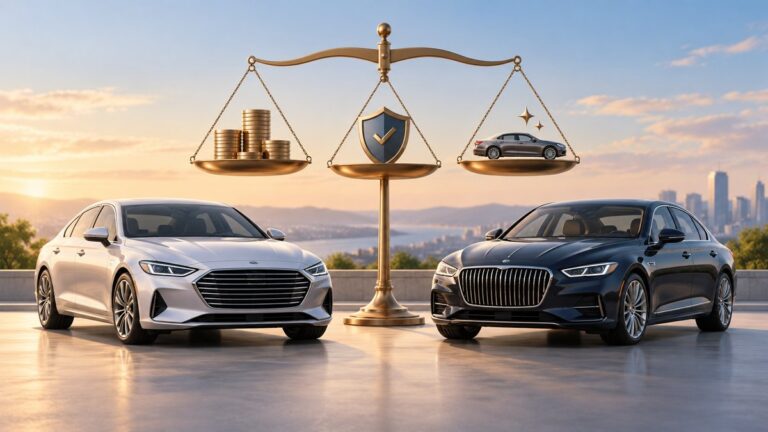
Choose the powertrain that fits your routes and charging or fueling routine, not the one with the most impressive headline specification. An electric luxury car is usually the better match when you can charge reliably at home or work, value quiet and immediate acceleration, and can plan occasional fast-charge stops. A gas-powered grand tourer remains compelling when you want quick, familiar refueling, long uninterrupted highway stretches, engine sound, and fewer changes to an established touring routine.
Neither category wins every use case. Compare the exact vehicles, your local energy prices, winter or hot-weather conditions, luggage needs, service access, and total ownership costs before deciding.
As an Amazon Associate I earn from qualifying purchases.
The Tool Desk
Outbyte PC Repair FREERepair Windows errors before they cause bigger problemsFix Now →Outbyte Driver Updater FREEFix the driver behind crashes, sound loss and screen glitchesFind Drivers →What you are actually choosing
“Luxury car” and “grand tourer” overlap, but they are not interchangeable descriptions. An electric luxury car may be a sedan, hatchback, crossover, or performance model prioritizing refinement, technology, and effortless power. A gas-powered grand tourer is generally designed for comfortable, rapid long-distance travel with a combustion engine, a fuel tank, and a conventional refueling network. Some models emphasize sporting responses; others emphasize rear-seat space and ride comfort.
The useful comparison is therefore not electric versus gasoline in the abstract. It is the specific electric model against the specific gasoline GT you would otherwise buy, using the same model year and country. Start with your real driving pattern, then test whether each vehicle can support it without inconvenient compromises.
Popular on Amazon

- Charge with Confidence: ChargePoint builds reliable, flexible EV charging stations for home, business, and fleets. Get 24/7 support and access to hundreds of thousands of North American charging locations.
- Charge Smart: With the user-friendly ChargePoint Mobile App, you can control your electric car charger, manage reminders, connect to smart home devices, find stations, get data and charging info, and access the latest features. Note: WiFi is needed for certain functionalities and troubleshooting steps if connectivity issues arise.
- Vast Network: Wherever you go, ChargePoint’s network includes 274k+ stations across North America and Europe and 565k+ roaming partner stations.
- Safe & Durable: Rely on this UL-certified EV charger for safe home charging. It can be installed indoors or outdoors by an electrician and includes a cold-resistant cable.
- Fast & Powerful: This EV charger charges 9× faster than a 120V outlet, delivering up to 45 mi/hr., dependent upon your vehicle. It features a J1772 connector for all non-Tesla EVs and requires a 20A or 80A circuit. For Tesla EVs, this will require an adapter.
Start with your routes, not the specification sheet
Make a one-page driving inventory before looking at range or horsepower figures. Record a normal week, your longest recurring trip, seasonal weather, passenger and luggage loads, and where the vehicle sits for several hours. The key question is whether the car can begin most days with enough energy without adding a special errand.
Build a route worksheet
- Daily mileage: Write the actual round-trip distance for work, school, errands, and exercise. Include infrequent but predictable weekly trips.
- Longest regular journey: Note the distance, highway speed, elevation changes, and where you normally stop.
- Seasonal conditions: Identify winter temperatures, summer heat, mountain driving, rain, snow, and strong headwinds. These affect an EV’s consumption and a gas car’s fuel economy.
- Occupancy and cargo: Include the people, equipment, pets, and luggage you carry on tours. A full cabin and loaded trunk change energy use and comfort.
- Parking time: List the locations where the car sits for four or more hours. Those are potential charging opportunities.
- Fallback options: Identify an alternative charger or fuel station on your frequent routes in case your first choice is busy or unavailable.
For an electric road trip, enter the actual route into a current vehicle or charging planner and add a practical battery buffer. Check the result for the selected wheel-and-tire package and expected weather. An EPA label is a standardized comparison number, not a promise that you can drive that distance at highway speed between stops.
What’s actually slowing this PC down?
Pick the symptom - the matching free tool is one click away.
Charging and refueling determine daily convenience
Home charging
The U.S. Department of Energy’s Alternative Fuels Data Center says most EV drivers charge overnight at home with AC Level 1 or Level 2 equipment. Level 1 uses a standard household outlet and adds energy slowly; it can be adequate for low daily mileage when the car is parked for a long time. Level 2 generally replenishes a fully depleted EV overnight, but the required circuit, installation, and charging rate depend on the vehicle and the home’s electrical service.
Before buying, ask an electrician to verify panel capacity, outlet location, cable routing, weather protection, and local permit requirements. Obtain a written installation quote that separates hardware, labor, panel upgrades, trenching, and inspection fees. Do not assume that a plug-in unit, a particular amperage, or an existing outlet is suitable for every home.
Also popular on Amazon

- WORKS WITH EVERY NON-TESLA EV: Standard J1772 connector plugs straight into Ford, Chevrolet, Hyundai, Kia, Nissan, BMW, Volkswagen, Audi, Rivian, Lucid and every other EV or plug-in hybrid sold with a J1772 port - no adapter needed. Tesla drivers can charge too, using the J1772 adapter that comes with the car.
- PLUG IN, NO HARDWIRING: Level 2 charger delivers up to 40A to fully charge most EVs overnight. Plugs into a 240V, 4-prong NEMA 14-50 outlet (the RV/range type - NOT a dryer outlet) on a dedicated 50A circuit. The extra-long 25 ft cable easily reaches across a garage or driveway. Before ordering, check your car's port type and that you have the right outlet.
- CONTROL & SAVE FROM YOUR PHONE: A stronger built-in antenna keeps the charger online even in a garage or basement. Use the free app to start/stop charging, set speed (6-40A), get reminders, and track energy use and cost. Schedule off-peak overnight charging to cut your electric bill. Requires 2.4 GHz WiFi.
- SAFETY-CERTIFIED & WEATHERPROOF: Independently tested and certified (UL, ETL, FCC, Energy Star). A fully sealed IP66 / NEMA 4 housing stands up to rain, snow, heat and dust indoors or out, and internal steel shielding protects the electronics for years of reliable use.
- GLOW-IN-THE-DARK HOLSTER: The included high-visibility holster glows in the dark so you can find and dock the plug easily at night. Holds the connector securely when not in use.
Workplace and destination charging
Workplace, apartment, hotel, and destination chargers can make an EV practical without a private driveway, but availability is not guaranteed. Confirm access hours, payment requirements, parking rules, connector type, and whether vehicles may remain after charging. Treat a charger that is frequently occupied or restricted as a possible bonus, not as your only plan.
Public DC fast charging
Long trips depend on more than a connector name. Check the selected car’s connector, maximum DC charging power, charging curve, battery preconditioning behavior, and the stations along your actual routes. A high peak-power figure does not guarantee that the car will hold that rate throughout a stop. Network reliability, payment methods, weather exposure, and station spacing can matter more than a laboratory maximum.
Do not promise yourself a universal stop duration. Charging time varies with battery state of charge, temperature, charger output, vehicle software, and how much energy you need. Plan stops around food, rest, and attractions when possible, and keep a second station in reserve on remote stretches.
Gasoline refueling
A gas-powered GT can normally use the existing gasoline station network and return to the road after a short stop. That flexibility is valuable if you make spontaneous detours, travel through areas with sparse charging, or cannot install home equipment. You still need to confirm the required fuel grade: premium gasoline can materially change operating cost, especially for a high-output engine.
Also popular on Amazon

- ⚡ Fast, Flexible Charging You Control- Equipped with a NEMA 14-50 plug and adjustable current (10A to 40A), the EVDANCE EV Charger gives you total control over your charging speed. Whether you're topping off at work or doing an overnight charge at home, simply tap the control button to select your ideal amperage. It’s precision charging, made easy NOTE: It is necessary to use a J1772 to Tesla adapter(not including) when charging your Tesla vehicles
- 8X Faster Charging: The EVDANCE ev charger level 2 comes with a NEMA 14-50 plug, charging at 240V and the maximum current can reach 40A, which can provide maximum 9.6kWh charging power. Experience unparalleled speed at approximately 8x faster than level 1 ev chargers
- Adjustable Charging Current: EVDANCE Level 2 charger supports adjustable currents settings ranging from 10A to 40A (10A/16A/20A/24A/32A/40A). Just touch the "A" button, you can easily select the appropriate charging speed to suit your specific needs
- Delayed Charging Function: With the delay start feature, you can set your charging time(delay 1-12 hrs), staggering the peak usage period and reducing your energy costs
- Intelligent 2.4"" TFT Display & & LED Indicators: Our 40A electric car charger equipped with a large 2.4"" TFT screen, it provides clear and real-time charging information, including charging current/voltage/power kWh, charging time and work status, etc.The LED indicator on the control box provides real-time charging status
Understand what range numbers do and do not tell you
Manufacturers and the EPA provide useful standardized figures, but real distance changes with speed, temperature, route elevation, HVAC use, tires, wheel size, passenger and cargo weight, battery condition, and driving style. Porsche explicitly lists those factors for its Taycan range estimates. Use the label to compare similarly tested vehicles, then use a route plan for your own trip.
Current electric examples illustrate the spread
| Vehicle and source timing | Published figure | How to interpret it |
|---|---|---|
| 2026 Lucid Air Grand Touring (U.S. manufacturer page) | Starting price $114,900; up to 512 miles of EPA-estimated range; 819 hp; manufacturer claim of 200 miles added in 12 minutes | These are manufacturer-published figures. Options, test conditions, charging state, temperature, and price exclusions apply; verify the live window sticker and current offer. |
| 2026 Porsche Taycan (U.S. EPA estimates by variant) | Taycan 318 mi; Taycan 4 294 mi; Taycan 4S 295 mi; Taycan GTS 293 mi; Taycan Turbo 317 mi; Taycan Turbo S 298 mi; Taycan Turbo GT 276 mi; Turbo GT with Weissach Package 269 mi | Range differs substantially by drivetrain, trim, equipment, wheels, tires, and package. Porsche says actual range varies with conditions, speed, topography, comfort equipment, weather, passengers, cargo, battery age and capacity, and charging habits. |
These examples are not a matched price or performance comparison with a gasoline grand tourer. A lower-range performance trim may suit you better than a higher-range model if its seats, ride, cargo area, and charging route fit your life.
Free tools Windows power users keep installed
One-click scans. No signup required.
Calculate energy cost with your local inputs
MPGe and MPG are different units. EPA MPGe converts electricity using 33.7 kilowatt-hours per gallon-equivalent; it is not a claim that an EV literally consumes gasoline. DOE’s model-year 2024 summary reports 53–140 MPGe for EVs and 9–57 MPG for gasoline vehicles, including traditional hybrids. That broad range covers many vehicle sizes and is not a luxury-EV-versus-GT bill.
EV calculation
- Estimate annual miles for the vehicle, including touring miles.
- Use the model’s expected kilowatt-hours per mile or kilowatt-hours per 100 miles, adjusted for your weather, speed, and wheel choice.
- Multiply annual miles by energy use to estimate annual kilowatt-hours.
- Split that energy between home, workplace, and public DC charging.
- Apply the actual rate for each source, including time-of-use pricing, session fees, taxes, and idle fees where applicable.
For example, if a car uses 0.30 kWh per mile and you drive 15,000 miles, the starting estimate is 4,500 kWh before charging losses. Multiply the home portion by your household tariff and the public portion by the prices you actually encounter. Charging losses and cold-weather use make the wall energy higher than the vehicle’s displayed consumption.
Also popular on Amazon

- WORKS WITH EVERY NON-TESLA EV: Standard J1772 connector plugs straight into Ford, Chevrolet, Hyundai, Kia, Nissan, BMW, Volkswagen, Audi, Rivian, Lucid and every other EV or plug-in hybrid sold with a J1772 port - no adapter needed. Tesla drivers can charge too, using the J1772 adapter that comes with the car. The extra-long 25 ft cable easily reaches across a garage or driveway.
- HARDWIRED - PROFESSIONAL INSTALL: This Level 2 charger is hardwired (not plug-in), so a licensed electrician installs it per National Electrical Code. It delivers up to 48A on a dedicated 60A, 240V circuit - enough to charge most EVs fully overnight. Want more speed? You can set DIP switches 4 and 5 to unlock 50A on a dedicated 70A circuit. Before ordering, check your car's port type and that your electrical panel can support the circuit.
- CONTROL FROM YOUR PHONE: A stronger built-in antenna keeps the charger online even in a garage or basement. Use the free app to start and stop charging, set the charging speed (6-48A), get reminders, and track how much energy and money each charge uses. Requires a 2.4 GHz home WiFi network.
- SAFETY-CERTIFIED & WEATHERPROOF: Independently tested and certified (UL, ETL, FCC, Energy Star). A fully sealed IP66 / NEMA 4 housing stands up to rain, snow, heat and dust indoors or out, and internal steel shielding protects the electronics for years of reliable use.
- GLOW-IN-THE-DARK HOLSTER: The included high-visibility holster glows in the dark so you can find and dock the plug easily at night. Holds the connector securely when not in use.
Gasoline calculation
- Estimate realistic combined fuel economy for your routes, not just the best highway number.
- Divide annual miles by miles per gallon to estimate gallons.
- Multiply gallons by the local price of the required fuel grade.
- Include seasonal blends, altitude, idling, and trailer or roof-load effects if they apply.
DOE’s model-year 2022 annual fuel-cost estimates assumed 15,000 miles per year, 55% city and 45% highway driving, regular gasoline at $4.87 per gallon, premium gasoline at $5.76 per gallon, and electricity at $0.13 per kWh. Those assumptions describe a dated comparison, not 2026 prices or your personal bill. Recalculate with current local rates.
Compare total ownership, not only energy
Fuel savings alone do not establish that an EV costs less to own. Build a five-year worksheet using current local quotes and the exact vehicles.
Recommended Free Tools
| Cost area | Electric luxury car questions | Gas-powered GT questions |
|---|---|---|
| Purchase | Current transaction price, options, destination charges, taxes, incentives, and financing | Current transaction price, premium trim content, destination charges, taxes, and financing |
| Energy | Home tariff, public charging share, charging losses, and demand or session fees | Fuel grade, realistic MPG, local pump price, and tank capacity |
| Maintenance | Tire wear, brake service, cabin filters, coolant or other scheduled items, and dealer capability | Oil and filter service, fluids, spark plugs where applicable, brakes, tires, and scheduled inspections |
| Infrastructure | Charger hardware, electrical work, permits, and possible network subscriptions | Usually no home infrastructure beyond normal parking; include any storage or fueling inconvenience |
| Risk and value | Insurance, depreciation, battery warranty, repair support, and residual-value assumptions | Insurance, depreciation, powertrain warranty, repair support, and residual-value assumptions |
Luxury EVs have fewer conventional engine components and may need less routine engine maintenance, but model-specific battery repair costs, insurance premiums, residual values, and lifetime totals vary. Obtain the warranty booklet, maintenance schedule, insurance quote, and tire replacement prices rather than applying a category-wide promise.
Compare the touring experience you actually want
Electric strengths to test
- Immediate, smooth acceleration without gear changes.
- Low powertrain noise at urban and highway speeds.
- Energy replenishment while the car is parked at home or work.
- One-pedal or regenerative-driving behavior, which some drivers find relaxing and others dislike.
- Cabin software, preconditioning, and remote climate features.
Gas GT strengths to test
- Short, familiar refueling stops and broad route flexibility.
- Engine sound, gear changes, and throttle response that may be central to the car’s character.
- Predictable long-distance planning based on a tank and widely available fuel stations.
- Established service routines in areas where EV technicians or parts are less accessible.
These are preference dimensions, not universal performance results. On the same test route, compare ride isolation, seat support after two hours, cabin noise, visibility, control ergonomics, luggage loading, rear-seat access, acceleration smoothness, and ease of parking.
Also popular on Amazon

- ✅【Fast & Adjustable Charging Power – Up to 7.68kWh, 16A–32A Output】This Level 2 portable EV charger delivers up to 32A and 7.68kWh for fast, efficient charging. Easily adjust current based on your home circuit: 32A for 40A, 24A for 30A, or 16A for 20A breakers. Simply long-press the “A” button to change amperage when pluged in,You can easily adjust the current (16A/24A/32A) to match your home circuit — no electrician required.
- ✅【Wide Compatibility – J1772 Connector for All Non-Tesla EVs】Equipped with a standard SAE J1772 plug, this EV charger works with most North American electric vehicles and plug-in hybrids, including models from Ford, GM, Nissan, Kia, Hyundai, BMW, and more. Tesla vehicles require a J1772-to-Tesla adapter (not included).
- ✅【Smart LED Screen】You Can View real-time charging data on the LED screen: amperage, voltage, speed, and delay settings. Stay fully informed with the built-in LED display that shows real-time charging data, including amperage, voltage, charging speed, and delay settings,Easily schedule your charging sessions during off-peak hours to save on electricity bills, set custom delays, It’s all about charging smarter, not just faster
- ✅ 【Smart Charging for Long-Term EV Care】: EVDANCE Level 2 EV charger offers flexible amperage settings ranging from 10A to 32A (10A/16A/20A/24A/32A). With a simple touch of the "A" button, you can easily select the appropriate charging speed to suit your specific needs. Lower amperage charging can reduce heat and extend battery health over time. Choose the current that suits your car and charging scenario — fast when you need it, gentle when you don’t.
- ✅【Built for Safety & Durability 】The EV charger is designed to handle tough environments with NEMA Type 4/IP66-grade protection against dust and water. While it’s not recommended for installation in direct sunlight or heavy rain, it performs reliably in garages, carports, and covered outdoor areas. The 25-foot military-grade charging cable features a drop-resistant plug tested to withstand over 10,000 insertions — built to last, wherever you charge.
Use a fair comparison table for shortlisted vehicles
| Axis | What to record | Why it can change the decision |
|---|---|---|
| Route fit | Normal-week miles, longest regular trip, speed, elevation, weather, and load | Official range and economy labels do not guarantee your real trip distance. |
| Energy access | Home panel capacity, workplace access, public coverage, connector, and backup locations | Access determines daily convenience and whether a long trip requires detours. |
| Energy cost | Local electricity by charging location, public DC share, fuel grade, and pump price | Category averages and old national assumptions are not personal bills. |
| Ownership | Price, incentives, insurance, maintenance, tires, depreciation, warranty, and repairs | A lower energy bill can be offset by other ownership costs. |
| Touring experience | Seats, ride, noise, controls, luggage, passenger space, acceleration, and visibility | Comfort and usability are model-specific and partly subjective. |
| Stops | Charging curve and route network, or tank range and fuel-station access | Stop time, reliability, and flexibility matter as much as nominal range. |
Follow this buying process
- Define a must-work route. Include the longest routine trip, winter or summer conditions, and your normal passenger and luggage load.
- Verify energy access. For an EV, inspect the electrical service and map dependable home, work, and public charging. For a GT, confirm fuel grade and station availability on remote routes.
- Shortlist comparable vehicles. Keep model year, body style, equipment, and seating requirements as similar as possible. Do not compare a high-performance EV trim with an unrelated base GT and call the result universal.
- Gather current prices. Obtain dealer quotes, taxes, incentives, financing terms, insurance premiums, and a written charger-installation estimate where relevant.
- Run local energy math. Use your annual miles, realistic efficiency, electricity rates, fuel grade, and public-charging mix.
- Test the physical fit. Load the largest suitcase or equipment you carry, sit in every seat, check child-seat access if needed, and measure garage clearance.
- Rehearse the routine. If considering an EV, complete a representative charging session and confirm payment, connector fit, preconditioning, and route-planner behavior. If considering a gas GT, drive your common highway route and note fuel-stop frequency and comfort.
- Read warranty and service terms. Identify battery coverage, roadside assistance, loaner policy, software support, authorized repair locations, and tire specifications.
- Score the trade-offs. Weight route reliability, comfort, operating cost, performance character, and purchase cost according to your priorities; do not let one headline number decide the purchase.
Common mistakes and how to avoid them
Treating the EPA range as a trip promise
Fix: Plan with weather, speed, elevation, HVAC use, wheels, cargo, and a reserve. Validate the route in the current car-specific planner.
Buying an EV before checking the electrical panel
Fix: Get an electrician’s assessment and permit requirements before signing. Price the complete installation, not only the charger hardware.
Do these 3 things before closing this tab:
1Scan for outdated or missing drivers - takes under a minute2Clear out junk files and repair common Windows errors3Fix the driver behind crashes, sound loss and screen glitchesAssuming public charging has one universal price or speed
Fix: Check the stations you will actually use, including connector, payment, posted rates, idle fees, reliability, and backup locations.
Using an old fuel-cost comparison as a current savings claim
Fix: Recalculate with today’s local electricity and fuel prices, your mileage, required gasoline grade, and charging mix.
Ignoring tires, insurance, and depreciation
Fix: Request quotes for the exact wheel-and-tire package and vehicle identification number, then model resale conservatively.
Comparing categories instead of real vehicles
Fix: Compare current U.S. specifications, warranties, cargo measurements, and transaction prices for the exact EV and GT trims you can buy.
Which buyer usually fits each choice?
An electric luxury car is likely to fit when
- You can charge dependably at home or work for most days.
- Your regular routes fit the car’s weather-adjusted range with a sensible reserve.
- You value quiet operation, immediate response, and charging while parked.
- You are comfortable planning occasional public-charge stops and checking connector compatibility.
- Local electricity rates and your charging mix produce an acceptable operating cost after installation expenses.
A gas-powered grand tourer is likely to fit when
- You frequently travel where charging is sparse, unreliable, or incompatible with your schedule.
- You cannot install dependable home or workplace charging.
- Quick conventional refueling and spontaneous detours matter more than parked charging.
- Engine sound, gear changes, and mechanical character are central to the experience you want.
- Your preferred GT offers the seats, luggage space, service support, and warranty terms you need at a workable total cost.
Bottom line
Choose an electric luxury car when charging access makes energy replenishment part of normal parking and your longest routes remain comfortable with realistic weather and speed assumptions. Choose a gas-powered grand tourer when refueling flexibility, remote-route confidence, and combustion-engine character outweigh the benefits of home charging and quiet electric response. The defensible decision comes from a route worksheet, local cost calculation, complete ownership budget, and back-to-back test drives of the exact models—not from range, MPG, horsepower, or a historical fuel-cost headline alone.