Quick wins for a faster PC:
Scan for outdated or missing drivers - takes under a minuteDriver Scan →Clear out junk files and repair common Windows errorsFree Scan →Fix the driver behind crashes, sound loss and screen glitchesFind Drivers →Some links on this page are affiliate links: if you buy through them we may earn a commission, at no extra cost to you.
For a driver who puts circuit handling and braking ahead of passenger space, the Ford Mustang Shelby GT500 is the better street-and-track choice in the available test evidence. Its optional Carbon Fiber Track package delivered substantially more measured cornering grip and shorter braking than the standard tire setup. The Dodge Charger Hellcat is the more useful performance car for daily passengers: it is a genuine four-door sedan with a larger back seat, a 17-cubic-foot trunk, and serious straight-line performance.
These are not interchangeable trims or body styles. The figures below refer mainly to a 2021 Charger SRT Hellcat, the 2021 Hellcat Redeye, a 2022 Charger review, and a 2022 Shelby GT500. A Redeye’s output cannot be used as the specification for every Hellcat, and the published sources do not include a direct Charger-versus-GT500 lap-time test.
As an Amazon Associate I earn from qualifying purchases.
PC Slower Than It Used to Be?
A free scan shows the junk files, broken settings and background clutter dragging Windows down - then fixes them in one click.Free scan · Windows 10 & 11Crashes, No Sound, or Screen Glitches?
Random freezes, missing sound and display glitches usually trace back to one bad driver. Find and replace yours safely.Free scan · under a minuteQuick answer: choose by the job the car must do
| Your priority | Better fit | Why |
|---|---|---|
| Frequent track days, cornering and braking | Mustang Shelby GT500 | The tested Carbon Fiber Track package produced 1.13 g of grip and a 142-foot stop from 70 mph, compared with 0.99 g and 150 feet for the standard tire setup. |
| Four usable doors and regular rear-seat access | Charger Hellcat | The sedan has five seats and a 17-cubic-foot trunk in the cited 2022 listing; the Mustang is a two-door coupe. |
| Maximum quoted factory horsepower | Charger Hellcat Redeye | The 2021 Redeye is rated at 797 hp and 707 lb-ft, but it is a different, more powerful trim from the 717-hp standard Hellcat. |
| One car for commuting and occasional track use | Depends on passengers | The GT500 has an agile chassis and manageable adaptive-damper ride; the Charger trades some steering feel for space and sedan practicality. |
Do not treat the table as a universal lap-time ranking. The available Charger evidence includes equipment descriptions and a manufacturer comparison between two Charger trims, while the GT500 evidence includes instrumented tire-package testing. Those are useful but different kinds of evidence.
What is actually being compared?
Charger Hellcat and Hellcat Redeye are separate trims
Dodge/Stellantis quoted 717 hp and 650 lb-ft for the 2021 Charger SRT Hellcat. The 2021 Charger SRT Hellcat Redeye was rated at 797 hp and 707 lb-ft. The Redeye’s additional output, rather than the standard Hellcat’s, is the level represented by Dodge’s 2022 “up to 797 hp and 707 lb-ft” High-Output-engine description. Confirm the badge, model year and equipment on any car you are considering.
Popular on Amazon

- Lateral siping on the outer blocks is designed to maximize cornering performance and control in hydroplaning situations
- Winter siping technology on the inner blocks improves snow traction and performance
- Variable sized tread elements with a specific pitch sequence are engineered to minimize noise inside the vehicle
- Circumferential grooves within the tread quickly remove water from the tire to reduce the risk of hydroplaning on wet roads
- Available with RunFlat, Pirelli Noise Cancelling System (PNCS), and SealInside technology on select sizes
The GT500 specification used here
Car and Driver lists the 2022 Shelby GT500 with a supercharged 5.2-liter V8 producing 760 hp and 625 lb-ft. It uses a seven-speed dual-clutch automatic and rear-wheel drive. The Charger review describes a 6.2-liter supercharged V8, an eight-speed automatic and rear-wheel drive. Both cars are front-engine, rear-drive muscle cars, but their transmissions and chassis priorities are different.
| Specification | 2021 Charger SRT Hellcat | 2021 Charger SRT Hellcat Redeye | 2022 Shelby GT500 |
|---|---|---|---|
| Engine | 6.2-liter supercharged V8 | 6.2-liter supercharged V8 | 5.2-liter supercharged V8 |
| Quoted output | 717 hp, 650 lb-ft | 797 hp, 707 lb-ft | 760 hp, 625 lb-ft |
| Transmission | Eight-speed automatic | Eight-speed automatic | Seven-speed dual-clutch automatic |
| Drive wheels | Rear-wheel drive | Rear-wheel drive | Rear-wheel drive |
| Body | Four-door sedan | Four-door sedan | Two-door coupe |
Horsepower alone therefore favors the Redeye, while the GT500’s 760 hp sits between the two Charger outputs. Torque figures also favor the Redeye, but a track car’s result depends on tires, braking, damping, weight distribution, cooling and the driver—not just peak output.
How each car works on the street
Charger Hellcat: the practical muscle-car choice
The Charger’s decisive advantage is access. Four doors make it possible to carry adults or child seats without folding a front seat forward, and the cited 2022 listing gives it five seats and 17 cubic feet of cargo volume. That makes weekend luggage, commuting and passenger duties far easier than in a two-door coupe.
Car and Driver’s 2022 review says the Charger Widebody handles better than expected for its size. Its steering, however, communicates less information than the reviewer wanted. You feel the car’s mass and width more clearly on a tight road than you would in the Mustang, even though the Widebody’s suspension and tire package give it genuine cornering ability.
The supercharged V8 supplies effortless passing power, but the standard Hellcat and Redeye deliver different levels of urgency. A used-car listing that simply says “Hellcat” is not enough information: verify whether it is the 717-hp model or the 797-hp Redeye before comparing insurance, tires or performance.
Also popular on Amazon

- PIRELLI P ZERO ALL SEASON - 305/35ZR20 (107Y) XL BW - DODGE [CHALLENGER (Aa)]
- DODGE [CHALLENGER (Aa)]
- 3053520
Shelby GT500: a coupe that can still commute
The GT500 gives up the Charger’s rear-door convenience in exchange for a shorter, more agile performance-car format. Car and Driver describes its handling as agile and its daily-driving ride as manageable for a track-oriented car, crediting standard adaptive dampers. That matters when the car must cover ordinary roads between events rather than live on a trailer.
Free tools Windows power users keep installed
One-click scans. No signup required.
Its cabin and front seats provide the comfort and controls expected of a modern performance coupe, but two-door access remains a practical limitation. If passengers regularly occupy the rear area or you load bulky items, the Charger’s sedan architecture will be less frustrating.
Traffic, weather and traction
Both cars send power to the rear wheels. Neither should be selected on the assumption that rear-drive traction will be effortless in rain, cold temperatures or worn-tire conditions. The supercharged engines can overwhelm a street tire with throttle, so tire age, compound and tread depth are more important to real-world confidence than a brochure horsepower number.
Track evidence: what the published tests actually show
GT500 tire-package results
Car and Driver tested the GT500 with its standard wheel-and-tire setup and with the optional Carbon Fiber Track package tire setup. The standard configuration reached 60 mph in 3.4 seconds, while the package setup recorded 3.6 seconds. That small acceleration disadvantage does not mean the package is slower on a circuit: its tires produced 1.13 g of measured cornering grip versus 0.99 g for the standard setup and stopped from 70 mph in 142 feet versus 150 feet.
| GT500 test configuration | 0–60 mph | Measured cornering grip | 70–0 mph braking |
|---|---|---|---|
| Standard wheel-and-tire setup | 3.4 seconds | 0.99 g | 150 feet |
| Carbon Fiber Track package tire setup | 3.6 seconds | 1.13 g | 142 feet |
These are test observations comparing two GT500 setups, not a Charger-versus-GT500 head-to-head. They do establish that the GT500’s optional track-oriented tire configuration materially changes the car’s braking and lateral capability. The slower 0–60 result is a reminder that a tire optimized for corner entry and braking need not produce the quickest launch.
Recommended Free Tools
Also popular on Amazon
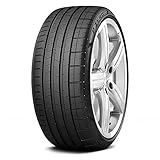
- speed rating: y
- load index: 107.0
- load capacity: 2149
- section width: 305.0
- Fit type: Universal Fit
Charger hardware and the Redeye road-course claim
Dodge lists 20-by-11-inch wheels with Pirelli tires for Charger Widebody SRT models, plus standard six-piston Brembo brakes and adaptive damping on SRT models. That is substantial equipment for a sedan, and it means the Charger should not be dismissed as a car designed only for straight-line pulls.
In a 2020 Stellantis/Dodge press release, the 2021 Redeye was reported to complete a 3.4-kilometer road course 1.2 seconds faster than the standard Charger Hellcat. This is a manufacturer-reported comparison between two Charger trims. It does not establish how either Charger compares with a GT500, because the cars, test conditions and publication methods are not the same.
Why a direct lap-time verdict is not available
No cited source supplies a controlled, same-day Charger Hellcat-versus-Shelby GT500 road-course test. Track length, weather, tire temperature, alignment, fuel load, driver and optional equipment can change results by more than a casual comparison suggests. The defensible conclusion is narrower: the GT500 has measured evidence favoring its track tire and braking package, while the Charger has credible hardware and a documented improvement for the Redeye over the standard Hellcat.
Power, transmission and driver workload
Charger’s eight-speed automatic
The Charger’s eight-speed automatic suits a large sedan: it can keep the V8 in its power band while remaining relaxed in top gear. The standard Hellcat’s 717 hp is already more than enough for public-road acceleration; the Redeye’s 797 hp and 707 lb-ft add straight-line reserve that is difficult to use legally on the street.
Do these 3 things before closing this tab:
1Scan for outdated or missing drivers - takes under a minute2Clear out junk files and repair common Windows errors3Fix the driver behind crashes, sound loss and screen glitchesGT500’s seven-speed dual-clutch
The GT500’s seven-speed dual-clutch automatic is a performance-oriented choice. Rapid, closely spaced shifts help it stay ready for corner exits without asking the driver to manage a manual clutch. The car’s lower quoted torque than the Redeye does not indicate a lack of speed; gearing, launch calibration, tire grip and vehicle mass all affect acceleration.
Also popular on Amazon

- Quality you deserve
- Package Dimensions: 21 H x 21 L x 13.3 W (inches)
- Package Weight: 31.0 pounds
- Country of Origin : Italy
For a track driver, the relevant question is how consistently the transmission, cooling system and brakes repeat performance over multiple sessions. The supplied sources do not provide endurance temperatures, fade measurements or a full consumables log for either car, so those factors should be checked on the exact vehicle before purchase.
Street practicality and ownership questions
Passenger and cargo needs
Choose the Charger if rear-seat access is a weekly requirement rather than an occasional compromise. Its four doors and 17-cubic-foot trunk make it the only one of these two formats that naturally serves a family or a group of adults. The GT500 is better suited to a driver whose passengers are usually in the front and whose cargo can be packed into a coupe.
Ride and steering trade-offs
The GT500’s standard adaptive dampers are an important street advantage because they allow a track-capable car to remain tolerable on ordinary pavement. The Charger Widebody’s ride and handling are more impressive than its size suggests, but its steering transmits less detail. Decide whether you value body control and feedback on a winding road or the ability to carry people without planning around doors.
Price and running-cost uncertainty
Current regional used prices and comparable ownership costs were not established for this comparison. Do not infer a fair purchase price from an old window sticker, a single online listing or the horsepower badge. Obtain several local examples with matching model year, mileage, accident history, options and condition.
Track use creates costs that neither headline price nor horsepower captures: high-performance tires, brake pads, rotors, brake fluid, alignment checks, transport, fuel and potential cooling or suspension repairs. The GT500’s Carbon Fiber Track package may improve lap consistency, but its specialized tires can also be expensive to replace. A Charger Widebody’s 20-inch, 11-inch-wide wheels and large Pirelli fitments likewise require careful budgeting.
Also popular on Amazon

- Product Type :Vehicle Tire
- "Package Dimensions :28.4 " L X 28.4 " W X 12.0 " H"
- Country Of Origin :Italy
- Package Weight :30.02Lbs
- Fit type: Universal
Tire replacement and fitment
The cited 2021 Charger Hellcat Redeye Widebody specification uses a Pirelli 305/35ZR20 as its standard tire. That is a model- and trim-specific reference, not a universal fitment for every Charger Hellcat. Before ordering replacements, read the driver-door placard and verify the exact year, Redeye or standard trim, wheel width and front/rear sizing. A tire that fits one Widebody configuration may be wrong for another wheel or axle.
Independent reader supportYour contribution helps us test, update, and keep practical guides available for everyone.Which trim makes sense for track use?
Standard Charger Hellcat
The standard Hellcat is the rational Charger choice when you want the sedan format and do not need the Redeye’s additional output. Its 717 hp and 650 lb-ft are already extreme, and the SRT equipment includes performance brakes and adaptive damping. Spend your evaluation time on tire condition, brake cooling, alignment and service history rather than assuming a higher-output badge automatically means a better track car.
Charger Hellcat Redeye
The Redeye adds 80 hp and 57 lb-ft over the cited standard 2021 Hellcat and is the version represented by the 797-hp Dodge High-Output figure. Dodge’s reported 1.2-second road-course advantage over the standard Hellcat shows that the extra performance is not limited to drag-strip acceleration, but it remains an internal Charger comparison, not proof of superiority over the GT500.
Shelby GT500 with the Carbon Fiber Track package
If circuit driving is central to the purchase, the GT500 with the tested Carbon Fiber Track package has the clearest evidence-based case. The package’s tire setup improved measured grip by 0.14 g and shortened the 70-mph stop by eight feet in Car and Driver’s test. Confirm that a used car actually has the package; a standard-tire GT500 should not be represented as having those results.
A sensible buying and track-day inspection process
- Identify the exact car. Record model year, standard Hellcat or Redeye trim, Widebody status, wheel design, tire sizes and every performance package.
- Verify the specification. Match the VIN, window sticker and door-placard information to the seller’s description. Do not use the 797-hp Redeye figures for a 717-hp Hellcat.
- Inspect tires. Check tread depth, age, heat-cycle history, uneven wear, sidewall damage and correct load and speed ratings. Track use can consume a tire quickly even when tread remains.
- Measure brake condition. Look for pad thickness, rotor cracks or lip, fluid discoloration and signs of overheating. Six-piston Brembo hardware is not a guarantee that consumables are fresh.
- Check alignment and suspension. Uneven shoulder wear can indicate a previous track alignment or bent component. Confirm adaptive-damper operation and inspect bushings, wheel bearings and underbody damage.
- Review cooling and service records. Ask for documented oil, transmission-fluid and brake-fluid changes and any cooling-system repairs. Repeated track sessions place different demands on fluids than commuting.
- Plan the first event conservatively. Use a technical inspection, fresh fluids, correct pressures and a gradual pace. Learn brake and tire temperatures before chasing lap times.
Common comparison mistakes
- Comparing a Redeye with a standard Hellcat without saying so. Their quoted outputs differ materially.
- Calling the GT500’s 1.13 g a Mustang-versus-Charger result. It is a comparison of two GT500 tire setups.
- Using the Redeye’s 1.2-second road-course claim as a GT500 result. Dodge compared two Charger trims on a 3.4-kilometer course.
- Assuming more horsepower guarantees a faster lap. Tire compound, braking, damping, cooling and driver consistency matter.
- Ignoring body style. A two-door coupe cannot replace the Charger’s rear-door access for a driver who regularly carries passengers.
- Budgeting only for fuel. Tires, pads, rotors, fluid, alignment and track damage can dominate operating costs.
- Ordering tires by model name alone. Confirm the exact wheel and door-placard size, especially on Widebody cars.
Decision guide
| If this describes you | Choose | Reasoning |
|---|---|---|
| You attend several track days each year and prioritize corner entry, braking and feedback. | 2022 Shelby GT500, preferably with the tested Carbon Fiber Track package | The available instrumented data supports its track-oriented tire setup. |
| You carry adults, children or bulky luggage every week. | Charger Hellcat | Four doors, five seats and a 17-cubic-foot trunk solve a problem the coupe cannot. |
| You want the strongest straight-line specification in the Charger family. | Hellcat Redeye | 797 hp and 707 lb-ft are the cited Redeye figures, not standard-Hellcat figures. |
| You want one performance car for commuting with occasional track use. | Either, based on passenger needs | The GT500 offers agile handling and adaptive dampers; the Charger offers unmatched sedan utility. |
| You need a proven direct lap-time winner. | Neither can be declared from these sources | No controlled Charger-versus-GT500 road-course comparison is provided. |
Final verdict
The Shelby GT500 is the stronger evidence-based choice for a street-and-track driver whose priority is handling, braking and repeatable circuit performance, especially when equipped with the Carbon Fiber Track package. The Charger Hellcat is the better answer when the car must function as a real four-door family sedan while retaining enormous V8 performance. Select the exact trim first, then compare tires, brakes, service history and intended passenger duty; the badges alone do not settle the decision.




