What’s actually slowing this PC down?
Pick the symptom - the matching free tool is one click away.
Some links on this page are affiliate links: if you buy through them we may earn a commission, at no extra cost to you.
Yes— in the United States, most electric cars can charge from a normal 120-volt household outlet. The connection is called Level 1 charging and uses a portable EVSE (the charging cord with built-in safety controls). It is convenient but slow: typical estimates are about 2–5 miles of driving range per hour, depending on the car and electrical setup.
Whether it is practical depends on your daily mileage, how long the car is parked, the condition of the outlet, and whether the circuit can safely supply the load. Check the vehicle maker’s instructions before plugging in; household voltage, plugs and charging equipment differ outside the United States.
As an Amazon Associate I earn from qualifying purchases.
What “a regular outlet” means for an EV
In U.S. charging terminology, a standard household receptacle supplies 120-volt (V) alternating current (AC). Charging an EV from it is known as Level 1. A Level 1 cordset normally has a household plug on one end and a vehicle connector on the other. The cord’s in-line control box is an EVSE (electric-vehicle supply equipment); it manages the connection and provides safety monitoring rather than simply acting as an extension cord.
The U.S. Department of Energy Alternative Fuels Data Center (AFDC) describes a typical arrangement as a household NEMA plug at the wall and a J1772 connector at the car. That J1772 example applies to vehicles equipped for it; some vehicles use a different inlet and therefore require the cordset specified by the manufacturer. Many new EVs include a portable Level 1 cordset, so buying another cable is unnecessary unless your car did not include one or the original needs replacement.
Popular on Amazon

- LEVEL 1 CHARGING - The Lectron Level 1 Charger lets you quickly charge your EV with a standard 120V outlet; You get 15 amps and 1.65 kW of power for the standard full-charge time for your car, at home or at wor
- CONVENIENT OVERNIGHT CHARGING - The Lectron 15 Amp EV Charger is a more affordable and faster charging option compared to other Level 2 EV chargers, delivering an extra 40-50 miles of overnight charge at home — without breaking the bank
- J1772 COMPATIBILITY - This J1772 charger is compatible with all electric vehicles that use the J1772 standard, including BMW, Ford, Honda, Hyundai, Kia, Porsche, Nissan, and Chevy
- SAFE AND RELIABLE - FCC and ETL certified (UL2594 standard) for safety with overvoltage, overcurrent, and short circuit protection; Energy Star certified for efficiency; IP65 rated for dust and water resistance
- PORTABLE CONVENIENCE - Whether you're on a road trip or visiting a friend, you can easily plug in your EV and charge with our portable EV charger. Please refer to the included User Manual for complete operating instructions and compatibility requirements
Check the plug and vehicle connector
- Read the owner’s manual for the approved cordset, connector and maximum current.
- Confirm that the wall plug matches the receptacle and that the vehicle connector matches the car’s inlet. Do not force a connection or rely on an adapter that the vehicle maker does not approve.
- Use equipment rated for the location. Outdoor charging requires a cordset and connections suitable for outdoor use, with protection from standing water and physical damage.
How much range does Level 1 add?
Level 1 adds range slowly. The AFDC estimates approximately 5 miles of range per hour when charging at about 1.9 kilowatts. Its consumer guidance gives a broader estimate of 2–5 miles per hour. Tesla’s current home-charging guidance gives 2–3 miles per hour with a Mobile Connector using a NEMA 5-15 adapter, depending on the vehicle. These are estimates, not guarantees or independent test results.
| Reference | Published estimate | Qualification |
|---|---|---|
| AFDC charging guidance | About 5 miles of range per hour | Assumes approximately 1.9 kW |
| AFDC consumer charging table | About 2–5 miles per hour | General Level 1 estimate; actual result varies |
| AFDC overnight example | About 40 miles after eight hours | Example for a midsize EV |
| Tesla home-charging guidance | About 2–3 miles per hour | Mobile Connector with NEMA 5-15 adapter; vehicle-dependent |
An eight-hour overnight session therefore might restore roughly 16–40 miles, with the result determined by the car and the electrical conditions. A large battery that is nearly empty can take 20 hours or more on Level 1, according to the AFDC.
Why two cars can charge at different speeds
The outlet is only one part of the system. Charging time depends on the battery’s capacity and state of charge, battery type, the vehicle’s onboard charger, the EVSE, and the available electrical service. A car with a larger battery does not necessarily accept energy at the same rate as a smaller car, and the miles gained per kilowatt-hour differ between vehicles. Treat the published figures as planning ranges rather than a promise for a particular model.
Also popular on Amazon

- Road-Trip Ready & Apartment-Friendly: Comes with a 20ft heavy-duty cable that easily spans a standard parking space, plus a NEMA 5-15 adapter for plug and play convenience. Whether you're charging at home or hitting the highway, this portable EV Charger is your ultimate travel companion for weekend getaways and camping trips
- Delay Timer & Adjustable Current: Use the built-in timer to delay your start by 1-12 hours and easily harvest off-peak energy savings. Then pick from 6/8/10/12/16A (Level 2) to match your garage grid. It automatically locks in your favorite setting and never forces you to re-adjust. No complicated apps or Wi-Fi needed, just straightforward, reliable control
- Tactile Buttons & LED Screen: No glitchy smartphone apps or finicky touchscreens that lag, freeze, and misfire in winter. Our EV charger is engineered with a high-definition LED display that tracks critical real-time data, including live voltage and current. Tactile buttons deliver direct, satisfying click feedback that remains highly responsive even when wearing heavy winter gloves or operating in torrential downpours—conditions where standard touchscreens completely fail
- ETL Certified Safety & IP65 All-Weather Shield: ETL certified to meet US safety standards for charging. Engineered with a certified IP65 dust-and-waterproof enclosure and a heavy-duty TPE cable that operates reliably across a wide -22°F to 130°F range. An intelligent multi-protection defense system (GFCI, over-voltage, over-current, surge, short-circuit, and over-temp) keeps a 24/7 watch for 100% safe, unattended overnight charging in any weather
- J1772 Compatible + Dual-Level Charging: Works with all J1772 EVs (Tesla requires a separate J1772 adapter). Level 2: built-in NEMA 6-20 plug. Level 1: included NEMA 5-15 adapter fits any standard outlet. Please confirm your outlet is NEMA 6-20 or 5-15 before purchase
Can overnight Level 1 charging cover normal driving?
For some drivers, yes. If the car is parked at home for eight to twelve hours and daily use is modest, the energy added overnight can replace that day’s driving. For example, a driver using 25–30 miles per day may be able to recover most or all of that distance during an overnight session at the higher end of the Level 1 estimate. A driver routinely using 50 miles or more may fall behind unless the car remains parked longer or receives charging elsewhere.
Use your own routine rather than the battery’s advertised maximum range to decide:
- Record the miles driven on a typical weekday and on your busiest day.
- Estimate the overnight addition using a conservative 2 miles per hour first; compare it with the AFDC’s 2–5-mile range.
- Allow extra time for days when the battery starts lower than usual or when you cannot leave the car plugged in overnight.
- Consider where a second charging session would come from if the overnight total is insufficient.
The AFDC notes that many drivers can meet daily needs with overnight Level 1 charging when an outlet on a dedicated branch circuit is close to the parking space. “Many” does not mean every driver: long commutes, large batteries, short parking periods or frequent road trips can make Level 1 impractical.
Do these 3 things before closing this tab:
1Repair Windows errors before they cause bigger problems2Scan for outdated or missing drivers - takes under a minute3Clear out junk files and repair common Windows errorsAlso popular on Amazon

- Flex Level 1 EV Charger - The EVDANCE Level 1 electric car charger is compatible with J1772 electric vehicles and plug-in hybrid vehicles (North American Standard). *Tesla requires a SAE J1772 adapter.
- Convenient to Use - This charger has both NEMA 6-20 plug for 16A 240V charging (3.68kW, 10-12 mi/h) and a NEMA 6-20 to 5-15 plug adapter for 12A 120V charging (1.44kW, 2-5 mi/h). The included bag makes it easier to carry on the go. It also has a 25ft cable length, you can use it flexibly from anywhere in the garage or driveway.
- Check Your Outlet Type -This charger works with standard 120V NEMA 5-15/5-20 outlets (2-5 mph charging speed) and 240V NEMA 6-20 outlets (10-12 mph) . It's not compatible with NEMA 6-15/10-30/14-30/14-50/6-50 outlets – you'll need a NEMA 14-50/14-30/10-30/6-50 to 6-20 adapter (sold separately) to connect.
- Compatible EV Models -This EV charger works with most major electric vehicles, including Ford, Chevrolet, Hyundai, Audi, Nissan Ariya, Rivian R1S, Kia, and others. However, it's not compatible with Mini Cooper Electric Hardtop,Toyota Prus Prime/Z4X/RAV4Prime, Porsche Taycan Base/4S/Turbo/Turbo S or Tesla models (Tesla requires a J1772 to Tesla Adapter, sold separately). For a full list of compatible models, check out the Full Compatibility List on our product page.
- Indication Displays - LED display that can tell you the status as well as indicate errors while charging your electric vehicle.
Electrical and safety requirements
Use an appropriate circuit
A nearby receptacle is not automatically suitable simply because a plug fits. The AFDC advises having an outlet on a dedicated branch circuit near the parking place. A dedicated circuit reduces the chance that the EV and another high-load appliance will overload the wiring or trip a breaker. If you do not know what else shares the circuit, ask a qualified electrician to inspect it before regular charging.
Inspect the receptacle and cord
- Do not charge through a cracked, loose, discolored or damaged receptacle.
- Stop if the plug, outlet or cord becomes unusually hot, smells of burning, shows arcing or repeatedly trips the breaker.
- Keep the cord away from vehicle tires, pinch points, standing water and walking paths.
- Use only the EVSE and adapters approved for your vehicle and the outlet. Do not improvise with household extension cords or multi-outlet devices.
- Follow the vehicle and EVSE instructions for outdoor use, rain protection and connection order.
If a breaker trips, unplug the car and identify what else is on that circuit. Repeated trips, heat or damaged wiring require an electrician; resetting the breaker over and over is not a fix.
How to charge from a household outlet
- Confirm compatibility. Verify the vehicle inlet, the cordset connector and the wall plug in the owner’s manual. Check that the EVSE is rated for the voltage and location.
- Choose the parking position. Park close enough that the cord reaches without tension, crossing a driveway where it can be crushed, or lying in a place where people can trip.
- Check the outlet. Make sure it is dry, firmly mounted and free of visible damage. Confirm that the circuit is appropriate and not carrying another heavy load.
- Connect as directed. Follow the cordset maker’s specified order for plugging into the wall and the vehicle. The EVSE indicators should show that the connection is ready and charging.
- Verify the car is actually charging. Use the vehicle’s charge light, dashboard message or mobile display. A plugged-in cable is not proof that current is flowing.
- Monitor the first sessions. After charging has started, check the plug and receptacle for abnormal heat. Stop immediately if you notice heat, odor, noise, arcing or a tripped breaker.
- Disconnect safely. End charging through the vehicle’s normal control, then remove the connector as instructed. Store the cord so it cannot be run over or exposed to damage.
Level 1 versus Level 2 at home
Level 2 is the usual upgrade when a 120-volt outlet cannot replenish the miles you need. Residential Level 2 normally uses 240 V and requires suitable electrical service, equipment and, often, installation work. Exact charging speed depends on the EVSE and vehicle, so there is no single range-per-hour figure that applies to every Level 2 setup.
Also popular on Amazon
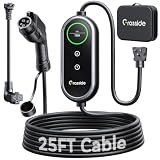
- Universal J1772 Compatibility: Designed with a standard J1772 connector, this J1772 charger works with most J1772 electric vehicles and PHEVs, including BMW, Mercedes-Benz, Hyundai, Kia, Nissan, Rivian, Ford, Chevy, Volkswagen, Toyota and more. Note: Tesla vehicles require a J1772 to Tesla adapter (not included)
- Flexible Outlet Compatibility: This portable EV charger comes with a NEMA 6-20 plug and a NEMA 5-15/5-20 to 6-20 adapter. Supports Level 1 (8–12A) and Level 2 (16A). Max 12A (1.44kW) on 120V NEMA 5-15/5-20 outlets, and full 16A (3.84kW) with a 240V NEMA 6-20 outlet. One charger is designed to cover home, garage, and travel charging needs with reliable performance
- Adjustable Smart Charging Control: Customize charging safely with adjustable current settings (8A/10A/12A/16A) to match different circuits. The 0–12 hour delay timer helps schedule overnight charging during lower electricity rates. Integrated LCD display shows real-time voltage, current, power, and charging status for clear monitoring without apps. Note: Press 'A' or 'T' for 3s to set and confirm.
- Home Charging & Travel Backup: For daily home use while remaining fully portable for travel. This level 1 ev charger includes a durable 25FT ev charging cord, providing flexible reach for garage or driveway charging. Charge overnight to take advantage of lower utility rates—potentially saving up to $500 annually on electricity costs. The included carrying case makes storage easy and keeps a dependable backup charger available in your trunk for road trips or visiting friends
- Engineered For Safety & Durability: Built for dependable daily use, this electric car charger features an IP65 waterproof rating for all weather operation. Equipped with a UL-listed cable, fully rubberized connector, and advanced protection against overcurrent, overheating, and electrical faults. Designed to ensure safe, stable, and long-term charging performance in demanding environments
| Characteristic | Level 1 | Level 2 |
|---|---|---|
| Typical residential voltage | 120 V AC | 240 V AC in typical U.S. installations |
| Wall connection | Standard household receptacle and compatible cordset | Dedicated 240-V circuit and compatible EVSE; exact receptacle or hard-wiring varies |
| Range added per hour | Approximately 2–5 miles; AFDC cites about 5 miles at 1.9 kW | Not a single stated value; varies by vehicle, EVSE and circuit |
| Installation | May use an existing suitable outlet; circuit condition still matters | Electrical assessment, installation and local-code requirements may apply |
| Best fit | Overnight charging for drivers whose daily miles fit the slow rate | Drivers who need substantially more energy during a shorter parking period |
| Connector | Must match the vehicle; J1772 is a common U.S. example | Must match the vehicle and the selected EVSE |
When a Level 2 installation makes sense
Consider Level 2 if your overnight addition consistently falls short of daily use, the car is parked at home for only a few hours, or you need a predictable refill before frequent longer trips. The decision is about time and electrical capacity, not merely convenience.
Before installation, have a qualified electrician evaluate the service capacity, panel, wiring route, outdoor exposure and local permitting or code requirements. The AFDC recommends consulting the vehicle manufacturer or dealer about Level 2 options. The electrician and vehicle documentation should determine the circuit and equipment; do not assume that an existing 240-V receptacle is automatically suitable for an EVSE.
Common problems and what to do
The car does not start charging
Recheck that the connector is fully seated, the EVSE has power and the vehicle is unlocked or otherwise ready to accept a charge. Confirm that a scheduled charging setting is not delaying the start. If the EVSE shows a fault, follow its manual rather than repeatedly reconnecting it.
Also popular on Amazon

- SAE J1772 Standard Charger: Compatible with all North American electric vehicles and plug-in hybrids, including Ford, Chevrolet, Nissan, BMW, Volkswagen, Hyundai, Kia, Audi, Mercedes-Benz, Rivian, Porsche, Toyota, Honda, Jeep, and GMC. Tesla vehicles can be charged with a separate SAE J1772 adapter (sold separately).
- Adjustable Current: Choose from 8A, 10A, 13A, or 16A to match your vehicle’s charging needs.Dual Plug Compatibility,NEMA 6-20 Plug (220/240V): Delivers up to 3.84 kW/h, providing approximately 15.36 MPH charging speed at 16A.NEMA 5-15 Plug (110/120V): Supports 10A charging at 120V, offering 1.2 kW/h (around 4.4 MPH). Customizable Charging: Easily adjust current to suit different charging scenarios, giving you maximum flexibility at home or on the go
- Hassle-Free Installation: Forget complicated setups—just plug in and go. Equipped with NEMA 5-15 and NEMA 6-20 (220V/240V) connectors, it works with any standard 110V–240V outlet. The 25-foot cable gives you the freedom to reach vehicles parked at a distance, making charging convenient anywhere.
- Intelligent Charging: Featuring a 2.8-inch touch display, you can easily select the charging current (8A / 10A / 13A / 16A) and schedule charging with a 1–12 hour delayed start. Perfect for maximizing off-peak hours and cutting electricity costs. (Example: Set a 2-hour delay, and charging begins automatically after 2 hours.)
- Comprehensive Safety: Designed to meet CE and FCC safety standards, this charger offers multiple layers of protection, including overvoltage, overload, short-circuit, grounding, and leakage safeguards. The durable IP65-rated waterproof housing and reinforced cable ensure reliable charging in all weather conditions, keeping your vehicle safe year-round.
Charging is slower than expected
Compare the observed result with the broad 2–5-mile-per-hour Level 1 estimate, not the maximum figure alone. A lower rate can reflect the vehicle’s onboard charger, battery state, equipment, voltage or other electrical conditions. If the result is dramatically lower or changes unpredictably, stop and have the outlet and circuit checked.
The breaker trips
Disconnect the EV and determine whether other appliances share the branch circuit. Do not keep resetting the breaker. An electrician should inspect the circuit before charging resumes, especially if the breaker trips with the EV as the only load.
The Tool Desk
Outbyte Driver Updater FREEFix the driver behind crashes, sound loss and screen glitchesFind Drivers →Outbyte PC Repair FREERepair Windows errors before they cause bigger problemsFix Now →The outlet or plug is hot
Stop charging, unplug after the vehicle’s normal shutdown procedure, and do not use that receptacle again until it has been inspected. Heat, discoloration, odor or arcing can indicate a poor connection or overloaded wiring.
Important U.S. and international limits
The 120-V, NEMA 5-15 and J1772 examples above are U.S.-specific. Other countries use different household voltages, plugs, electrical codes and vehicle equipment. A “regular outlet” in another country may deliver a different voltage or require a different EVSE, so use local manufacturer guidance rather than transferring U.S. assumptions.
Public charging statistics should not be confused with home charging. AFDC reported that less than 1% of U.S. public charging ports were Level 1 in 2023. That describes the public network, not the availability or usefulness of a 120-V outlet at a private residence.
Quick Recap
Practical decision checklist
- Is the car supplied with a compatible Level 1 cordset, or do you need an approved replacement?
- Can the car remain parked long enough to recover your daily miles at roughly 2–5 miles per hour?
- Is the receptacle in good condition and on a suitable, preferably dedicated branch circuit?
- Can the cord reach without damage, trip hazards or exposure outside its rating?
- Do your driving pattern and turnaround time justify the electrical work required for Level 2?
- Have you checked the vehicle manual and, for installation questions, consulted a qualified electrician?




