Quick wins for a faster PC:
Fix the driver behind crashes, sound loss and screen glitchesFind Drivers →Clear out junk files and repair common Windows errorsFree Scan →Scan for outdated or missing drivers - takes under a minuteDriver Scan →Some links on this page are affiliate links: if you buy through them we may earn a commission, at no extra cost to you.
Yes. In the United States, many electric cars can charge from an ordinary 120-volt household outlet using a compatible Level 1 EVSE cordset. You do not necessarily need a wall-mounted charger. The trade-off is speed: Level 1 adds range slowly, so the practical answer depends on your daily mileage, how long the car sits overnight, the vehicle’s charging capability, and whether the outlet and circuit are suitable.
A wall-mounted unit and a dedicated electrical circuit are different things. You can skip the wall unit while still needing an appropriate outlet—ideally on a circuit without another substantial load—for safe, predictable charging.
As an Amazon Associate I earn from qualifying purchases.
What charging without a wall unit actually means
“Charging without a dedicated wall charger” normally means Level 1 charging. The car is connected to a standard 120-volt outlet with an Electric Vehicle Supply Equipment (EVSE) cordset. The cordset, sometimes called a portable charging cable, manages the connection between the household supply and the vehicle; it is not simply an ordinary extension lead.
The U.S. Environmental Protection Agency describes the basic arrangement this way: “You can plug your car directly into the 120 Volt outlet using the charge cable (technically called the Electric Vehicle Supply Equipment or EVSE) that often comes with the vehicle.” Read the agency’s home charging guidance and charging basics for the vehicle-specific cautions.
Popular on Amazon

- LEVEL 1 CHARGING - The Lectron Level 1 Charger lets you quickly charge your EV with a standard 120V outlet; You get 15 amps and 1.65 kW of power for the standard full-charge time for your car, at home or at wor
- CONVENIENT OVERNIGHT CHARGING - The Lectron 15 Amp EV Charger is a more affordable and faster charging option compared to other Level 2 EV chargers, delivering an extra 40-50 miles of overnight charge at home — without breaking the bank
- J1772 COMPATIBILITY - This J1772 charger is compatible with all electric vehicles that use the J1772 standard, including BMW, Ford, Honda, Hyundai, Kia, Porsche, Nissan, and Chevy
- SAFE AND RELIABLE - FCC and ETL certified (UL2594 standard) for safety with overvoltage, overcurrent, and short circuit protection; Energy Star certified for efficiency; IP65 rated for dust and water resistance
- PORTABLE CONVENIENCE - Whether you're on a road trip or visiting a friend, you can easily plug in your EV and charge with our portable EV charger. Please refer to the included User Manual for complete operating instructions and compatibility requirements
Many battery-electric cars and plug-in hybrids include a portable cordset, but the equipment is not universal. Confirm what came with your vehicle before assuming you can charge from a household receptacle.
How fast is Level 1 charging?
Level 1 is the slowest normal home-charging option. EPA gives a typical figure of about 3–5 miles of driving range per hour. ENERGY STAR reports roughly 2–5 miles per hour, with results varying according to conditions and the battery’s state of charge. These are broad published estimates, not a guarantee for a particular car, outlet or temperature.
That pace can still add a useful amount of energy during a long overnight stop. It is less suitable when you return home with a nearly empty battery and need to drive a long distance again early the next morning. Charging speed is measured in added range, not a fixed percentage of battery capacity, because vehicles differ in efficiency and battery size.
When an ordinary outlet is enough
The key question is not whether Level 1 is the fastest option; it is whether it replaces the energy you use between parking periods. Use this checklist before deciding.
Also popular on Amazon

- Road-Trip Ready & Apartment-Friendly: Comes with a 20ft heavy-duty cable that easily spans a standard parking space, plus a NEMA 5-15 adapter for plug and play convenience. Whether you're charging at home or hitting the highway, this portable EV Charger is your ultimate travel companion for weekend getaways and camping trips
- Delay Timer & Adjustable Current: Use the built-in timer to delay your start by 1-12 hours and easily harvest off-peak energy savings. Then pick from 6/8/10/12/16A (Level 2) to match your garage grid. It automatically locks in your favorite setting and never forces you to re-adjust. No complicated apps or Wi-Fi needed, just straightforward, reliable control
- Tactile Buttons & LED Screen: No glitchy smartphone apps or finicky touchscreens that lag, freeze, and misfire in winter. Our EV charger is engineered with a high-definition LED display that tracks critical real-time data, including live voltage and current. Tactile buttons deliver direct, satisfying click feedback that remains highly responsive even when wearing heavy winter gloves or operating in torrential downpours—conditions where standard touchscreens completely fail
- ETL Certified Safety & IP65 All-Weather Shield: ETL certified to meet US safety standards for charging. Engineered with a certified IP65 dust-and-waterproof enclosure and a heavy-duty TPE cable that operates reliably across a wide -22°F to 130°F range. An intelligent multi-protection defense system (GFCI, over-voltage, over-current, surge, short-circuit, and over-temp) keeps a 24/7 watch for 100% safe, unattended overnight charging in any weather
- J1772 Compatible + Dual-Level Charging: Works with all J1772 EVs (Tesla requires a separate J1772 adapter). Level 2: built-in NEMA 6-20 plug. Level 1: included NEMA 5-15 adapter fits any standard outlet. Please confirm your outlet is NEMA 6-20 or 5-15 before purchase
- Daily distance: Short commutes and modest daily driving are easier to replenish at Level 1 than high-mileage routines.
- Parking time: A car left plugged in overnight, or for most of a workday and night, has more opportunity to recover range.
- Vehicle type: Plug-in hybrids generally have smaller batteries and may be particularly well matched to slow charging. A full-size battery-electric vehicle used for long daily trips may need more charging power.
- Backup access: Workplace or public charging can fill occasional gaps when home charging cannot replace a busy day’s energy.
- Season and conditions: The published miles-per-hour figures vary with conditions, so leave a margin rather than planning around the most optimistic number.
The U.S. Department of Energy’s Alternative Fuels Data Center guidance notes that many drivers can meet daily range needs by charging overnight when a suitable outlet on a dedicated branch circuit is near the parking location.
Level 1, Level 2 and away-from-home charging compared
| Option | What it uses | Typical published rate or benefit | Main limitation |
|---|---|---|---|
| Level 1 | Standard 120-volt outlet plus a compatible EVSE cordset | About 3–5 miles of range per hour in EPA guidance; ENERGY STAR gives about 2–5 miles per hour depending on conditions and battery charge | Slow replenishment; depends heavily on daily mileage, parking time, vehicle and circuit |
| Level 2 | 240-volt circuit and EVSE, either plugged in or hardwired | About 25–40 miles of range per hour in EPA’s home-charging overview | Usually requires electrical capacity planning and often professional installation |
| Public or workplace charging | Charging equipment away from home | Can cover days when Level 1 cannot restore the energy used | Availability, access and timing depend on the location and your schedule |
The rates in the table are agency estimates. Actual results vary by vehicle, battery condition, temperature, charging limits and the equipment being used.
Free tools Windows power users keep installed
One-click scans. No signup required.
Safety: check the outlet and circuit first
EV charging is a sustained electrical load, unlike briefly plugging in a small appliance. EPA’s charging details advises that a plug-in electric vehicle ideally use a dedicated circuit, or a circuit without another electrical load. That recommendation matters even when you are not installing a wall-mounted unit.
Inspect the receptacle and its surroundings
- Use an outlet that is in good condition, with no looseness, cracking, discoloration, scorch marks or signs of overheating.
- Make sure the outlet is appropriate for the charging cordset and is protected from weather when the equipment is used outdoors.
- Do not assume an old garage or exterior outlet can safely carry a continuous EV load simply because it powers other appliances.
- If the outlet, wiring, breaker capacity or grounding is uncertain, stop and have a qualified electrician assess it.
Avoid unapproved extension-cord arrangements
Do not treat a generic household extension cord as an EV charging solution unless the vehicle and EVSE manufacturers explicitly approve the exact arrangement. The official guidance cited here does not provide blanket approval for ordinary extension cords. An improvised setup can introduce overheating, voltage drop or connection problems that are difficult to see while the car is charging.
Also popular on Amazon

- Flex Level 1 EV Charger - The EVDANCE Level 1 electric car charger is compatible with J1772 electric vehicles and plug-in hybrid vehicles (North American Standard). *Tesla requires a SAE J1772 adapter.
- Convenient to Use - This charger has both NEMA 6-20 plug for 16A 240V charging (3.68kW, 10-12 mi/h) and a NEMA 6-20 to 5-15 plug adapter for 12A 120V charging (1.44kW, 2-5 mi/h). The included bag makes it easier to carry on the go. It also has a 25ft cable length, you can use it flexibly from anywhere in the garage or driveway.
- Check Your Outlet Type -This charger works with standard 120V NEMA 5-15/5-20 outlets (2-5 mph charging speed) and 240V NEMA 6-20 outlets (10-12 mph) . It's not compatible with NEMA 6-15/10-30/14-30/14-50/6-50 outlets – you'll need a NEMA 14-50/14-30/10-30/6-50 to 6-20 adapter (sold separately) to connect.
- Compatible EV Models -This EV charger works with most major electric vehicles, including Ford, Chevrolet, Hyundai, Audi, Nissan Ariya, Rivian R1S, Kia, and others. However, it's not compatible with Mini Cooper Electric Hardtop,Toyota Prus Prime/Z4X/RAV4Prime, Porsche Taycan Base/4S/Turbo/Turbo S or Tesla models (Tesla requires a J1772 to Tesla Adapter, sold separately). For a full list of compatible models, check out the Full Compatibility List on our product page.
- Indication Displays - LED display that can tell you the status as well as indicate errors while charging your electric vehicle.
Outdoor charging
For a driveway or exterior outlet, choose equipment rated for the expected weather exposure. EPA specifically advises selecting charging equipment rated for outdoor conditions. Keep the connector and control box positioned as the manufacturer directs, and follow the vehicle manual for rain, snow and standing-water precautions.
Check the cordset and connector before plugging in
Use the EVSE supplied with the car or one approved for that vehicle. Connector standards differ by model and model year. EPA says almost all vehicles use J1772 for Level 1 and Level 2, while some newer vehicles beginning with model year 2025 use the J3400/NACS connector. That is a general description, not a substitute for checking your specific car.
- Look in the vehicle manual or manufacturer’s charging documentation for the approved Level 1 cordset and connector.
- Confirm that the cordset’s vehicle plug fits your car without an unapproved adapter.
- Check whether the cordset has a household plug designed for the outlet you intend to use.
- If the original cordset is missing, damaged or incompatible, select a replacement only after verifying the vehicle and electrical requirements. ENERGY STAR says certified chargers are tested for safety by a nationally recognized testing laboratory; certification should be verified for the exact model rather than assumed.
How to start a first Level 1 charging session
- Park within reach of the outlet. Position the vehicle so the supplied cordset reaches without tension, stretching or an unapproved extension.
- Check the outlet. Confirm that it is dry, undamaged and on a suitable circuit with no other significant load operating on it.
- Read the vehicle instructions. Follow the manufacturer’s sequence for connecting the EVSE and setting a charging schedule.
- Connect the household plug. Insert it fully into the receptacle. Do not use a loose-fitting outlet.
- Connect the vehicle plug. Insert the connector into the car’s charge port until it locks or indicates a secure connection.
- Verify charging. Use the EVSE indicator and the vehicle’s dashboard or charging screen to confirm that energy is flowing.
- Monitor the first session. During the initial charge, check for unusual heat, odor, buzzing, repeated interruptions or a tripped breaker. Stop charging if any of these occur and arrange an electrical inspection.
When Level 2 is the better choice
Level 2 uses 240 volts and restores range much faster. It is the more practical home solution for long daily drives, limited overnight parking, frequent full recharges or households that cannot rely on workplace and public charging.
Installation requirements depend on the EVSE, the home’s service capacity, existing wiring and local electrical rules. EPA gives a specific example: a 40-amp Level 2 charger requires a dedicated 50-amp circuit. The agency also notes that, in this context, the circuit breaker should be sized to at least 125% of the charger’s current. That example is not a universal requirement for every charger; a qualified electrician must apply the equipment specifications and local code.
Also popular on Amazon
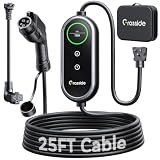
- Universal J1772 Compatibility: Designed with a standard J1772 connector, this J1772 charger works with most J1772 electric vehicles and PHEVs, including BMW, Mercedes-Benz, Hyundai, Kia, Nissan, Rivian, Ford, Chevy, Volkswagen, Toyota and more. Note: Tesla vehicles require a J1772 to Tesla adapter (not included)
- Flexible Outlet Compatibility: This portable EV charger comes with a NEMA 6-20 plug and a NEMA 5-15/5-20 to 6-20 adapter. Supports Level 1 (8–12A) and Level 2 (16A). Max 12A (1.44kW) on 120V NEMA 5-15/5-20 outlets, and full 16A (3.84kW) with a 240V NEMA 6-20 outlet. One charger is designed to cover home, garage, and travel charging needs with reliable performance
- Adjustable Smart Charging Control: Customize charging safely with adjustable current settings (8A/10A/12A/16A) to match different circuits. The 0–12 hour delay timer helps schedule overnight charging during lower electricity rates. Integrated LCD display shows real-time voltage, current, power, and charging status for clear monitoring without apps. Note: Press 'A' or 'T' for 3s to set and confirm.
- Home Charging & Travel Backup: For daily home use while remaining fully portable for travel. This level 1 ev charger includes a durable 25FT ev charging cord, providing flexible reach for garage or driveway charging. Charge overnight to take advantage of lower utility rates—potentially saving up to $500 annually on electricity costs. The included carrying case makes storage easy and keeps a dependable backup charger available in your trunk for road trips or visiting friends
- Engineered For Safety & Durability: Built for dependable daily use, this electric car charger features an IP65 waterproof rating for all weather operation. Equipped with a UL-listed cable, fully rubberized connector, and advanced protection against overcurrent, overheating, and electrical faults. Designed to ensure safe, stable, and long-term charging performance in demanding environments
A Level 2 unit may be plug-in or hardwired. Either way, adding a circuit or outlet can involve load calculations, permits and inspection. Ask the electrician to evaluate the panel, cable route, receptacle, disconnecting means and outdoor protection before purchasing equipment.
Independent reader supportYour contribution helps us test, update, and keep practical guides available for everyone.What if Level 1 cannot cover your routine?
Use a mixed charging plan
You do not have to choose one method exclusively. Some drivers use Level 1 for normal overnight replenishment and occasionally charge at work or in public when a long trip or unusually high-mileage day creates a deficit. This avoids an immediate electrical upgrade while preserving a faster backup.
Consider your parking pattern
If the car is parked at home for only a few hours, slow charging has less time to work. A driver with a long overnight stop may find Level 1 adequate even when the same vehicle would be inconvenient for someone who parks at home briefly between shifts.
Reassess after real use
Track the car’s state of charge when you arrive home and leave the next morning for several ordinary days. If the battery consistently falls behind, move some charging to work or public equipment or obtain an electrician’s assessment for Level 2. Do not increase charging current or alter a cordset outside the vehicle and EVSE manufacturer’s instructions.
Also popular on Amazon

- Complete Package Contents: Power plug 1; Cable 1; Control box 1 (equipped with an LCD color display, current switch button, and time-setting buttons). The charging gun interface adopts a universal 5-hole US standard design. A US standard plug adapter will also be provided for compatibility with Level 1 household power outlets
- Advanced Portable Charger Features: The Charger is engineered for modern new energy vehicles, such as all-electric, extended-range, and hybrid models, and is compatible with the National Standard 5pin AC charging interface. It automatically stops charging once the battery is full and offers flexible charging options including scheduled start and customizable duration limits. Built in safety mechanisms protect against overvoltage, overheating, and overload, while an intuitive display shows real-time metrics like current, voltage, power, and temperature. Suitable for both home and commercial use, the charger can be permanently installed or carried on the go for flexible charging convenience
- Simple Operation Instructions: To begin normal charging, first ensure the electrical outlet and wiring are functioning properly, then connect the charger to the power supply. Modify the charging current or make time reservation as needed, then connect the vehicle for charging
- Customizable Charging Settings: Initial Interface - Press and hold 3 seconds to enter TIME settings menu - Click once to add 2 hours, 8 hours maximum; Press and hold Initial Interface Set Delayed Time touch key 3 seconds to enter Current settings menu, Click once to select charging current, Long press 3 seconds to confirm
- Safety Guidelines and Specifications: The charging current of the Toptoo charger must not exceed the rated current of your power outlet. Before use, ensure the power outlet is not worn out or of poor quality. Do not use damaged or counterfeit outlets, as they may overheat and pose safety risks. Toptoo is not responsible for accidents caused by improper charging setups including non-compliant wiring or electrical standards
Apartment, condominium and rental considerations
An existing outlet may be available in a garage, parking area or exterior location, but access and electrical responsibility vary by property. EPA notes that suitable outlets are commonly found outside homes, inside garages and at many condos, apartments and workplaces. That does not establish that every shared outlet is approved for EV charging.
- Ask the property owner or manager whether the outlet may be used for vehicle charging and whether electricity is separately metered.
- Confirm that the parking space is assigned and that the cord will not cross a pedestrian path or create a trip hazard.
- For any new outlet or circuit, obtain permission before arranging electrical work.
- Use only equipment and installation methods accepted by the property and local code.
Country and model-year limits
This explanation is framed around U.S. homes and standard 120-volt outlets. Household voltage, receptacle types, wiring rules, EVSE supplied with a vehicle, connectors and permitting differ by country and building. UK residential chargepoint requirements, for example, follow UK standards and should not be applied as rules for U.S. ordinary-outlet charging; see the UK government specification for that jurisdiction.
The Tool Desk
Outbyte Driver Updater FREEFix the driver behind crashes, sound loss and screen glitchesFind Drivers →Outbyte PC Repair FREEClear out junk files and repair common Windows errorsFree Scan →Likewise, “many cars include a Level 1 cordset” does not mean every EV does. The vehicle manual and manufacturer are the authority for compatible connectors, adapters, charging limits and any restrictions on portable charging.
Bottom line
You can charge many electric cars at home without buying a dedicated wall-mounted charger. A compatible Level 1 EVSE cordset and a suitable 120-volt outlet may be enough, especially for short daily trips, plug-in hybrids and vehicles parked overnight. Because charging is slow and the load is continuous, verify the cordset, inspect the outlet, avoid unapproved extension-cord setups and use a circuit without another substantial load. If your mileage or schedule exceeds what Level 1 can replace, combine it with workplace or public charging or have a qualified electrician plan a Level 2 installation.