The Tool Desk
Outbyte PC Repair FREEClear out junk files and repair common Windows errorsFree Scan →Outbyte Driver Updater FREEScan for outdated or missing drivers - takes under a minuteDriver Scan →Battery swapping is usually the faster option only when a compatible station is close to your normal route and has batteries available. Home charging is often simpler when you have secure parking, a suitable outlet and enough time to leave the motorcycle plugged in. Neither method is universally cheaper. The right choice depends on your local swap plan, electricity tariff, motorcycle, monthly riding and the time or distance required to reach a station.
This guide explains how the two systems work, how to calculate running cost without misleading per-mile claims, and which questions to answer before buying an electric motorcycle.
As an Amazon Associate I earn from qualifying purchases.
What is the difference between battery swapping and home charging?
With home charging, you connect the motorcycle’s battery system to an approved charger and draw electricity from your own outlet or charging circuit. The motorcycle remains parked while energy is added. Depending on the model, the charger, the circuit and the starting state of charge, this can take several hours.
With battery swapping, you ride to a compatible station, remove or exchange the depleted battery pack, and install a charged pack supplied by the network. The station operator controls the batteries and their charging. You pay for access under a service agreement rather than necessarily buying the battery outright.
#1 Best Overall

- 【Razor Motorcycle Charger】Razor electric scooters and vehicles, including the E100, E125, E150, E175, E200, E200S, E225, E275, E225S, E300, E300S, E325, E325S, E500, E500S, PR200, MX350, ZR350, MX400, SX350, Pocket Mod, Sports Mod, and Quad ATVs
- 【AC Input /Output 】Input : 100V -240VAC 50/60Hz. /Output:24V 1500MA / 6.6 Ft Power Cable
- 【Electric Dirt Bike Charger】Equipped with built-in protection against overheating, overloading, and short circuits, ensuring longevity for both your device and the charger itself
- 【LED Display】A red light indicates that the scooter is charging, while a green light signals that the battery is fully charged
- 【After-Sales Service】 If you have any questions about our products, Please contact us by email in time. We provide 24 hours online service
These are not interchangeable standards. A motorcycle must be designed for the particular network, battery shape, software and access system. A station in another city may be useless if your motorcycle is not approved for it, and a removable battery does not automatically mean that a network will swap it.
Which option costs less to run?
There is no defensible universal winner from the available evidence. A home-charging calculation needs the electricity drawn from the wall and your applicable tariff. A swapping calculation needs the local subscription or service fee, what usage it includes, overage rules and any activation, equipment or additional-mileage charges.
Calculate home-charging cost
For a chosen period, use:
Home-charging energy cost = electricity taken from the wall during the period × your electricity rate.
Crashes, No Sound, or Screen Glitches?
Random freezes, missing sound and display glitches usually trace back to one bad driver. Find and replace yours safely.Free scan · under a minuteWindows Errors? Fix Them Before They Spread
Repair common Windows errors and clear accumulated junk for a smoother, more stable PC - no reinstall needed.Free scan · no reinstallBattery capacity is a useful input, but it is not the same as the electricity billed for every ride. Charging losses, the charge window you use, temperature, speed, hills, payload and other riding conditions affect wall consumption. The most reliable method is to measure energy at the outlet over several representative charging sessions. If you do not have a meter, use the manufacturer’s capacity and efficiency information as an estimate and label it as such.
For context, the current Zero S specification lists a 14.4 kWh maximum battery capacity and 12.6 kWh nominal capacity. Those are battery specifications, not a promised range, energy use per mile or electricity cost. A Zero XE specification lists a 4.3 kWh nominal battery. Applying either figure directly to every ride would overstate or understate actual billed energy depending on how far you ride and how much charging loss occurs.
Calculate swapping cost
List every recurring and usage-based charge in the service agreement:
- Base subscription or battery-service fee.
- Included swaps, mileage or battery use, if any.
- Additional mileage, battery-use or other overage fees.
- Activation, account or deposit charges.
- Any required charger, installation or accessory cost.
- Travel cost and time for detours to stations.
Gogoro’s Taiwan battery-service agreement states that Gogoro Network retains ownership of its Smart Batteries. The agreement describes basic and additional fees based on the selected plan and additional mileage or battery use; it does not establish one rate for every country or rider. Its plan names include Flex, Fixed and Fleet, and availability is region-specific. Obtain the current contract and price for your market before comparing it with a utility bill.
Recommended Free Tools
Use a like-for-like monthly comparison
- Record your expected monthly distance or number of riding days.
- For home charging, estimate wall energy for that usage and multiply it by your tariff, including any time-of-use differences.
- For swapping, request the local plan’s recurring fee, included usage and overage schedule in writing.
- Add one-time equipment or activation costs over the period you expect to keep the motorcycle.
- Value your station detours and waiting time separately instead of hiding them inside a fuel-style cost-per-mile figure.
- Recalculate for low-use and high-use months. A plan that looks attractive for daily commuting may not suit occasional riding.
Do not publish or rely on a numerical cost-per-mile comparison unless the market, date, vehicle, tariff, plan and riding assumptions are all specified. The available sources do not provide a cross-market price comparison.
Rank #2
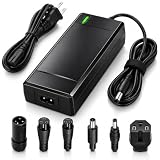
- 🌍 [Universal Compatibility] One Charger for All Your 48V Rideables Replace multiple messy chargers with this universal 54.6V 2A charger. Comes with 6 interchangeable connectors to ensure seamless compatibility with most 48V lithium-ion devices. Perfectly compatible with Gotrax, Hiboy, Jetson, Segway, Ninebot, Razor electric scooters, ebikes, hoverboards, and more. A direct replacement for your lost or damaged OEM charger, saving space and keeping your gear organized.
- 📊 [ Plug‑and‑Play Replacement] Meets or Exceeds OEM Standards No complicated setup – just pick the right connector, plug it in, and start charging. This replacement charger delivers the same or better performance than your original OEM unit. It’s the ideal solution for a lost or faulty charger, giving you dependable power without the hassle.
- 🛡️ [SGS-Certified Safety] Built-in Multi-Protection & Durable Housing Safety first! Constructed with a sturdy aluminum alloy housing for excellent heat dissipation to prevent overheating. Features full multi-protection against over-voltage, over-current, short-circuit, and over-temperature. This durable, scratch-resistant, and corrosion-proof design ensures reliable performance both indoors and outdoors, giving you peace of mind on every charge.
- ⚡ [Fast & Efficient 2A Charging] Auto Trickle Mode for Battery Care Get back on the road quickly with fast and stable 54.6V 2A output. Unlike cheap chargers, our smart charger automatically switches to trickle charge when the battery is full. This protects your battery cells, extends its overall cycle life, and ensures consistent performance for your ebike, scooter, or hoverboard — charge with confidence.
- 🌐 [Worldwide Use] Plug-and-Play Replacement for OEM Chargers Designed for global travelers and everyday commuters. Supports a wide 100–240V AC input, making it perfect for use anywhere. This replacement charger is a direct plug-and-play solution that meets or exceeds OEM performance standards. Simply select the right connector, plug it in, and enjoy a reliable, efficient, and safe charge every time.
Is swapping more convenient than charging overnight?
Swapping can reduce the motorcycle’s stop time, but only if a compatible, operating station is on your route and a charged battery is available. Gogoro says the battery exchange itself takes six seconds at its GoStations in Taiwan. That is the exchange interval, not the complete trip: riding to the station, parking, authentication, opening the cabinet, handling the battery and possible queues add time.
Home charging removes the station detour. If the motorcycle is parked at home for the night or during a workday, the charging session can happen while you are doing something else. The tradeoff is that the motorcycle may be unavailable until the session is complete, and the parking location must have a legal, secure outlet or charging circuit.
Manufacturer charging examples
| Motorcycle or equipment | Charging method | Published time | What the figure means |
|---|---|---|---|
| Current Zero S | Standard household outlet | 9.2 hours | 0–95% charge, a model specification |
| Current Zero S | Level 2 | 4 hours | 0–95% charge, a model specification |
| Zero XE or XB with the 800W off-board charger | Standard North American household outlet | 5 hours | 0–95% for the 4.3 kWh battery; compatible model and regional accessory requirements apply |
These are not averages for all electric motorcycles. Zero publishes the times for particular models and charging configurations. Your result can differ with battery temperature, starting charge, outlet capacity, extension-cord restrictions, circuit sharing and the charger supplied with your model.
Quick wins for a faster PC:
Fix the driver behind crashes, sound loss and screen glitchesFind Drivers →Clear out junk files and repair common Windows errorsFree Scan →Scan for outdated or missing drivers - takes under a minuteDriver Scan →What happens when your routine changes?
- Regular commuter: Overnight charging may cover predictable daily distance. Swapping is more useful when you routinely exceed the motorcycle’s usable range or cannot leave it parked while charging.
- Apartment resident: A nearby station can solve the lack of a private outlet, but only if building rules, station coverage and plan availability work for your address.
- Long-distance or multi-shift rider: Swapping can reduce turnaround time where stations form a reliable corridor. Home charging may require a second battery or a longer stop.
- Occasional rider: Compare minimum subscription charges with the low electricity cost of infrequent home charging. Do not assume a high-availability plan is economical when the motorcycle sits unused.
- Rural rider: Station density and detour distance often dominate the decision. A network that is extensive in a city may provide little practical coverage outside it.
Can you charge an electric motorcycle at home?
Many can, but the answer is model-specific. Verify the supplied charger, outlet type, circuit requirements, battery warranty and approved accessories in the motorcycle’s current manual and specification sheet. Do not assume that every battery is removable, that every removable battery can be charged indoors, or that a household outlet is suitable for every charger.
Standard-outlet charging
A manufacturer may approve a standard household outlet with its supplied charger. The Zero X Line 800W off-board charger, for example, is described as plugging into a standard North American household outlet and charging a 4.3 kWh battery from 0–95% in five hours on compatible XE and XB motorcycles. Confirm the model year and regional version before purchasing or using the accessory.
Use an outlet and circuit that meet the manufacturer’s requirements. Avoid overloaded circuits, damaged receptacles and unapproved adapters or extension cords. If the manual requires a dedicated circuit, have the installation evaluated by a qualified electrician rather than treating a general-purpose outlet as equivalent.
Level 2 or higher-power charging
Some motorcycles accept a higher-power charging connection or an optional charger. The current Zero S example reaches 0–95% in four hours on Level 2 versus 9.2 hours on a standard household outlet. The faster result depends on the motorcycle and its approved equipment; it is not a promise that any electric motorcycle will charge at that rate.
Removable-battery charging
A removable battery can let you bring the pack to an outlet, which may help when the motorcycle cannot be parked near a socket. It also introduces handling, storage and fire-safety considerations. Follow the battery maker’s instructions for indoor charging, temperature, ventilation, transport and storage. A removable pack is not evidence that a swap subscription exists or that the network will accept it.
Rank #3
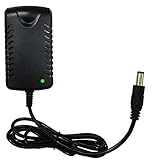
- 【Compatible Models】12 Volt Battery Charger Compatible for Ride on Toys Compatible with Wrangler, Kid Jeeps car, Motorcycle, Dynacraft, Mercedes-Benz, Range Rove, BMW i8, Kidzone Lamborghini Car, Best Choice Products, Ferrari Farm, Kid Tractor Car, Hello Kitty Car, Bumper Car,Toddler Car, Kidzone Bumper Car, Truck, SUV, Trax, AVT, UVT Ride On Cars and more
- 【Input /Output 】 Input : 110V -240VAC 50/60Hz; Output:12VDC 1000MA ; 5 Ft Power Cable
- 【Smart LED light】 Red light when charging, Green light when full
- 【Notes】 Please check the compatibility and connector type of your battery before purchasing. Before buying this charger, please check - Whether the battery is damaged
- 【After sale service】If you have any questions about our 12 volt charger, Please contact us by email in time. We provide 24 hours online service
How battery ownership and service agreements change the tradeoff
Home charging normally leaves you responsible for the motorcycle’s battery, charger and warranty conditions. A swap service can separate battery ownership from the vehicle. Under Gogoro’s Taiwan agreement, Gogoro Network owns the Smart Batteries, while subscribers receive access through the selected service plan.
Read the agreement for limits that are easy to miss in a station advertisement:
- Which motorcycle models and battery generations are compatible.
- Where the plan can be used and whether coverage is restricted to a region.
- Whether the fee is fixed, usage-based or both.
- How additional mileage, battery use or extra swaps are billed.
- What happens if an account is suspended, a battery is damaged or a station is unavailable.
- Whether the motorcycle can be charged outside the network and which chargers are approved.
- Transfer, cancellation, deposit and warranty responsibilities.
Gogoro’s contract permits network swaps and charging with a GoCharger Mobile or another Gogoro-approved charger. Gogoro also markets GoCharger Mobile for Gogoro 2 Series as a way to charge through a standard wall outlet. This is a model- and market-specific dual approach, not proof that every swap motorcycle can be charged at home.
Do these 3 things before closing this tab:
1Repair Windows errors before they cause bigger problems2Scan for outdated or missing drivers - takes under a minute3Clear out junk files and repair common Windows errorsHow much coverage does a swap network really provide?
Network scale is useful context, not a guarantee that a station is convenient for you. Gogoro’s Taiwan materials report more than 2,500 GoStation sites across 1,000 locations. Gogoro’s 2026 Form 20-F reports more than 2,700 battery-swapping locations and more than 665,000 monthly battery-swapping subscribers in Taiwan as of December 31, 2025. The different counts use the companies’ stated terms and dates; neither figure proves coverage in another country or city.
The same filing reports more than 800 million battery swaps and more than 14.7 billion kilometers ridden as of December 2025. These are company-published network totals, not evidence that swapping costs less or that a station will have a battery when you arrive.
Check your actual route
- Open the network’s current station map for your country or region.
- Mark your home, workplace, regular errands and backup routes.
- Measure the added distance and travel time for a station visit at the hours you ride.
- Check station operating status, access rules, payment method and battery availability information.
- Ask whether the plan works across every station in your intended area or only a defined service territory.
- Confirm that the exact motorcycle, battery generation and software account are eligible.
What are the main safety, reliability and environmental tradeoffs?
Home charging
- You control when charging happens and can inspect your own charger, outlet and cable.
- A fault at your home outlet can stop charging until repaired.
- Outdoor parking requires weather protection and security appropriate to the equipment.
- Long charge sessions make electrical installation quality and cable management important.
Battery swapping
- The station operator manages charging infrastructure and battery rotation.
- You rely on station uptime, inventory and network software.
- Battery condition is managed by the service, but the contract determines how damage, loss and disputes are handled.
- A station outage can require a detour to another location or a change in plans.
Neither approach eliminates electricity demand or battery manufacturing. Swapping can centralize charging and keep the rider moving, while home charging can use electricity at a time selected by the owner. Claims about emissions or battery life require data for the specific electricity mix, charging practices and battery-management system; the cited material does not establish a general environmental winner.
Decision framework: choose the setup that fits your use
| Your situation | Likely advantage | Questions to verify |
|---|---|---|
| Private parking and predictable overnight downtime | Home charging | Is the outlet or circuit approved, and is the charge time sufficient for your daily distance? |
| No reliable outlet but several stations on your daily route | Battery swapping | Is the motorcycle compatible, and what are the plan’s fixed and usage-based fees? |
| High daily mileage with short turnaround windows | Swapping, or a model-specific dual setup | How many practical stations exist on the route, and what happens during a station outage? |
| Low or irregular monthly use | Often home charging where available | Does the swap plan impose a recurring minimum charge? |
| Travel outside the network’s core region | Home charging or another broadly supported method | Can you charge at the destinations, and does the service agreement cover them? |
Questions to ask a dealer, utility or network before committing
- What is the exact battery capacity, and is it nominal or maximum?
- What are the manufacturer’s 0–95% times on a standard outlet and on the fastest approved charger?
- Which outlet, circuit, connector and installation requirements apply in my region?
- Can the battery be removed, and is indoor charging permitted?
- What is the current local electricity tariff, including time-of-use rates and fixed charges?
- What is the swap plan’s monthly fee, included usage, overage formula and cancellation policy?
- Who owns the battery, and who pays for damage, degradation or replacement?
- How many stations are within a realistic detour from my home and regular destinations?
- What backup exists if a station is offline or has no charged battery?
- Are the quoted specifications valid for this model year and country?
Bottom line
Choose battery swapping when the compatible network is genuinely on your route, its stations are reliable and the service terms fit your mileage. Choose home charging when you have safe, approved parking and can leave the motorcycle connected between rides. Compare a local plan with measured or carefully estimated wall energy, not with a generic subscription or a battery-capacity figure. For some motorcycles, a model-specific removable-battery charger provides a useful middle ground, but compatibility and regional rules must be confirmed before purchase.
What’s actually slowing this PC down?
Pick the symptom - the matching free tool is one click away.
Henry Chiang, Gogoro’s CEO, described the company’s approach in its Singapore launch announcement of October 16, 2024: “Gogoro battery swapping provides a quick, easy and safe electric refueling experience that doesn’t require parking or time to charge.” That is the company’s description of its service; your actual convenience still depends on station access, queue time, battery availability and the agreement in your market.
Quick Recap
Product prices and availability are accurate as of the date/time indicated and are subject to change. Any price and availability information displayed on Amazon at the time of purchase will apply.




