Used tires can be safe to buy, but only when the individual tire’s fit, wear, age, damage, and repair history check out. Remaining tread is not a safety certificate: a tire can have usable-looking grooves and still contain hidden inner-liner, bead, or repair damage.
Use the vehicle manufacturer’s size guidance, measure tread in several places, inspect both sidewalls and the tread, decode the DOT manufacture date, and have a qualified tire-service professional demount and inspect the tire before it is mounted on your vehicle. If the seller will not allow that inspection or the tire’s history cannot be established, buying a tire with known condition is the safer choice.
As an Amazon Associate I earn from qualifying purchases.
What determines whether a used tire is safe?
A used tire is a condition-specific purchase, not a category that can be declared safe or unsafe in the abstract. Two tires of the same model and apparent tread depth may have very different histories: one may have been properly stored and gently used, while another may have suffered a puncture, run-flat event, chronic underinflation, overloading, or an improper repair.
Evaluate these factors together:
- Fit: The size and type must be approved for your vehicle, including the required load and speed capability shown in the vehicle documentation.
- Wear: Tread must be above the replacement threshold and wear evenly across the tire.
- Damage: There must be no unacceptable cuts, cracks, bulges, exposed cords, or other injury.
- Age: The DOT Tire Identification Number (TIN) reveals when the tire was made; the vehicle or tire maker’s replacement guidance determines how that age should be treated.
- Hidden condition: A qualified professional must check the inside as well as the outside before mounting.
- History and value: A known, credible history and a realistic total cost matter more than a low sticker price.
The National Highway Traffic Safety Administration (NHTSA) and the U.S. Tire Manufacturers Association (USTMA) both emphasize that a visual check alone has limits.
#1 Best Overall

- 1.Accurate and Efficient: Different colors on the bar represents different scopes, the red range on bar: 0 - 3/ 32; Yellow range on bar: 3/ 32 - 6/ 32; Green range on bar: 6/ 32 - 32/ 32, allowing you easy and fast to read and calibrated
- 2.Reusable:Tire tread gauge is made of sturdy material, reusable and long lasting, which is an efficient tool to moenitor tire tread levels, make driving safer
- 3.Convenient:Tire tread Depth gauge measures approx 3.35 x 1.06 inch, small size, also features a pocket clip for easy carrying, you can clip it on your pocket, ideal for quick and convenient getting and using
- 4.Simple to use :Place the black flat edge of the tire tread gauge on both sides of the tire tread, press down the color bar until it reaches the bottom of the tread groove, and read the depth measurement on the indicator bar.
- 5.Easy to read: There are 3 different color codes of areas on the bar that add simplicity and convenience, which show you a clear result of your tyre condition, really easy to read, giving you a fast and accurate measurement to tread depth, smart, high efficiency
Confirm the tire fits your vehicle before inspecting it
Use the door-jamb placard and owner’s manual
Read the Tire and Loading Information label, usually attached to the driver’s door jamb, and the owner’s manual. NHTSA advises buying the original tire size or another size specifically recommended by the vehicle manufacturer. Record the complete designation, such as the section width, aspect ratio, wheel diameter, construction type, load index, and speed rating.
Do not assume that a tire will fit because its wheel diameter matches. A different load rating can leave the tire unsuitable for the vehicle’s weight, and a different overall diameter can affect speedometer readings, clearance, electronic driver aids, and the operation of all-wheel-drive systems. If the listing does not show the complete sidewall marking, ask for a clear photograph before traveling to see it.
Check that all tires are appropriate as a set
Replacing only one or two tires can create differences in diameter, tread pattern, or grip. Follow the vehicle maker’s instructions for axle pairing and allowable tread-depth differences, especially on four-wheel-drive and all-wheel-drive vehicles. If the seller cannot identify the exact size and specification, treat the tire as unverified rather than guessing.
Recommended Free Tools
Measure tread depth and look for uneven wear
Use the 2/32-inch replacement threshold
NHTSA’s TireWise guidance says a tire should be replaced when tread reaches 2/32 inch. USTMA service guidance likewise identifies 2/32 inch or less at any point as worn out. Built-in treadwear indicators across the grooves provide a quick screen: when the surrounding tread is level with an indicator bar, the tire has reached that threshold.
Rank #2

- Accurate and precise tire tread depth readings in 1/32 inch increments (1/128 inch resolution)
- Durable dial type gauge with easy-to-read 32nds scale (max. tread depth 14/32 inch)
- Color coded scale shows true tire health - safe range (green), showing wear (yellow), or needs replacement (red)
- Calibrated to meet or exceed industry standards for precise accuracy of tire tread depth (+/- 0.25%)
- Rugged, convenient, and compact design for easy storage with included leather pouch
A tread-depth gauge gives a more precise reading than a photograph. Measure in the main grooves at several points around the circumference and across the tread width. Record the lowest reading, not the most flattering one. A simple penny test can provide a rough screening check, but it cannot substitute for a gauge or professional assessment.
Interpret the wear pattern, not just the deepest groove
Uneven wear can reveal alignment, suspension, inflation, or load problems. Look for:
- Shoulder wear: The inner or outer edge is much more worn than the center.
- Center wear: The middle rib is worn more heavily than both shoulders.
- Cupping or scalloping: Repeated dips around the circumference, often associated with suspension or balance problems.
- Feathering: Tread blocks feel smooth in one direction and sharp in the other.
- Different depths around one tire: A localized worn area can indicate a past mechanical or inflation problem.
Uneven wear may leave part of the tread above 2/32 inch while another area is at or below it. Do not average the readings. A tire with suspicious wear needs professional evaluation, and a tire at or below the threshold anywhere should be rejected.
Do not convert tread depth into a mileage promise
Tread depth alone cannot establish how many miles remain. Remaining life depends on the original tread design, rubber aging, climate, alignment, inflation, driving, and prior damage. Treat a seller’s mileage estimate as an opinion unless it is supported by a documented history and a professional inspection.
Rank #3

- 1. Accurately measures tire tread depth gauge, Calibrated from 0 to 1 inch in 1/32 inch
- 2. Color coded tire tread depth gauge clearly indicates the tire different phase by colors
- 3. Tire tread depth gauge of Red range on bar: 0-3/32; Yellow Range on bar: 3/32 - 6/32; 5. Green Range on bar: 6/32-32/32
- 4. Comes with a pocket clip, easy to carry a tire tread depth gauge
- 5. Tire tread depth gauge reads in 32nds Suitable for trucks, motorcycles, automobiles and any passenger vehicle
Inspect the tread and sidewalls for visible damage
Reject obvious injury
With the tire clean and well lit, examine every tread groove, shoulder, sidewall, bead area, and the portion near the rim. NHTSA identifies cuts, cracks, bulges, irregular wear, and other signs of damage as reasons for concern. Reject a tire with a bulge or blister: it can indicate damaged internal cords. Also reject tires with exposed cords, deep gouges, severe scrapes, separations, or cracking that reaches into the rubber structure.
Look for puncture repairs and plugs. A repair that appears neat from the outside does not prove that the injury was in a repairable area or that the correct internal patch-and-plug procedure was used. Multiple repairs, repairs close to the shoulder, or a puncture whose location cannot be established warrant professional inspection before any purchase decision.
Know what a mounted inspection cannot show
The wheel hides the inner liner and part of the bead. A tire can also conceal a repair, a separation, or damage caused by being driven while flat or severely underinflated. USTMA notes that run-flat, underinflation, overloading, and similar events can damage internal components without leaving a reliable external clue. Photographs and a seller’s visual check therefore cannot establish the tire’s full condition.
Do these 3 things before closing this tab:
1Repair Windows errors before they cause bigger problems2Scan for outdated or missing drivers - takes under a minute3Clear out junk files and repair common Windows errorsDecode the DOT manufacture date
Read the final four digits
The DOT TIN is molded into the sidewall. Its final four digits identify the week and year of manufacture: the first two digits are the week, and the last two are the year. For example, “2323” means the 23rd week of 2023. Check both sides of the tire because the complete TIN may appear on only one side.
Rank #4
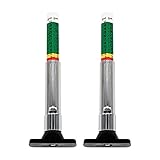
- Accurate measures tire tread depth gauge tool
- Calibrated from 0 to 1 inch in 1/ 32 inch
- Red range on bar: 0-3/32; Yellow Range on bar: 3/32 - 6/32; 5. Green Range on bar: 6/32-32/32
- Pocket-sized gauge, easy handy
- 2 pack
Record the date for every tire you are considering. Tires sold as a set may not have been made in the same week or even the same year.
Apply manufacturer guidance instead of a universal age rule
NHTSA advises checking the manufacture date when purchasing and following the vehicle or tire manufacturer’s replacement timeframe. Some manufacturers recommend replacement after six to 10 years, but that range is not a universal NHTSA age limit. The correct interval depends on the relevant manufacturer’s guidance, the tire’s condition, storage, service history, and climate.
Age does not make every tire automatically unacceptable, and a recent date does not erase damage or an unknown history. Use the date as one part of the decision and ask the manufacturer or a qualified professional when the applicable replacement recommendation is unclear.
Require a professional internal and external inspection
Why demounting matters
USTMA recommends that a qualified tire-service professional inspect a used tire internally and externally before mounting it. The tire must be removed from the wheel to examine the inner liner, bead, sidewall interior, and any repair. A professional can identify scuffing, creasing, run-flat evidence, separation, or an improper repair that is invisible while the tire remains mounted.
Best Value

- 1. Accurately measures tire tread depth gauge tool, Calibrated from 0 to 1 inch in 1/32 inch
- 2. Color coded tire tread depth gauge tool clearly indicates the tire different phase by colors
- 3. Tire tread depth gauge of Red range on bar: 0-3/32; Yellow Range on bar: 3/32 - 6/32; 5. Green Range on bar: 6/32-32/32
- 4. Comes with a pocket clip, easy to carry a tire tread depth gauge tool
- 5. Tire tread depth gauge tool reads in 32nds Suitable for trucks, motorcycles, automobiles and any passenger vehicle
What to ask the tire shop to document
- Whether the inner liner shows abrasion, stretching, or heat damage.
- Whether the bead and bead seat are intact and suitable for the wheel.
- Whether a puncture repair uses an acceptable patch-and-plug method and is located in a repairable area.
- Whether there are signs the tire was driven underinflated, overloaded, or flat.
- Whether the tire holds air and can be balanced without abnormal runout or vibration.
Arrange this inspection before paying for mounting. If a seller refuses to let a qualified professional demount the tire, or if the tire is already mounted and cannot be inspected without an additional charge, include that uncertainty in the price decision. Walking away is prudent when the condition cannot be established.
Independent reader supportYour contribution helps us test, update, and keep practical guides available for everyone.Investigate the tire’s history and the seller
Questions worth asking
- Why is the tire being sold?
- Which vehicle was it removed from, and was that vehicle involved in a collision?
- Has it ever been punctured, repaired, driven flat, or used on a commercial, trailer, track, or heavily loaded vehicle?
- How was it stored, and for how long?
- Are the other tires from the same set available, with matching dates and wear?
A complete answer does not replace an inspection, but evasive answers or no history increase uncertainty. Do not treat a seller’s statement that the tire was “inspected” as equivalent to a demounted inspection by a qualified tire professional.
Compare total installed cost
Compare each candidate on the same basis: purchase price, shipping or transport, demounting, mounting, balancing, valve stems, tire-pressure-monitoring service, and disposal of the old tire. A low-priced tire can lose its advantage if it requires extra work or cannot be safely installed. The relevant comparison is the cost of a properly inspected, fitted, and balanced tire—not the listing price alone.
The Tool Desk
Outbyte Driver Updater FREEFix the driver behind crashes, sound loss and screen glitchesFind Drivers →Outbyte PC Repair FREEClear out junk files and repair common Windows errorsFree Scan →A practical used-tire screening table
| Check | Acceptable evidence | Reject or pause when |
|---|---|---|
| Vehicle fit | Complete sidewall size and specification match the placard or a manufacturer-approved alternative. | Size, load index, speed rating, or intended use is unknown or unsuitable. |
| Tread | Measurements are above 2/32 inch at every point and wear is even. | Any point is at or below 2/32 inch, or wear is sharply uneven. |
| Visible condition | No bulges, exposed cords, deep cuts, structural cracks, or severe scrapes. | Any structural damage or suspicious separation is present. |
| DOT date | Date is legible and consistent with the manufacturer’s replacement guidance. | Date is missing, unreadable, unexpectedly old, or cannot be evaluated for the relevant vehicle or tire maker. |
| History | Seller provides a credible use and repair history. | History is unknown and the seller will not permit professional inspection. |
| Internal inspection | Qualified professional approves the demounted tire before installation. | No qualified inspection is possible. |
Follow this buying sequence
- Collect vehicle requirements. Photograph the door-jamb label and consult the owner’s manual for approved size, load, speed, axle, and drivetrain requirements.
- Pre-screen the listing. Request clear photographs of both sidewalls, the full tread, the DOT TIN, and any repair. Eliminate tires with missing specifications or visible structural damage.
- Verify the date. Read the final four DOT digits on the tire itself and compare the age with the applicable manufacturer guidance.
- Measure in person. Use a tread-depth gauge at multiple circumferential and cross-tread locations. Note the lowest reading and any irregular pattern.
- Schedule demounting. Have a qualified tire-service professional inspect the inside and outside before mounting. Ask for a written or clearly explained condition assessment.
- Install as directed. Confirm axle placement, balancing, valve and TPMS service, and the vehicle maker’s inflation pressure.
- Recheck after installation. Monitor pressure and watch for vibration, pulling, unusual noise, a bulge, or unexplained pressure loss. Stop driving and seek immediate professional attention if a warning sign appears.
When buying new is the better decision
Choose a tire with known condition rather than an uncertain used tire when the date, history, fit, or internal condition cannot be verified; when tread is at or below 2/32 inch; when wear is irregular; or when the total installed cost approaches that of a suitable replacement with a documented condition. This is a risk-management decision, not a claim that every used tire is unsafe.
U.S. guidance and local requirements
The recommendations above reflect NHTSA and USTMA consumer and service guidance and are written for U.S. buyers. State laws, inspection rules, labeling requirements, and commercial-tire standards can differ. Check the rules where the vehicle is registered, but do not rely on legal minimums as a guarantee of suitability for your vehicle or driving conditions.
Quick Recap
Product prices and availability are accurate as of the date/time indicated and are subject to change. Any price and availability information displayed on Amazon at the time of purchase will apply.




