Yes—but mainly as solar-assisted electric vehicles. Integrated photovoltaic panels can add useful energy while a car is parked or moving, reduce how often you plug in, and lower the share of electricity drawn from the grid. They do not currently make conventional charging unnecessary for most drivers.
Whether the benefit is meaningful depends on local sunlight and season, where the car is parked, exposed panel area, vehicle efficiency, annual mileage, and how the solar energy is routed into the battery. The strongest published results are conditional measurements, models, or manufacturer demonstrations—not a universal range promise.
As an Amazon Associate I earn from qualifying purchases.
What “solar-powered car” means in practice
Most modern proposals are better described as vehicle-integrated photovoltaics (VIPV). Solar cells are built into body panels—usually the roof and, where practical, parts of the bonnet, tailgate, or sides. An energy-management system sends the electricity to the traction battery or uses it for the vehicle’s electrical loads.
Free tools Windows power users keep installed
One-click scans. No signup required.
That is different from a car that runs only on sunshine. A passenger vehicle has limited surface area, spends time in shade or at low sun angles, and consumes more energy on some trips than its panels can collect. The practical question is therefore not “Can sunlight power the car?” but “How much of this car’s annual energy can its integrated panels supply under my conditions, and how often will I still need to charge?”
#1 Best Overall
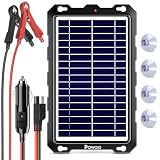
- Upgrade Intelligent Charge Controller: Built-in internal protection system and smart fast charging Cooperate with Quality solar silicon material ensures high conversion and stable output the solar panel's energy conversion efficiency to 25-30%
- Smart Internal Protection System: From POWOXI technology Solar battery charger will not damage the battery and overcharge. The built-in smart protection system and blocking diode structure ensures no overvoltage and short circuit. Make charging safer
- Stronger & More Long-lasting: The 7.5W solar car battery charger adopts high-transparency glass, which is high-strength, impact-resistant, wind-snow-resistant low-iron tempered. This waterproof solar battery charger needs no additional maintenance
- Scratch Protection Design: The ABS+PC frame is stronger than flexible solar panels, so there's no need to worry about the solar panels bending. Aluminum alloy may damage the car paint, but with the ABS+PC frame, for durability this is not a concern
- Easy to Install and Use: The solar battery maintainer is easy to install, and convenient to use, just insert it in the car power outlet, as known as the cigar lighter socket or connect the solar panel to the battery with the alligator clips directly
The answer is potentially useful supplementation. A solar-equipped EV can gain energy while parked at work or at home and may arrive at a plug-in charger less often. Drivers should still plan for ordinary AC or DC charging, particularly for long journeys, winter driving, covered parking, or repeated high-mileage use.
What the latest road data and modeling actually show
Two European project updates provide the clearest context, but they should not be treated as interchangeable. TNO reported measured drive-cycle results in September 2025, while Fraunhofer ISE’s 2026 summary combined a much larger dataset with modeled scenarios. Each figure below retains its date, method, and assumptions.
| Source and evidence type | What was studied | Reported result | How to interpret it |
|---|---|---|---|
| TNO, 8 September 2025 Road measurements and initial modeling |
18 instrumented vehicles; more than 1 million kilometres on European roads over nine months, with measurements beginning in March 2024 | Average modeled irradiance of 2.8 kWh/m²/day on vehicle tops and 1.3 kWh/m²/day on sides; side-mounted panels received about 50% less irradiance than rooftop panels | Real driving confirms that orientation and shading matter. These are study averages, not a daily output guarantee for every car. |
| TNO, 2025 initial Lightyear 0 result | Early data from the project’s solar-vehicle measurements | Up to 50% of annual energy in Southern Europe and 35% in Central Europe | TNO described this as an initial result and said more seasonal data was needed. |
| Fraunhofer ISE, 2026 Measured data combined with satellite, weather, vehicle, and driving profiles |
About 1.3 million kilometres of data from 23 vehicle types, ranging from compact passenger cars to heavy trucks | Modeled best-case coverage of up to 55% of annual passenger-car energy in Central Europe and up to 80% in Southern Europe | The upper figures assume a passenger car with a large roof area and short annual usage cycles. They are not typical-driver guarantees. |
| Fraunhofer ISE, 2030 system scenario | Simulation in which all new vehicles sold from 2024 through 2030 were equipped with VIPV | Up to 15.6 TWh of European grid electricity demand avoided in 2030 | This is a regional, system-level scenario—not a prediction of one owner’s annual savings. |
TNO senior consultant Lenneke Slooff said the Netherlands and North Germany drive-cycle measurements “confirm that side-mounted panels receive approximately 50% less irradiance than rooftop panels,” supporting the earlier 2.8 kWh/m²/day top and 1.3 kWh/m²/day side assumptions. TNO also identifies shading and user behavior as material challenges. Read TNO’s full update.
The Tool Desk
Outbyte Driver Updater FREEScan for outdated or missing drivers - takes under a minuteDriver Scan →Outbyte PC Repair FREEClear out junk files and repair common Windows errorsFree Scan →Fraunhofer ISE senior engineer Christian Braun recommended refining shading models and adding route-location and usage-specific behavior to improve VIPV predictions. That qualification matters: a modeled percentage can be technically sound while still being a poor forecast for a particular street, workplace, season, or parking routine. See Fraunhofer ISE’s 2026 summary.
Why one driver gets much more solar energy than another
Geography and season
Solar availability changes with latitude, cloud cover, daylight hours, and the sun’s angle. The published Southern European and Central European percentages are therefore not portable promises. A car used in a sunnier region may collect substantially more annual energy than the same vehicle used under cloudier skies; winter can be the limiting season even where summer output looks impressive.
Rank #2

- 【Ultra-Smart MPPT Technology】This 12v solar panel battery charger is crafted with SUNER POWER's unique Ultra-Smart MPPT( Max Power Point Tracking) technology, the innovative MPPT allows to deliver high tracking efficiency of up to 99% and peak conversion efficiency of 98%, improving approximately 20%-30% utilization rate than other competitors
- 【Improved 3-stages Charging】The improved 3-Stages charging algorithm (Bulk, Absorption, Float) allows to charge 12-volt battery more effectively, ensures battery is safely recharged and increases battery life and performance
- 【Free Maintenance】The solar trickle charger stops charging when battery has full charge, and automatically resumes when battery has discharge, totally free maintenance. A fully-automatic, worry-free and smart 12volt solar charger
- 【Full Safety Protections】Built-in multiple protections including over-charge, over-discharge, over-voltage, over-current, over-load, short circuit, reverse polarity, and over-temperature, waterproof and spark-proof, the battery is fully protected
- 【Wide Compatibility】It's not just a solar powered battery charger, it's an advanced solar battery maintainer for 12-volt sealed lead-acid car, automotive, marine, RV, power sport, boat, dump trailer, motorcycle, trolling motor, tractor, ATV and deep-cycle batteries, including flooded, gel, AGM, SLA and maintenance-free, plus lifepo4 lithium batteries
Parking shade
A car parked under a tree, between tall buildings, inside a garage, or beside larger vehicles may spend its most useful charging hours partially shaded. Moving the car later does not recover energy that was unavailable earlier. TNO’s work emphasizes that shading models and actual user behavior need more refinement, so a brochure maximum should never be treated as a guaranteed daily intake.
Panel area and orientation
The roof generally offers the broadest, least obstructed surface. Side panels can add area, but they receive less irradiance in real driving. TNO measured roughly half the irradiance on side-mounted panels compared with rooftop panels in the cited drive cycles. A vehicle with a large roof therefore has a structural advantage over a small car with little exposed horizontal surface.
Recommended Free Tools
Vehicle efficiency and annual mileage
The same solar yield represents a larger share of energy demand in an efficient car driven a short distance each year. That is why Fraunhofer ISE’s highest modeled passenger-car percentages assume short annual usage cycles. A driver covering long motorway distances will consume energy faster than the panels can replenish it and should expect solar to cover a smaller fraction of total demand.
How the energy is managed
Output can be used for propulsion, auxiliary loads, or battery charging depending on the vehicle’s electrical architecture and control software. The useful figure is not panel area alone; ask how much electricity reaches the traction battery under the manufacturer’s stated conditions and whether that figure is measured or modeled.
Measured results, modeled scenarios, and company claims are not the same
When comparing solar-car announcements, classify the evidence before comparing numbers:
Rank #3

- 【High-Efficiency Monocrystalline Core 】 Precision-engineered with premium monocrystalline cells delivering 20%-25% photoelectric conversion efficiency (STC), outperforming polycrystalline and amorphous counterparts in energy yield under equivalent conditions.
- 【Ultra-Thin & Flexible Design (0.11in, Coin-Thin)】At only 0.11 inches thick (as thin as a coin), this flexible panel conforms to curved surfaces. Install on windshields, sunroofs, or boat decks with included suction cups and carabiners—no drilling required, no bulky setup.
- 【4 Plug-and-Play Charging Methods】Comes with 4 connection options: cigarette lighter plug, alligator clips, OBDII adapter, and ring terminals. Plug-and-play setup works for cars, boats, RVs, and motorcycles—no complicated wiring needed.
- 【Sustainable Energy Autonomy】 Solar-powered preservation ideal for infrequently used assets. Proactively combats parasitic drain from vehicle telematics/alarms, ensuring instant start readiness. Engineered for battery longevity, not deep-cycle recharge.
- 【Fail-Safe Charging Intelligence】 Integrated smart controller enables autonomous charge cycling - halting at full capacity, reactivating upon voltage drop. Guarantees zero reverse current discharge for perpetual battery safeguarding.
- Measured road data: instrumented vehicles are driven through specified routes and conditions. TNO’s 2025 update falls into this category, although its Lightyear 0 percentage was labeled an initial result.
- Modeled scenarios: researchers combine vehicle data with weather, satellite, route, and usage assumptions. Fraunhofer ISE’s 2026 percentages are best-case modeled outcomes, not a warranty for an individual car.
- Manufacturer demonstrations or estimates: a company reports its own prototype, development vehicle, or planned specification. These figures can show technical potential but do not establish independent, repeatable performance across ordinary cars.
Ask for the geography, season, route, shade assumptions, panel area, battery state-of-charge limits, and whether the range number was measured or estimated. Without those details, two percentages may look comparable while describing entirely different conditions.
Windows Errors? Fix Them Before They Spread
Repair common Windows errors and clear accumulated junk for a smoother, more stable PC - no reinstall needed.Free scan · no reinstallCrashes, No Sound, or Screen Glitches?
Random freezes, missing sound and display glitches usually trace back to one bad driver. Find and replace yours safely.Free scan · under a minuteWhat current vehicle announcements do—and do not—prove
Lightyear’s Nissan demonstration
In a 27 January 2026 announcement, Lightyear described a solar solution demonstrated with Nissan. The company cited approximately 3.8 m² of panels and up to 23 km of extra range in clear, sunny conditions. Those are Lightyear’s figures for that demonstration, limited to the stated weather; they are not an independently established result for every Nissan vehicle or a typical annual range gain. Read Lightyear’s announcement.
The same announcement makes the practical limitation explicit: integrated solar is intended to reduce charging needs, not replace plug-in charging. It also describes a development and near-production-ready solution, which is not the same as a universally purchasable solar passenger car or a retrofit compatible with arbitrary existing vehicles.
Sono Motors’ Sion and Solar Bus Kit
Sono Motors’ 2022 production-design announcement listed 456 solar half-cells, a 54 kWh battery, and an estimated 305 km range for the planned Sion. The company estimated an average solar extension of 112 km per week, with up to 245 km per week. Those were forward-looking company estimates attached to a planned production design; they do not confirm current retail availability or delivered real-world performance. See Sono Motors’ 2022 release.
The same release described a Solar Bus Kit rated at about 1.4 kW peak across roughly 8 m². Sono estimated up to 1,500 litres of diesel and four tonnes of CO₂ saved per bus annually, with an approximately three-to-four-year payback depending on operating days and fuel prices. Those are historic projections for buses, not evidence that a passenger-car solar retrofit will deliver the same result.
What’s actually slowing this PC down?
Pick the symptom - the matching free tool is one click away.
Rank #4
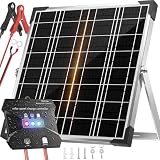
- High-Efficiency MPPT Solar Charger - Advanced tracking technology delivers 20-30% faster charging for 12V batteries. A+ monocrystalline panels maximize power conversion. Perfect 20W solar trickle charger for cars, RVs, boats, and trailers. More sun captured, less time waiting.
- Advanced Multi-Layer Protection - Built-in safeguards prevent overcharge, over-discharge, short circuit, and reverse polarity damage. Smart controller stops draining power at night. Keeps your 12V battery healthy and extends lifespan. Worry-free operation for long-term use.
- Universal 12V Battery Compatibility - Works with LiFePO4, AGM, Gel, Flooded, and Lithium Ion batteries. Ideal as RV solar battery charger, trailer solar battery charger, or marine solar battery charger. One versatile solution for all your 12V charging needs.
- IP67 Waterproof & Weather-Resistant - Marine-grade construction withstands -40°F to 185°F. Built for harsh outdoor conditions - rain, snow, or extreme heat. 25+ year lifespan with corrosion-resistant materials. Perfect for boats, RVs, off-grid solar systems, and trailers.
- Plug-and-Play Installation - Pre-drilled mounting holes enable 30-second setup - no tools required. Auto-stop charging when battery is full, auto-resume when voltage drops. LED indicators display real-time status (25%-100%). Perfect for camper, gate opener, and dump trailer use.
Neither announcement establishes a universal, plug-and-play solar propulsion panel for ordinary passenger cars. A generic panel placed on a vehicle may lack the required crash integration, weather sealing, power electronics, battery controls, and high-voltage safety systems. Treat integrated VIPV as vehicle engineering, not as an accessory that can be assumed compatible with any EV.
Which everyday driving patterns are most favorable?
| Driving and parking pattern | Likely practical value of integrated solar | What still matters |
|---|---|---|
| Low annual mileage, sunny region, outdoor parking with an unobstructed roof | Most favorable. Solar could supply a meaningful share of annual energy and reduce plug-in frequency. | Confirm seasonal data and the vehicle’s measured output, not just a clear-day maximum. |
| Moderate mileage, mixed sun and shade, mostly daytime parking | Potentially useful as a supplement, especially for short trips between parking periods. | Shade, roof area, and local winter performance will determine whether the difference is noticeable. |
| High-mileage motorway use or frequent long trips | Usually a smaller fraction of total consumption because driving demand outpaces onboard generation. | Reliable access to home, workplace, or public charging remains central. |
| Garage parking or dense urban parking with frequent obstruction | Limited unless the vehicle regularly spends time in direct sunlight elsewhere. | Calculate the actual exposed hours; panel capacity is irrelevant when the panels are shaded. |
| Cloudier or higher-latitude climate with strong seasonal variation | Useful in brighter months but less dependable as an annual substitute for charging. | Demand independent winter figures and the location used for the estimate. |
This is a decision framework, not a promise of a particular range. The most favorable case combines high solar exposure, a large roof, an efficient vehicle, and short annual usage. The least favorable case combines shade, little exposed area, high mileage, and a winter-heavy schedule.
Independent reader supportYour contribution helps us test, update, and keep practical guides available for everyone.How to evaluate a solar-integrated EV before buying
- Map where the car actually parks. Note whether the roof is exposed from morning through afternoon, and record recurring shade from buildings, trees, balconies, and neighboring vehicles.
- Separate seasons. Request monthly or seasonal production estimates for your region. An annual average can hide a large summer-winter imbalance.
- Check the exposed area and panel layout. Ask for roof and side-panel areas separately. TNO’s measurements show why side area should not be valued like roof area.
- Match solar energy to your mileage. Compare the vehicle’s stated energy consumption and your annual kilometres with the solar estimate. Short, predictable trips are easier for onboard generation to offset than repeated long journeys.
- Identify the evidence label. Is the number measured on public roads, modeled from weather and usage data, or supplied by the manufacturer? Record the test location, period, route, and weather assumptions.
- Confirm charging access anyway. Keep a dependable home, workplace, or public charging option. Solar should reduce visits, not remove the need for a charging plan.
- Check service and warranty coverage. Integrated body panels, power electronics, and battery interfaces are part of the vehicle system. Confirm who repairs them after collision or panel damage and whether replacement parts are available.
- Ignore an unqualified clear-day maximum. A figure such as “up to” describes a favorable boundary condition. It is not the amount the car will add every day or every week.
Common mistakes when judging solar-car practicality
Treating annual percentages as personal savings
“Up to 55%” in Central Europe and “up to 80%” in Southern Europe come from Fraunhofer ISE’s modeled best-case passenger-car scenarios with a large roof and short annual use. They should not be converted directly into a household’s expected bill reduction without substituting its location, mileage, parking, and vehicle efficiency.
Comparing a prototype range claim with a measured fleet result
Lightyear’s 23-km clear-sun demonstration figure, TNO’s drive-cycle irradiance measurements, and Fraunhofer ISE’s modeled annual shares answer different questions. A valid comparison must hold geography, season, panel area, route, and evidence type constant.
Assuming every body panel contributes equally
Roof and side surfaces see different irradiance. Curvature, orientation, shadows from mirrors or roof rails, and nearby obstructions can further reduce usable output. Panel count alone is not a performance metric.
Best Value

- 【High Conversion Rate】This 20W solar panel with monocrystalline A+ solar cell has an excellent cell efficiency of 21%-30%. Designed to charge and maintain 12V rechargeable batteries like LiFePO₄, Lithium Ion, AGM, SLA, GEL, EFB, MF, etc. Keep batteries in charged for trailer, tractor, truck, boat, motorcycle, RV, car, lawn mower, water pump, gate opener, electric fence, etc
- 【Built to Last】 Low-iron tempered glass surface and corrosion-resistant aluminum frame, make this solar panel 100% waterproof and rustproof, and provide the prolonged lifespan up to 25 years. This 12V solar panel can withstand all weather conditions such as sandstorm, strong wind, thunderstorm, blizzard, hail, etc. It can withstand up to 2400Pa wind pressure and 5400Pa snow load
- 【Smart MPPT Controller】The charging efficiency of this upgraded 10A controller is 30% higher than other controllers on the market. Its intelligent three-stage charging design effectively prevents the battery from overcharging, over-voltage and short circuit. It takes no power from the battery. You will clearly know the charging status of the battery through the two indicator lights on the controller
- 【360° Adjustable Bracket & Plug-and-Play Installation】Comes with a fully 360° angle adjustable mounting bracket, which allows you to adjust the solar panel to the optimal sun-facing angle for maximum solar energy absorption and higher charging efficiency. Pre-drilled mounting holes and matched screws greatly simplify the installation process, no complicated tools or professional skills are required. All cable connections support plug-and-play, enabling quick and effortless installation and disassembly for both indoor and outdoor scenarios.
- 【Complete Accessories & Reliable After-Sales Service】Our SOLPERK Solar Panel kit includes 1*20W solar panel, 1*smart MPPT charge controller, 1*adjustable mounting bracket, 1*alligator clip, 1*O-ring and a full set of mounting accessories to meet your diverse installation and use needs. We offer 1-year professional after-sales service and lifetime technical support, with 7×24-hour online customer service to respond to your questions and solve problems within 24 hours, bringing you a worry-free shopping and using experience.
Planning to drive without a charging fallback
Solar production is intermittent and weather-dependent. Long trips, several cloudy days, garage parking, and winter demand can exhaust the battery faster than the panels replenish it. Integrated solar changes charging frequency; it does not eliminate charging infrastructure.
So, are solar-powered cars practical for everyday driving?
They are practical when the goal is supplemental energy: reducing plug-in frequency, recovering some energy while the car is parked, and lowering grid demand for drivers with good sun exposure, efficient vehicles, and modest annual mileage. The technology is less compelling when the car is shaded, stored indoors, driven long distances, or expected to operate independently of charging.
The evidence is moving from prototypes toward larger measurement sets. TNO’s road data confirms the importance of roof-versus-side exposure and real-world shading, while Fraunhofer ISE’s 2026 analysis shows that VIPV could cover a substantial share of annual passenger-car energy in carefully defined best-case scenarios. Neither establishes one universal percentage for all drivers.
Quick wins for a faster PC:
Fix the driver behind crashes, sound loss and screen glitchesFind Drivers →Repair Windows errors before they cause bigger problemsFix Now →Use solar as one input to an EV decision, not as a replacement for a charging plan. The practical buyer’s test is simple: identify the car’s real parking exposure, annual kilometres, local seasonal sunlight, and the source and conditions behind every quoted range figure. If those answers line up, integrated solar can be a worthwhile efficiency feature; if they do not, conventional plug-in charging will remain the dependable foundation.
Quick Recap
Product prices and availability are accurate as of the date/time indicated and are subject to change. Any price and availability information displayed on Amazon at the time of purchase will apply.




