Do these 3 things before closing this tab:
1Repair Windows errors before they cause bigger problems2Scan for outdated or missing drivers - takes under a minute3Clear out junk files and repair common Windows errorsSome links on this page are affiliate links: if you buy through them we may earn a commission, at no extra cost to you.
In the United States, an electric flying car must be legal twice: it has to meet motor-vehicle requirements when driven on public roads and FAA aircraft requirements when flown. An FAA approval does not make a vehicle street-legal, and state registration does not give it permission to take off.
Powered-lift rules now exist, but that does not mean a consumer can buy any vehicle, drive it home, and fly it anywhere. Legality depends on the specific aircraft’s certification category, airworthiness status, pilot qualification, operating limitations, launch and landing site, airspace, weather, and the state and locality where the road portion occurs.
As an Amazon Associate I earn from qualifying purchases.
What “legal” means for a flying car
A roadable electric aircraft sits under two separate regulatory systems. The road system covers the vehicle as a motor vehicle; the aviation system covers it as an aircraft. Each system has its own approval, registration, equipment, operating and insurance requirements.
Road use and flight are separate permissions
- On the road: federal motor-vehicle safety requirements and state rules can govern title, registration, driver’s-license class, insurance, lighting, braking, dimensions and road-speed limits.
- In the air: FAA rules govern aircraft registration, airworthiness, pilot certification, operating limitations, maintenance, inspection, airspace, weather and the takeoff or landing site.
Passing one system does not satisfy the other. A vehicle may be registered with a state department of motor vehicles but not be airworthy. Conversely, an aircraft may have an FAA certificate yet be impossible to register for ordinary road use in a particular state.
Popular on Amazon
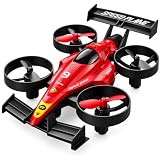
- 2-in-1 Land & Air RC Toy — One-button switch transforms this flying car from a ground racing car to a stunt drone in seconds. Drive on the floor or soar through the air — double the fun in a single toy for boys and girls ages 6-12. No more boring single-function vehicles!
- Beginner-Friendly Controls — Altitude hold (auto-hover), one-key takeoff/landing, and headless mode make this rc drone car easy to fly for kids age 6+. 3-speed adjustment, 360° flips, and auto-circle mode at the push of a button. 2.4GHz anti-interference ensures stable, frustration-free control.
- Durable Drop-Resistant Design — Built with premium PP+ABS material to survive crashes, drops, and hard landings. The lightweight compact body (4.9 x 6.9 x 2 inches) improves flight response and battery efficiency. Colorful LED night lights add extra excitement for indoor and outdoor evening play.
- Dual Rechargeable Batteries Included — Each battery provides ~8 minutes of flight or ground driving time. Swap instantly and keep the action going. USB rechargeable for convenience. (Remote control requires 3 AAA batteries, not included.)
- Perfect Gift for Kids Ages 6-12 — Ideal for birthday, Christmas, and holiday gifting. This 2-in-1 rc car drone helps develop hand-eye coordination, spatial awareness, and directional judgment — far more educational than ordinary toys. A top choice gift for boys and girls who love cars, planes, and STEM toys.
What the FAA’s powered-lift rules changed in 2024
The FAA’s October 2024 final rule integrated powered-lift aircraft into the National Airspace System. The Department of Transportation summary says the rule permanently amended relevant pilot-certification and operating provisions and created a ten-year Special Federal Aviation Regulation.
What counts as powered-lift
The Federal Register describes powered-lift as an aircraft capable of vertical takeoff and landing that transitions to wing-borne forward flight. That description covers the flight concept used by many electric vertical-takeoff-and-landing designs, but it does not certify any particular model.
Free tools Windows power users keep installed
One-click scans. No signup required.
A framework is not the same as a certified product
The 2024 final rule stated: “Currently, there are no type-certified powered-lift in civil operations; however, there are several applicants seeking type certificates for such aircraft.” This is the critical distinction for buyers. The FAA has rules for how powered-lift pilots and operations can be regulated, while aircraft designers still must obtain the appropriate certification and demonstrate compliance before a mass-market aircraft can operate under unrestricted normal-category assumptions.
The rule also preserved operating rules under Parts 91, 97, 135 and 136. Which provisions apply depends on the aircraft category and the proposed operation. A private experimental flight, a scheduled air-taxi service and a future type-certificated personal aircraft will not have identical permissions.
Aircraft certification, registration and airworthiness
FAA paperwork uses several terms that are often confused in marketing material. Registration identifies an aircraft in the federal record; it does not establish that the aircraft is safe to fly or approved for every mission.
Registration is an identification record
The FAA assigns an aircraft registration record and identification information. The registry itself warns that its information “should not be used to determine the airworthiness of an aircraft.” A registration entry therefore cannot answer whether a particular aircraft may carry passengers, operate commercially, use a given airport or fly beyond its operating limitations.
Quick wins for a faster PC:
Fix the driver behind crashes, sound loss and screen glitchesFind Drivers →Clear out junk files and repair common Windows errorsFree Scan →Scan for outdated or missing drivers - takes under a minuteDriver Scan →Airworthiness is a separate determination
The FAA states that a civil aircraft cannot be flown unless it is certificated as airworthy. Before a flight, an owner or operator must know the certificate category, the aircraft’s operating limitations, required maintenance and inspections, pilot qualifications and whether the planned operation complies with the applicable rules.
Certificate categories affect what you may do
- Experimental or special-airworthiness aircraft: normally operate under specific limitations issued with the certificate. Those limitations can restrict where the aircraft may fly, who may fly it, what testing or demonstration is permitted and whether passengers or compensation are allowed.
- Light-sport or other limited categories: have their own eligibility, maintenance, pilot and operating requirements. The label does not automatically authorize ordinary road use or unrestricted passenger service.
- Type-certificated aircraft: are approved against a defined design and operating basis, but still require a current airworthiness status, qualified pilot, compliant maintenance and lawful operating environment.
Ask for the actual certificate and operating limitations for the delivered aircraft, not just a brochure statement that a prototype, concept or company has received an approval.
Do you need a pilot license to drive one?
A car driver’s license may be enough for the road portion if the vehicle is legally registered and the state permits that driver’s license class. It does not authorize flight. Once the vehicle leaves the ground, the operator must hold the FAA certificate and aircraft qualification required for the applicable powered-lift category and operation.
Why an ordinary pilot certificate may not be enough
The 2024 powered-lift rule created alternate pathways for initial powered-lift pilots and instructors, including aircraft with a single pilot station. The precise pathway depends on the aircraft and the operation. Readers should not assume that a private-pilot certificate, a drone TRUST test or a driver’s license alone qualifies them to fly a piloted electric aircraft.
The Tool Desk
Outbyte Driver Updater FREEScan for outdated or missing drivers - takes under a minuteDriver Scan →Outbyte PC Repair FREEClear out junk files and repair common Windows errorsFree Scan →Training may include powered-lift-specific knowledge, flight experience, practical testing, endorsements, medical eligibility and currency requirements. The exact combination can change with the aircraft’s certification category and whether the operation is private, instructional, commercial or another regulated activity.
Also popular on Amazon

- Dual Land-Air Modes - 2 in 1 rc plane and rc car goes from road to air and back with one button. Packed with one-key takeoff, stable hovering, racing mode, and 360° aerial flips, can drive on the ground and fly in the air. Whether indoors or outdoors, playing RC drones with friends or family is the perfect choice.
- 360° Flip & Aerial Stunts - The remote control plane car adopting 2.4G wireless remote control technology, it ensures stable signal transmission within 32.8ft. The rc plane equipped with high/medium/low speed settings, plus one-key takeoff/landing. Kids make 360° whirling turns while staying suspended in air as steady. Perfect for 8 9 10 11 12 year old boys girls for indoor and outdoor play.
- Safe for Kids - Featuring four built-in propellers with a unique protective structure, this foam remote control airplane ensures flight safety, and the ultra-tough EPP foam structure absorbs impacts, providing higher safety for kids.
- Long-Lasting Battery - Comes with 2 high-quality rechargeable batteries. Each battery approx 15 minutes in ground drift mode about approx 7 minutes in aerial flight mode, back to completely charged in 1 hour. Suitable for longer outdoor-indoor play. Play Longer, Explore Further Equipped.
- Ideal Gifts for Kids - The rc drone suitable for both indoor and outdoor use, this remote-control drone performs aerial stunts and off-road driving on the ground, offering rich and varied gameplay. Ideal gift for kids boys aged 8 9 10 11 12.
What to verify before training or purchase
- The exact FAA pilot certificate and powered-lift category or rating required for that model.
- Whether the aircraft has one pilot station and qualifies for an alternate pathway under the current rule.
- Required medical, knowledge, flight-training, practical-test and currency standards.
- Whether the aircraft’s operating limitations require a particular instructor, checkout or proficiency program.
- Whether the planned use involves compensation, passenger carriage or another operation with additional rules.
Can you fly through controlled airspace?
Sometimes, but not simply because the aircraft is electric or registered. Airspace access is specific to the location, route, aircraft, pilot, weather and operation.
Permissions and procedures that can apply
- Prior authorization to enter certain controlled airspace.
- Airport-specific arrival, departure, communication and traffic-separation procedures.
- Weather minima and visibility requirements for the aircraft and pilot.
- Compliance with the aircraft’s operating limitations, including any geographic or altitude restrictions.
- Coordination with the takeoff or landing site and any applicable local authority.
FAA recreational-drone guidance illustrates the general principle that controlled airspace may require prior authorization and that operators remain responsible for avoiding other aircraft. Drone guidance is not the rulebook for a piloted flying car, however; a powered-lift operator must use the rules and authorizations applicable to the aircraft and operation.
Airspace is not a blanket right of access
Even if a route appears clear on a map, the flight can be unlawful if the pilot lacks required authorization, violates an operating limitation, ignores an airport procedure or launches in weather below the applicable minimum. A road trip to an airport does not eliminate those flight obligations.
PC Slower Than It Used to Be?
A free scan shows the junk files, broken settings and background clutter dragging Windows down - then fixes them in one click.Free scan · Windows 10 & 11Outdated Drivers Are Slowing You Down
One free scan finds every outdated or missing driver and matches the right update for your exact hardware.Free scan · exact hardware matchCan you take off from a driveway or public road?
Usually, you cannot assume so. A driveway, street or empty parking lot is not automatically an approved aviation site.
Site issues that must be resolved
- The aircraft’s certificate and operating limitations may specify approved or prohibited launch and landing areas.
- Local zoning, nuisance, fire, building and public-safety rules may restrict vertical operations.
- Private-property permission is different from permission to use the surrounding airspace.
- Public roads are designed for ground traffic; stopping, blocking lanes or launching may violate state or local traffic law even if the aircraft could technically lift off.
- Nearby airports, heliports, obstacles, people, power lines and buildings can make a site unsuitable or unlawful.
A lawful flight plan therefore needs both an aircraft- and pilot-compliant operation and a lawful, suitable launch and landing site. “It fits in my driveway” is not an aviation authorization.
What makes the road portion legal?
No cited source establishes one nationwide flying-car road-registration rule. Road legality depends on the delivered configuration and the jurisdiction where it will be driven.
Federal and state requirements can overlap
Federal motor-vehicle safety requirements may apply to the vehicle’s design and equipment. State law then controls matters such as title, registration, driver’s-license class, insurance and inspection. Local governments may add rules affecting parking, road use, noise or operations.
Equipment and dimensions matter
Road authorities may examine lighting, braking, mirrors, tires, seat belts, signals, visibility, vehicle width, height, weight and road-speed capability. An aircraft configuration can also create unusual issues: folded rotors or wings may change dimensions, while exposed aviation components may not satisfy ordinary road-equipment rules.
“Road-legal” is not a universal status
A manufacturer may describe a design as road-legal based on a particular jurisdiction, prototype configuration or intended conversion process. Before paying a deposit, obtain written confirmation that the exact delivered vehicle can be titled, registered, insured and driven in your state, with the required equipment installed. Verify whether the statement applies to a production vehicle rather than a demonstration aircraft.
Alef Model Zero: what the public records actually show
Alef provides a useful example of why individual records must be read carefully.
FAA registry entry
The FAA registry lists Alef Aeronautics’ Model Zero 24 as a rotorcraft with an electric engine. The record shows a registration certificate issue date of April 14, 2026, and no type-certificate data sheet listed. The FAA registry warns that registry information should not be used to determine airworthiness.
Also popular on Amazon

- Dual Mode, More Fun: This remote control airplane car toy features a 2-in-1 mode, allowing seamless switching between land mode and air mode with a single button press. Combining ground racing and aerial stunt flight, it offers diverse gameplay and endless fun, making the entire experience far more dynamic than ordinary single-function toys. Perfect for boys and girls aged 8 9 10 11 12 to play with
- Easy to Operate: The rc drone car features wireless remote control with stable signal transmission within a 164ft range and work in the 2.4GHz independent frequency band with absolutely no interference which supports a group of kids to play together without interference, making it a great toy for parent-child interaction and party games. It comes equipped with three speed settings (high/medium/low), 360-degree rotation, one-touch takeoff/landing, and headless mode functionality. Simple to operate, it can be quickly mastered by children aged 6 and above as well as beginners
- Sturdy and Durable: The spider rc airplane is made of durable ABS material, unlike foam which damages easily upon impact. It boasts excellent crash resistance, significantly reducing the risk of collision damage. This provides higher safety assurance for children during play, making it highly suitable for boys and girls aged 8-12 as well as beginners practicing
- More Playtime: The remote control plane is equipped with 3 rechargeable batteries, with a total endurance of 30 minutes. The reference endurance time for a single battery is about 10 minutes in ground drift mode and about 7 minutes in aerial flight mode. It only takes 40 minutes to fully charge a single battery. Note: The remote control requires 3 AAA batteries (not included)
- Perfect Gift for Kids: This rc flying car toy is suitable for both indoor and outdoor play, capable of performing aerial stunts and drifting on the ground, providing a rich and diverse gaming experience. It is something that can keep them away from electronic screens, maintain focus and sustained curiosity, and is very suitable as a birthday gift for boys and girls over 8 years old. Tips: Please do not use it outdoors in strong winds
Company disclosure about an experimental certificate
Alef’s SEC filing says its Model Zero received an FAA experimental special-airworthiness certificate in 2023 and says FAA rules apply in the air while National Highway Traffic Safety Administration rules apply on the ground. Those are company disclosures, not a nationwide authorization for consumers.
What an experimental certificate does and does not mean
An experimental special-airworthiness certificate generally carries operating limitations. It is not blanket approval for unrestricted passenger service, commercial operations or nationwide street use. A person considering such an aircraft would need to review the actual certificate, limitations, maintenance and inspection status, pilot requirements, road-registration evidence and intended operating area.
Independent reader supportYour contribution helps us test, update, and keep practical guides available for everyone.Comparing lawful-use pathways
The same “flying car” description can refer to very different legal situations. This comparison uses the categories and distinctions established by current FAA rules and the available public example; where a value is not established, it is identified as not stated.
| Option | Certification category | Pilot and training | Allowed purpose | Operating limits | Sites and airspace | Road status |
|---|---|---|---|---|---|---|
| Conventional electric vertical-takeoff-and-landing air-taxi service | Aircraft-specific FAA certification required; exact category for a given service is not stated here. | Powered-lift qualification and operator training required; exact pathway depends on the aircraft and operation. | Commercial passenger service may be possible only under the applicable operating rules and approvals. | Set by the aircraft certification, operator approvals and applicable FAA parts, including Parts 135 and 136 where relevant. | Approved or authorized vertiports, airports or other lawful sites; controlled-airspace procedures apply. | Not generally a road vehicle; road registration is not established by the aviation approval. |
| Experimental roadable aircraft | Experimental or special-airworthiness certificate with aircraft-specific limitations. | Required powered-lift certificate, qualification and any limitations-specific checkout or training. | Testing, development, demonstration or other purposes allowed by the certificate; unrestricted passenger or commercial use is not automatic. | Usually detailed in the operating limitations accompanying the certificate. | Launch and landing sites, routes and airspace must comply with the certificate, FAA rules and local permissions. | Must separately satisfy federal and state motor-vehicle requirements; no nationwide rule is established. |
| Future type-certificated personal powered-lift aircraft | Type certification and an appropriate airworthiness certificate would be required; broad civilian availability is not established by the 2024 rule. | Powered-lift pilot certificate or rating, training, testing and currency as required for the model and operation. | Potentially private personal use within the approved category and limitations. | Defined by the type design, flight manual, airworthiness status and operating rules. | Airport or other approved sites, with applicable airspace authorization and traffic procedures. | Still needs separate compliance with state road-registration and equipment rules if designed for road use. |
How to verify a specific vehicle before buying or flying
Use this sequence for any model marketed as both a car and an aircraft. It prevents a road claim, a prototype certificate or a registry entry from being mistaken for complete legal authority.
- Identify the exact delivered configuration. Record the model, serial number, propulsion system, seats, pilot-station layout and whether the vehicle is a prototype, kit or production aircraft.
- Determine the FAA certificate category. Ask for the airworthiness certificate, not just a registration number or a statement that an application has been filed.
- Read the operating limitations. Note approved purposes, passenger restrictions, geographic limits, required inspections, maintenance conditions, test areas and any special pilot or instructor requirements.
- Confirm current airworthiness. Check inspection and maintenance status and identify who is authorized to perform required work. Registration alone cannot answer this question.
- Map the pilot requirement. Obtain the exact powered-lift certificate, rating, medical, training, practical-test and currency requirements for the aircraft and intended operation.
- Plan the route and airspace. Check controlled-airspace authorization, airport procedures, traffic separation, weather minima, obstacles and the aircraft’s altitude or route limitations.
- Approve the launch and landing sites. Secure property permission and confirm local zoning, public-safety, airport or heliport and site-specific requirements.
- Verify road compliance in the actual state. Confirm title, registration, driver’s-license class, insurance, inspection, lighting, braking, dimensions and road-speed rules for the delivered configuration.
- Check passenger and commercial restrictions. Determine whether the certificate permits passengers, compensation, demonstrations, instruction or only a narrower purpose.
- Document the answers. Keep the certificate, limitations, inspection records, registration documents, insurance evidence, state approvals and site permissions together. If a seller cannot provide them, treat the use case as unverified.
Answers to common practical scenarios
“Can I drive it with my normal driver’s license?”
Possibly, but only if the vehicle is legally registered and your state accepts your license class for that configuration. The same license does not authorize flight; the FAA pilot and aircraft requirements begin when you operate it as an aircraft.
“If the DMV registers it, can I fly it?”
No. DMV registration addresses road use. Flight still requires an airworthy aircraft, the appropriate FAA pilot qualification, compliance with operating limitations and a lawful flight environment.
“If the FAA registers it, is it street-legal?”
No. FAA registration creates an aircraft record and identification. It does not certify road equipment, state registration eligibility, insurance compliance or local road use.
“Can I launch from my own property?”
Ownership of the property is only one issue. The aircraft’s limitations, local rules, nearby obstacles and airports, airspace authorization, weather and public-safety requirements all still apply.
“Can I fly it through controlled airspace?”
Only when the pilot, aircraft and operation meet the applicable requirements and any required authorization or airport procedure has been obtained. A powered-lift aircraft is not exempt because it can also drive.
Common mistakes that make a flying car operation unlawful
- Equating an FAA registration number with an airworthiness certificate.
- Assuming the 2024 powered-lift rule means every electric vertical aircraft is type-certified.
- Using a drone test or ordinary driver’s license as a substitute for powered-lift pilot qualification.
- Relying on the phrase “road-legal” without checking the exact state and delivered configuration.
- Treating an experimental special-airworthiness certificate as permission for unrestricted passenger or commercial service.
- Launching from a driveway, public road or parking lot without checking operating limitations and local permissions.
- Planning a route through controlled airspace without the required authorization or airport coordination.
- Ignoring weather, traffic separation, maintenance, inspection and insurance requirements because the aircraft is intended for personal use.
The practical legal standard
A flying car is lawful for a particular trip only when every relevant layer lines up: the vehicle is road-compliant for the ground segment; the aircraft has the correct certificate and current airworthiness status; the pilot holds the required powered-lift qualification; the operation fits the certificate’s limitations and FAA rules; the launch and landing sites are lawful; and the route, airspace, weather and traffic conditions are compliant.
As of the FAA’s October 2024 rule and the public records described above, the United States has a regulatory path for powered-lift operations but not a universal consumer permission slip. Verify the aircraft-specific documents and the state and local road rules before treating any electric flying car as legal to drive and fly.




