Some links on this page are affiliate links: if you buy through them we may earn a commission, at no extra cost to you.
Yes—some classic Toyota pickups can serve reliably as daily drivers, but the badge is not the deciding factor. A truck that is structurally sound, maintained, properly documented and suited to your commute can be dependable. Another truck of the same year can be a constant repair project because of rust, deferred maintenance, modifications or hard use. Treat Toyota’s historical reputation as context, then judge the individual vehicle.
This guide uses “classic Toyota pickup” to mean older Toyota pickups sold in North America, related Hilux models sold in other markets, and early Tacoma trucks. Those names are not interchangeable in every year or configuration, so identify the exact market, model year, engine, drivetrain and cab style before evaluating one as transportation.
As an Amazon Associate I earn from qualifying purchases.
Crashes, No Sound, or Screen Glitches?
Random freezes, missing sound and display glitches usually trace back to one bad driver. Find and replace yours safely.Free scan · under a minuteWindows Errors? Fix Them Before They Spread
Repair common Windows errors and clear accumulated junk for a smoother, more stable PC - no reinstall needed.Free scan · no reinstallWhat “classic Toyota pickup” actually covers
Toyota Pickup, Hilux and Tacoma are different references
Toyota’s Hilux history spans multiple generations and markets. In North America, older trucks were commonly sold as Toyota pickups, while Hilux remained the name in many other countries. Tacoma is a later North American model line. Equipment, engines, transmissions, emissions systems, body dimensions and parts support can differ even when two trucks look similar.
For that reason, a statement such as “classic Toyota pickups are reliable” is too broad to guide a purchase. Record the vehicle identification number, model year, market of original sale, engine code, transmission, drivetrain and cab or bed configuration. Use those details when ordering parts, checking recalls or choosing a manual.
Popular on Amazon
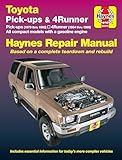
- Step-by-step procedures written from a complete teardown and rebuild, giving you the confidence to tackle repairs at any skill level.
- Over 700+ clear photos and diagrams that simplify complex systems, helping you complete jobs faster and with fewer mistakes.
- Comprehensive troubleshooting and fault-finding guides to quickly diagnose problems and reduce costly downtime.
One historical specification is not a universal specification
Toyota’s corporate history says the early Hilux used a 1.5-liter four-cylinder petrol engine and a four-speed, column-shift manual transmission. That describes an early historical version, not every classic Toyota pickup. Later trucks and vehicles sold in other markets may have different engines, gearboxes, axle ratios and safety equipment.
What Toyota’s reliability reputation does—and does not—prove
The reputation is useful background
Toyota UK Magazine’s 2020 history of the Hilux says it “has earned a reputation as one of the world’s most trusted and reliable commercial vehicles.” That is Toyota’s characterization of the model’s historical standing, not an independent failure-rate study of surviving classic trucks.
The available evidence does not establish generation-by-generation failure rates, typical annual repair bills, fuel-economy comparisons or a controlled reliability comparison with other used pickups. No numerical reliability score or cost guarantee should be inferred from the historical reputation.
Condition matters more than the emblem
Age changes the reliability question. Corrosion, previous collision repairs, neglected fluids, worn suspension, electrical modifications and years of commercial or off-road use can leave two trucks from the same model year with completely different ownership prospects. A well-preserved, regularly serviced example may be easier to live with than a newer truck that has been repeatedly abused.
The practical test is therefore not “Is Toyota reliable?” It is “Is this truck’s structure, mechanical condition, documentation and parts situation good enough for the work I need it to do every day?”
Also popular on Amazon

- Detailed repair and maintenance coverage trusted by professional technicians and DIYers for decades.
- Clear step-by-step instructions supported by wiring diagrams, diagnostic charts, and technical illustrations.
- Covers routine maintenance through advanced repairs, making it the go-to resource for keeping your vehicle running reliably.
Daily-driver suitability: the decision factors that matter
1. Match the truck to your commute
Decide what failure or inconvenience you can tolerate. A short local commute with public transportation available is a different risk from a long highway journey, a job that requires punctual arrival or regular winter travel. Classic trucks may lack the ride quality, climate control, sound insulation, driver-assistance systems and crash protection found in newer vehicles. Those are practical trade-offs, not automatic reliability defects.
Also account for downtime. Even when a repair is straightforward, an older vehicle may need a specialist, a hard-to-find trim piece or a part shipped from another region. If missing work is unacceptable, budget for a backup commute before making the truck your only vehicle.
2. Treat structural corrosion as a purchase-stopping issue
Have a qualified mechanic inspect the frame, crossmembers, suspension attachment points, body mounts, cab floors, bed supports and brake or fuel lines. Surface discoloration is not the same as perforation or weakened structure. The inspector should distinguish cosmetic rust from corrosion that affects load paths, steering or suspension mounting.
Do not rely on photographs or a seller’s description. Dirt, undercoating and fresh paint can hide repairs. A lift inspection with safe access to the underside is more informative than a quick walk-around.
3. Check every system that makes the truck usable
- Brakes: Inspect hydraulic leaks, hoses, hard lines, calipers or wheel cylinders, parking-brake operation and rotor or drum condition.
- Steering and suspension: Check free play, ball joints, tie-rod ends, bushings, wheel bearings, shocks, leaf springs and steering-box condition.
- Tires and wheels: Verify load rating, age, even wear, sidewall condition and whether the spare and jack are usable.
- Engine: Look for oil or coolant leaks, overheating evidence, smoke, unstable idle, hard starting and abnormal noises during a cold start and a fully warm drive.
- Cooling and charging: Test radiator condition, hoses, thermostat behavior, alternator output, battery fitment and grounds.
- Transmission and driveline: Check clutch engagement or automatic shift quality, gear noise, transfer-case operation where fitted, driveshaft joints, differential leaks and axle seals.
- Electrical equipment: Test lighting, wipers, heater, defroster, gauges, horn, turn signals, charging warning lamps and any aftermarket wiring.
This is a prudent used-vehicle inspection checklist, not a claim that every Toyota pickup shares a particular defect.
Recommended Free Tools
Also popular on Amazon
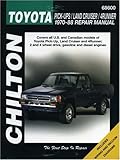
- 1970 - 1988 Toyota Pick-ups, Land Cruiser and 4Runner, Chilton's Total Car Care Manual
4. Require a credible maintenance story
Ask for invoices, inspection reports, registration history and notes showing when fluids, belts, hoses, brakes, tires and suspension parts were replaced. A thick folder is not proof that work was done correctly, but missing records should increase the money and time you reserve for baseline service.
Toyota describes its owner’s manuals and warranty information as resources for vehicle operation and maintenance. The correct service intervals and fluid specifications belong to the individual model year, engine and market; do not substitute a schedule from a similar-looking truck.
5. Check recalls by the actual VIN
Use Toyota’s U.S. recall lookup for vehicles intended for the United States, its territories or Mexico, and use the National Highway Traffic Safety Administration’s VIN and model tools as an additional check. NHTSA states, “Once a vehicle has been recalled, that recall never expires.” A clean result for a different truck, or a search based only on model year, is not a substitute for entering the candidate’s VIN.
Ask the seller for documentation that completed recall work was performed. If a recall remains open, confirm with an authorized repair facility whether parts and appointment capacity are available before relying on the truck.
What’s actually slowing this PC down?
Pick the symptom - the matching free tool is one click away.
A step-by-step process for buying one as a daily driver
- Write down the identity. Capture the VIN, model year, original market, engine, transmission, drivetrain, cab and bed configuration. Avoid buying parts until those details are verified.
- Set a use case. Note daily mileage, highway percentage, weather, payload or towing needs, parking constraints and how much downtime you can absorb.
- Review records before a test drive. Look for consistent ownership, major rust repairs, engine or transmission replacements, accident work and long periods off the road.
- Inspect the underside professionally. Require a lift inspection focused on frame integrity, mounting points, brake and fuel lines, steering and suspension.
- Drive it cold and hot. Confirm starting behavior, temperature stability, clutch or automatic operation, braking in a straight line, steering response, vibration and noises after warm-up.
- Scan and verify paperwork. Match the VIN on the truck to the title and records, then run the Toyota and NHTSA recall searches for that VIN.
- Price the baseline service. Obtain written estimates for fluids, filters, belts, hoses, tires, brakes and any corrosion treatment the inspection identifies.
- Plan parts and backup transportation. Confirm that routine service parts, safety components and specialist repairs are available where you live, and decide what you will drive during delays.
- Make the daily-driver decision. Buy only if the structure is sound, safety systems work, the records and inspection are credible, and the remaining risk fits your budget and commute.
How to compare two candidate trucks without an unsupported model-year ranking
There is no reliable evidence here for declaring one generation or engine universally superior. Compare the actual candidates using verified information rather than internet folklore.
Also popular on Amazon

- 1997 - 2000 Toyota Pick-Ups, Land Cruiser & 4Runner, 2 & 4 Wheel Drive Models, Chilton's Total Car Care Manual
| Comparison axis | What to verify | Why it changes daily-driver risk |
|---|---|---|
| Structure | Frame, crossmembers, body mounts, floors and suspension attachment points | Structural corrosion can make a truck unsafe or uneconomical regardless of engine reputation. |
| Maintenance history | Invoices, fluid service, cooling-system work, brake and suspension replacements | Documented care reduces uncertainty about deferred work. |
| Powertrain configuration | Exact engine, transmission, drivetrain and market specification | Parts, manuals and repair expertise depend on the precise configuration. |
| Parts access | Local suppliers, specialist shops and availability of safety-critical components | A usable truck can still create long downtime if essential parts are scarce. |
| Safety equipment | Seat belts, lighting, brakes, tires, restraints and any factory safety systems | Older equipment may not provide the same protection or convenience as a newer vehicle. |
| Recall status | VIN results and proof of completed campaigns | Open safety work should be resolved before regular use. |
| Downtime plan | Backup commute, repair budget and time available for troubleshooting | Reliability is partly a fit between the truck’s risks and your schedule. |
Manuals, maintenance and parts planning
Use documentation for the exact year
Toyota’s Owners site organizes Tacoma manuals by model year and says manuals for most Toyota models produced before 1990 can be accessed through its Technical Information System. Availability and coverage depend on the vehicle, so confirm that the manual matches your market and configuration. A manual for a nearby year may show different wiring, emissions equipment, capacities or service procedures.
Keep the owner’s manual with the truck and obtain appropriate repair information before tackling work that affects brakes, steering, fuel systems or structural components. Follow the specified fluids, inspection intervals and torque procedures rather than applying a generic classic-truck schedule.
Build a realistic parts strategy
Separate routine consumables from model-specific and body-specific parts. Filters, belts, hoses, brake components and common bearings may be easier to source than trim, glass, wiring connectors, interior pieces or corrosion-repair panels. Ask local repair shops which systems they are willing to service and whether they can support the exact engine and transmission.
Do not assume that a part listed for “Toyota pickup” fits every year. Verify the VIN, engine code, transmission and production details, and compare the supplier’s application data with the manual.
Budget for condition-based work, not a universal annual figure
No authoritative annual repair-cost figure is established for classic Toyota pickups as a group. Your inspection should produce a vehicle-specific list: immediate safety repairs, reliability work that can be scheduled, and cosmetic projects that can wait. Keep an emergency reserve for failures that cannot be predicted from a brief test drive.
Also popular on Amazon

- Used Book in Good Condition
Common mistakes and how to avoid them
Buying the reputation instead of the truck
A seller may invoke Toyota durability while providing no inspection or records. Require evidence of condition; historical reputation cannot compensate for a weakened frame or neglected brakes.
Using the wrong name or manual
Hilux, Toyota Pickup and Tacoma labels vary by market and year. Confirm the identity before ordering parts or following specifications.
Accepting a model-year recall search as proof
Recall coverage is tied to the vehicle. Enter the VIN in the relevant tools and verify completed work.
Ignoring comfort and safety needs
A mechanically sound truck may still be a poor daily choice if its seating, climate control, visibility, noise level or safety equipment does not suit your route. Evaluate those factors during the actual commute conditions.
Forgetting repair downtime
Classic ownership can involve diagnosis, sourcing and waiting even when the final repair is modest. Decide in advance how you will get to work or school when the truck is unavailable.
Bottom line
A classic Toyota pickup is a viable daily driver only when the specific example passes a structural and mechanical inspection, has a credible maintenance history, carries no unresolved safety concerns that you cannot address, and fits your tolerance for older-vehicle comfort and downtime. Toyota’s long-standing reputation helps explain why these trucks remain desirable, but it cannot predict the reliability of an aged survivor. Let the VIN, inspection report, records, parts plan and your commute—not the badge alone—make the decision.
Quick wins for a faster PC:
Clear out junk files and repair common Windows errorsFree Scan →Scan for outdated or missing drivers - takes under a minuteDriver Scan →



