Recommended Free Tools
Some links on this page are affiliate links: if you buy through them we may earn a commission, at no extra cost to you.
Charles Brownlee’s 60-year Texas robbery sentence is now a test of whether police need a warrant to search historical automated license-plate-reader (ALPR) records. Investigators used Flock camera data to connect an SUV to five armed robberies in the Dallas–Fort Worth area. Brownlee argues that assembling the sightings into a travel history is a Fourth Amendment search; prosecutors say the system records only separate, occasional images of vehicles on public roads. The Fifth Circuit heard arguments on October 5, 2026, but had not ruled in the latest report. A separate Oklahoma ruling has already found a monthlong, warrantless search unconstitutional, while the Fifth Circuit’s earlier United States v. Porter decision approved a narrower use.
What happened in Brownlee’s case?
Investigators were looking for a vehicle matching eyewitness descriptions of the SUV used in five 2024 armed robberies around Dallas–Fort Worth. They searched Flock’s database for vehicle descriptions, identifying details and plate images, found an SUV near multiple robbery scenes, and used those records to locate it. Brownlee was convicted and is serving a 60-year sentence. His appeal challenges the way the vehicle history was assembled, not the ordinary act of an officer seeing a license plate on a public street. The basic case history is reported by CarScoops and Morning Overview.
As an Amazon Associate I earn from qualifying purchases.
What’s actually slowing this PC down?
Pick the symptom - the matching free tool is one click away.
Brownlee was a passenger in his sister’s SUV, creating a separate standing question: whether he can invoke a privacy right in vehicle-location records when he did not own or drive the vehicle. The Fifth Circuit also must consider whether evidence independent of the ALPR records supported the conviction and what remedy would follow if the search was unlawful.
Texas has an estimated 13,000 Flock cameras, according to Morning Overview. That estimate illustrates the potential scale of the issue but is not an official statewide inventory.
Popular on Amazon

- Never Let a Dead Battery Ruin Your Drive. The LISEN 4 in 1 Retractable Car Charger delivers reliable power for your entire journey. Compatible with standard 12V cigarette lighter sockets, it keeps phones, tablets, and devices charged during daily commutes, road trips, and long drives — the perfect practical gift for dads, truck drivers, and anyone who lives on the road.
- Daily Driver Essential: Always Ready When You Need It. Featuring two retractable cables ( USB C & Old iPhone Charging Cable ) that extend up to 31.5 inches and dual USB ports, this charger solves cable clutter while charging up to 4 devices simultaneously. Ideal for busy fathers, commuters, and families who want a tidy car and never worry about low battery again.
- Deliver full-speed PD fast charging for iPhone 18 Pro Max & iPhone 18 Pro Max & iPhone 18 Pro right inside your car. The built-in 45W PD USB-C port hits the peak charging speed for these latest iPhone models, juicing up your phone to 50% power in just 15 minutes while you drive.(Note: Maximum 45W PD output is available under 24V vehicle power supply. When used with standard 12V car sockets, the peak output is limited to 36W.)
- Standard 12V Power Solution: Designed as a dedicated USB power supply for charging devices. Note: Does NOT support CarPlay, Bluetooth, or data transfer. Compatible with most phones, tablets, and small electronics. This retractable charger is a core car organization tool, keeping your vehicle tidy. Not compatible with Micro-USB devices.
- Clutter-Free Tech Organization: Featuring dual USB ports and retractable cables, the LISEN 4 in 1 charger provides a clean car storage solution. Perfect for truck enthusiasts or as a thoughtful gift for drivers, it supports fast USB-C charging for devices like the iPhone 18Pro & iPhone 18 ProMax. Keep your vehicle organized while ensuring efficient power delivery for all your tech on the road.
Does aggregating ALPR records require a warrant?
The constitutional dispute turns on aggregation. A single plate image exposes information visible to anyone on a public road. A database query that collects many images over time can reveal where a vehicle repeatedly travels, potentially creating a “pattern of life.” Brownlee’s lawyer says that retrospective reconstruction is meaningfully different from an isolated observation. Justice Department attorney Michael Weisbuch calls the records “episodic”: individual photographs of cars on public roads where drivers have no reasonable expectation of privacy.
Why the distinction matters
Flock searches can be retrospective. An investigator can begin with a vehicle description, search historical records, compare times and locations, and then identify a vehicle that appeared near several crime scenes. That capability allows a search after the fact rather than requiring officers to watch a suspect in real time. The legal question is whether the resulting compilation is more like a constitutionally protected location history than a series of independent public observations.
What the Fifth Circuit already said in Porter
In United States v. Porter, filed March 17, 2026, the Fifth Circuit held that using an LPR system did not invade a reasonable expectation of privacy and therefore was not a search requiring a warrant. The court emphasized periodic scans at fixed locations on “public streets and highways,” a limited camera network, and the system’s inability in that case to follow a person’s complete movements in the way cellphone-location data can. The opinion is available in the court’s PDF of United States v. Porter.
Also popular on Amazon

- ✅【Designed for Magsafe】 - The most fashionable iphone car mount in 2026 Magsafe is designed for iPhone 18 Pro Max/17/16/15/14/13/12 Pro Max Mini and official Magsafe cases and other magnetic phone cases and can be fixed directly to these phones without the need to affix metal plates. All Android Phones Will Work: Metal rings are provided; they fit cases and other phones without magsafe. Based on Unique Grandmaster Design (Protected by US Design Patent No. US D1,112,194 S)
- ✅【STRONG MAGNETIC MagSafe Car Mount】 - This powerful magnetic phone holder can create a powerful attraction that firmly supports your device while allowing you to drive without distraction. it easily and securely holds your phone through bumps, sharp turns or even sudden stops, no worrying of dropping your phone.
- ✅【SUPER STICK FORCE】 - VHB Dash Mounted Holders adhesive provides strong stick force between the dashboard and the car phone holder, which can firmly stick to any plane in the car, fix your device, adapt to a variety of road conditions such as sudden braking, speed bump, and rugged mountain road.
- ✅【SAFE DRIVING VIEW】 - Mini-size, not taking up space, it is placed in the dashboard without blocking the view at all, and does not need to look down at the device to ensure your safe driving. Cell Phone Car Mount is suitable for most cars, pickups, SUV, taxi; It is the best assistant for Uber and Lyft drivers
- ✅【360° FREE ROTATION】 - With an adjustable swivel ball joint, you can rotate your smartphone or device at your own will, providing the best viewing angle. Quickly pick and place with one hand, free your hands and make calls and GPS navigation more convenient
Brownlee’s appeal asks whether a larger or more systematic historical query crosses the line that Porter left open. The answer could depend on the number and geographic density of scans, the length of the period searched, and whether the database was used to identify a vehicle near separate events or to reconstruct routine travel.
How does the Oklahoma Kyle ruling differ?
On October 1, 2026, U.S. District Judge Sara E. Hill ruled that a warrantless query of more than 50 Flock records covering roughly one month violated the Fourth Amendment. She suppressed the records and evidence from a later vehicle search, including approximately 91 pounds of methamphetamine. Hill described the practice as “a type of indiscriminate mass surveillance,” according to Law Commentary.
Kyle is a federal district-court decision from Oklahoma, not a nationwide injunction or a binding rule for every court. Reporting said Flock expected an appeal. Its importance is analytical: the judge treated the monthlong accumulation of more than 50 historical sightings as materially different from a few periodic scans. The decision therefore supplies Brownlee with a fact pattern supporting his aggregation argument, while Porter supplies prosecutors with a contrary appellate precedent.
Free tools Windows power users keep installed
One-click scans. No signup required.
Also popular on Amazon

- High Quality Material: The coaster is made of environmentally friendly silicone, safe, non-toxic and odorless. Soft with toughness, easily embedded in the cup holder. Very durable, wear-resistant, long service life. High temperature resistance, can withstand 100 ℃ high temperature water cups.
- Wide Compatibility: The coaster has a diameter of 3.15 inches and a height of 1.18 inches, which is widely used in most vehicles, such as SUV, sedan, MPV, etc., as long as the size fits your car cup holder.
- Protection Function: Our car cup holder coaster has a carry handle design and a stand-up ring edge on its edge to effectively prevent food crumbs, drinks and water from leaking out and preventing the car cup holder from getting dirty.Meanwhile,Thickened design effectively prevents the cup holder from being scratched by the cup when driving on bumpy roads and eliminates the annoying thumping sound, making your journey more enjoyable.
- Easy to Use and Clean: With embedded installation, you just need to put it flat on the car cupholder. It is also very quick to remove, there is a small bump on the coaster, pinch it and you can easily remove the coaster. It is very easy to clean, rinse with water or wipe with a wet towel (be careful not to clean with sharp tools).
- 100% Satisfaction: Our products have quality assurance, if you have questions or are not satisfied after receiving the product, don't worry, please contact us as soon as possible, we provide after-sales service.
What will the Fifth Circuit have to decide?
The panel heard oral argument on October 5, 2026, and had issued no decision by the latest report. Several issues could shape the ruling:
- Search or ordinary observation: whether the combined historical records expose a constitutionally protected travel pattern rather than merely repeat information visible on public roads.
- Scope of the database search: how many scans, how long a period, and how geographically dispersed the cameras were. A limited network and intermittent hits favor the government’s Porter analogy; dense, monthlong aggregation favors Brownlee’s argument.
- Standing: whether a passenger can challenge records tied to a vehicle owned by someone else. Brownlee’s status as a passenger in his sister’s SUV makes this a threshold issue.
- Legal process: whether investigators needed a warrant, whether a subpoena or another authorization could suffice, or whether an emergency exception applied. The record described in the reports centers on a warrantless query.
- Independent evidence and remedy: whether other proof supported the convictions and, if the ALPR search was unlawful, whether suppression of the records or related evidence is required.
How are these ALPR searches used in practice?
The Brownlee investigation illustrates a common retrospective workflow rather than a live pursuit:
- Start with a description. Investigators enter vehicle characteristics and other identifying details supplied by witnesses or investigators.
- Search historical records. The system returns matching vehicle records and plate images captured at participating camera locations.
- Compare locations and times. Investigators look for appearances near multiple robbery scenes or other relevant places.
- Locate the vehicle. A recent or recurring sighting can direct officers to a vehicle or person for conventional investigative steps.
- Use the result in court. Prosecutors may offer the records and evidence derived from them; the defense can challenge the search, reliability, identification and causal connection.
This process differs from an officer reading a plate once. It also differs from cellphone tracking: the cameras do not necessarily record every movement, and coverage depends on where participating cameras are installed. Those practical limits were central to the Fifth Circuit’s reasoning in Porter, while the volume and duration of the query drove the Oklahoma court’s concern in Kyle.
Also popular on Amazon
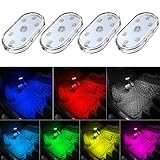
- 7 Colors Car Light: The led interior car lights are built-in 6 RGB LED lamp beads, which can be changed 7 different colors by touching, such as white, red, green, blue, yellow, pink purple, ice blue. The colors are bright and vivid, but not dazzling.Attention: Please charge before use.
- Touch Switch Design: Our led lights for car interior features touch control, one-key perspective lighting. Long touch to turn on/off, touch once to change the colors.
- Easy to Use: Stick the the iron plate in one place with double-sided tape, then put the light on it to complete the installation and fixation. Due to magnetic design, quickly install and remove, you also can attach the interior car lights to other metals.
- Portable & USB Rechargeable: Compact size, easy to carry, does not take up space. The wireless car led lights interior is charged by the USB cable, only need takes 40 minutes to fully charge the lights at a time, and keep lighting for about 2 hours.
- Wide Application: LED touch lights can be installed in dark places, such as storage boxes, armrest boxes, seat corners, etc. It's also suitable for bedside lights, wardrobe lights, reading lights, backpack lights, place it anywhere in the room, any dark place can be illuminated by it.
How do the Brownlee, Porter and Kyle cases compare?
| Case | Tracking scope | How records were treated | Procedural status |
|---|---|---|---|
| Brownlee (Texas) | Flock records used to connect an SUV with five 2024 armed robberies around Dallas–Fort Worth; the appeal challenges reconstruction of a travel history. | Defense calls the compilation a searchable “pattern of life”; prosecutors call the sightings episodic. | Fifth Circuit argument held October 5, 2026; decision pending in the latest report. |
| United States v. Porter | Periodic scans at public-road camera locations in a limited network. | Fifth Circuit held the use was not a Fourth Amendment search and no warrant was required. | Fifth Circuit opinion filed March 17, 2026. |
| United States v. Kyle | More than 50 Flock records spanning roughly one month. | District judge found the warrantless aggregation unconstitutional and suppressed the records and evidence from the later vehicle search. | Oklahoma federal district-court ruling dated October 1, 2026; reporting said an appeal was expected. |
What does this mean for the legality of license-plate cameras?
Neither ruling creates a blanket national ban. Porter remains binding in the Fifth Circuit unless the court revisits it or a higher court changes the law, but Brownlee could clarify how that precedent applies when a search covers many records and locations. Kyle shows that at least one federal judge viewed monthlong aggregation as a search, yet its suppression order ordinarily addresses the evidence in that case rather than every agency’s database.
The decisive facts are likely to be duration, scan volume, geographic density, retrospective scope and the relationship between the records and the person challenging them. Retention and sharing policies may also matter to future cases, but the reported Brownlee, Porter and Kyle decisions do not establish one nationwide retention period for ALPR data.
Frequently Asked Questions
Can a passenger challenge license-plate records from someone else’s car?
Not automatically. A passenger generally must show a personal privacy interest that the search invaded, and Brownlee’s status as a passenger in his sister’s SUV is why the Fifth Circuit is expected to address standing separately from the warrant question.
Also popular on Amazon

- Creative DIY Mode: Choose from 16 million available colors or customize car led light effects to your liking in DIY mode via Govee Home app. Make your car stand out in unique style with creative freedom and outdoor decorations.
- Dynamic Music Mode: Built-in mic helps interior car lights sync with any music type. Liven up your road trips, weekend getaways or evening commute with colors that dance vibrantly to your favorite songs.
- Smart App Control: Manage the colors and brightness of car lights or choose music mode by one simple tap with Govee Home app. Enjoy a comfortable and vibrant driving experience with convenient control.
- 2 Lines Design: 2 lines design connect the 4 car led strip lights, attaching the inside car lights easily to any car model without worrying about exposed wiring or an untidy look.
- Simple Installation: Before you install, make sure the installation surface is clean and dry. Then attach the led lights for car to your vehicle with adhesive and support clips. Rubber tubing outside protects lights from water spills.
Is a Flock search the same as real-time GPS tracking?
No. ALPR systems depend on cameras installed at particular locations and produce sightings when vehicles pass those points. Courts are examining whether many retrospective sightings nevertheless reveal enough of a person’s movements to function like location tracking.
Does the Kyle decision invalidate every Flock record already collected?
No. The Oklahoma order suppressed records and derivative evidence in that prosecution. It does not, by itself, erase databases or bind courts in other states, and its reasoning may be changed on appeal.
The Tool Desk
Outbyte PC Repair FREEClear out junk files and repair common Windows errorsFree Scan →Outbyte Driver Updater FREEFix the driver behind crashes, sound loss and screen glitchesFind Drivers →When will the Fifth Circuit decide Brownlee’s appeal?
The panel heard oral argument on October 5, 2026, but the latest report supplied for this case contained no decision date. Until an opinion issues, the scope of warrant requirements for aggregated ALPR searches in the circuit remains unsettled.




