PC Slower Than It Used to Be?
A free scan shows the junk files, broken settings and background clutter dragging Windows down - then fixes them in one click.Free scan · Windows 10 & 11Crashes, No Sound, or Screen Glitches?
Random freezes, missing sound and display glitches usually trace back to one bad driver. Find and replace yours safely.Free scan · under a minuteBefore driving home, complete a cooldown lap, park safely, let the tires and brakes cool, then inspect in this order: tires, wheels and fasteners, fluids and leaks, warning lights, and any wear points named in your owner’s manual. Restore cold tire pressure to the vehicle manufacturer’s road specification, re-enable any systems you disabled for the session, and reset the tire-pressure monitoring system (TPMS) if required. Your owner’s manual and tire placard—not a generic track checklist—control torque values, pressures, alignment, and service intervals.
Do not use this inspection as a substitute for diagnosis. A damaged tire or wheel, leak, brake concern, abnormal bearing movement, or warning light means the car should be assessed using the vehicle-specific manual or by a qualified mechanic before you continue on the road.
As an Amazon Associate I earn from qualifying purchases.
1. Cool the car down before touching or measuring anything
Finish with a cooldown lap at moderate speed so the engine, brakes, tires, and other components shed heat gradually. Park on a safe, level surface away from traffic. Hyundai’s track-day guidance warns against applying the handbrake immediately after a session because the heat can create a brake-pad problem. Follow the exact parking instruction for your model; if the manual warns against the handbrake while components are hot, leave the car in the specified gear or park setting until it has cooled sufficiently.
Do not check tire pressure, wheel fasteners, or hot fluid components immediately after coming off track. Track temperatures can produce readings and surfaces that are unsafe to handle. Give the car enough time to cool for a meaningful cold-pressure check and a careful visual inspection.
#1 Best Overall

- HIGH ACCURACY: Every ETENWOLF's pencil tire gauge is calibrated to ANSI B40.1 Grade B, it is accurate to 2% of span in the middle 50% of range and 3% of span in the lower and upper 25% of range. Each ETENWOLF pencil tire pressure gauge is manually calibrated and has its unique calibration number printed on the pencil
- WIDER RANGE: ETENWOLF's tire gauge offers 2 pressure ranges: 10-50PSI, 20-120PSI for all types of vehicles
- ALL METAL: ETENWOLF tire gauges are made of all solid metal, zinc alloy head and stainless steel body, they are durable and can be used for many years unless you lose them
- DEFLATION: You can also use ETENWOLF's tire gauge to deflate tires when the tire pressure is overinflated
- 16 CAPS IN 2 CASES: ETENWOLF even offers 16 valve stem caps, so you won't worry about losing tire caps anymore
2. Inspect every tire after it has cooled
Look across the complete tire, not only the tread center
Walk around the vehicle and examine the full surface of each tire. Look for cuts, punctures, bulges, blisters, cords, embedded objects, or any deformation. Inspect the tread blocks, both shoulders, and the sidewalls. Abnormal shoulder wear can indicate that the tire has been overheated, overloaded, or used with an unsuitable pressure or alignment. Check for sections that look different from the matching tire on the other side of the axle.
Measure or closely inspect tread depth before beginning the road trip home. Michelin’s track-day guidance states that at least 2/32 inch of tread should remain. That is Michelin’s stated guidance for its track-day advice, not a universal legal limit and not proof that a tire is safe after a demanding session. A tire with damage, exposed cords, a bulge, or an uncertain condition should not be driven simply because it still has measurable tread.
Restore cold road pressure
After the tires have returned to a cold state, set each tire to the pressure listed on the vehicle’s tire placard or in the owner’s manual. Do not substitute a generic number or the pressure printed on the tire sidewall. The placard specification is the road setting for that vehicle, load, and tire fitment.
Do these 3 things before closing this tab:
1Scan for outdated or missing drivers - takes under a minute2Repair Windows errors before they cause bigger problems3Fix the driver behind crashes, sound loss and screen glitchesTrack pressure and road pressure are different checks. Michelin advises starting a track session at the manufacturer’s recommended cold pressure, bringing dry-track hot pressure back toward the manufacturer’s recommendation, and not reducing warm-tire pressure below the road recommendation. For the drive home, use the manufacturer’s cold road specification once the tires are cold; do not chase a hot reading with a guess.
Rank #2

- Professional Tire Pressure Gauge for Cars - This heavy duty mechanical tire pressure gauge is calibrated to ANSI B40.1 Grade B (2%) international accuracy standard so you get a precise, accurate pressure reading every time you use it. Makes great car accessories, car stuff, tire deflator, car stuff for men, cool car gadgets, car gifts for men, him, dad.
- Recommended by mechanics - It features a steel and brass construction with an extended 5mm chuck tip, so you get a great seal with no air leakage. This automotive tool is also surrounded by a rubber cover, so it is protected from drops and is easy to grip.
- No batteries required - This top-rated, professional tire monitoring system is easy to use and is reliable in all weather conditions. A perfect accessory for your car, motorcycle, truck, bike, SUV, RV or ATV - it will not let you down.
- Easy to read dial with a 45 degree angled and fully swivelling chuck. Our built in relief valve allows you to press the bleed button whilst the gauge is still on the tire valve, releasing air until you reach the exact target required.
- Car accessories for men and women - Give as the perfect gifts for men, car accessories gifts for men, gifts for dad, car gifts, car gifts for men, car stuff for men, gifts for car guys, car guy gifts for men, gifts for car lovers, cool car gifts, car lovers gifts for men.
Restore electronic systems
If you switched off stability control, traction control, an electronic safety mode, or another driver-assistance function for the session, restore the normal road setting before entering public roads. Reset TPMS when your vehicle’s procedure calls for it. A tire-pressure gauge is a useful tool for the measurement, but the vehicle’s manual remains the authority for the reset sequence and any required relearn drive.
3. Check wheels and wheel fasteners
Inspect the wheels
Look at the inner and outer faces of each wheel for cracks, bends, impact marks, missing weights, or fresh contact damage. A wheel can be damaged on the inside where it is difficult to see without turning the steering or removing it. Compare the wheel position with any unusual vibration, pull, or pressure loss you noticed on track.
Verify lug-nut or wheel-bolt torque
Use the torque value specified for your exact vehicle, model year, trim, wheel, and fastener type. Ford’s track-use instructions call for checking and setting lug-nut torque after track driving, and Hyundai’s checklist also recommends a post-session fastener check. There is no safe universal lug-nut number for all cars.
The Tool Desk
Outbyte Driver Updater FREEFix the driver behind crashes, sound loss and screen glitchesFind Drivers →Outbyte PC Repair FREEClear out junk files and repair common Windows errorsFree Scan →A torque wrench and the correct socket let you perform this check if you know the manufacturer’s procedure and can work safely. Follow the tightening pattern, thread condition requirements, and any distinction between dry and lubricated threads in the manual. If you do not have the correct specification or equipment, have a qualified technician perform the check rather than estimating.
Rank #3

- Accurate, Dependable Readings: Factory‑calibrated to ±1 PSI, so you can confidently match your vehicle’s recommended PSI (check the door jamb sticker). Ideal for monthly checks and road trips — consistent results every time, cold or warm.
- Bright Backlit Display & Nozzle Light: The illuminated nozzle helps you find the valve stem in the dark, while the backlit LCD makes readings crystal clear in dim garages or at night. No more squinting or holding a flashlight.
- 4 Measurement Units, One Button: Quickly switch among PSI, Bar, Kgf/cm², and KPA with a single press. No complex settings — just press and cycle to your preferred unit. Perfect for drivers who need multiple scales.
- Broad Compatibility for Everyday Vehicles: 0–150 PSI covers cars, SUVs, motorcycles, and spare tires (often 60 PSI). Fits standard Schrader valves; just press on for a reading.
- Auto‑Off to Extend Battery Life: The gauge automatically powers down after 30 seconds of inactivity, so the included 2*AAA batteries last longer. Always ready for your monthly checks without surprise dead batteries.
4. Check fluid levels, leaks, and warning lights
Check the reservoirs and dipsticks named by the manual
With the car parked safely and at the temperature specified by the manual, inspect engine oil, coolant, brake fluid, and any other fluid the vehicle maker identifies for post-track checking. A low level is a symptom to investigate, not an instruction to keep topping up and drive on. Use only the fluid type and fill procedure specified for the vehicle.
Search for fresh leaks
Look beneath the engine, transmission, differential or axle, brake areas, and around hoses, lines, seals, and reservoirs for fresh fluid. Note the color, location, and amount. A leak near a wheel or brake component is a safety issue even if the reservoir level appears normal. Do not crawl under a car supported only by a jack.
Read the instrument cluster
Before leaving, check for oil-pressure, coolant-temperature, brake, ABS, stability-control, TPMS, or other warning lights. Record any message rather than clearing it. A warning that appeared during or after the session needs the vehicle-specific diagnostic procedure; continuing to drive can turn a recoverable problem into a failure.
5. Inspect the wear points specified for your vehicle
Track-use sections in owner’s manuals may call out checks that are not part of a basic road inspection. One Ford manual specifically names front and rear wheel bearings and brake-caliper dust boots. Inspect those items only as described for the covered vehicle; they are examples from a particular manual, not a universal requirement for every car.
Rank #4

- PROCESS LEVEL ACCURACY: This heavy duty tire pressure gauge is calibrated manually to ANSI B40.1 Grade A (±1% of span)
- PRESSURE RANGE 0-75 PSI: ETENWOLF’s tire gauge can measure pressure of pickup, motorcycle, truck, bike, SUV, RV or ATV
- EASY TO READ IN THE DARKNESS: The large glow dial helps you clearly read the pressure at night or in low light
- EASY TO USE: 360 degree swivel chuck allows you to measure and take a reading from a tire valve at any angle
- ACCURACY IN EXTREME WEATHER: PSI gauge works normally even in extreme cold or hot weather
Wheel bearings
If the manual provides a check for bearing play, movement, noise, or temperature, follow that method. A bearing check may require lifting the vehicle and safely supporting it, so it is not appropriate if you lack the equipment or experience. Any looseness, roughness, or new noise warrants professional inspection.
Brake components
Check the brake areas for visible damage, abnormal wear, fluid leakage, or a condition that differs between sides. A soft pedal, vibration, grinding, pulling, or a brake warning light is a reason to stop and obtain qualified service rather than relying on a visual check alone.
Independent reader supportYour contribution helps us test, update, and keep practical guides available for everyone.6. Follow the exact track-use maintenance schedule
There is no universal rule that every car needs an oil change or brake-fluid flush after every track day. Service requirements vary by model, model year, trim, market, engine, axle, and equipment. Find the track-use section in your owner’s manual and record the accumulated track time or distance.
| Example guidance | What it applies to | How to use it |
|---|---|---|
| Change engine oil and filter after four hours of track use | A covered Ford vehicle in the cited owner-manual passage; year and version are not stated in that extract | Use only if your own manual gives the same interval for your vehicle |
| Replace wheel bearings every 2,000 km (1,200 mi), or when inspection finds free play or movement | A covered Ford vehicle in the cited manual | Vehicle-specific; do not generalize to another model |
| Change engine oil and filter after one track weekend or approximately four hours of track use | A different Ford vehicle and market in a separate owner-manual page | Check the applicable market and model manual before adopting it |
| Change rear axle fluid every 800 km (500 mi), or when the instrument cluster reports axle-fluid over-temperature | The different Ford vehicle covered by that separate manual | Only follow this interval when your manual identifies that axle and condition |
These figures illustrate why copying a schedule from another car is unsafe. Your manual may specify a different time, distance, temperature warning, fluid, or inspection condition. If the manual is unavailable, obtain the correct edition from the vehicle manufacturer or ask a qualified service provider to identify the applicable schedule.
Best Value
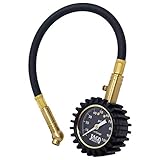
- Mechanic Recommended - performance tested, certified, & calibrated accurate within ANSI Standards (±1.5%) at our ANSI accredited calibration facility, ensuring precise tire pressure readings without relying on batteries
- Feels rugged in the hand & built to last from solid brass shielded by our durable shock-resistant gear-style protective guard; features our signature HybridFlex leak-proof air hose providing a soft feel with superior strength & flexibility
- Robust design is equipped with a built-in air bleeder valve to reduce pressure in overinflated tires, and the handy 360-degree swivel chuck allows for easy access to the tire valve from any angle
- Larger, 2" glow dial features easy-to-read 100 PSI single increment scale that glows in the dark, providing accurate readings that "lock" in place until the pressure reset button on the brass neck is pressed
- 100% Lifetime Warranty by JACO when you order today, so click buy with confidence and enjoy longer-lasting tires, improved gas mileage, and a smoother car driving experience with the help of properly inflated tires.
7. Decide whether you can finish the inspection yourself
Self-inspection is reasonable when you have the correct specifications, a reliable pressure gauge, a correctly rated torque wrench and socket, safe lifting equipment where required, adequate lighting, and the experience to recognize abnormal wear. A qualified mechanic is the better choice when the check requires wheel removal, bearing-play measurement, brake diagnosis, leak tracing, or interpretation of a warning light.
| Situation | Self-check may be suitable | Arrange professional inspection |
|---|---|---|
| Tire pressure and visible tire condition | You can wait for cold tires and compare every tire with the placard specification | A cut, bulge, blister, exposed cord, repeated pressure loss, or uncertain damage is present |
| Wheel fasteners | You have the exact torque specification, correct socket, and calibrated torque wrench | The specification is unknown, fasteners are damaged, or you cannot safely access them |
| Fluids and leaks | Levels and visible areas are accessible and normal | A level is low, a leak is fresh, fluid is contaminated, or the source is unclear |
| Bearings and brakes | Your manual gives a simple check and you have the required equipment | There is play, noise, vibration, a soft pedal, abnormal wear, or a warning light |
8. Use this sequence before the road drive home
- Complete a cooldown lap and park safely.
- Follow the manual’s hot-parking instruction; avoid immediate handbrake use if the vehicle guidance warns against it.
- Wait for the tires, brakes, and other components to cool.
- Inspect tread, shoulders, sidewalls, and the entire surface of all four tires for damage or abnormal wear.
- Check tread condition; Michelin’s track-day guidance calls for at least 2/32 inch remaining, without treating that figure as a universal legal limit or a guarantee of fitness.
- Set cold tire pressures to the vehicle maker’s road specification.
- Restore electronic safety systems and reset TPMS when applicable.
- Inspect wheels for cracks, bends, impact damage, and missing weights.
- Check wheel-nut or wheel-bolt torque to the exact vehicle specification.
- Check the specified fluid levels, search for leaks, and read every warning light or message.
- Perform the additional bearing, dust-boot, brake, or axle checks named in your owner’s manual.
- Confirm that any time- or distance-based track maintenance is due, and arrange it before normal driving if required.
9. Stop and get help when a safety concern appears
Do not drive home on a tire with a bulge, exposed cord, major cut, or unexplained pressure loss. Do not continue with a cracked or bent wheel, loose wheel fastener, active leak, abnormal bearing movement, compromised brake pedal, or persistent warning light. If the car cannot be moved safely, arrange recovery. If it can be moved only under the manual’s limited operating instructions, follow those instructions and go directly to qualified service.
Ford’s owner-manual warning states: “Failure to properly inspect and maintain your tires and wheels after track use, can dramatically increase the risk of tire failure, loss of vehicle control, personal injury or death.” The warning is a reminder that a post-session inspection is a safety step, not merely a way to prepare the car for its next event.
Quick Recap
Product prices and availability are accurate as of the date/time indicated and are subject to change. Any price and availability information displayed on Amazon at the time of purchase will apply.




