What’s actually slowing this PC down?
Pick the symptom - the matching free tool is one click away.
Using the wrong engine oil can cause anything from a specification mismatch with no immediate symptom to poor lubrication and engine damage. The outcome depends on the vehicle, the oil’s viscosity and performance specifications, how much was added, and whether the engine was run. Do not guess or rely on a universal drain-now rule: identify the exact vehicle and oil, check the owner’s manual, and obtain vehicle-specific advice if the remedy is not clear.
What counts as the wrong engine oil?
Engine oil is not defined by one number alone. A bottle can show a viscosity grade that looks familiar while failing another requirement printed in the vehicle manual. Before deciding what to do, separate the possible mismatches.
As an Amazon Associate I earn from qualifying purchases.
Viscosity grade
The SAE viscosity grade describes how the oil flows at different temperatures. The vehicle maker selects one or more grades for the engine and its expected operating conditions. A grade outside the permitted range can alter oil flow during cold starts and at operating temperature, and it can affect fuel economy. Kia and Hyundai owner manuals both warn that using a viscosity other than the recommended one may result in engine damage.
Performance category
The manual may require an API, ILSAC, ACEA or another performance category. These categories describe tests and properties beyond thickness. ACEA’s 2023 sequences distinguish applications and state that some categories are unsuitable for certain engines. Therefore, matching only the SAE grade is not enough.
#1 Best Overall
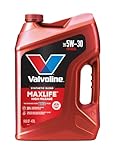
- Formulated for engines with 75,000 miles or more, Valvoline MaxLife High Mileage synthetic blend is formulated with seal conditioners to help prevent oil leaks and reduce oil consumption
- Delivers 20% better wear protection and 15% better sludge defense than industry standards to help prevent engine breakdown
- Extra detergents safeguard against friction, corrosion and deposits to keep high-mileage engines clean
- Advanced friction-fighting additives help maximize performance and improve fuel efficiency
- Provides performance benefits for high mileage, new and re-built engines alike
Manufacturer approval
Some engines require an approval or specification issued by the vehicle manufacturer. A product can have an acceptable viscosity and a broadly familiar category yet lack the approval your engine requires. Read the entire bottle label and compare it with the manual rather than selecting oil by a single number.
Amount added
The quantity matters as much as the label. A small top-up, a complete refill, and an unknown amount create different risks and different decisions. Record approximately how much was poured in, whether the crankcase was already full, and whether the dipstick or electronic level display was checked using the procedure in the manual.
| Possible mismatch | Why it matters | Information needed before choosing a remedy |
|---|---|---|
| Viscosity outside the permitted grade | Temperature-dependent flow, cold starting and fuel-economy behavior can differ; the manuals warn of possible engine damage. | Exact vehicle, engine, climate guidance in the manual, oil grade and whether the engine has run. |
| Wrong API, ILSAC or ACEA category | Performance categories are not interchangeable for every engine; ACEA identifies category-specific suitability. | Complete bottle specification and the exact category required by the manual. |
| Missing manufacturer approval | The oil may not meet an engine-specific requirement even if its viscosity appears correct. | Approval wording on the bottle and the manual’s required approval. |
| Too much or an unknown quantity | The level itself must be assessed before the vehicle is operated further. | Amount added, prior oil level and the manual’s checking procedure. |
Why viscosity can affect engine operation
Oil must move through passages and reach lubricated parts under both cold-start and hot-running conditions. Kia’s 2025 owner-manual content explains that viscosity guidance is connected with fuel economy and cold-weather starting and oil flow. Its warning states: “Using oils of any viscosity other than those recommended could result in engine damage.” Hyundai’s 2026 owner-manual content gives the same type of warning: “Using oils of any viscosity other than those recommended may result in engine damage.”
Rank #2

- High Mileage for engines 75,000+ miles
- Helps extend engine life of higher mileage vehicles
- Protects for 15,000 miles – guaranteed*
- Contains additives to help fight sludge
- Keeps your engine running like new
Those statements establish a potential risk, not a guarantee that every mistaken fill immediately damages an engine. The manuals do not provide a universal safe mileage, time limit or damage percentage. A grade that is permitted for one engine or temperature range may not be permitted for another, so the correct comparison is always between your manual and the bottle in your hand.
Why the oil category and approval matter
ACEA’s 2023 Oil Sequences for Light-Duty Engines describe distinct categories for different intended applications. Its consumer guidance cautions: “These engine oils are unsuitable for use in certain engines – consult vehicle-OEM’s owner’s manual/handbook in case of doubt.” In practical terms, a viscosity match does not override an incompatible category.
Check every required element: SAE grade, API or ILSAC wording where specified, ACEA category where specified, and any manufacturer approval. If the manual lists more than one permitted option, use only those alternatives. Ford owner-manual information likewise illustrates that permitted alternatives depend on the specification for the particular vehicle rather than on a universal substitute.
Rank #3

- Helps extend engine life, even in severe conditions
- Protects for 15,000 miles – guaranteed*
- Contains additives to help fight sludge
- Keeps your engine running like new
What to do immediately after discovering a mismatch
- Stop and document the facts. Write down the make, model, model year, engine, oil brand and product name, SAE grade, every API, ILSAC or ACEA marking, any manufacturer approval, and the approximate amount added. Photographing the front and back labels prevents a later guessing exercise.
- Check the vehicle’s own manual. Find the engine-oil section and note the required grade, performance category, approval, capacity and level-checking instructions. ACEA specifically directs owners to the vehicle maker’s manual when category suitability is uncertain.
- Establish the current level safely. Use the manual’s procedure for parking position, warm-up or wait time, and dipstick or electronic measurement. If the amount added is unknown or the level appears above the permitted mark, do not continue operating while trying to estimate the correction.
- Decide whether the engine should run again. If it has not been started, leave it off until the requirement and next step are confirmed. If it has run, avoid additional driving until you know whether the oil is permitted. There is no evidence-based universal distance that makes every mismatch safe.
- Watch for symptoms and warnings. An oil-pressure or engine warning lamp, unusual noise, rough running, smoke, overheating or a sudden change in operation warrants switching off safely and contacting a qualified mechanic or the manufacturer’s service channel. This cautious step follows the manuals’ stated possibility of engine damage; it is not a claim that every warning proves an oil-related failure.
- Ask for vehicle-specific advice when any key detail is missing. Give the adviser the vehicle identification, oil label photographs, amount added, current level and symptoms. A manufacturer service department or qualified independent mechanic can determine whether the oil must be replaced immediately, whether a level correction is needed, and whether inspection is appropriate.
When an oil and filter change is the appropriate correction
Whether to drain the oil depends on the exact vehicle, the specification mismatch, the amount used and how long the engine operated. Do not turn a general warning into an automatic instruction for every car. Follow the manual or the service professional’s direction.
If a replacement is directed
- Select engine oil that meets the exact viscosity, performance category and manufacturer approval listed for the vehicle. Keep the container or label available in case the service provider needs to verify it.
- Confirm the required quantity and the correct level-checking method from the manual. Capacity figures can differ by engine and can depend on whether the filter is replaced.
- Use the vehicle-specific oil filter and change it when the prescribed service calls for one. Mazda’s CX-5 manual, for example, says to use the correct specification to protect against poor-lubrication damage and not to omit the prescribed oil-filter change. That instruction is a Mazda example, not a universal schedule for every model.
- Have the work performed by a competent person who can prevent spills, install the drain plug and filter correctly, and verify the final level. If you are not equipped or trained to do this safely, use a qualified service facility.
- Afterward, retain the receipt and record the oil specification, quantity and date. These details help with future maintenance and with any later technical assessment.
Situations that need different handling
The engine was never started
Keeping the engine off limits further circulation of the oil while you verify the requirements. Contact the vehicle maker or a qualified mechanic if the manual does not clearly establish whether the oil is acceptable.
The engine ran briefly and seems normal
No symptom does not prove that the oil is suitable. Stop unnecessary use, preserve the oil and vehicle details, and obtain advice based on the exact specifications. The sources do not establish a universal run time that is harmless.
Rank #4

- Advanced protection against the four main causes of engine breakdown: wear friction heat and deposits
- Delivers 40% stronger wear protection than industry standards to reduce friction and improve fuel economy
- Provides 15% better deposit defense vs. industry standards, keeping engines cleaner for smoother performance and longer-lasting protection
- Up to 2.5X better heat protection vs. industry standards to fight harmful sludge formation and thermal breakdown
- Engineered for excellent low-temperature flow, reducing metal-to-metal contact during cold starts — when most engine wear typically occurs
The vehicle is running roughly or showing a warning
Move to a safe location only if necessary to avoid immediate danger, then switch off and arrange professional assistance. Continuing to drive can complicate diagnosis when the underlying mismatch or level is unknown.
The level is high or the amount is uncertain
Do not dilute the problem by adding another product or guessing at a quantity. Recheck the level exactly as the manual directs and ask a professional whether removal and inspection are required.
Windows Errors? Fix Them Before They Spread
Repair common Windows errors and clear accumulated junk for a smoother, more stable PC - no reinstall needed.Free scan · no reinstallCrashes, No Sound, or Screen Glitches?
Random freezes, missing sound and display glitches usually trace back to one bad driver. Find and replace yours safely.Free scan · under a minuteThe vehicle has already been driven for a long period
Distance alone does not establish that damage occurred or that the oil is safe. Stop relying on elapsed mileage as a test; provide the complete history to a manufacturer service channel or qualified mechanic.
Best Value

- Phosphorus Replacement Technology helps extend emission system life
- Superior dispersancy that fights sludge build up
- Exceptional oil burn-off protection exceeding industry standards* | Seal conditioners to help reduce leaks
- Advanced additives that help prevent engine wear | Improved Fuel Economy**
- Meets or exceeds the following specifications: API SP/SN PLUS/SN/SM | ILSAC GF-6 | Meets Ford WSS-M2C946-B1 | Meets Ford WSS-M2C961-A1 | * Based on API and ACEA volatility specifications | ** In 5W-20, 5W-30 and 10W-30 grades versus industry specifications
How to choose a compliant replacement oil
Use this comparison order whenever you are buying oil for the corrective service or a routine change.
| Check | What to match | Why the check comes first |
|---|---|---|
| Vehicle identity | Make, model, year and engine | Requirements can change between engines and model years. |
| SAE viscosity | Every grade permitted in the owner’s manual for the operating conditions | Viscosity affects flow, cold starting and fuel-economy behavior. |
| Performance category | Required API, ILSAC or ACEA category | ACEA warns that categories are not suitable for every engine. |
| Manufacturer approval | The exact approval or specification printed in the manual | A viscosity match alone cannot establish compliance. |
| Quantity and filter | Manual’s capacity and filter requirement | Prevents an incorrect level and avoids omitting a prescribed filter change. |
| Operating temperature | The manual’s temperature-dependent allowance | Some vehicles permit different grades only within stated conditions. |
Mistakes that can make the situation worse
- Adding an additive as a shortcut. Kia’s manual cautions that additives can change oil properties and may cause serious engine failure. An additive is not a specification correction.
- Matching only the viscosity number. Verify categories and approvals as well as the SAE grade.
- Assuming another vehicle’s recommendation applies. Temperature ranges and permitted alternatives are vehicle-specific.
- Continuing to drive to see what happens. The sources do not establish a safe test distance or duration.
- Throwing away the container. The label is needed to identify exactly what entered the engine.
- Expecting a guaranteed warranty result. The available manuals and technical guidance do not establish an automatic warranty outcome. Keep service records and ask the manufacturer about the specific case.
When professional help is the safest choice
Use a qualified mechanic or the manufacturer’s service channel when the oil or amount cannot be identified, the vehicle shows a warning or abnormal behavior, the level is above the permitted mark, the manual lists a specification you cannot interpret, or you are unsure how to drain and refill the engine safely. Provide the written details and photographs rather than relying on a product name alone.
A practical record for the next service visit
- Vehicle make, model, year and engine
- Date and odometer reading when the oil was added
- Exact oil product, SAE grade, category markings and approvals
- Estimated quantity added and the level before and after
- Whether the engine was started or driven, and for how long
- Any warning lights, noises, smoke, rough running or overheating
- Receipts, photographs and advice already received
This record lets a technician distinguish a viscosity issue from a category mismatch, incorrect level or unrelated fault, and helps determine whether a change, inspection or simple documentation is appropriate.
Quick Recap
Product prices and availability are accurate as of the date/time indicated and are subject to change. Any price and availability information displayed on Amazon at the time of purchase will apply.




