Recommended Free Tools
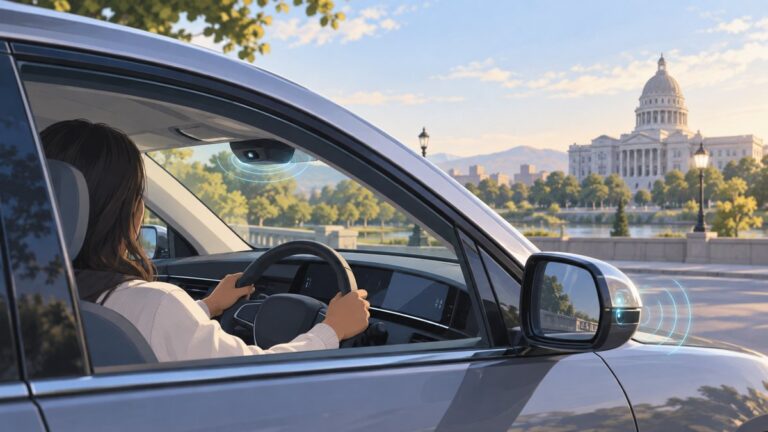
A connected car can collect and transmit far more than its GPS position. Depending on the make, model year, market, connectivity hardware, enrolled services and settings, it may process precise location, speed, braking, acceleration, seatbelt use, trip details, vehicle diagnostics, voice interactions, camera or sensor information, app activity and other personal information. It may send that information to the automaker and disclose it to connectivity, emergency-response, roadside, wireless, dealer, service and other providers tied to features you choose.
There is no universal data inventory for every vehicle. The authoritative answer for your car is its current privacy notice, product-specific service terms, connected-account settings and owner’s manual.
As an Amazon Associate I earn from qualifying purchases.
What “connected car” includes
“Connected car” is a broad category. A vehicle may have factory-installed wireless connectivity, or it may transmit information through a separately enabled connected service, smartphone integration, subscription or companion app. Ford’s U.S. Privacy Notice effective July 1, 2026, for example, defines connected-vehicle information to include data from vehicles with either type of connectivity. That means a car can remain a data-producing device even when a driver does not think of it as actively using an app.
Connectivity can be built into the vehicle’s modem, infotainment system, emergency-assistance equipment, navigation service, mobile application or a third-party feature. Collection can begin when a feature is enabled, when a vehicle is enrolled in a service, when an event triggers a safety system, or when the car automatically communicates for maintenance or software functions. The exact trigger depends on the vehicle and service.
#1 Best Overall

- Never Let a Dead Battery Ruin Your Drive. The LISEN 4 in 1 Retractable Car Charger delivers reliable power for your entire journey. Compatible with standard 12V cigarette lighter sockets, it keeps phones, tablets, and devices charged during daily commutes, road trips, and long drives — the perfect practical gift for dads, truck drivers, and anyone who lives on the road.
- Daily Driver Essential: Always Ready When You Need It. Featuring two retractable cables ( USB C & Old iPhone Charging Cable ) that extend up to 31.5 inches and dual USB ports, this charger solves cable clutter while charging up to 4 devices simultaneously. Ideal for busy fathers, commuters, and families who want a tidy car and never worry about low battery again.
- Deliver full-speed PD fast charging for iPhone 18 Pro Max & iPhone 18 Pro Max & iPhone 18 Pro right inside your car. The built-in 45W PD USB-C port hits the peak charging speed for these latest iPhone models, juicing up your phone to 50% power in just 15 minutes while you drive.(Note: Maximum 45W PD output is available under 24V vehicle power supply. When used with standard 12V car sockets, the peak output is limited to 36W.)
- Standard 12V Power Solution: Designed as a dedicated USB power supply for charging devices. Note: Does NOT support CarPlay, Bluetooth, or data transfer. Compatible with most phones, tablets, and small electronics. This retractable charger is a core car organization tool, keeping your vehicle tidy. Not compatible with Micro-USB devices.
- Clutter-Free Tech Organization: Featuring dual USB ports and retractable cables, the LISEN 4 in 1 charger provides a clean car storage solution. Perfect for truck enthusiasts or as a thoughtful gift for drivers, it supports fast USB-C charging for devices like the iPhone 18Pro & iPhone 18 ProMax. Keep your vehicle organized while ensuring efficient power delivery for all your tech on the road.
The overview here is U.S.-focused, with California examples. Other countries, states, model years and service plans can impose different disclosures, controls and legal rights.
What information can a connected car collect?
Federal Trade Commission materials describe connected-car data as potentially including biometric, telematic, geolocation, video and other personal information. California’s Privacy Protection Agency says connected vehicles often gather location, preferences and details about daily life through built-in apps, sensors and cameras. These are possible categories, not a promise that every car collects each one.
| Data category | Examples named in official notices | What can trigger or limit collection |
|---|---|---|
| Location and telematics | Precise vehicle location, route or trip information, time and duration of a trip, and vehicle-generated telematics. | Navigation, emergency assistance, roadside services, geofencing, theft or safety functions, an enrolled service and the vehicle’s connectivity state. |
| Driving behavior | Speed, braking, acceleration habits, seatbelt use and related driving events. | Safety, service, scoring or other connected features; availability and consent controls vary by vehicle and jurisdiction. |
| Vehicle and service information | Vehicle status, diagnostics, maintenance or quality information, software and account details. | Remote functions, service appointments, warranty or quality programs, updates and support. |
| Voice interactions | Commands and interactions with an in-car or service-based AI assistant. | Only when the assistant or related feature is available and used; the notice should explain audio, transcript and retention practices. |
| Exterior camera and sensor information | Images or video, plus detected road information such as signs and lane markings. | Camera-equipped safety features, a detected safety event, mapping or other functions. Some notices distinguish road information from retained images or video. |
| Infotainment, app and preference data | Settings, connected-service use, smartphone integration, entertainment preferences and account activity. | App installation, account enrollment, paired phones and the services a driver elects to use. |
| Biometric or other personal information | The FTC lists biometric information among categories connected cars may involve. | Whether this applies depends on the vehicle, authentication method, feature and applicable notice; it is not a universal feature. |
Location and trip details
Location can be precise enough to reveal where a vehicle starts and stops, which routes it takes, how long a trip lasts and potentially patterns such as a home, workplace, school or medical visit. A connected vehicle may need location to provide navigation, real-time traffic, emergency dispatch or roadside assistance. Whether historical routes are retained, for how long and with whom they are shared is vehicle- and service-specific.
The Tool Desk
Outbyte PC Repair FREEClear out junk files and repair common Windows errorsFree Scan →Outbyte Driver Updater FREEFix the driver behind crashes, sound loss and screen glitchesFind Drivers →Driving behavior
Manufacturer disclosures can include speed, seatbelt use, braking, acceleration and related trip information. Driving data can support safety alerts, vehicle services, quality analysis or a feature the driver selected. A notice should identify whether data is collected continuously, only during particular events, or only after enrollment.
Cameras, sensors and road observations
Camera-equipped vehicles can process images or video outside the car. General Motors’ California Consumer Privacy Statement says external camera images or video may be collected with consent or when the vehicle detects a safety event. It also says road information such as signs and lane markings may be collected even when images or video are not. That distinction matters: turning off image retention may not disable every sensor-derived road observation.
Rank #2

- High Quality Material: The coaster is made of environmentally friendly silicone, safe, non-toxic and odorless. Soft with toughness, easily embedded in the cup holder. Very durable, wear-resistant, long service life. High temperature resistance, can withstand 100 ℃ high temperature water cups.
- Wide Compatibility: The coaster has a diameter of 3.15 inches and a height of 1.18 inches, which is widely used in most vehicles, such as SUV, sedan, MPV, etc., as long as the size fits your car cup holder.
- Protection Function: Our car cup holder coaster has a carry handle design and a stand-up ring edge on its edge to effectively prevent food crumbs, drinks and water from leaking out and preventing the car cup holder from getting dirty.Meanwhile,Thickened design effectively prevents the cup holder from being scratched by the cup when driving on bumpy roads and eliminates the annoying thumping sound, making your journey more enjoyable.
- Easy to Use and Clean: With embedded installation, you just need to put it flat on the car cupholder. It is also very quick to remove, there is a small bump on the coaster, pinch it and you can easily remove the coaster. It is very easy to clean, rinse with water or wipe with a wet towel (be careful not to clean with sharp tools).
- 100% Satisfaction: Our products have quality assurance, if you have questions or are not satisfied after receiving the product, don't worry, please contact us as soon as possible, we provide after-sales service.
Voice, app and account activity
Voice assistants can create audio, transcripts or command records, depending on the implementation. Smartphone integration, remote-start apps, entertainment services and account portals can add data that is not generated by the vehicle’s mechanical systems. Review the privacy terms for each app or service rather than assuming the vehicle maker’s general notice covers it.
How does the car collect and transmit it?
Sensors and electronic control systems generate readings while the vehicle is operating. The infotainment unit, telematics control module, cameras, microphones and paired devices can then process or transmit those readings through a cellular or other wireless connection. A service may receive data continuously, at intervals, on demand or after an event such as a crash or airbag deployment.
Collection and transmission are separate questions. A vehicle can process information locally without sending every raw signal off the car; a service may receive a derived value, an event record, an image, a video clip or a location update instead. The privacy notice should explain the relevant categories, purposes, recipients, retention and controls, but the technical detail differs by model and software version.
Why is connected-car data collected?
- Safety and emergency response: crash detection, emergency calling, roadside dispatch and assistance to locate a vehicle.
- Navigation and traffic: route guidance, traffic conditions, map improvements and location-based services.
- Vehicle operation and support: remote commands, diagnostics, maintenance reminders, service scheduling, software updates and troubleshooting.
- Quality and security: investigating faults, improving reliability, detecting misuse and protecting connected accounts or systems.
- Features you choose: entertainment, smartphone integration, voice assistants, insurance or other optional services. The feature’s own enrollment and consent flow can change what is collected.
A purpose listed in a privacy notice does not by itself establish that every vehicle uses every category for that purpose. Check the notice for the specific model, market and service.
Who may receive the information?
The recipient depends on the data category and the service. General Motors’ California notice gives examples that include emergency and roadside providers, wireless providers, dealers and parties connected to a service a consumer chose or authorized. Other automakers’ notices may use different categories or exceptions.
Rank #3

- ✅【Designed for Magsafe】 - The most fashionable iphone car mount in 2026 Magsafe is designed for iPhone 18 Pro Max/17/16/15/14/13/12 Pro Max Mini and official Magsafe cases and other magnetic phone cases and can be fixed directly to these phones without the need to affix metal plates. All Android Phones Will Work: Metal rings are provided; they fit cases and other phones without magsafe. Based on Unique Grandmaster Design (Protected by US Design Patent No. US D1,112,194 S)
- ✅【STRONG MAGNETIC MagSafe Car Mount】 - This powerful magnetic phone holder can create a powerful attraction that firmly supports your device while allowing you to drive without distraction. it easily and securely holds your phone through bumps, sharp turns or even sudden stops, no worrying of dropping your phone.
- ✅【SUPER STICK FORCE】 - VHB Dash Mounted Holders adhesive provides strong stick force between the dashboard and the car phone holder, which can firmly stick to any plane in the car, fix your device, adapt to a variety of road conditions such as sudden braking, speed bump, and rugged mountain road.
- ✅【SAFE DRIVING VIEW】 - Mini-size, not taking up space, it is placed in the dashboard without blocking the view at all, and does not need to look down at the device to ensure your safe driving. Cell Phone Car Mount is suitable for most cars, pickups, SUV, taxi; It is the best assistant for Uber and Lyft drivers
- ✅【360° FREE ROTATION】 - With an adjustable swivel ball joint, you can rotate your smartphone or device at your own will, providing the best viewing angle. Quickly pick and place with one hand, free your hands and make calls and GPS navigation more convenient
| Recipient category | Typical reason for disclosure | What to verify |
|---|---|---|
| Automaker and affiliated service operators | Run connected features, provide support, maintain systems, improve quality or respond to safety events. | Which entities act as service providers, contractors or independent businesses, and how long they retain data. |
| Wireless and connectivity providers | Transmit vehicle and app communications. | Whether network partners receive location, diagnostics, usage or account identifiers. |
| Emergency, roadside and towing providers | Respond to crashes, breakdowns or assistance requests. | What information is sent automatically and what is sent only after a request or consent. |
| Dealers and repair providers | Service appointments, diagnostics, maintenance and warranty support. | Whether a dealer receives ongoing telemetry or only information needed for a particular service. |
| Providers for a feature you choose | Navigation, entertainment, voice, insurance or other authorized services. | The separate provider’s notice, account controls, retention and deletion process. |
“Shared” does not always mean “sold,” and a disclosure to a service provider can be governed differently from a disclosure for another business purpose. Use the definitions and recipient descriptions in the applicable notice instead of assuming all transfers have the same legal treatment.
Why precise location and driving data deserve extra care
Location and driving patterns can reveal routines, relationships and sensitive destinations. In January 2026, the FTC announced a finalized order with General Motors and OnStar after allegations concerning the collection and sale of precise geolocation and driving-behavior data. The order bars those companies for five years from disclosing consumers’ geolocation and driver-behavior data to consumer reporting agencies.
For the order’s 20-year life, it also requires affirmative express consent before the named companies collect, use or share connected-vehicle data, subject to stated exceptions; a way for U.S. consumers to request a copy of their data and seek deletion; and specified controls for location and behavior data. Those are binding terms directed at General Motors and OnStar. They are not a rule that automatically governs every automaker or every connected vehicle.
What privacy rights may apply?
Rights depend on where you live, the business involved, the data category and legal exceptions. California’s Attorney General guidance, updated August 28, 2026, describes rights that can include:
- knowing what personal information a business collects, uses or discloses, subject to applicable limits;
- deleting personal information, subject to exceptions;
- opting out of the sale or sharing of personal information in covered circumstances;
- correcting certain inaccurate personal information; and
- limiting use or disclosure of sensitive personal information in covered circumstances.
California’s rights do not guarantee deletion of every vehicle record. Safety, security, legal, warranty, accounting and other exceptions may apply, and a connected-service provider may have a separate request process. Residents should use the current state guidance and the automaker’s designated request channel. People elsewhere should check the law that applies to their residence and the company’s role.
Rank #4

- Buyer's Guide: The seat guard for car seat between seat & console measures 15.75*2.7*1.53", suitable for gaps of 1.43-1.53" in width, please double-check carefully the distance between your seat and the center console before placing an order
- Storage and Filling in One: Differ from traditional single-function gap fillers, gap filler for car incorporates storage function, offers you the convenience of storing phones and various other items, so that you can access them at any time while driving
- Avoid Items Slipping: With the bumps and vibrations of the car, phones, keys may fall into the seat crevices, which is difficult to pick up, and distracts the driver's attention. Car gap seat filler fills gaps seamlessly to create an effective barrier
- Easy to Install: Car side seat gap filler is easy to install, simply insert it into the gap between the seat and the center console, gap seat filler for car can fit tightly without affecting the normal adjustment of the seat and the use of the seat belt
- Premium Material: Crafted from premium EVA material, our car seat side gap filler boasts a combination of wear-resistant, softness&durability. Maintenance is effortless, simply rinse and wipe to quickly clean the dust and debris in corners and crevices
How to find out what your own car collects
- Record the exact vehicle identity. Note make, model, model year, trim, market or country, software version if shown, and whether the car has a built-in modem.
- List every connected enrollment. Include the automaker account, emergency or roadside plan, navigation, remote-control app, smartphone integration, voice assistant and any optional service.
- Read the current general privacy notice. Look for sections covering vehicle-originated data, telematics, location, driving behavior, cameras, voice, retention, sharing and deletion.
- Open product-specific terms. A service notice can add data practices that are not described in the general notice. Ford directs owners to check whether their vehicle has connectivity and to consult product-specific notices and the owner’s manual for additional details.
- Check in-car settings and the account portal. Review switches for location, driving data, cameras, microphone, personalization, diagnostics, data sharing and optional services. Record what is enabled before changing it.
- Ask targeted questions. Contact the automaker or service provider about data fields, collection triggers, retention period, recipients, deletion, portability and whether disabling a setting stops collection, transmission or only a particular use.
Settings can change after an update or when a new service is enrolled, so recheck them after software updates, a vehicle handoff or a change in account holder.
Independent reader supportYour contribution helps us test, update, and keep practical guides available for everyone.How to limit collection without disabling needed safety features
Start with the feature that creates the data rather than switching off connectivity indiscriminately. For example, a driver may be able to decline an optional voice assistant or personalized service while retaining emergency calling. Another vehicle may tie several functions together, making a setting change affect navigation, remote controls or roadside assistance.
- Review location permissions in both the vehicle and the companion app.
- Disable optional driving-data programs or consent choices when the notice allows it.
- Remove paired phones and revoke app access when another person should no longer control the car.
- Check microphone and camera controls, while confirming what safety functions depend on them.
- Cancel services you do not use and ask whether cancellation stops future collection or only ends access.
- Keep a record or screenshot of consent choices and confirmation numbers for privacy requests.
Never assume that a dashboard indicator means all data transmission has stopped. A vehicle may still send information required for emergency, security, legal, maintenance or other disclosed purposes.
What to do before selling or transferring the vehicle
- Sign out of the automaker account and remove the vehicle from the account.
- Delete paired phones, contacts, navigation destinations, garage-door codes and saved addresses from the head unit.
- Cancel or transfer connected subscriptions according to the provider’s instructions.
- Use the vehicle’s factory reset or privacy-reset procedure, then verify that personal profiles and keys are gone.
- Ask the automaker how to request deletion of account or connected-service data and which records must be retained under an exception.
- Give the next owner only the information needed to activate their own account; do not leave your credentials in the vehicle.
The FTC specifically advises consumers to wipe car data before resale. A head-unit reset may not delete records already held by an automaker or service provider, so make a separate account or deletion request where available.
Free tools Windows power users keep installed
One-click scans. No signup required.
How to compare two connected vehicles or services
Marketing labels such as “smart,” “connected” or “privacy-focused” are not enough for a meaningful comparison. Compare notices for the same market and model year, and document the following:
Best Value

- 🔰 UPGRADED SIDE STORAGE DESIGN - Our console cover is thinner than the old one, universal for all seasons. There is an 8.66*5.12 inch storage pocket design on each left and right side, expanding the storage space, convenient and practical. Meet the storage needs of the main passenger seat, you can store your cell phone, keys, tissues, ID and some other small daily items.
- 🔰 PREMIUM MICROFIBER LEATHER MATERIAL - This car center console cover is made of quality microfiber leather material, soft and skin-friendly touch. Exquisite and fashionable diamond shaped stitching, every detail is in place. Inside the car center console cover is made of thickened memory foam, even after squeezing, it can slowly recover to its original shape.
- 🔰 RELIEVE DRIVING FATIGUE - The arm rest cover for car adopts ergonomic design, giving just the right amount of arm support, effectively dispersing elbow pressure and relieving driving fatigue. Protect your car's center console from getting dirty or scratched. Especially suitable for long time driving or long distance traveling, bringing you a new experience of relaxation and comfort!
- 🔰 NON-DESTRUCTIVE INSTALLATION - This car console cover is designed with an elastic band for a firm fit and not easy to shake. And the back side is full of protruding dots, which can effectively avoid the armrest cover from slipping and shifting. All you need to do is to open the center console cover, put the elastic band directly into the cover and then close it.
- 🔰 BUYER'S GUIDE - You will receive a car armrest storage box with the size of 12.13*7.80 inch, please measure the size of your car's armrest storage box before you buy. We have prepared five simple and beautiful colors for you, you can choose according to your own preferences. Suitable for most of the vehicles on the market, such as car, truck, SUV, RV, van, etc.
| Comparison question | Evidence to collect |
|---|---|
| Which categories are collected? | Location, driving behavior, vehicle data, voice, cameras, sensors, app activity, biometrics and other listed categories. |
| What activates collection? | Factory connectivity, service enrollment, a paired phone, a safety event, an account setting or a user request. |
| Why is each category used? | Safety, emergency response, navigation, diagnostics, quality, personalization, advertising or an optional feature. |
| Who receives it? | Automaker, affiliates, wireless provider, emergency or roadside provider, dealer, contractor or a third party chosen by the consumer. |
| How long is it retained? | Published retention period, event-based retention, account lifecycle and exceptions. |
| What controls exist? | In-car switches, account settings, consent withdrawal, access, correction, deletion and opt-out mechanisms. |
| Which law applies? | Residence, business role, data category and any state-specific or country-specific rights. |
If a notice does not state a comparable value, treat it as “not stated,” not as evidence that the vehicle does not collect or share the data.
Important limits on broad claims
California’s Privacy Protection Agency reported more than 35 million vehicles registered in California in its July 31, 2023 connected-vehicle review announcement. That is a California figure for that announcement, not a current national count.
The agency’s executive director, Ashkan Soltani, described modern vehicles this way: “Modern vehicles are effectively connected computers on wheels. They’re able to collect a wealth of information via built-in apps, sensors, and cameras, which can monitor people both inside and near the vehicle.”
Do these 3 things before closing this tab:
1Clear out junk files and repair common Windows errors2Scan for outdated or missing drivers - takes under a minute3Repair Windows errors before they cause bigger problemsThat observation explains the scope of the issue, but it does not establish a market-wide number of data fields or prove that every car collects or sells a particular category. The exact answer remains tied to the vehicle’s hardware, software, model year, enabled features, service enrollment, market and applicable law.
Quick Recap
Product prices and availability are accurate as of the date/time indicated and are subject to change. Any price and availability information displayed on Amazon at the time of purchase will apply.