Volkswagen Beetle generations fall into three broad groups, but they are not one uninterrupted mechanical design. The original Type 1 was a rear-engine, air-cooled, rear-wheel-drive car built worldwide through 2003; the New Beetle was a Golf-based, front-engine revival from 1997/1998 through 2010; and the 2011–2019 Beetle was a lower, wider successor that ended the nameplate’s modern era.
At a glance: three Beetle generations, but only one continuous mechanical lineage
The Volkswagen Beetle story is best understood as three major generations:
As an Amazon Associate I earn from qualifying purchases.
- Original Beetle, Volkswagen Type 1, or Käfer: the rear-engine, air-cooled car produced worldwide from the late 1930s until 2003.
- New Beetle: the 1997/1998–2010 Golf-based, front-engine, front-wheel-drive revival, including the New Beetle Cabriolet from 2003.
- Beetle or The Beetle: the lower, wider, more conventionally proportioned 2011–2019 successor, sold in the United States mainly as 2012–2019 model-year vehicles and offered as a Cabriolet from 2012.
The biggest mistake in Beetle history is treating the New Beetle as a mechanical continuation of the original. The resemblance is primarily visual. The original Type 1 used a longitudinal, rear-mounted, air-cooled flat-four and rear-wheel drive. The New Beetle and the 2011 Beetle used transverse, water-cooled engines at the front, front-wheel drive, and Volkswagen Group platforms related to the Golf.
| Generation | Production story | Engine and drivetrain | How to recognize it |
|---|---|---|---|
| Original Type 1 | 1938–2003 worldwide history; German sedan production ended in 1978 | Rear-mounted, longitudinal air-cooled flat-four; rear-wheel drive | Classic upright rounded body, separate fenders, rear engine lid and front luggage compartment |
| New Beetle | 1997/1998–2010; Cabriolet 2003–2010 | Front-mounted, transverse, water-cooled engines; front-wheel drive, with a rare AWD RSi | Highly rounded retro body, tall domed roof, flower-vase dashboard detail |
| Beetle / The Beetle | 2011–2019; Cabriolet 2012–2019 | Front-mounted, transverse, water-cooled engines; front-wheel drive | Longer hood, lower roof, wider stance, stronger C-pillar and sportier proportions |
Dates require some qualification. Volkswagen’s archive generally describes the New Beetle as a 1997–2010 model, while technical listings and some markets use 1998 as the first model period. Volkswagen launched the third-generation car in Germany on November 5, 2011, but United States listings generally identify the first examples as 2012 model-year cars.
#1 Best Overall

- Car Size: Long 13cm , Width 5.5cm , Hight 5.5cm
- Product Material:zinc alloy plastic rubber
- Color: Black , Yellow , Beige , Red , Pink , Blue , Skyblue
- Car doors can be opened, pull back action drives car forward
- It is perfect for collector's display and also can be used as a toy or gift.
Generation 1: Original Volkswagen Beetle, Type 1, or Käfer
1938–1945: conception, war-era origins and the postwar restart
The Type 1 was conceived as an affordable, compact and aerodynamic “people’s car.” Its defining engineering formula was established early: a rear-mounted longitudinal flat-four engine, air cooling, rear-wheel drive and a body mounted over a largely load-bearing floorpan.
Although the Beetle story is often dated from 1938, regular postwar production is the more useful starting point for most owners and historians. Series production resumed under British control shortly after World War II. Volkswagen records that the first postwar production cars came off the line shortly after Christmas 1945, with 55 vehicles produced by the end of that year.
1945–1949: basic postwar cars and the Export model
Early postwar sedans were comparatively plain, with limited trim and equipment. The 1949 Export model added higher-gloss paint, more chrome trim and an interior-operated front-trunk lock. Early cars are often identified by their split “pretzel” rear window, although the precise changeover depends on production date, market and chassis details rather than a single universal calendar date.
1950–1953: ventilation, sunroofs and the oval rear window
- 1950: no-draft ventilation was introduced, and Volkswagen began producing cars with a sunroof.
- 1951: side ventilation flaps appeared.
- 1952: revisions included tires, vent windows, bumpers, horns and rear lighting.
- 1953: the small split rear window gave way to a larger oval rear window.
For identification purposes, the rear-window change is one of the most useful early Beetle clues. A split window and an oval window usually point to different early production eras, but restoration work can make visual identification less reliable than the car’s chassis and production information.
1955–1959: more glass and better everyday usability
Volkswagen continued improving the Beetle without abandoning its basic design. Dual exhaust and revised rear lamps arrived in 1955. For 1957, the windshield and rear window grew, and Volkswagen redesigned the rear hood, license-plate light and instrument panel.
The 1959 update made the car easier to live with. Fixed door handles, pushbuttons and a trunk approximately 65 percent larger improved access and practicality. These were incremental changes, but that steady approach was central to the Type 1’s long life: the body remained recognizable while Volkswagen continually revised the details.
1960–1965: safety equipment, lighting and the 1300
During the early 1960s, the Beetle gained windshield washers, asymmetric low beams, turn signals, revised tail lamps, larger window areas and a changed wiper-rest position. These updates can help distinguish an early-1960s car from a 1950s example, although equipment varied by market.
The 1965 model year brought the 34-horsepower 1200 A and the Volkswagen 1300. Perforated disc wheels and flatter hubcaps also became important visual identifiers. Engine and model names were not always used identically in every country, so a “1300” badge should be treated as a starting point for identification rather than proof of a particular specification.
Mid-1960s to early 1970s: larger engines and the Super Beetle
Engine capacity increased from the original 1.2-liter family to 1.5-liter and then 1.6-liter flat-fours. The 1.5-liter engine reached 45 horsepower in the historical specification cited for this period. The 1.6-liter engine introduced around 1970 developed 50 horsepower in the referenced specification. Output ratings can differ with market, emissions equipment and testing standard.
The major packaging change was the 1302 Super Beetle, introduced in 1970. It had a longer front end and revised front suspension, creating more front luggage space and a visibly different nose from the standard Beetle. The Super Beetle’s front-end shape and suspension layout are therefore more significant than its badge alone when identifying one.
1972–1975: the 1303, curved windshield and special editions
The 1303 moved the Beetle toward a more modern interior and driving environment. It introduced a curved windshield and a revised dashboard layout. The 1303 S and related special editions added equipment and trim.
PC Slower Than It Used to Be?
A free scan shows the junk files, broken settings and background clutter dragging Windows down - then fixes them in one click.Free scan · Windows 10 & 11Crashes, No Sound, or Screen Glitches?
Random freezes, missing sound and display glitches usually trace back to one bad driver. Find and replace yours safely.Free scan · under a minuteThe 1973 Yellow-Black Racer, commonly called the GSR, became an important part of Beetle history. Its yellow-and-black appearance was later echoed by the limited 2013 GSR based on the modern Beetle.
Rank #2

- Die-cast metal body with plastic parts
- Opening doors and engine compartment
- Detailed chassis
- Item Package Weight: 1.28 pounds
1978–2003: production moves from Germany to Mexico
German sedan production ended in 1978, but the original Beetle did not disappear worldwide. The Karmann-built convertible continued through 1980, while Mexican and other South American production kept the classic architecture in manufacture for much longer. The last Mexican Type 1 left Volkswagen’s Puebla plant on July 30, 2003.
Late Mexican Beetles can look deceptively similar to much older cars, but their mechanical and emissions equipment changed substantially. Volkswagen’s historical account records several important updates:
- 1988: the Mexican 1.6-liter engine moved from contact-controlled ignition to electronic ignition.
- 1990: a catalytic converter was introduced.
- 1993: the 1600 sedan received fuel injection, hydraulic valve lifters and a lambda-probe catalytic-converter system.
That means “classic-looking” does not necessarily mean “mechanically identical to a 1950s or 1960s Beetle.” A late Mexican car may have different ignition, fuel, emissions and valve-train requirements from an earlier Type 1.
Do these 3 things before closing this tab:
1Repair Windows errors before they cause bigger problems2Fix the driver behind crashes, sound loss and screen glitches3Clear out junk files and repair common Windows errorsThe original Beetle’s final production run
The final Type 1 production run culminated in the Mexican Última Edición. This car is still an original Beetle in the engineering sense: it retained the air-cooled rear-engine architecture. It is not an early New Beetle and should not be serviced with New Beetle procedures or parts.
Volkswagen’s archive gives two slightly different total-production figures for the Type 1: 21,528,480 on one historical page and 21,529,464 on a later model-specific page. The safest way to report the total is to acknowledge the archive discrepancy and describe production as approximately 21.5 million vehicles.
Generation 2: New Beetle, 1997/1998–2010
The New Beetle was a new car underneath
The New Beetle revived the visual language of the original without continuing its mechanical design. Volkswagen based it technically on the Golf IV. Its engine was mounted transversely at the front, it used water cooling and it drove the front wheels. Platform and chassis components were shared with the Golf family.
Quick wins for a faster PC:
Scan for outdated or missing drivers - takes under a minuteDriver Scan →Clear out junk files and repair common Windows errorsFree Scan →Fix the driver behind crashes, sound loss and screen glitchesFind Drivers →The concept appeared as the Volkswagen Concept One at the January 1994 Detroit Motor Show. Production sales began in the late 1990s. Volkswagen’s archive uses 1997–2010 for the New Beetle’s model history, while technical profiles list many sedan variants from the 1998 model period. Both date conventions can be correct when discussing different markets or the difference between production launch and model year.
The interior deliberately played on Beetle memories. The dashboard flower vase, glovebox treatment, grab handles and other trim details made the car feel like a modern lifestyle interpretation of the classic rather than a literal engineering successor.
1997/1998 launch: 2.0-liter, 1.8T and diesel choices
The initial range included a 2.0-liter gasoline engine and a 1.9-liter direct-injection turbo-diesel. A 1.8T turbocharged gasoline engine was also part of the early-generation range and provided a more performance-oriented alternative to the naturally aspirated 2.0-liter.
Engine availability, power ratings and transmissions varied by country. A European technical profile cannot be used as a complete list of what was sold in the United States, Canada or another specific market.
The Tool Desk
Outbyte Driver Updater FREEScan for outdated or missing drivers - takes under a minuteDriver Scan →Outbyte PC Repair FREEClear out junk files and repair common Windows errorsFree Scan →1999–2001: a broader range of engines
Volkswagen expanded the New Beetle range during the early 2000s:
Rank #3

- package height : 7.111 cm
- package length : 29.718 cm
- package width : 19.05 cm
- Product type : TOYS AND GAMES
- 1.6-liter gasoline variants: recorded from 1999 onward in the technical profile.
- 2.3-liter V5: listed from 2000 to 2005 in markets where it was offered.
- 1.8T and 2.0-liter gasoline engines: continued as core options in different forms.
- 3.2-liter RSi: produced from 2001 to 2003, with permanent all-wheel drive.
The RSi is an unusual performance derivative, not a representative New Beetle. Its 3.2-liter engine and permanent AWD make it especially important to identify correctly before ordering parts or comparing it with an ordinary front-wheel-drive car.
2003: the New Beetle Cabriolet
Volkswagen presented the first Beetle convertible with a folding roof in 2003. The New Beetle Cabriolet continued through 2010. It shared the generation’s basic front-engine, water-cooled, front-wheel-drive concept but had body-specific roof, structural, trim and equipment changes.
Do not assume that a hardtop repair procedure, interior part or weather-seal specification automatically applies to the Cabriolet. Body style is as important as year when identifying a New Beetle.
Recommended Free Tools
2005–2006: exterior and interior revisions
Volkswagen identifies a slight modification in 2005. Secondary United States model-year summaries associate the broader update with the 2006 redesign period and describe revised bumpers, headlights, taillights, center console, gauge cluster, sun visors and trim.
These details should be treated as market-specific and production-date-specific rather than universal. A car registered in 2006 may have been built during a changeover, and equipment could differ between countries and trim levels.
2007–2010: mature-generation continuity
The New Beetle continued with relatively few headline changes near the end of its run. Volkswagen’s technical profile records several gasoline and diesel families through 2010, but not every engine was sold in every market. The most useful distinction for a buyer or technician is still the basic one: this is a Golf-related, front-engine, water-cooled car—not an air-cooled Type 1.
Generation 3: Beetle or The Beetle, 2011–2019
2011 global introduction and 2012 US model year
The third-generation car followed the New Beetle on Volkswagen’s PQ35 platform but changed its proportions substantially. Volkswagen launched it in Germany on November 5, 2011. In the United States and some other markets, the first cars are generally described as 2012 model-year vehicles. The clearest editorial label is therefore 2011 global introduction / 2012 US model year.
Compared with the 1998 New Beetle, the new car was longer, wider and slightly lower. The international launch presentation gave dimensions of 4,278 mm long, 1,808 mm wide and 1,486 mm high, compared with approximately 4,080 mm long, 1,725 mm wide and 1,500 mm high for the 1998 New Beetle profile.
The roof was less domed, the hood was longer, the windshield more swept back, the tracks wider and the C-pillar stronger. This created a sportier silhouette that moved closer to the proportions of the original Beetle while avoiding the toy-like exaggeration of the first modern revival.
More usable space
The redesign was not merely cosmetic. Volkswagen said rear-seat room improved and luggage capacity increased from 206 liters in the New Beetle to 310 liters in the new Beetle. The lower roofline might suggest less practicality, but the longer body and revised packaging produced a more usable passenger compartment and cargo area.
What’s actually slowing this PC down?
Pick the symptom - the matching free tool is one click away.
Initial engine range
The initial European range ran from a 1.2-liter TSI producing 105 PS to a 2.0-liter TSI producing 200 PS. Higher-output versions used XDS electronic differential-lock functionality as standard in the cited launch presentation.
Rank #4
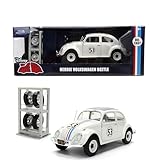
- Iconic movie styling – Features Herbie's #53 livery, racing stripes, and vintage license plate for screen-accurate authenticity
- Premium die-cast build – Crafted from sturdy metal with high-quality paint execution; perfect for display or play
- Dynamic functionality – Opening doors, hood, and decklid reveal interior and engine details; adds interactive realism
- Collector-ready extras – Includes bonus tire rack accessory for added diorama flair or shelf appeal
- Jada Toys – Trusted by collectors and fans for delivering high-detail, officially licensed pop culture vehicles
As with the New Beetle, engine names and outputs should not be transferred directly from European specifications to North American cars. Turbocharged gasoline engines, diesel options, transmissions, emissions standards and available equipment varied by market and model year.
2012–2019: Beetle Cabriolet
Volkswagen’s model index lists the Beetle Cabriolet from 2012 through 2019. It belongs to the third generation, but its folding roof and body structure create separate fitment and equipment considerations. A listing that says simply “2012 Beetle” is incomplete unless it also identifies coupe or Cabriolet, engine and market.
2013: limited-edition GSR
The 2013 Beetle GSR revived the visual theme of the 1973 1303 S Yellow-Black Racer. Volkswagen says 3,500 were built. The modern edition used yellow-and-black paint, yellow interior accents, 19-inch wheels and a 2.0-liter TSI rated at 210 PS in the official European description.
The GSR is more than a color package in historical terms: it connects the final-generation Beetle to a specific 1970s Type 1 special edition. However, exact equipment and power ratings still need to be checked against the market in which the car was sold.
2014–2016: Dune concept and production model
Volkswagen showed the Dune concept in 2014, followed by a production Beetle Dune in 2015 or 2016 depending on market. The Dune used crossover-inspired styling, increased ground clearance, a wider track, black wheel-arch and sill cladding, and distinctive 18-inch Canyon wheels.
Despite its raised appearance, the Dune remained front-wheel drive. It should not be confused with an all-wheel-drive off-road Beetle. Its design changes were primarily styling, ride-height and equipment changes rather than a transformation into a four-wheel-drive utility vehicle.
2016 facelift: design and technology update
Volkswagen described a spring 2016 product refinement that brought a redesigned front apron and optional LED taillights. The range also gained or updated equipment such as:
Recommended Free Tools
- Dune and Denim equipment lines
- Euro 6-compliant engines in the cited European specification
- a coasting function for DSG transmissions
- a rear-view camera
- rear traffic alert
- blind-spot sensing
- an updated Discover Media infotainment system
Not every item was standard on every trim, and emissions certification differed by market. For a used-car listing, “2016 Beetle” does not by itself prove that the vehicle has LED taillights, blind-spot monitoring, a camera or the revised infotainment system.
2017: Europe ends, but worldwide production continues
Volkswagen states that imports for the German market officially ended on April 29, 2017, and that the closed Beetle was discontinued in Europe during 2017. That was a regional end, not the end of global production. Puebla production continued for remaining markets, particularly the United States.
2019: Final Edition and the end of Beetle production
The last Beetle left Volkswagen’s Puebla plant on July 10, 2019. In the United States, the Final Edition was offered in SE and SEL forms and drew on the idea of the 2003 Última Edición.
Final Edition cars used a 2.0-liter turbocharged gasoline engine and added model-specific equipment including distinctive colors, Final Edition badges, chrome details, a sunroof, leather-wrapped steering wheel, automatic climate control, infotainment and special upholstery. The SEL version also included a 400-watt Fender sound system.
Quick wins for a faster PC:
Repair Windows errors before they cause bigger problemsFix Now →Scan for outdated or missing drivers - takes under a minuteDriver Scan →Clear out junk files and repair common Windows errorsFree Scan →The 2019 Final Edition is therefore the end of the water-cooled Beetle generation, not the final version of the air-cooled Type 1. The original Beetle had already ended worldwide in 2003.
Best Value

- CLASSIC REPLICA: Authentic 1:32 scale die-cast metal model of the iconic 1967 Volkswagen Classic Beetle in a beautifal paint finish
- DETAILED DESIGN: Features include chrome-style bumpers, realistic headlights, detailed wheels, and accurate body styling
- DIMENSIONS: Approximately 5 inches in length, perfect size for display or play
- INTERIOR FEATURES: Detailed cabin with beige interior, visible dashboard, and clear windows
- CONSTRUCTION: Durable die-cast metal body with plastic components and rolling rubber wheels
Original Beetle vs. New Beetle vs. Beetle: the engineering differences
| Feature | Original Type 1 | New Beetle | Beetle / The Beetle |
|---|---|---|---|
| Approximate production period | 1938–2003 worldwide; postwar production from 1945 | 1997/1998–2010 | 2011–2019 |
| Engine position | Rear | Front | Front |
| Engine orientation | Longitudinal | Transverse | Transverse |
| Cooling | Air-cooled | Water-cooled | Water-cooled |
| Typical drive wheels | Rear | Front | Front |
| Exceptional drivetrain | Not applicable to the standard Type 1 formula | Permanent AWD on the rare 3.2-liter RSi | No AWD identity for the Dune; it remained front-wheel drive |
| Platform concept | Dedicated Type 1 floorpan and architecture | Golf IV-related platform and chassis | PQ35-based successor to the New Beetle |
| Design character | Incremental evolution of the original rounded body | Highly retro, tall and domed | Lower, wider and more muscular |
How to identify a Beetle generation correctly
1. Start with the engine and cooling system
If the car has a rear-mounted air-cooled flat-four, it is an original Type 1 regardless of whether it was built in Germany, Mexico or another production market. If it has a front-mounted water-cooled engine, it is a New Beetle or third-generation Beetle.
2. Use the body proportions
- Original Type 1: separate-fender classic profile, front trunk and rear engine lid.
- New Beetle: taller, more bulbous roof and strongly rounded retro shape; the flower-vase interior is a useful clue.
- 2011–2019 Beetle: longer hood, lower roof, wider body and stronger C-pillar.
3. Check the production date, model year and market
Production year and model year are not interchangeable. The New Beetle can be described as a 1997 production-era model or a 1998 model-period car depending on the source and market. The third generation appeared globally in 2011 but is commonly a 2012 model-year car in the United States.
4. Identify the body style
The New Beetle Cabriolet ran from 2003 to 2010. The Beetle Cabriolet ran from 2012 to 2019. Roof, structural, weather-sealing, trim and some equipment details can differ substantially from the corresponding hardtop.
5. Confirm the engine before ordering parts or buying a manual
A badge such as 1300, 1600, 1.8T, TDI, TSI or RSi narrows the possibilities but does not replace a VIN, production-date and market check. Engine availability changed by country, and late Mexican Type 1 cars may have electronic ignition, fuel injection, catalytic-converter equipment and hydraulic lifters that earlier repair information does not cover.
Common year and naming mistakes
- “The 2003 Beetle”
- This could mean a final Mexican air-cooled Type 1, a New Beetle hardtop, a New Beetle Cabriolet or a market-specific registration/model-year description. Always state the generation.
- “The New Beetle is a classic Beetle underneath”
- It is not. The New Beetle is a Golf IV-related, front-engine, water-cooled, front-wheel-drive vehicle, apart from the rare AWD RSi.
- “The 2011 Beetle”
- That is a valid global introduction reference, but many US cars are identified as 2012 model-year vehicles.
- “The Dune is four-wheel drive”
- The Beetle Dune’s raised styling and cladding are crossover-inspired, but the Dune remained front-wheel drive.
- “2017 was the end of all Beetles”
- Europe ended the closed Beetle in 2017, while production continued in Puebla until July 10, 2019 for remaining markets.
- “All Beetle engines and features were global”
- They were not. Technical profiles often describe European or global ranges, while North American and other-market availability differed.
What changed across the whole Beetle story?
The original Type 1 achieved longevity through continuous incremental improvement. Volkswagen enlarged its windows, revised ventilation and lighting, increased engine capacity, added the Super Beetle’s revised front suspension and eventually introduced electronic ignition, catalytic-converter systems and fuel injection in late Mexican production. The core rear-engine, air-cooled formula survived even as details changed.
The New Beetle preserved the silhouette but changed almost every important mechanical relationship. Its platform, engine placement, cooling system and drivetrain came from the modern Golf family. The flower vase and rounded cabin communicated Beetle heritage, while the actual car was a contemporary front-wheel-drive hatchback or convertible.
The 2011 Beetle responded to criticism that the first revival was too tall and cartoon-like. It was longer, wider and lower, had more luggage capacity and rear-seat room, and offered stronger turbocharged performance. Its GSR and Dune variants connected it to different parts of Beetle history: the GSR to the 1973 Yellow-Black Racer and the Dune to a crossover-inspired lifestyle direction.
Do these 3 things before closing this tab:
1Repair Windows errors before they cause bigger problems2Scan for outdated or missing drivers - takes under a minute3Clear out junk files and repair common Windows errorsFinally, the 2019 Final Edition closed the water-cooled Beetle chapter. The nameplate’s complete history is therefore a story of visual continuity paired with two major engineering breaks.
Which details matter most when researching a Beetle?
- Generation: Type 1, New Beetle or third-generation Beetle.
- Production date and model year: especially around 1997/1998, 2011/2012 and the 2005/2006 New Beetle update.
- Market: German, European, United States, Mexican or another market can change engines, emissions hardware, trim and safety equipment.
- Body style: hardtop, New Beetle Cabriolet or Beetle Cabriolet.
- Engine and transmission: engine families and outputs varied considerably.
- Special edition: Super Beetle, 1303 S, GSR, RSi, Dune, Denim or Final Edition cars may have unique equipment and parts.
For restoration, service or parts ordering, do not rely on the word “Beetle” alone. Match the exact generation, body style, engine, market and production date. A classic Type 1 manual is not suitable for a New Beetle, and a New Beetle manual does not explain the air-cooled rear-engine systems of a 1960s or late Mexican Type 1.
Frequently Asked Questions
Is a 2003 Volkswagen Beetle an original Beetle or a New Beetle?
It could be either. The final original, air-cooled Mexican Type 1 was built in 2003, while the front-engine, water-cooled New Beetle was also sold during that period. The registration year alone does not identify the generation; check the engine location, cooling system, body shape, VIN and market.
Is the New Beetle mechanically the same as the original Beetle?
No. The New Beetle was based technically on the Golf IV and used a transverse, front-mounted, water-cooled engine with front-wheel drive. The original Type 1 used a rear-mounted, air-cooled flat-four and rear-wheel drive. The rare 3.2-liter New Beetle RSi added permanent all-wheel drive, but it was still not mechanically related to the classic Type 1.
What’s actually slowing this PC down?
Pick the symptom - the matching free tool is one click away.
Which years was the Volkswagen Beetle available as a convertible?
The New Beetle Cabriolet was produced from 2003 through 2010. The later Beetle Cabriolet, based on the third generation, ran from 2012 through 2019. Convertible-specific roof, structural and trim details should be matched separately from hardtop information.
When did Volkswagen stop making the Beetle?
Volkswagen ended German Beetle sedan production in 1978, and the Karmann-built convertible continued through 1980. The original Type 1 continued in Mexico until July 30, 2003. The later water-cooled Beetle remained in production at Puebla until July 10, 2019.
What is the difference between a standard Beetle and a Super Beetle?
The Super Beetle, introduced as the 1302 in 1970, used a longer front end and revised front suspension. That created more front luggage space and a visibly different nose from the standard Beetle. Later 1303 versions added a curved windshield and revised dashboard layout.
The Bottom Line
The Beetle name covered three very different vehicles. The original Type 1 evolved incrementally from the postwar 1945 restart to its final Mexican production car in 2003. The 1997/1998 New Beetle revived the shape on Golf-based, front-engine mechanicals, and the 2011 Beetle made that revival lower, wider and more practical before global production ended in 2019. When identifying one, generation, market, body style, engine and production date matter more than the badge or registration year.
Outdated Drivers Are Slowing You Down
One free scan finds every outdated or missing driver and matches the right update for your exact hardware.Free scan · exact hardware matchWindows Errors? Fix Them Before They Spread
Repair common Windows errors and clear accumulated junk for a smoother, more stable PC - no reinstall needed.Free scan · no reinstallQuick Recap
Product prices and availability are accurate as of the date/time indicated and are subject to change. Any price and availability information displayed on Amazon at the time of purchase will apply.




