Beginner driving is a staged risk-management process, not simply learning how to move a car or pass a road test. A new driver must learn vehicle control, traffic judgment, defensive habits, emergency response, and the limits of both the driver and the car.
This guide is written for learners in the United States, including permit holders, newly licensed teens, adult beginners, returning drivers, people adapting to a new country, and first-time car owners. The skills are broadly useful nationwide, but licensing rules, insurance requirements, passenger restrictions, and collision-reporting laws vary by state.
Before practicing on public roads, read your current state driver handbook. Search “[your state] DMV learner permit requirements” and use the official state-government result as the legal authority. The IIHS graduated-licensing comparison is useful for seeing how states differ, but it does not replace your DMV’s current rules.
What a beginner driver must be able to do
Before driving alone, you should be able to:
- Complete the permit, education, supervised-practice, testing, insurance, and registration steps required in your state.
- Set up the vehicle, locate its controls, recognize important warning lights, and perform a basic safety check without becoming distracted.
- Start, stop, steer, turn, reverse, park, change lanes, merge, and use highways smoothly.
- Scan for hazards well ahead, maintain a safe time gap, and anticipate pedestrians, cyclists, motorcyclists, trucks, and emergency vehicles.
- Recognize when traffic, weather, fatigue, impairment, or anxiety exceeds your current ability.
- Use driver-assistance features as backup tools—not as substitutes for observation or judgment.
- Choose and maintain a first car based on safety, visibility, power, insurance, repair costs, and total ownership cost.
- React safely to a missed exit, tailgater, flat tire, breakdown, warning light, collision, or severe weather.
A license establishes legal permission to drive. It does not prove that a person has mastered every road, weather condition, vehicle type, or judgment challenge.
What’s actually slowing this PC down?
Pick the symptom - the matching free tool is one click away.
#1 Best Overall

- The Road Guardian- The portable roadside assistance kit is designed and hand picked by a group of experienced veterans and experts to provide every essential tools you need in roadside emergencies. The automotive safety bag contains accessories such as repair cable ties, bungee cords, electrical tape, space blanket, rain poncho, reflective warning triangle, glass breaker, seatbelt cutter, safety gloves, tow rope and more to get your vehicle back on the road and continue your travel.
- Top-Notch Digital Auto Tire Inflator- lightweight and compact air compressor can inflate your standard vehicles tire in seconds. With auto shutoff function, simply plug it into the 12v power outlet and attach the stem to the tire valve, preset the tire pressure and press the power button. The compressor starts the inflating process and stop once your tire reaches at your preset level. This cool gadget also has led light for winter nighttime and three extra nozzles for inflammable bed, others
- Copper-Clad Aluminum 12 Feet 8 Gauge Jumper Cable- A durable battery starter cable is a must-have for your trip. Unlike other kits on the market, our jumper cable has reasonable length to get your cars connected. 8 gauge wires and 300 amp output is more than enough to get your standard vehicle started. UL listed heavy-duty battery jumper cables make you physically and environmentally safer and more reliable.
- Completed 108 Pieces First Aid Kit- By having a completed first aid kit, provide you and your family proper basic wound/hygiene treatment before it possibly get worsened during your road trip. Our kit includes alcohol pads, bandages, cotton tips, knuckle bandages, butterfly bandages, wound pad, sting relief pads, gloves, tape, dressing, PBT bandage, CPR mask, tweezer, safety pins, soap wipe, disinfect wipe, adhesive wound pad, triangular bandage, finger bandage.
- Veteran Owned Company 5-Star Customer Support- Everlit is committed into providing the most comprehensive customer service. We proudly offer the exclusive 60-days hassle-free return among all products. We stand behind the quality of our inventory; all original Everlit products are covered with a 1-year satisfaction warranty.
Before you drive: licensing, supervision, and insurance
The U.S. process is state-specific
There is no single national beginner-driving process. States set their own rules for minimum ages, learner permits, vision and knowledge tests, driver education, supervised hours, night practice, passenger limits, road tests, intermediate licenses, and reporting obligations.
A typical sequence looks like this:
- Read the current driver handbook for your state.
- Apply for a learner permit if your state requires one.
- Pass the vision and knowledge tests.
- Complete state-required driver education or behind-the-wheel instruction, if applicable.
- Practice with a supervising driver who meets the state’s age, license, and experience requirements.
- Record the required practice hours, including night or adverse-weather hours where applicable.
- Schedule and pass the road test.
- Follow all intermediate-license restrictions after passing, including passenger and nighttime rules that may apply.
- Obtain the required insurance and comply with registration requirements before driving independently.
Do not copy the requirements from a friend in another state. California, New York, and Texas, for example, differ in permit ages, supervised hours, nighttime restrictions, and passenger restrictions. Check your own DMV shortly before applying because these rules and procedures can change.
Legal minimum versus competence target
The number of hours required by your state is a legal minimum, not a guarantee of readiness. A useful practice record should track more than hours:
| Date | Location and traffic | Weather and lighting | Skills practiced | Mistakes or concerns | Next goal | Supervisor sign-off |
|---|---|---|---|---|---|---|
| May 10 | Empty lot | Day, dry | Smooth stops, reversing, turns | Braked late twice | Stop at marked lines | ________ |
| May 14 | Residential streets | Day, light rain | Stop signs, pedestrians, following gap | Missed one crosswalk | Scan left-center-right | ________ |
Progress when you can perform the current skill repeatedly and calmly, not merely once under ideal conditions. If a learner becomes overwhelmed, the supervisor should direct the driver to a safe place to stop rather than continuing to “push through” panic.
Choose the supervising driver carefully
A supervising driver should be legally qualified, patient, sober, rested, and able to give short, early instructions. A person who frequently becomes angry, grabs the wheel, uses a phone, or teaches aggressive habits is not a good instructor, even if that person has decades of driving experience.
A professional instructor can be valuable when a learner needs structured feedback, the family vehicle is difficult to control, or a parent and learner are repeating the same disagreement. Instruction costs more, but it may prevent habits that are harder to correct later.
Arrange insurance before independent driving
Do not wait until after buying a car to find out what it costs to insure. Get several insurance quotes for the exact vehicle, model year, driver, address, usage, and coverage levels. The National Association of Insurance Commissioners explains that requirements and rating practices vary by state. Factors can include location, age, driving experience, record, claims history, vehicle type, mileage, coverage, deductibles, and sometimes credit-based insurance information.
Ask about discounts for driver education, good grades, multiple vehicles, low mileage, safety equipment, and telematics programs. Telematics may reduce premiums for some drivers but involves monitoring and can have privacy or behavior-related trade-offs.
The Tool Desk
Outbyte Driver Updater FREEFix the driver behind crashes, sound loss and screen glitchesFind Drivers →Outbyte PC Repair FREEClear out junk files and repair common Windows errorsFree Scan →Understand the difference between liability, collision, comprehensive, uninsured-motorist, medical-payments, and personal-injury-protection coverage in your state. If the car is financed, the lender may require collision and comprehensive coverage. Never misrepresent the primary driver or how the car is used.
Learn the car before moving
Spend a parked session learning the vehicle. Controls and feature names vary, so the owner’s manual controls any model-specific procedure.
Find these controls without looking down for long
- Accelerator, brake, and clutch if the car has a manual transmission.
- Gear selector, Park, Neutral, Reverse, and Drive positions.
- Parking brake or electronic parking-brake switch.
- Turn signals, headlights, high beams, hazard lights, horn, wipers, washer fluid, and rear defroster.
- Instrument-cluster warning lights and the trip or information display.
- Fuel door, charging port, charging-status indicators, and range display where applicable.
- Backup camera, parking sensors, blind-spot alerts, and driver-assistance controls.
- Tire-pressure information and the location of the spare tire, inflator, jack, or roadside-assistance instructions.
Hybrid and electric vehicles may accelerate immediately and quietly, use regenerative braking, and have different displays and charging procedures. Some offer one-pedal driving, while others do not. Learn the particular car rather than assuming every hybrid or EV behaves alike.
Set up the seating position and mirrors
- Adjust the seat so you can fully press the pedals without stretching or locking your knees.
- Set the steering wheel so you can see the instruments and maintain a comfortable distance from the airbag. Do not sit unnecessarily close to the wheel.
- Set the inside mirror to show the rear window.
- Angle each side mirror outward so it shows the adjacent roadway rather than duplicating much of the inside mirror. The NHTSA mirror guide explains this approach.
- Buckle every occupant and make sure the lap belt sits low across the pelvis while the shoulder belt crosses the chest.
- Remove loose objects, and confirm that floor mats are secured and cannot interfere with the pedals.
- Set the navigation route, music, climate controls, and phone mode before moving.
- Check that doors are closed and release the parking brake only when ready.
- Look completely around the vehicle before moving, especially behind and beside it.
Correct mirror adjustment reduces overlap but does not eliminate blind spots. Every lane change still requires an appropriate shoulder check.
Quick wins for a faster PC:
Repair Windows errors before they cause bigger problemsFix Now →Scan for outdated or missing drivers - takes under a minuteDriver Scan →Clear out junk files and repair common Windows errorsFree Scan →The staged beginner-driving practice plan
Use progressively more demanding environments. Do not jump from an empty lot to a crowded freeway because the learner can make the car move.
Stage 0: Parked controls
With the vehicle stationary, practice locating the signals, lights, wipers, high beams, hazard lights, horn, gear selector, parking brake, defroster, and other frequently used controls. The goal is to reduce the need to look away from traffic later.
Stage 1: Empty parking lot
Begin at walking speed. Practice:
- Starting and shutting down.
- Releasing the brake smoothly and moving in a straight line.
- Braking gently and stopping at marked lines.
- Wide and tight turns.
- Backing slowly with a complete visual check.
- Pulling forward into spaces and backing out.
- Using signals even when no other traffic is present.
Do not practice emergency maneuvers by deliberately creating a dangerous situation. Learn emergency braking conceptually and from an instructor in a controlled setting.
Stage 2: Quiet residential streets
Add stop signs, right and left turns, driveway traffic, parked vehicles, pedestrians, bicycles, speed control, lane position, and a following cushion. The supervisor should ask the learner to identify hazards before reaching them.
Recommended Free Tools
Stage 3: Moderate traffic
Practice traffic lights, four-way stops, uncontrolled intersections, protected and unprotected left turns, lane changes, multilane roads, busier pedestrian areas, and vehicles entering from driveways.
Stage 4: Parking and reversing
Practice perpendicular, angle, parallel, and hill parking. Learn to back into or out of a space, use mirrors and cameras together, and stop immediately when visibility is lost. A camera helps you see low or rearward objects, but it cannot show every child, animal, cyclist, or vehicle around the car.
Stage 5: Highways and freeways
Wait until the learner can control speed, hold a lane, scan mirrors, and make decisions without becoming overloaded. Then practice:
- Choosing the correct entrance lane.
- Checking traffic before entering the ramp.
- Accelerating smoothly toward the speed of traffic when conditions permit.
- Signaling and selecting a usable gap.
- Merging without stopping on the ramp unless stopping is necessary to avoid a collision.
- Maintaining a larger following gap.
- Moving toward the exit lane early enough to avoid a last-second crossing.
- Continuing to the next legal route if an exit is missed.
Stage 6: Complex conditions
Introduce night driving, rain, snow, ice, heavy traffic, construction zones, rural roads, hills, curves, unfamiliar destinations, and long trips separately. A learner who is comfortable in daylight on dry residential roads has not necessarily learned night driving or winter driving.
Do these 3 things before closing this tab:
1Clear out junk files and repair common Windows errors2Scan for outdated or missing drivers - takes under a minute3Repair Windows errors before they cause bigger problemsRank #2

- Portable & Compact: The car safety kit is designed to fit neatly into an organizer bag, allowing for easy storage in either the backseat or trunk of your vehicle. This ensures that all essential safety items are kept together and easily accessible in case of an emergency. By keeping the kit organized and readily available, you can be better prepared for unexpected situations while on the road
- Fully Prepared: This kit should include essential tools and supplies to help you in case of an emergency. By being prepared, you can feel more secure while driving and have the necessary resources to handle unexpected situations
- Multi-Purpose Emergency Kit: This emergency kit contains everything you need for emergencies. It's suitable for different occasions such as winter weather, commuting and road trips
- Premium Material: The cable surface is covered by PVC material and the interior is made of premium copper wire. The use of premium materials can significantly enhance the overall quality and value of a product. This universal cable is suitable for small vehicles
- Wonderful Car Safety Kit: This kit is ideal for family and friends, especially for teenagers who are about to own their first car. It's a thoughtful and practical present that will undoubtedly be appreciated by the recipient
Stage 7: Independent trips
Start with familiar routes at low-complexity times. Gradually add unfamiliar destinations, parking garages, busy traffic, longer distances, and changing weather. The goal is not to avoid all discomfort; it is to maintain enough attention and decision-making capacity to drive safely.
Basic driving skills, step by step
Starting an automatic vehicle
- Confirm that the vehicle is in Park.
- Press the brake pedal.
- Start the vehicle.
- Check the instrument cluster for warnings.
- Check mirrors and the intended path.
- Select Drive or Reverse only after confirming that the path is clear.
- Release the parking brake if applicable.
- Signal before entering traffic.
- Release the brake smoothly and use gentle accelerator pressure.
Keep your eyes outside the vehicle and your hands available for steering. Do not use the first moments after startup to program navigation or adjust entertainment.
Starting a manual-transmission vehicle
Exact procedures vary, but training normally begins with the clutch fully depressed, a confirmed gear selection, and practice finding the clutch engagement point on a flat, empty surface. Use only enough accelerator to move smoothly, avoid resting your foot on the clutch, and use the parking brake on hills until you can coordinate the controls safely. Manual driving is a useful skill for some drivers, but it is not a required rite of passage; the first priority is safe control and awareness.
Braking and stopping
- Look well ahead and begin slowing early.
- Come off the accelerator when appropriate before applying the brake.
- Use smooth pressure for routine stops.
- Leave enough space to stop behind the vehicle ahead.
- Do not assume a green light guarantees a clear intersection.
- In an ABS-equipped vehicle during emergency braking, apply firm, continuous pressure and steer as needed. Do not pump the brake pedal; this is also the NHTSA guidance for ABS in winter conditions.
Following distance
Use time rather than a fixed number of car lengths. A three-second gap in favorable conditions is a useful defensive-driving baseline. Pick a fixed object ahead, note when the vehicle in front passes it, and count until you pass the same object.
Crashes, No Sound, or Screen Glitches?
Random freezes, missing sound and display glitches usually trace back to one bad driver. Find and replace yours safely.Free scan · under a minutePC Slower Than It Used to Be?
A free scan shows the junk files, broken settings and background clutter dragging Windows down - then fixes them in one click.Free scan · Windows 10 & 11Increase the gap at night, in rain, snow, ice, poor visibility, behind a motorcycle, when following a truck or trailer, or whenever you need more time to react. The California Driver Handbook uses the three-second technique, but it is not a universal federal law. If a vehicle cuts into your gap, ease off the accelerator and rebuild the space instead of making an aggressive correction.
Scanning and lane position
Look at least several seconds ahead rather than staring only at the bumper immediately in front of you. California’s handbook teaches scanning at least 10 seconds ahead as a defensive-driving technique; that is training guidance, not a nationwide legal measurement.
Search left, center, and right before intersections. Check mirrors regularly. Watch parked vehicles for opening doors and pedestrians emerging between cars. Look for escape space, avoid remaining beside another vehicle for long periods, and treat brake lights several vehicles ahead as an early warning.
Turns and intersections
- Approach at a speed that allows you to stop.
- Stop behind the limit line, crosswalk, or intersection edge as required by the markings and local law.
- Scan for pedestrians, bicycles, motorcycles, and vehicles.
- Yield when turning across opposing traffic.
- Do not assume an approaching vehicle’s turn signal is accurate.
- Turn into the appropriate lane and stabilize the vehicle before changing lanes.
- Do not enter an intersection unless there is room to clear it.
At a four-way stop, the first vehicle to stop generally proceeds first, but local signs and law control. If vehicles stop at the same time, yield according to your state’s rules and communicate clearly through position and movement rather than relying on a wave that another driver may misunderstand. The California handbook’s intersection and right-of-way section provides useful examples, but it should not be treated as the law of every state.
When waiting to turn left, keep the front wheels straight where appropriate. Turning them toward opposing traffic can push the vehicle into that traffic if it is struck from behind.
Roundabouts
- Slow before entering.
- Yield to traffic already circulating.
- Enter counterclockwise when a safe gap exists in a standard U.S. roundabout.
- Stay in the lane appropriate for your exit and follow the signs and pavement markings.
- Do not stop or pass within the roundabout.
- Signal when exiting where required or customary.
- If you miss the exit, continue around rather than stopping or making an abrupt maneuver.
Lane-selection rules can vary with local markings. Read the signs before entering.
Changing lanes
Use this sequence: decide, check, signal, mirror, shoulder, gap, move, cancel.
- Decide early rather than waiting until the last moment.
- Check the intended lane and traffic ahead.
- Signal.
- Check the inside mirror and side mirror.
- Look over the appropriate shoulder for the blind spot.
- Confirm a safe gap and compatible speed.
- Move smoothly into one lane without drifting or crossing multiple lanes at once.
- Cancel the signal and rebuild your following distance.
The California DMV lane-change guidance follows this general process. Signal timing, lane markings, and local rules still control.
Freeway merging and exiting
A ramp is for building speed and assessing traffic, not for racing to the end. Look early, signal, match traffic speed when safe, select a gap, and merge smoothly. Do not force another driver to brake. After merging, leave extra space and avoid lingering beside trucks.
Move toward the exit lane early enough to make a calm maneuver. If you miss an exit, continue to the next legal exit or route. Never reverse on a freeway, stop abruptly, cross a gore area, or make a last-second lane change.
Reversing
Reversing combines low speed with poor visibility, making it a high-risk beginner maneuver.
- Walk around the vehicle when practical.
- Check mirrors and the area behind and beside the car.
- Look through the rear window where possible.
- Use the camera as an aid, not the only source of information.
- Reverse slowly enough to stop immediately.
- Stop if a person, object, or area becomes hidden.
- Recheck the area after entering the vehicle.
NHTSA emphasizes that backup cameras do not replace mirrors or physically checking around the vehicle.
Free tools Windows power users keep installed
One-click scans. No signup required.
Parking
For perpendicular and angle parking, slow early, center the car between the lines, and check both sides before opening a door. For parallel parking, signal, position alongside the space, reverse slowly using reference points appropriate to that vehicle, and make small corrections rather than large steering inputs.
On a hill, apply the parking brake, select Park or the appropriate gear, and position the wheels according to your state handbook and the vehicle owner’s manual. The exact wheel direction depends on whether the vehicle is uphill or downhill and whether a curb is present.
Safety rules that must become automatic
Seat belts first
The car does not move until everyone is buckled correctly. The lap belt belongs low across the pelvis; the shoulder belt should cross the chest. Never place the shoulder belt behind the back or under the arm, and never share one belt between occupants.
NHTSA reports that 48% of passenger-vehicle occupants killed in 2024 were unrestrained among cases with known belt-use information. NHTSA also says a correctly worn seat belt reduces the risk of fatal injury by 45% for a front-seat occupant in a passenger car. Airbags supplement seat belts; they do not replace them. Children need current, age- and size-appropriate restraints under state and manufacturer guidance.
Rank #3
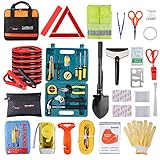
- ESSENTIAL RESOURCES: Packed with practical supplies from jumper cables, reflective triangle and vest to tow rope, and tire presure gauge, we've got everything you need to stay safe during an roadside emergency. But that's not all - it also includes rarely used but essential items like safety hammer, emergency blanket, and survival whistle. With these, you'll be prepared for almost everything the road throws your way.
- RELIABLE JUMPER CABLES: Say goodbye to uncoated jumper cable clamps! Our clamps are fully covered with premium PVC material to protect you from electrical shocks and make sure you can use them safely. The four giant alligator clamps are equipped with strong jagged teeth and springs for an excellent grip force. With a 6 gauge thick inner core, our cables are reliable even in cold winter weather.
- FOLDABLE SURVIVAL SHOVEL: At 16.5 inches, it's a portable size and comes with a carrying pouch. Its versatile design allows for shoveling, digging, hoeing, sawing, and chopping, making it the perfect tool to get you out of any tight situation.
- CAR REPAIR TOOL SET: This handy kit contains all the necessary tools for emergency vehicle repairs and basic household DIY projects, including hammer, wrench, plier, tape measure, PVC tape, digital display test pen, 3 screwdrivers, and 5 hex key. Each tool is neatly organized in a handy case for easy storage and portability.
Put the phone away
Distracted driving includes far more than texting. Scrolling, entering navigation, eating, reaching for an object, adjusting clothing, and intense passenger interaction all remove attention from the road.
- Turn on Do Not Disturb before moving.
- Put the phone out of reach.
- Set the route and music before departure.
- Ask a passenger to handle messages or navigation.
- Pull completely off the roadway and park before handling the phone.
NHTSA reports 3,208 deaths and more than 315,000 injuries in traffic crashes involving distracted drivers in 2024. Treat every trip as a no-phone task.
Control speed
Speed leaves a beginner less time to identify hazards, increases stopping distance and crash energy, and makes small steering errors more consequential. Obey the posted limit, but also slow for visibility, traffic, curves, weather, work zones, pedestrians, and road conditions.
NHTSA reports that speeding was a factor in 33% of passenger-vehicle teen drivers involved in fatal crashes in 2024. That statistic concerns teen drivers in a defined crash population; it is not a claim that speeding causes one-third of all beginner crashes.
The Tool Desk
Outbyte PC Repair FREERepair Windows errors before they cause bigger problemsFix Now →Outbyte Driver Updater FREEScan for outdated or missing drivers - takes under a minuteDriver Scan →Never drive impaired
If there is any doubt about impairment, do not drive. Alcohol, cannabis, illegal drugs, prescription medicines, over-the-counter cold medicine, sleep aids, and drug combinations can affect judgment, reaction time, coordination, or alertness. Driving impaired by any substance is illegal in every state, although specific laws and thresholds vary.
Designate a sober driver before drinking, arrange a taxi or ride-hailing service, ask a trusted adult for a ride, or stay where you are. Never ride with an impaired driver. Coffee, food, a shower, and fresh air do not reliably make an impaired person safe to drive.
Stop for fatigue
Pull over safely if you drift across markings, hit a rumble strip, cannot remember the last few miles, repeatedly yawn, struggle to keep your eyes open, or miss signs and exits. NHTSA recorded 644 deaths from drowsy-driving-related crashes in 2024 but cautions that fatigue is difficult to measure precisely.
Adequate sleep is the only reliable protection. A short nap combined with caffeine may provide temporary help, but it is not a substitute for sleep. Do not begin a long trip while already tired.
Limit passengers at first
Passengers create conversation, noise, social pressure, and distraction. Extra teen passengers can increase risk for novice teen drivers, and many graduated-license systems restrict them. Follow your state’s exact restrictions rather than borrowing rules from another state. Initially, one calm passenger—or no passenger—is usually the simplest learning environment.
Night, rain, snow, and difficult traffic
Night driving
Practice night driving separately after the learner is comfortable in daylight. Learn the headlight controls, manage glare from oncoming vehicles, slow enough to see within the illuminated area, and watch carefully for pedestrians, cyclists, animals, rural curves, and unlit vehicles. Do not overdrive the headlights by traveling faster than you can safely stop within the visible distance.
Fatigue makes night driving especially demanding. The CDC reports that 44% of teen motor-vehicle crash deaths in its 2020 dataset occurred between 9 p.m. and 6 a.m.; this is a year-labeled statistic, not a current annual rate for all beginners.
Rain and hydroplaning
- Slow before visibility becomes poor.
- Increase following distance.
- Use headlights according to local law and the vehicle’s instructions.
- Avoid abrupt steering, acceleration, and braking.
- Watch for standing water and do not assume the road is safe because other vehicles are moving quickly.
- Follow the owner’s manual and state guidance regarding cruise control on slippery roads.
If hydroplaning begins, remain calm, ease off the accelerator, avoid abrupt inputs, and steer smoothly toward the desired path. Vehicle-specific instructions take priority.
Recommended Free Tools
Snow and ice
Delay nonessential travel when conditions are severe. Before leaving, clear snow and ice from every window, mirror, light, roof, and camera. Reduce speed substantially, increase following distance, and make gentle steering and braking inputs.
All-wheel drive and four-wheel drive can help a vehicle accelerate on a slippery surface; they do not guarantee shorter stopping distances on snow or ice. Do not crowd or pass a snowplow. If stranded, keep the exhaust pipe clear so exhaust cannot enter the cabin.
NHTSA reports that in 2023, snow- or sleet-related conditions were involved in 320 fatal crashes and an estimated 22,293 injury crashes. Its winter-driving guidance recommends slower speeds, more following distance, correct tire pressure, and emergency preparation.
Pedestrians, cyclists, motorcycles, and children
Do not rely only on the phrase “right of way.” Look for people who may not see you, may be hidden by a parked vehicle, or may make an unexpected move.
- Scan crosswalks and sidewalks before turning.
- Check for cyclists before opening a door and before turning across a bike lane.
- Look twice for motorcycles, which can be hidden in blind spots.
- Slow near schools, parks, driveways, parked cars, and residential streets.
- Give people using wheelchairs or other mobility devices enough time and space.
- Give road workers and emergency responders a wide margin.
Trucks and buses
Large vehicles have blind spots, take longer to stop, and need extra room to turn. Avoid traveling beside a truck for a long time, leave space before merging in front of one, and never cut closely in front of a truck or bus. If you cannot see the truck driver in the appropriate mirror, assume the driver may not see you.
Emergency vehicles and roadside workers
All 50 states have Move Over laws, according to NHTSA. When approaching a stopped vehicle with flashing lights, change lanes away from it when safe or slow to a reasonable speed if a lane change is not safe. The vehicles covered and required speeds vary, so learn your state’s rule.
Driver-assistance technology is not self-driving
Current consumer systems are driver assistance. The human driver remains responsible for steering, braking, monitoring, and responding. NHTSA says Level 3 through Level 5 automated vehicles are not available for consumer purchase.
| Feature | What it may do | What it cannot guarantee |
|---|---|---|
| Forward-collision warning | Warn about a possible forward crash | It may warn late, miss an object, or provide no warning |
| Automatic emergency braking | Brake in some detected collision situations | It cannot prevent every crash or replace following distance |
| Lane-departure warning | Alert when the vehicle leaves detected lane markings | Faded markings, construction, curves, and weather can defeat it |
| Lane-keeping assistance | Provide steering input in some situations | It does not make the car autonomous and may disengage |
| Blind-spot warning | Alert to a vehicle in a detected adjacent area | It does not remove the need for a mirror and shoulder check |
| Adaptive cruise control | Adjust speed to a detected vehicle ahead | The driver must monitor traffic, curves, weather, and system limits |
| Backup camera and sensors | Show or detect some areas around the vehicle | They cannot show everything; physical checks remain necessary |
Snow, dirt, rain, glare, damage, poor lane markings, and unusual objects can block or confuse sensors. Feature names, capabilities, and availability vary by model, trim, software, and model year. Read the owner’s manual and never use marketing language such as “autopilot” or “self-driving” as permission to stop paying attention.
PC Slower Than It Used to Be?
A free scan shows the junk files, broken settings and background clutter dragging Windows down - then fixes them in one click.Free scan · Windows 10 & 11Outdated Drivers Are Slowing You Down
One free scan finds every outdated or missing driver and matches the right update for your exact hardware.Free scan · exact hardware matchRank #4

- If your car is parked at the scene of an accident waiting to be rescued, you may need this car emergency kit
- If this roadside assistance kit can help a novice driver or a family member or friend in the event of an accident on the road, they will surely thank you for gifting him this car emergency kit
- Lightweight and compact tire inflator inflates standard vehicle tires in seconds. The surface of the reinforced cable is made of high-quality PVC, which has the characteristics of anti-freezing, anti-cracking, and anti-tangling
- Roadside emergency car kits come in handy during winter weather, hiking, camping, road trips, or traveling in a car or other vehicle
- All of our products are stowed inside a high quality bag to keep our products in the trunk. Perfect for teens, novices, and experienced car enthusiasts
Choosing a first car
A first car should be selected for predictable control and affordable ownership, not image or maximum acceleration. A conservative priority order is:
- Crash protection.
- Crash-avoidance technology.
- Manageable size and good outward visibility.
- Predictable handling and braking.
- Moderate power.
- Affordable insurance.
- Reasonable fuel or charging costs.
- Affordable tires and maintenance.
- Controls that do not require excessive screen interaction.
- A clean recall and service history.
- A fit appropriate for the driver’s height, mobility needs, roads, and passengers.
Safety ratings and vehicle size
Use NHTSA’s 5-Star Safety Ratings to compare the exact model year and body style. Compare vehicles within the same class and specified weight range; a rating for a large SUV should not be treated as directly interchangeable with a rating for a small sedan.
Prioritize electronic stability control, automatic emergency braking, forward-collision warning, blind-spot warning, rear cross-traffic warning, good headlights, effective belt reminders, a rear camera, simple controls, and clear visibility.
IIHS and Consumer Reports use conservative criteria for teen recommendations that exclude excessive-power and performance-oriented vehicles, minicars, and vehicles below 2,750 pounds. They also caution that very large SUVs and pickups can be difficult for inexperienced drivers to handle and may take longer to stop. These are sensible screening criteria, not an absolute rule that every small or large vehicle is unsafe.
Quick wins for a faster PC:
Repair Windows errors before they cause bigger problemsFix Now →Fix the driver behind crashes, sound loss and screen glitchesFind Drivers →The IIHS/Consumer Reports safe-vehicle list is time-sensitive. In its 2026 update, it identified 45 used vehicles priced below $10,000 with good crash protection for teen drivers and another 29 used vehicles under $20,000 with additional features such as well-rated headlights and pedestrian-detecting automatic emergency braking. Its 2026 new-vehicle list includes models under $45,000 that meet its safety and usability criteria. Prices, availability, trims, and local inventory change, so verify the model year, trim, price source, and date checked before relying on any list.
New versus used
| Choice | Advantages | Trade-offs |
|---|---|---|
| New | Current crash-avoidance technology, warranty coverage, predictable history, and lower likelihood of hidden prior damage | Higher purchase price, depreciation, and potentially expensive sensor, camera, and display repairs |
| Used | Lower purchase price, potentially lower depreciation, and more choices within a fixed budget | Unknown maintenance or crash history, aging tires and safety systems, older crash-test standards, and greater inspection needs |
A sedan may be easier to maneuver and have a lower center of gravity. A compact SUV may offer easier entry and a higher seating position. The SUV can also be heavier, more expensive to insure, and harder to place in tight spaces. Choose based on the actual driver and environment, not a category stereotype.
Gas, hybrid, EV, AWD, and manual trade-offs
Gas, hybrid, and electric vehicles can all work as first cars. Consider charging access, range, climate, local energy costs, service availability, and how quickly the vehicle delivers power. IIHS notes that EVs can provide immediate access to power, an important consideration for a young or inexperienced driver.
AWD or 4WD may help with traction while accelerating in snow, but does not shorten braking distance on ice. A manual transmission adds clutch and gear coordination; an automatic reduces that initial workload. Neither transmission type replaces practice.
How to buy a used first car
- Set a total ownership budget, not merely a purchase-price maximum.
- Get insurance quotes for the exact vehicle before negotiating.
- Check the exact model year and body style through NHTSA’s safety-rating database.
- Search the VIN for open safety recalls at NHTSA’s recall lookup.
- Obtain a vehicle-history report, but do not treat it as a mechanical inspection.
- Check the title for salvage, flood, rebuilt, or other branding.
- Test warning lights, airbags, seat belts, tires, brakes, lights, climate controls, windows, locks, cameras, and driver-assistance features.
- Arrange an independent mechanical inspection before purchase.
- Read the FTC Buyers Guide.
- Confirm whether the vehicle is sold with a warranty or as is.
- Put every promised repair or included item in writing.
- Compare the out-the-door price, taxes, fees, interest rate, term, and total financing cost.
- Do not assume a federal three-day cancellation period exists.
The FTC’s used-car guidance says dealers must display and provide a Buyers Guide for used vehicles. It explains warranty status and emphasizes that a vehicle-history report does not replace an independent inspection. Federal law generally does not require a dealer to give buyers three days to return a vehicle. Review the FTC Used Car Rule and state law before signing.
Calculate the real ownership cost
- Purchase price or down payment.
- Loan interest and finance charges.
- Sales tax, registration, and fees.
- Liability, collision, and comprehensive insurance.
- Fuel or charging.
- Tires and tire installation.
- Oil, filters, and scheduled service.
- Repairs and deductibles.
- Parking and tolls.
- Roadside assistance.
- An emergency reserve for an unexpected breakdown.
A cheaper car can become more expensive if it needs tires, brakes, a battery, insurance, or immediate repairs. Price the complete first year, not just the vehicle.
Independent reader supportYour contribution helps us test, update, and keep practical guides available for everyone.Basic maintenance every new driver should know
Routine checks
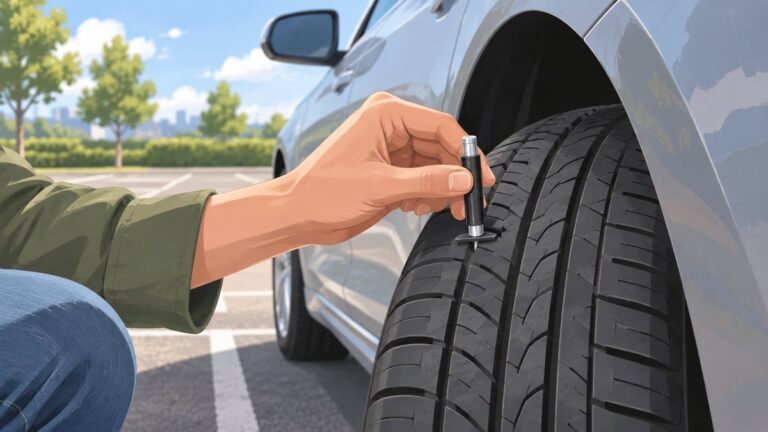
- Check tire pressure, including the spare if equipped.
- Inspect tread, sidewall damage, bulges, cracks, and uneven wear.
- Test headlights, brake lights, turn signals, and hazard lights.
- Check wipers and washer fluid.
- Check engine oil, coolant, and other fluids according to the owner’s manual.
- Look for battery corrosion or visible damage.
- Confirm emergency equipment is present and accessible.
- Check recall status.
The correct tire pressure is on the driver-door-jamb label or in the owner’s manual, not the maximum pressure printed on the tire sidewall. Check tires when cold. NHTSA’s tire-safety guidance and the manufacturer’s maintenance schedule should guide routine care.
Do not accept an unusually frequent maintenance package without asking what the owner’s manual requires. The FTC advises comparing a repair shop’s recommendations with the manufacturer’s schedule. Request a written estimate and repair order, seek a second opinion for expensive or unclear work, and keep receipts with mileage.
What’s actually slowing this PC down?
Pick the symptom - the matching free tool is one click away.
Warning-light triage
Symbols and colors vary, so consult the owner’s manual. As a general risk screen:
- Red oil-pressure, overheating, brake, or charging warning: stop as soon as safely possible, consult the manual, and arrange assistance if necessary.
- Flashing check-engine light or severe vibration: reduce risk, stop when safe, and seek professional help.
- Tire-pressure warning: slow down, inspect the tire, and check pressure promptly.
- Amber driver-assistance warning: the feature may be unavailable; continue without relying on it.
Do not remove a warning light by disconnecting the battery or clearing codes without diagnosing the cause.
What to do when something goes wrong
Missed turn, exit, or navigation instruction
Stay in your lane, continue forward, and let the navigation system recalculate. Never reverse on a road or freeway, cross a painted gore area, stop unexpectedly, or make a last-second lane change. Use the next legal exit or turnaround.
Wrong lane
Follow the lane markings if already committed. Continue through the intersection and reroute afterward. A missed turn is inconvenient; a sudden correction can cause a collision.
Free tools Windows power users keep installed
One-click scans. No signup required.
Tailgated
Do not speed up to satisfy the driver and do not brake-check. Maintain a steady course, increase the space ahead, and change lanes when safe to let the vehicle pass. More space ahead gives you room to slow gradually.
Aggressive driver nearby
Do not make eye contact, gesture, race, or retaliate. Create distance. If the driver follows or threatens you, go to a populated public location and call law enforcement when safe. NHTSA recommends giving aggressive drivers space rather than engaging them.
If you panic at an intersection
Brake if necessary, look toward the path you need to follow, and avoid freezing in a moving lane. If you are already proceeding through the intersection, continue safely rather than stopping unexpectedly in its path. A calm supervisor should provide one short instruction at a time.
If the vehicle skids
Avoid abrupt steering and braking, look toward the desired path, and make smooth corrections. In an ABS-equipped vehicle during emergency braking, use firm continuous pedal pressure. Vehicle-specific stability-control and winter-driving instructions belong to the owner’s manual and should be reinforced by a qualified instructor.
Best Value

- 【Things you may need】: This roadside assistance packages is a perfect gift.Contain the necessary roadside kits, snow shovel, flashing lights, reflective triangle warning signs, advanced jumpers (8.2 foot), powerful towing rope, safety hammer and seat belt cutters, life blankets, raincoats, compasses and more!
- 【Safe and durable】: UL certified jumper cables are safer and more reliable than other non-UL certified cables. Four huge alligator clips provide excellent grip. The grip of the clip is covered with an insulating rubber sleeve. The surface of the reinforced cable is made of high-quality PVC, which has the characteristics of anti-freezing, anti-cracking, and anti-tangling.
- 【Car repairs tool box】: Small and compact, suitable for any place, the tools are neat and orderly. Including hammer, pliers, utility knife, tape measure, PVC tape, digital display test pen, 3 screwdrivers. Each kit has a separate location. Clean, safe, convenient, light and strong plastic shell can withstand pressure
- 【Upgrade kit】: Our hammer head is made of high-quality high-carbon steel, with a pointed and flat hammer. It helps to use any side of the car escape tool to quickly break the window in an emergency. We provide raincoats and reflective safety clothing, which can be safer to wear when you repair a broken down car.
- 【Emergency car kit】: This emergency kit car, It’s lightweight, compact. that can fit anywhere in your backseat, trunk or even in your spare tire compartment, can handle unexpected things,it also includes preparedness survival tools for outdoor activities like camping, hiking, hunting, act. perfect for family use at home.
If a tire blows out
- Hold the steering wheel firmly.
- Do not slam on the brakes.
- Ease off the accelerator.
- Keep the vehicle pointed in its lane.
- Signal and move to a safe location after speed decreases.
- Call for help if changing the tire would expose you to traffic.
Do not practice a simulated blowout as an inexperienced driver. Learn the response before an emergency occurs.
If the vehicle breaks down
- Signal and move as far from traffic as safely possible.
- Turn on the hazard lights.
- Record the road, direction, exit, or mile marker.
- Call roadside assistance or 911 if there is immediate danger.
- Do not stand in front of or behind the vehicle.
- Do not try to push an inoperable vehicle in live traffic.
- Exit only when doing so is safer than remaining inside.
- If safely off the road, remain inside with the doors locked until help arrives.
AAA’s breakdown guidance similarly emphasizes getting away from traffic, using flashers, recording your location, and avoiding dangerous positions around the vehicle.
If the vehicle overheats
Pull over safely and turn off the engine if the temperature warning indicates overheating. Do not open a hot radiator cap. Wait for professional help if the cause is unclear.
After a collision
- Stop.
- Check for injuries.
- Call 911 when anyone is injured or the scene is dangerous.
- Move the vehicle out of traffic if it can be done safely and local law permits.
- Turn on hazard lights.
- Exchange required information.
- Photograph the scene and damage if safe.
- Do not argue or make roadside admissions about fault.
- Notify the insurer.
- Follow your state’s reporting requirements.
Collision-reporting thresholds differ. For example, California has its own injury and damage reporting rules, described in its driver handbook. Do not apply California’s reporting process automatically in another state.
Do these 3 things before closing this tab:
1Scan for outdated or missing drivers - takes under a minute2Repair Windows errors before they cause bigger problems3Fix the driver behind crashes, sound loss and screen glitchesPrintable beginner-driving checklists
Before every trip
- Am I rested, unimpaired, and emotionally calm enough to drive?
- Are all occupants buckled?
- Are the seat, steering wheel, and mirrors adjusted?
- Are the floor mats secure and the pedals unobstructed?
- Are the windows, mirrors, lights, and camera clean?
- Is the phone silenced and out of reach?
- Is navigation already set?
- Is the vehicle in the correct gear and is the path clear?
Before a highway, night, or bad-weather trip
- Check weather, traffic, fuel or charge, and route.
- Confirm tires are properly inflated.
- Bring a charged phone but keep it out of reach while moving.
- Know where you can safely stop.
- Clear snow and ice from the entire vehicle.
- Leave earlier so a missed exit will not create pressure.
- Tell a passenger that the driver—not the passenger—makes the final safety decision.
Questions to ask after practice
- What hazards did I identify early?
- Where did I look too late?
- Did I maintain a time gap?
- Did I make any rushed lane or turn decision?
- What single skill should be repeated next time?
Beginner-driving decisions at a glance
| Decision | Often makes sense when | Trade-off |
|---|---|---|
| Professional instructor or parent practice | The learner needs structured feedback or the supervising adult is anxious | Instruction costs more, but may prevent bad habits |
| Automatic or manual | Automatic is useful when reducing initial workload is the priority | Manual adds clutch and gear coordination |
| New or used | New suits a budget that allows current safety technology and predictable ownership | Used usually costs less but needs more history and inspection work |
| Sedan or compact SUV | A sedan may maneuver easily; a compact SUV may offer easier entry and visibility | An SUV may cost more to insure and can be harder to place or stop |
| Gas, hybrid, or EV | The choice fits charging, range, climate, service, and energy conditions | Power delivery and operating requirements differ |
| ADAS package | The attentive driver wants an additional warning or intervention layer | It can encourage overconfidence and may fail or disengage |
| Telematics insurance | The driver accepts monitoring for a possible discount | Privacy and behavior-scoring concerns |
| AWD or 4WD | Extra acceleration traction is useful in some conditions | It does not shorten stopping distance on snow or ice |
Frequently asked questions
How many hours should a beginner practice?
Complete your state’s required hours first, then continue until you can perform essential skills consistently in varied traffic, lighting, weather, and road conditions. Track skills and errors rather than treating the legal number as proof of readiness.
Is driving school necessary?
It is not universally required, but a professional instructor can be worthwhile when the learner needs structured feedback, the state requires education, or family practice is tense or inconsistent. A good arrangement often combines professional lessons with supervised practice between lessons.
Is an automatic easier to learn?
For most beginners, an automatic reduces the initial workload because there is no clutch or manual gear coordination. That leaves more attention for steering, traffic, speed, and observation. Manual driving can be learned later if it is useful.
What is the best first car?
There is no single best model for every driver. Look for strong crash protection, useful crash-avoidance technology, manageable size, good visibility, moderate power, affordable insurance, reasonable tire and repair costs, and a clean recall and service history. Check the exact model year and trim rather than relying on a generic model name.
Should a beginner buy new or used?
New vehicles generally offer newer safety technology and more predictable history, but used vehicles can provide safer equipment within a limited budget. For a used car, obtain an independent inspection, check recalls by VIN, review the FTC Buyers Guide, and price insurance and repairs before buying.
How long should I wait before driving on the freeway?
There is no universal number of lessons or hours. Wait until you can hold a lane, control speed, scan mirrors, judge gaps, and respond to instructions without becoming overloaded. Begin in light traffic and good weather, then add complexity gradually.
Is three seconds always enough following distance?
No. Three seconds is a useful favorable-condition baseline, not a guarantee and not a universal law. Increase the gap at night, in rain, snow, ice, poor visibility, behind large vehicles or motorcycles, or whenever you need more reaction time.
Can a beginner use adaptive cruise control?
Only after learning the vehicle’s system and limitations and only when the road and conditions are appropriate. It does not monitor everything, does not make the car autonomous, and does not remove the driver’s responsibility to watch traffic and steer.
Recommended Free Tools
What should I carry in the car?
Carry the vehicle’s required documents, a charged phone, appropriate clothing or a reflective item, a flashlight, basic first-aid supplies, water, and equipment appropriate to the car and climate. A tire inflator or spare-tire setup is useful only if you know how it is intended to be used safely. Never place yourself in live traffic to perform a repair.
What if I feel nervous while driving?
Reduce complexity instead of forcing the trip: slow within the legal and safe limit, increase your following gap, avoid unnecessary lane changes, and pull into a safe legal location if you cannot concentrate. Practice the difficult situation later with a qualified supervisor. Nervousness is a reason to pause and simplify, not to speed or make a rushed maneuver.
Can I drive after taking cold medicine?
Check the label and ask a pharmacist or doctor if the medicine may cause drowsiness, dizziness, slowed reaction, or impaired judgment. Do not drive if you feel affected, even when the medicine is sold over the counter.
How do I know whether a warning light is serious?
Use the owner’s manual. Red oil-pressure, overheating, brake, or charging warnings generally require stopping as soon as safely possible. A flashing check-engine light, severe vibration, smoke, or loss of control also warrants reducing risk and seeking professional help. An amber assistance-system light may mean the feature is unavailable, so drive without relying on it.
Frequently Asked Questions
How many hours should a beginner practice?
Complete your state’s required hours, then continue until you can perform essential skills consistently in varied traffic, lighting, weather, and road conditions. A practice log should record skills and errors, not just time.
Free tools Windows power users keep installed
One-click scans. No signup required.
What is the best first car for a new driver?
Choose based on crash protection, crash-avoidance features, visibility, manageable size, moderate power, affordable insurance, tire and repair costs, and recall history. Verify the exact model year and trim.
Is three seconds of following distance always enough?
No. Three seconds is a useful baseline in favorable conditions. Increase it at night, in poor weather, behind large vehicles or motorcycles, or whenever you need more time to react.
What should I do if I miss my freeway exit?
Continue to the next legal exit or route. Do not reverse, stop abruptly, cross a gore area, or make a last-second lane change.
Can a beginner rely on a backup camera or driver assistance?
No. These systems can help but may miss objects, disengage, or be affected by dirt, weather, glare, damage, or poor markings. The driver remains responsible for observation and control.
What should I do after a serious warning light appears?
Consult the owner’s manual. Stop as soon as safely possible for red oil-pressure, overheating, brake, or charging warnings. A flashing check-engine light, severe vibration, or smoke also requires immediate risk reduction and professional help.
The Bottom Line
Become a beginner driver in stages: learn the law, master the parked controls, practice from an empty lot through increasingly complex roads, and add highways, night driving, and bad weather only when the fundamentals are dependable. Make seat belts, distraction-free driving, sobriety, adequate sleep, safe spacing, and calm recovery from mistakes automatic. Choose a first car for safety and ownership cost rather than status, and remember that no camera, sensor, all-wheel-drive system, or driver-assistance feature replaces an attentive human driver.
Quick Recap
Product prices and availability are accurate as of the date/time indicated and are subject to change. Any price and availability information displayed on Amazon at the time of purchase will apply.