What’s actually slowing this PC down?
Pick the symptom - the matching free tool is one click away.
Short answer: Donut Lab has demonstrated a real battery cell and a real motorcycle battery pack, but it has not publicly proved that they are the advertised lithium-free, all-solid-state batteries with 400 Wh/kg and 100,000-cycle life.
As of August 9, 2026, the strongest evidence supports a functioning battery with impressive short-term charging performance, useful high-temperature behavior, and no thermal runaway in the specific published abuse tests. It does not independently verify Donut’s headline chemistry, energy density, cycle-life, cost, or production claims.
Later electrochemical analysis by researcher Ryan Hughes of Ziroth, reviewed by more than 20 battery specialists, argues that the tested cell behaves more like a lithium-based cell with a graphite anode than the lithium-free or sodium-ion technology described in Donut’s presentation. That evidence is significant, although it is not the same as a direct teardown and chemical analysis. The fairest verdict is therefore: the hardware is real; the advertised breakthrough remains unproven and is increasingly contradicted by the public evidence.
Research cutoff: August 9, 2026.
The two answers readers need
There are two different questions hidden inside the claim that Donut Lab has a revolutionary solid-state battery:
#1 Best Overall

- 40% Smaller & Lighter Portable Charger: Powered by the industry’s first TinyCell high-density battery technology, this ultra-compact 10,000mAh portable charger power bank is 40% smaller and 36% lighter than conventional chargers. Whether you are an office user slipping a mini small portable battery into a purse for commuting, or a student looking for lightweight college essentials, you get powerful daily carry convenience without the extra bulk to keep you powered on the go.
- 45W Pro Speed Portable Phone Charger: This 45W fast charger boosts an iPhone 17 Pro Max to 76%, a Galaxy S25 Ultra to 84%, or an iPad Pro to 60% in just 30 minutes (charging from 20%). Whether you are a driver needing a quick portable charger for car, a commuter relying on a desk phone charger, or a gamer wanting a seamless Switch battery pack and Steam deck charger portable, you will spend less time tethered to a wall and more time enjoying your day.
- Detachable Cable for Multiple Devices: Unlike a standard portable charger with built in cable that becomes useless if the cord breaks, INIU's 0.4ft detachable braided USB-C cable can be swapped anytime to save your investment. It effortlessly transforms into a versatile travel charger for multiple devices, ensuring your family or group travelers always have a reliable portable charger for all cell phones to keep everyone connected without carrying messy cords.
- Airline-Safe Travel Essentials: This TSA-compliant, flight safe power bank provides nearly 2 full charges for your smartphone, making it the perfect battery pack flight safe for business trips, cruise vacations, and airplane travel essentials. Beyond flights, it empowers campers, hikers, and outdoor users with ultimate camping essentials and road trip essentials—so you can explore freely without battery anxiety, making it ideal gifts for travelers women and men.
- Trusted Emergency Backup: As the SAFE Fast Charge Pro trusted by over 38 million users, we ensure the safest charging with the highest-grade materials. When unexpected storms or hurricanes strike, it acts as a lifeline—providing a dependable power outage battery backup and emergency phone charger for emergency users.
- Does a real battery exist? Yes. Donut has shown pouch cells, published commissioned test reports from VTT, and demonstrated an 18 kWh battery pack charging at roughly 100 kW in a Verge motorcycle.
- Has Donut proved the full CES specification package? No. The public record does not independently establish 400 Wh/kg, 100,000 cycles, lithium-free chemistry, a solid electrolyte, lower cost than lithium-ion, or mass-production readiness.
This distinction matters. Describing the entire product as fake would dismiss genuine test results. Repeating Donut’s marketing specifications as independently validated would be just as misleading.
What Donut Lab promised at CES
Donut Lab’s CES announcement presented a battery intended for electric vehicles and other demanding applications. The company’s claims included:
- 400 Wh/kg energy density.
- A full charge in five minutes.
- Up to 100,000 charge cycles.
- No lithium or dependence on rare or sensitive materials, with later reporting describing the intended technology as sodium-ion.
- No flammable liquid electrolyte.
- Operation across extreme temperatures, including more than 99% capacity retention at −30 °C.
- Lower cost than conventional lithium-ion batteries.
- Availability to vehicle manufacturers, production-vehicle applications, and eventual gigawatt-hour-scale manufacturing.
Donut’s current battery page continues to present several of those numbers as current product claims, including 400 Wh/kg, five-minute full charging, 100,000 cycles, lower cost, and availability today.
These are not one claim. They are a collection of claims about chemistry, construction, energy density, charging, durability, safety, economics, and manufacturing. Each requires different evidence. A fast charge test cannot prove cycle life, and a cell that does not ignite in one abuse test cannot prove the absence of a liquid electrolyte.
Why the phrase solid-state is easy to misuse
A solid-state battery uses a solid electrolyte instead of a liquid or gel electrolyte. That is the defining feature. Solid-state does not automatically mean sodium-ion, lithium-free, safer in every circumstance, or capable of 400 Wh/kg.
Conversely, lithium chemistry and solid-state construction are not mutually exclusive. A battery can use lithium ions and still have an all-solid-state electrolyte. The U.S. Department of Energy’s explanation of next-generation batteries is useful on this point: the charge carrier and the electrolyte’s physical state describe different aspects of a battery.
Important distinction: Evidence that Donut’s cell is lithium-based would strongly challenge a lithium-free or sodium-ion claim. It would not, by itself, prove that the cell has a conventional liquid electrolyte. Establishing or disproving the all-solid-state construction requires direct examination of the electrolyte, separator, electrodes, and packaging.
That is why the current evidence supports a narrower conclusion than either side’s most confident slogan. The cell may be an unusual lithium-based, semi-solid, hybrid, or all-solid-state design. Public electrochemical evidence strongly points toward lithium-based chemistry, but it does not disclose every physical component.
The Tool Desk
Outbyte Driver Updater FREEFix the driver behind crashes, sound loss and screen glitchesFind Drivers →Outbyte PC Repair FREEClear out junk files and repair common Windows errorsFree Scan →What VTT actually tested
VTT performed a series of customer-commissioned tests on cells supplied by Donut Lab. The reports contain valuable measurements of current, voltage, capacity, temperature, thickness, and degradation. However, the reports repeatedly describe the devices as cells that the customer supplied and identified as solid-state batteries. They are performance reports, not independent chemistry investigations.
That difference does not make the tests meaningless. It means their conclusions must be kept within scope: VTT measured how the supplied cells behaved under particular protocols; it did not certify their complete composition or validate Donut’s entire marketing package.
| Date | Report | What was tested | What the result establishes | What it does not establish |
|---|---|---|---|---|
| February 9, 2026 | VTT-CR-00092-26 | 5C and 11C charging | The supplied cell accepted very high charge rates under the stated laboratory conditions. | It does not prove chemistry, 400 Wh/kg, cycle life, or production readiness. |
| March 2, 2026 | VTT-CR-00124-26 | Discharge at high temperature | The tested cell delivered substantial measured capacity at 80 °C and 100 °C without igniting under the protocol. | It does not prove that the electrolyte is solid or that the cell cannot fail under other abuse conditions. |
| March 4, 2026 | VTT-CR-00125-26 | Self-discharge over 240 hours | The device stored electrochemical energy and retained most of its measured charge over ten days. | It does not prove solid-state or sodium-ion chemistry, energy density, or long-term cycle life. |
| March 16, 2026 | VTT-CR-00178-26 | 5C cycling of a previously damaged cell | The damaged cell continued operating without thermal runaway during the test. | It lost 54.66% of its capacity in 50 cycles, so this is not evidence of 100,000-cycle life. |
| May 12, 2026 | VTT-CR-00251-26 | Thickness change during cycling | The cell showed measurable charge-discharge dilation and limited net swelling during the reported experiment. | It does not prove that the cell swells one-fifth as much as a defined group of competing solid-state cells. |
The strongest positive result: very fast charging
The first VTT report examined a nominally 26 Ah, 3.6 V cell with approximately 94 Wh of nominal energy. VTT charged it at 5C and 11C. Those rates corresponded to currents of approximately 130 A and 286 A, respectively.
Donut’s later summary emphasizes that the cell reached approximately 80% state of charge in about 4.5 minutes at 11C. That is a genuinely notable laboratory result. The most defensible description, however, is:
Quick wins for a faster PC:
Clear out junk files and repair common Windows errorsFree Scan →Scan for outdated or missing drivers - takes under a minuteDriver Scan →A single customer-supplied cell accepted an 11C charge and reached approximately 80% charge in roughly 4.5 minutes under the published test conditions.
That is narrower than saying an electric motorcycle can receive a full charge in five minutes. The test used controlled laboratory equipment and heat sinks. Also, the final constant-voltage portion of a lithium battery’s charge normally takes longer than the initial constant-current portion. A result reaching 80% in 4.5 minutes does not establish that the cell reaches 100% in five minutes.
The test also says nothing by itself about how many times the cell can be charged that quickly, how much energy the complete pack stores per kilogram, or whether an ordinary vehicle charging installation can supply the required current. Fast charging is the strongest positive evidence in the dossier, but it validates fast charging—not every other claim.
The motorcycle pack demonstration
Donut later reported a pack-level demonstration with Verge. According to the company’s account and Electrek’s coverage, the air-cooled motorcycle pack stored 18 kWh and charged from approximately 10% to 50% in five minutes. It reached about 70% in slightly more than nine minutes and approximately 80% in 12 minutes while sustaining more than 100 kW, or roughly a 5C rate.
This demonstration is more meaningful than a single loose cell because it shows that multiple cells, a pack, a cooling system, a battery-management system, and a motorcycle can operate together during a high-power charge. It is evidence of a working vehicle application.
It is not an independent certification of:
- 400 Wh/kg at the cell or pack level.
- 100,000-cycle durability.
- Lithium-free or sodium-ion chemistry.
- A solid electrolyte.
- Long-term thermal performance.
- Standardized charging performance across multiple production vehicles.
- Customer delivery of cells meeting the CES specifications.
The event was a company and customer validation demonstration at a public charger, not a publicly documented independent pack certification. Charging power and energy density are also different measurements: a pack can accept high power without being especially light.
High-temperature performance was encouraging—but the cell lost its vacuum
In the second VTT test, Donut’s cell reportedly delivered approximately 110% of its room-temperature nominal capacity at 80 °C and approximately 107% at 100 °C. Donut presented this as evidence of unusual high-temperature operation.
Those figures should not be read as the battery suddenly gaining 110% of its rated energy. Battery capacity measurements can vary with temperature, discharge rate, voltage behavior, and the test’s operating window. The result shows what the cell delivered under that high-temperature protocol; it does not establish a higher gravimetric energy density.
Free tools Windows power users keep installed
One-click scans. No signup required.
Rank #2
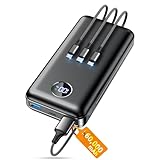
- Huge Capacity 60000mAh Power Bank: ZZI portable charger features a new high-density polymer battery that provides 10 charges for iPhone 15, freeing you from battery anxiety. Compatible with almost all types of smart devices on market including iPhone 17/16/15/14/13/12 Series, iPad, Samsung, Google Pixel series, Switch, and other Android phones and tablets.(IMPORTANT: 60000MAH PORTABLE CHARGER ARE NOT ALLOWED ON AIRPLANE)
- Charge 5 Devices Simultaneously: Portable charger power bank comes with a 3-in-1 high-strength nylon braided cable (Type-C / iOS / Micro USB) that has passed over 10,000 folding and plug-in/unplug tests, ensuring long-term durability and wear resistance. Charge up to five devices at once—suitable for home, travel, camping, hiking, vacation and outdoor trips
- 22.5W Super Fast Charging & Battery Protection: The battery charger can charge your iPhone 15 to 60% in just 30 minutes — 3 times faster than a standard portable phone charger. Built-in smart recognition chip automatically adjusts power output for different devices, delivering efficient and safe charging that protects your battery—so you can enjoy worry-free charging every time
- Ultra Compact & Smart LED Display: With its massive 60,000mAh capacity, ZZI battery bank provides long-lasting power without feeling bulky. Measuring only 5.8×2.9×1.1in, its size is similar to an iPhone 15, about twice the thickness, striking an ideal balance between capacity and portability. The LED digital display of portable battery shows the remaining battery in real time, allowing precise control over every charge
- Reliable 5-Layer Safety Protection: The battery pack portable charger features overcharge, overcurrent, overdischarge, overvoltage, and short-circuit protection, keeping your devices safe at all times, giving you complete confidence with every charge. What You Get: 1* power bank, 1* 3-in-1 USB cable, and 1* user manual
The test also produced an important complication: the pouch lost its vacuum. Donut characterized this as an edge-seam or adhesive failure involving packaging materials borrowed from conventional lithium-ion battery construction. VTT then tested the damaged cell rather than simply discarding it.
There are two defensible ways to interpret that sequence:
- Donut’s interpretation: The active battery remained functional and did not enter a fire or thermal runaway event after a packaging failure, suggesting graceful failure.
- The skeptical interpretation: A pouch that loses its vacuum and later becomes firm and 17% thicker may have experienced gas generation, chemical degradation, or exposure to air and moisture. That is not evidence of exceptional cycle life.
The test is therefore positive evidence about behavior under one high-temperature protocol and a packaging failure. It is not proof that the battery is fireproof, maintenance-free, or immune to degradation.
The self-discharge test rules out a simple supercapacitor theory
One early theory was that Donut’s device might be a capacitor or supercapacitor marketed as a battery. The self-discharge test makes that explanation substantially less plausible.
For VTT’s test, cell DL1 was charged to approximately 50% state of charge and left idle for 240 hours at ambient temperature. It retained 97.7% of its measured charged capacity. Its voltage declined from 3.861 V initially to 3.733 V after the ten-day idle period. The company’s own summary uses the result to rebut the idea that the device is merely a supercapacitor.
That rebuttal is reasonable in its limited form: the device stores energy like a battery and does not show the extreme leakage expected from a simple high-leakage capacitor. But self-discharge does not identify the electrolyte or electrodes. A conventional, hybrid, or solid-state battery could all show battery-like charge retention.
The most important negative result: damaged-cell cycling
VTT’s damaged-cell cycling report is easy to misrepresent because it contains both a safety observation and a major durability failure.
The laboratory tested the same DL2 cell that had lost its vacuum during the earlier 100 °C test. It ran 50 cycles at 5C between 0% and 90% state of charge. The cell’s initial 1C discharge capacity was 24.689 Ah. After those 50 high-rate cycles, its average 1C discharge capacity was 11.194 Ah—a reduction of 54.66%. The pouch had also become firm and approximately 17% thicker.
The cell did not enter thermal runaway during the published test. That is a positive safety result. But it is not a cycle-life success. A battery that loses more than half its capacity in this sequence cannot be used as evidence for a 100,000-cycle claim.
There is an important qualification: this was not a clean cycle-life test of a fresh, representative sample. The cell had already suffered vacuum loss and a high-temperature test. It would be wrong to conclude that every Donut cell loses 54.66% after 50 cycles. It would also be wrong to omit the result when discussing Donut’s durability claims. At minimum, it shows that the particular damaged cell’s ability to retain capacity was poor under the reported conditions.
What the swelling report does—and does not—show
In May, VTT measured thickness changes in a cell that had already undergone prior testing. The test used 0.5C, 1C, and 2C cycling at approximately 23 °C. The cell was held under approximately 86 mbar of pressure in a ComprePouch device.
VTT reported approximately 4.4% charge-discharge dilation amplitude and approximately 0.8% net swelling over the experiment. The cell expanded during charging and contracted during discharge. The report also noted a feature near approximately 70% state of charge, a maximum cell temperature of 37.6 °C, and 32 total cycles.
Windows Errors? Fix Them Before They Spread
Repair common Windows errors and clear accumulated junk for a smoother, more stable PC - no reinstall needed.Free scan · no reinstallOutdated Drivers Are Slowing You Down
One free scan finds every outdated or missing driver and matches the right update for your exact hardware.Free scan · exact hardware matchThat is useful mechanical data. It shows that the cell changes thickness during operation and that the measured net swelling was limited over the particular test. It does not prove that there is no liquid electrolyte or that the cell has an advantage over every competing design.
Donut’s testing campaign describes the result as roughly one-fifth the swelling of typical solid-state cells. The VTT report itself measures Donut’s cell; it does not provide a controlled head-to-head comparison against a defined set of competing solid-state batteries. The comparison therefore remains a marketing interpretation rather than an independently established benchmark.
The chemistry evidence increasingly points to lithium-based construction
The most consequential challenge to Donut’s public presentation came from the Ziroth investigation led by Ryan Hughes. The analysis examined the public VTT data, particularly the voltage curve and thickness changes during cycling. More than 20 battery specialists reportedly reviewed the material and agreed that the tested cell looked more like lithium-ion chemistry than the sodium-ion solid-state battery described in the investigation. Electrek reported the findings, while the TechSpot technical summary provides additional context.
Voltage behavior
The tested cell reportedly sat around 3.7 to 3.8 V at roughly half charge. That range is more familiar from high-nickel lithium-ion cells than from many sodium-ion chemistries. Voltage alone is not a chemical fingerprint, but it is one piece of the evidence.
Do these 3 things before closing this tab:
1Fix the driver behind crashes, sound loss and screen glitches2Repair Windows errors before they cause bigger problems3Scan for outdated or missing drivers - takes under a minuteExpansion behavior
The more revealing clue may be the expansion curve. The reported swelling data contain a feature associated with lithium insertion into graphite. Sodium ions are too large to intercalate into graphite in the same way, so a matching feature would conflict with a sodium-ion cell using that chemistry.
The combination of voltage and expansion signatures is stronger than a visual comparison of one graph. It is still an inference. The public material does not include a full teardown, solvent analysis, separator identification, microscopy package, elemental assay, or X-ray diffraction study that identifies every component conclusively.
Most accurate chemistry verdict: The published electrochemical data strongly point toward a lithium-based, graphite-anode cell and conflict with the lithium-free or sodium-ion interpretation. They do not, on their own, prove whether the electrolyte is liquid, gel, solid, or hybrid.
This is where some skeptical coverage goes too far. Saying that the cell resembles conventional lithium-ion chemistry is justified by the reported signatures. Saying that lithium-ion chemistry automatically disproves an all-solid-state battery is not. A lithium-based battery can use a solid electrolyte.
Recommended Free Tools
Rank #3

- Huge Capacity 50000mAh Portable Charger - The 50000mAh power bank ultra-high massive capacity will keep your phone and other device running for many days!Without extra worry about low phone battery. Ideal for traveling, camping and hiking.
- Latest PD 22.5W High-Speed Charging - OHOVIV 50000mAh Portable phone charger adopts the latest Super Charger Protocol and Fast Charger Protocol with 22.5W output USB-C port.Support QC4.0 QC3.0 huge capacity power bank with fast charging, it only takes 30 minutes to charge your iPhone 14 from 0% to 55%.(NOTE: The 50000mAh PORTABLE CHARGER ARE NOT ALLOWED ON AIRPLANE!!)
- Power 3 Devices at Once - Cell phone external battery pack is equipped with 2 USB-A (22.5W output) ports, 1 USB-C (18W input/22W output) port and 1, and it can charge three devices at the same time. The portable power bank is universally compatible with all products via USB charging cable, including all iOS and Android smartphones, watch, bluetooth headsets and so on.
- LED Digital Display & Compact Design - OHOVIV 50000mAh Cell phone portable charger comes with smart LED digital display, accurately keep track of remaining juice, allowing you to easily operate your power.Our battery pack charger portable is 13.4*7*3.4cm(5.27*2.75*1.33in), and weigh 613g (21.6oz), which is easy to carry.
- Safe Powerful Phone Charger - OHOVIV 50000mAh portable charger power bank with premium Li-polymer battery, this portable battery charger can charge your devices multiple times.Battery bank adopt smart chips to prevent overcharge, overvoltage, overcurrent, and short circuit to ensure customer safety.
The 400 Wh/kg claim has not been independently demonstrated
Donut claims 400 Wh/kg. The published VTT reports provide electrical test data, but the reports reviewed do not publish the cell mass needed to independently calculate gravimetric energy density. The nominal 26 Ah, 3.6 V cell contains approximately 94 Wh of nominal energy, but without a reliable measured mass, its Wh/kg cannot be confirmed from the report.
The distinction between different energy-density figures is important:
- Cell-level Wh/kg: electrical energy divided by the mass of the cell.
- Pack-level Wh/kg: usable or nominal pack energy divided by the mass of the complete pack, including cooling, structure, wiring, electronics, and protection.
- Nominal energy: a stated capacity and voltage calculation.
- Usable energy: the energy available within the battery-management system’s permitted operating limits.
The Ziroth-linked analysis estimated approximately 298 Wh/kg from the available data. That would be a strong lithium-ion result, but it would be materially below Donut’s 400 Wh/kg claim. The estimate should be treated as an investigator’s calculation, not an official independent measurement.
A proper validation would require an independent laboratory to weigh multiple representative cells, measure their discharge energy over a defined voltage window, and publish the calculation. A pack demonstration cannot substitute for that measurement.
Do these 3 things before closing this tab:
1Scan for outdated or missing drivers - takes under a minute2Clear out junk files and repair common Windows errors3Fix the driver behind crashes, sound loss and screen glitches100,000 cycles remains a design claim
Donut describes the battery as designed for up to 100,000 cycles. No public independent test has demonstrated anything close to that figure.
The 50-cycle damaged-cell test cannot validate the claim. It was performed on a cell that had already lost its vacuum, and the cell lost 54.66% of its capacity during the test. It would be unfair to use that result as a prediction for a fresh cell, but it is equally inappropriate to cite the test as support for 100,000-cycle durability.
A meaningful cycle-life claim would need to state the conditions and the definition of failure. At minimum, readers would need to know:
- Whether the cells were fresh and representative production samples.
- The charge and discharge C-rates.
- The state-of-charge window and depth of discharge.
- The operating temperature.
- The number of cells tested and the spread between samples.
- How often reference-capacity measurements were taken.
- The end-of-life threshold, such as 80% remaining capacity.
- How cycle aging was separated from calendar aging.
Even a genuine 100,000-cycle result would need context. A battery operated over a shallow state-of-charge window at a low rate may achieve a very different life than one repeatedly fast-charged from empty to full. Without those details, the number is not a usable engineering specification.
Safety: promising observations, not a fireproof certification
The public tests contain several encouraging safety observations:
- The cell continued operating after the reported pouch-vacuum loss.
- The damaged cell did not enter thermal runaway during the published 5C cycling test.
- The cell survived the stated 80 °C and 100 °C discharge protocol without ignition.
Those are real observations. They should be reported as such. But the appropriate wording is did not enter thermal runaway under the published test conditions, not fireproof or incapable of catching fire.
No complete independent abuse-test matrix has been publicly located in the supplied evidence. Important missing tests include nail penetration, overcharge, crush, external short circuit, internal short circuit, thermal propagation, and gas or smoke characterization. A battery can perform well in one test and still have failure modes in another.
The 17% thickness increase and 54.66% capacity loss in the damaged-cell cycling test also illustrate why safety and durability must be treated separately. A cell can avoid a fire while suffering severe degradation. That may still be a useful graceful-failure characteristic, but it is not the same as proving a durable, production-ready battery.
Production and customer-delivery claims remain difficult to verify
At CES, Donut and Verge said the battery was ready for original-equipment manufacturers and that 2026 Verge motorcycles would be on the road in the first quarter. Later reporting described different delivery timelines: earlier orders were expected to begin in the first quarter, while new U.S. orders could be delivered in the fourth quarter of 2026, with some markets extending into 2027. InsideEVs reported on the delivery timeline.
By June, Donut’s official response said the company stood behind its technical data and was progressing on schedule. Donut’s current website says the battery is available today, is in production vehicles, and is involved in programs with Verge, WattEV, Cova Power, and ESOX.
Those statements are relevant company and partner claims. They are not the same as independent evidence of production volume, factory yield, representative production-cell specifications, or customer vehicles inspected by an outside laboratory. The careful conclusion is not that Donut has definitely shipped no vehicles. It is that publicly available evidence has not independently verified that customer-delivered vehicles contain cells meeting the CES headline specifications.
What happened to the original may-be-real assessment?
The original January 13, 2026 Electronic Design article was appropriately cautious for the information available at the time. It asked whether Donut’s battery might be physically plausible rather than declaring it genuine or fraudulent.
What’s actually slowing this PC down?
Pick the symptom - the matching free tool is one click away.
That early article made several useful points:
- Solid-state batteries face difficult problems involving ionic conductivity, electrode-electrolyte interfaces, cathode compatibility, and mechanical expansion.
- The combination of 400 Wh/kg, five-minute charging, 100,000 cycles, extreme-temperature operation, high safety, and low cost would be extraordinary even if the claims were considered separately.
- Nordic Nano appeared to be a likely development or manufacturing participant, meaning Donut Lab may not have developed every underlying material or process itself.
- Nordic Nano materials used language such as electrostatic bipolar capacitor, creating confusion about whether the device was a battery, capacitor, or hybrid.
At that point, there was not enough public information to answer whether the cell contained a solid electrolyte, lithium, sodium, or another ion; whether it weighed enough to reach 400 Wh/kg; whether it could survive 100,000 cycles; or whether the CES cell was the same version later tested by VTT.
The later reports and electrochemical analysis changed the balance of evidence. The original title’s question remains legitimate, but its tentative possibility should now be treated as a historical hypothesis rather than the current verdict.
Independent reader supportYour contribution helps us test, update, and keep practical guides available for everyone.The whistleblower allegations are relevant, but not proof by themselves
Former Nordic Nano executive Lauri Peltola reportedly alleged that Donut’s public claims were misleading and filed a complaint. The allegations and leaked correspondence are relevant because they concern the development and commercial chain behind the battery. They remain allegations, not established facts.
Donut says Peltola was not part of the relevant technical workgroup and questions his access to current technical information. Donut also stated that Nordic Nano filed a police report concerning Peltola’s activities. Electrek’s report and Donut’s official statement present the competing positions.
Rank #4

- 56,800mAh Portable Charger – Multi-Day Power: Built for extended use, this high-capacity power bank keeps your devices charged for days. Compatible with iPhone 18/17/16/15/14/13 series, Samsung Galaxy S25/S24/S23, Google Pixel 9/8/7, Android phones, iPad, tablets, earbuds, and other USB devices. A practical Travel Essential for camping, road trips, outdoor work, power outages, and emergency backup. Not allowed on airplanes due to battery capacity.
- Triple Device Charging with USB-A & USB-C: This portable charger battery pack features 2 USB-A outputs and one two-way USB-C port, so you can charge up to 3 devices at once without waiting. The smart power bank automatically adjusts current output for stable, efficient charging and helps protect connected devices. Ideal for iPhone, Samsung, Android phones, iPad, tablets, and other USB-powered electronics during road trips, long commutes, business meetings, family outings, or power outages.
- 22.5W PD Fast Charging & 10+ Device Charges: This portable charger delivers fast, stable USB-C charging for iPhone 18/17/16/15, Samsung Galaxy S25/S24, Android phones, tablets, and more. The fast charging power bank charges iPhone 17 to about 60% in around 40 minutes, while the 56,800mAh battery pack powers iPhone 17 or Galaxy S25 10+ times, helping reduce battery anxiety during travel, camping, work, and emergencies.
- LED Display & Multi-Layer Safety Protection: The built-in LED digital display shows the remaining battery percentage clearly, so you can check your portable charger power level at a glance. This high-capacity power bank battery pack is designed with safeguards against overvoltage, overheating, short circuits, and overcurrent, helping deliver safe, stable charging for phones, tablets, earbuds, and other USB-powered devices during daily use, travel, and backup power needs.
- Heavy-Duty Backup Power for Outdoor Use: Built as a reliable external battery, this 56,800mAh portable charger power bank provides long-lasting backup power when outlets are not available. The high-capacity battery pack fits in backpacks, gear bags, or emergency kits, making it useful for road trips, hiking, camping, outdoor work, storms, and power outages. Works with your own USB charging cables for flexible everyday use.
A police report does not prove wrongdoing by either side, and a whistleblower’s status does not automatically prove that every technical allegation is correct. The most useful evidence remains the test data, the methods, the missing measurements, and whether independent laboratories can reproduce the results.
What the evidence proves—and what it does not
| Question | Best-supported answer as of August 2026 |
|---|---|
| Is there a real battery? | Yes. Real cells and a real vehicle pack have been tested and demonstrated. |
| Does it behave like a battery rather than merely a supercapacitor? | Yes, based on the self-discharge test. The result does not identify the chemistry. |
| Can a tested cell charge very quickly? | Yes. VTT observed approximately 0–80% charging in 4.5 minutes at 11C under laboratory conditions. |
| Can a motorcycle pack accept roughly 100 kW? | Donut reported that it did in a Verge demonstration; the event was not an independent pack certification. |
| Is it all-solid-state? | Not independently established. VTT performance reports accepted Donut’s identification of the cells and did not analyze electrolyte composition. |
| Is it lithium-free or sodium-ion? | Unverified and challenged. Voltage and expansion data strongly suggest lithium-based, graphite-anode chemistry. |
| Does it deliver 400 Wh/kg? | Not publicly proven. The reviewed VTT reports do not publish the cell mass needed to verify the claim. |
| Does it last 100,000 cycles? | Not publicly proven. No suitable long-duration independent cycle test has been published. |
| Is it safer than conventional lithium-ion in every failure mode? | Unknown. It avoided thermal runaway in specific tests, but a complete abuse and propagation matrix is not public. |
| Is it in production vehicles with the advertised specification? | Company claims say yes or that it is available today; independent verification is absent. |
What would settle the controversy?
The dispute would not be resolved by another promotional video or another demonstration involving one motorcycle. A decisive validation package would need to test both the physical construction and the performance claims.
1. Independent teardown and chemical analysis
An outside laboratory should publish cross-sectional microscopy, identify the separator or solid-electrolyte layer, analyze electrolyte solvents, and characterize the electrodes and current collectors. Elemental analysis for lithium, sodium, nickel, manganese, cobalt, and other active materials would help establish what chemistry is actually present.
This is the missing evidence most relevant to the all-solid-state question. Electrochemical curves can suggest a chemistry; they cannot replace direct component analysis.
Recommended Free Tools
2. Independent energy-density measurement
The laboratory should weigh multiple representative cells, measure their discharge energy across a defined voltage window, and publish the resulting cell-level Wh/kg. The complete pack should then be weighed separately, with usable energy, cooling, structure, wiring, and electronics included in the pack-level calculation.
3. Transparent long-duration cycling
Fresh cells from a representative batch should be cycled under disclosed rates, temperatures, and state-of-charge limits. The test should publish capacity-retention curves, coulombic efficiency, reference-capacity checks, sample count, variation, and a defined end-of-life threshold. Several hundred or several thousand public cycles would be an important start; 100,000 cycles would require especially clear methodology because the result depends so strongly on operating conditions.
4. Independent pack validation
Multiple packs should be weighed, charged, discharged, and thermally characterized under a standardized procedure. The test should disclose the cooling system, usable energy, peak and sustained power, charging limits, and repeatability.
5. Production evidence
Production claims require more than a statement that manufacturing is scalable. Useful evidence would include the factory identity and capacity, production-cell sampling, yield and defect rates, traceable serial numbers, customer vehicles or products that can be independently inspected, and test results from cells taken from normal production rather than a selected demonstration batch.
PC Slower Than It Used to Be?
A free scan shows the junk files, broken settings and background clutter dragging Windows down - then fixes them in one click.Free scan · Windows 10 & 11Outdated Drivers Are Slowing You Down
One free scan finds every outdated or missing driver and matches the right update for your exact hardware.Free scan · exact hardware match6. Full safety testing
A credible vehicle-battery safety package should address nail penetration, crush, overcharge, external and internal short circuits, thermal abuse, propagation, and gas or smoke release. The exact standards and procedures should be disclosed so the results can be compared with competing batteries.
How to interpret the competing narratives
The case made by Donut’s supporters
The company has working hardware. VTT measured unusually aggressive charging, useful high-temperature output, low self-discharge, and no thermal runaway in the published damaged-cell test. Verge’s motorcycle demonstration shows that the technology is not merely a loose laboratory coin cell or a presentation mock-up. A real battery could have unusual construction or materials without fitting neatly into ordinary lithium-ion categories.
That case is strongest when it says the technology deserves technical investigation and may offer useful fast-charging behavior. It becomes weaker when it treats those demonstrations as proof of 400 Wh/kg, 100,000 cycles, a solid electrolyte, or production-scale performance.
The case made by skeptics
The VTT reports are not chemistry certifications. The damaged cell lost more than half its capacity in 50 cycles and became 17% thicker. The published mass data do not establish 400 Wh/kg, and the electrochemical signatures reportedly resemble lithium-ion with a graphite anode. The lack of public teardown data leaves the central chemistry claim unresolved while the available evidence increasingly points away from the lithium-free or sodium-ion description.
Free tools Windows power users keep installed
One-click scans. No signup required.
That case is strongest when it says Donut has not substantiated its advertised breakthrough. It becomes weaker when it concludes that any lithium-ion signature automatically disproves solid-state construction or that the existence of a conventional-looking electrochemical curve proves the entire cell is an ordinary liquid-electrolyte lithium-ion product.
Final verdict
Donut Lab’s battery should not be dismissed as nonexistent. The pouch cells and motorcycle pack are real, and the fast-charge results are potentially significant. The self-discharge and specific abuse-test results also show a functioning electrochemical storage device with some encouraging behavior.
But the public evidence does not support treating Donut’s CES announcement as independently validated. The company has not publicly demonstrated the claimed 400 Wh/kg energy density or 100,000-cycle life. It has not published direct evidence that the tested cell contains a solid electrolyte or is lithium-free. Its production and customer-delivery claims remain largely company or partner statements. And the voltage and swelling signatures now provide substantial evidence that at least the tested V1 cell uses lithium-based, graphite-anode chemistry.
The most credible current interpretation is a genuine but insufficiently disclosed battery technology whose public marketing claims outrun the evidence. The next decisive step is not another high-power charging video. It is an independent teardown, a measured cell mass, transparent long-term cycling, and reproducible tests on representative production cells.
Sources and further reading
- Electronic Design: Donut Lab’s original January 2026 assessment
- Donut Lab’s CES battery announcement
- Electrek’s review of the five VTT reports
- Electrek’s report on the Ziroth chemistry analysis
- DNV guidance on standardized battery-cell performance testing
- IEEE Spectrum’s overview of the controversy
Frequently Asked Questions
Is Donut Lab’s battery fake?
No—not based on the public evidence. Donut has demonstrated real pouch cells, published VTT test reports, and shown an 18 kWh pack charging in a Verge motorcycle. What remains unproven is the larger advertised package: all-solid-state construction, lithium-free chemistry, 400 Wh/kg, 100,000 cycles, lower cost, and production-scale validation.
Is Donut Lab’s cell lithium-ion?
The public electrochemical evidence strongly suggests lithium-based chemistry with a graphite anode. The reported voltage and expansion behavior resemble high-nickel lithium-ion cells and conflict with a lithium-free or sodium-ion interpretation. However, no public teardown has conclusively identified the electrolyte, so the evidence does not by itself prove that the cell is a conventional liquid-electrolyte lithium-ion battery.
Did VTT prove that Donut Lab has a solid-state battery?
No. VTT independently performed the commissioned performance tests, but its reports describe customer-supplied cells that Donut identified as solid-state. The reports measure charging, temperature behavior, self-discharge, degradation, and swelling; they do not independently analyze the electrolyte or complete cell chemistry.
Can Donut Lab’s battery really charge in five minutes?
The clearest public result is approximately 0–80% charge in 4.5 minutes at 11C for a single cell under controlled VTT laboratory conditions. Donut also reported that an 18 kWh motorcycle pack reached about 80% in 12 minutes while sustaining more than 100 kW. Those results do not establish a full 0–100% charge in five minutes for a production vehicle.
The Tool Desk
Outbyte PC Repair FREEClear out junk files and repair common Windows errorsFree Scan →Outbyte Driver Updater FREEFix the driver behind crashes, sound loss and screen glitchesFind Drivers →What is the most concerning published test result?
A previously damaged cell lost 54.66% of its measured capacity after 50 cycles at 5C between 0% and 90% state of charge, and its pouch became approximately 17% thicker. The cell did not enter thermal runaway, but the result does not support Donut’s unverified 100,000-cycle claim.
The Bottom Line
Bottom line: Donut Lab has a real, fast-charging battery demonstration—not a proven 400 Wh/kg, lithium-free, all-solid-state production breakthrough. Until independent chemistry analysis, cell weighing, long-term cycling, and representative production testing are published, the headline claims should be treated as unverified.
Quick Recap
Product prices and availability are accurate as of the date/time indicated and are subject to change. Any price and availability information displayed on Amazon at the time of purchase will apply.