
What it is
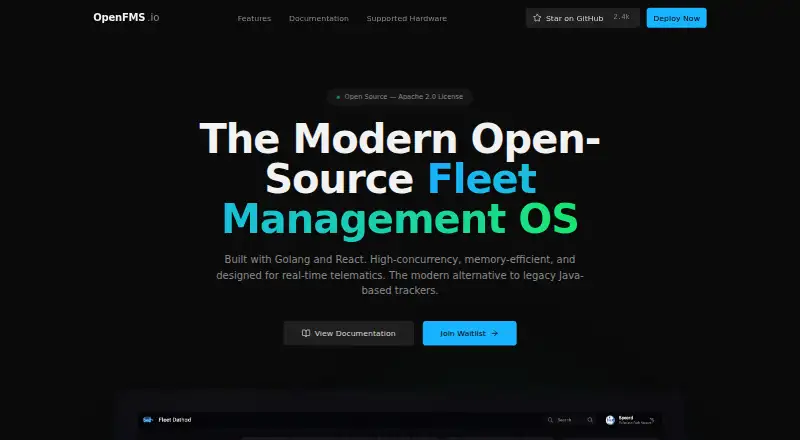
OpenFMS is a free, open-source fleet management system for real-time telematics. It provides GPS tracking and geofencing, with a customizable web dashboard aimed at fleet dispatchers. Developers can connect through its full API, which includes REST and gRPC interfaces. The product is built with Go and React: its backend is described as supporting thousands of concurrent TCP connections and real-time GPS data streams with minimal CPU footprint, while its React dashboard is responsive and customizable.
OpenFMS runs on infrastructure you manage. It can be deployed on your own servers using Docker, and its advertised deployment stack includes PostgreSQL. Its listed platforms are API, self-hosted, and web. The product is intended for developers and modern fleet dispatchers who want to deploy a telematics system and work with its tracking, dispatch interface, and integrations. OpenFMS uses the Apache 2.0 license.
Who it suits. OpenFMS suits developers and fleet dispatchers who need real-time GPS tracking and geofencing in a system they can deploy on their own servers. Its API and web dashboard support teams building fleet workflows around their own infrastructure.
Good to know
- Free and open source under the Apache 2.0 license
- Real-time GPS tracking and geofencing
- REST and gRPC interfaces are available
- Docker deployment on your own servers
- Responsive, customizable React dashboard for dispatchers
Watch for
- Requires self-hosted deployment on your own servers
- Its advertised deployment stack includes PostgreSQL
Choose OpenFMS if you want a free, open-source telematics system with GPS tracking, geofencing, a dispatcher dashboard, and REST and gRPC APIs. It is intended for teams able to deploy and operate software on their own servers.
Your product? You can pay for an editorial review of OpenFMS; CarCody's editors write the verdict · from $99/mo. How it works →
Its site
Getting started
- Visit the OpenFMS website
- Prepare a server for self-hosted deployment
- Deploy OpenFMS using Docker
- Use the advertised PostgreSQL stack
- Connect through the REST or gRPC API, or use the web dashboard
On record
- Product
- OpenFMS describes itself as an open-source fleet management OS for real-time telematics.
- Technology
- The product says it is built with Go and React.
- Backend
- The site says the Go backend handles thousands of concurrent TCP connections and real-time GPS data streams with minimal CPU footprint.
- Dashboard
- The site describes a responsive, customizable React dashboard for fleet dispatchers.
- Hosting
- OpenFMS says it is self-hosted and can be deployed on users’ own servers via Docker.
- Tracking
- The site says the system provides real-time GPS tracking and geofencing.
- Database
- The advertised deployment stack includes PostgreSQL.
- APIs
- The site lists REST and gRPC, and describes the product as having a full API.
- Intended users
- The site describes OpenFMS as designed for developers and modern fleet dispatchers.
- Product
- OpenFMS describes itself as an open-source fleet management OS for real-time telematics.
- License
- The site states that OpenFMS uses the Apache 2.0 license.
- Backend
- The site says its Go backend handles thousands of concurrent TCP connections and real-time GPS data streams with minimal CPU use.
- Dashboard
- The site describes a responsive, customizable React dashboard for fleet dispatchers.
- Deployment
- The site says OpenFMS is self-hosted and can be deployed on your own servers via Docker.
- GPS tracking
- Yes
Questions
How much does OpenFMS cost?
OpenFMS is free and open source.
Can I host OpenFMS myself?
Yes. It can be deployed on your own servers using Docker.
What platforms does OpenFMS support?
Its listed platforms are API, self-hosted, and web.
Does OpenFMS support GPS tracking?
Yes. It provides real-time GPS tracking and geofencing.
What APIs does OpenFMS offer?
It lists REST and gRPC interfaces and describes itself as having a full API.
What license does OpenFMS use?
OpenFMS uses the Apache 2.0 license.