The Tool Desk
Outbyte PC Repair FREEClear out junk files and repair common Windows errorsFree Scan →Outbyte Driver Updater FREEScan for outdated or missing drivers - takes under a minuteDriver Scan →The Ford 4.6L V8 does not have one universal list of failure points: its 2-valve, 3-valve and 4-valve versions have different reported issues. Ford service bulletins document difficult spark-plug removal on certain 3-valve engines and describe how to distinguish normal 3-valve ticking from noises that may need repair. Other recurring reports concern intake-manifold cracks on some 2-valve Mustangs and timing or oil-pump problems on certain 3-valve applications. These reports identify what to check—not how often each problem occurs across all 4.6L engines.
Which 4.6L engine do you have?
“4.6 Triton” is often used as a general name for Ford’s 4.6L Modular V8, but the family includes different cylinder-head and valve configurations. Identify the vehicle, engine variant and engine build date before applying a known problem or repair procedure to your car or truck.

As an Amazon Associate I earn from qualifying purchases.
| Variant | Configuration | Reported concerns covered here |
|---|---|---|
| 2-valve (2V) | SOHC | Intake-manifold cracking on certain 1996–2001 Mustang applications; spark-plug thread repair is addressed in a Ford bulletin for specified 2V heads and model years. |
| 3-valve (3V) | SOHC | Ford-documented spark-plug removal difficulty on specified applications with engines built before November 30, 2007; Ford-documented noise diagnosis; secondary reports of timing and oil-pump issues on certain applications. |
| 4-valve (4V) | DOHC | The Ford bulletins discussed here do not establish a single dominant 4V problem pattern. Do not assume a 2V or 3V issue applies. |
The reports below are not a population-wide reliability ranking. The Ford bulletins document particular symptoms, applications and service procedures; they do not give failure-rate statistics for the full 4.6L family.
3-valve spark plugs can be difficult to remove
Ford Technical Service Bulletin (TSB) 08-7-6, published April 1, 2008, says some vehicles with 4.6L 3V engines may be difficult to service because a spark plug can be damaged during removal, leaving part of it in the cylinder head. Ford’s affected-vehicle coverage includes specified 2005–2008 Mustang, 2006–2008 Explorer and Mountaineer, and 2007–2008 Explorer Sport Trac applications, among others. For the 4.6L 3V, the bulletin applies to engines built before November 30, 2007; check the exact application and build date rather than relying on model year alone.
Ford’s removal precautions
Ford’s procedure is sensitive to engine temperature and technique. The bulletin states: “DO NOT REMOVE PLUGS WHEN THE ENGINE IS WARM OR HOT.” It directs technicians to work at room temperature, use hand tools rather than air or power tools, back the plug out only 1/8 to 1/4 turn, apply Motorcraft Carburetor Tune-Up Cleaner and let it soak for at least 15 minutes, then work the plug gradually. Ford describes about 33 lb-ft (45 N-m) as the expected removal torque.
If a plug separates, Ford specifies Rotunda special service tool 303-1203 and a 9.0 x 1.0 mm plug tap for extraction. A broken plug is not a reason to improvise with a drill or force a tool into the cylinder head: follow the applicable service procedure or have a qualified technician handle the extraction.
Rank #2

- Comprehensive Repair Guide: This Haynes Manual provides detailed instructions for servicing and repairing Ford Mustang models from 2015 to 2023.
- Extensive Repair Information: Offers over 10 times more details than previous manuals, ensuring complete coverage of all repairs.
- Interactive QR Codes: Access extra repair content, continuously updated, via QR codes for more in-depth information.
- Multi-Device Accessibility: Supplementary content is available on any computer or mobile device for added convenience.
- Full-Color Visuals: Clear, full-color illustrations enhance ease of use compared to black-and-white manuals.
2-valve plug-thread repairs are a separate issue
Ford’s Modular 2V thread-repair bulletin covers specified 4.6L cylinder-head and model-year ranges, including head types associated with 1993–2000, 1997–2005 and 2002–2005 applications. It documents repair with approved Full-Torque inserts. This is distinct from the 3V plug-removal problem: confirm the engine and head before choosing a repair method.
Free tools Windows power users keep installed
One-click scans. No signup required.
How to tell normal 3-valve ticking from a repair issue
Ford TSB 06-19-8, published September 13, 2006, addresses ticking or knocking after a 4.6L 3V engine reaches normal operating temperature and a rattle at startup. Its coverage includes 2005 Mustang and specified 2004–2005 F-150, Expedition, Super Duty and Navigator applications. Ford cautions that these engines can make several normal noises, so diagnosis depends on when the sound occurs: cold or hot, at idle or above 1,200 rpm.
Rank #3

- Comprehensive Coverage: This Haynes Repair Manual covers Ford Fiesta models from 2014–2019 with 1.6L Ti-VCT (Duratec) and 1.6L ST (EcoBoost) engines, plus online coverage for the 1.0L M1JH (EcoBoost) engine.
- Print + Online Access: In-book repair and service instructions with additional online resources including interactive wiring diagrams, diagnostic guides, and up-to-date service data.
- Step-by-Step Instructions: Includes detailed procedures for maintenance, engine, transmission, drivetrain, and electrical systems supported by hundreds of illustrations and photos.
- Trusted Source: Haynes is the world’s leading DIY repair manual publisher with over 60 years of trusted, professional-grade repair guidance.
- Essential Reference: Save money and keep your GMC Sierra 2500 or 3500 performing at its best with this comprehensive service and repair guide.
- Injector ticking: A tick that rises with engine speed is described by Ford as normal.
- Lash-adjuster tapping: This may occur at any engine speed or temperature.
- Light hot-idle VCT knock: Ford says a light knock from the variable cam timing (VCT) system at hot idle does not affect performance or durability of the part.
- Louder hot-idle knock: If the knock is more than lightly audible and disappears above 1,200 rpm, Ford directs technicians to replace the cam phaser.
- Brief startup rattle: A qualifying rattle from the front of the engine lasting 1–3 seconds follows the bulletin’s VCT phaser-kit diagnostic path.
Those thresholds describe Ford’s diagnostic guidance for the listed vehicles, not a rule for every 4.6L. A new, worsening or persistent noise should be diagnosed against the correct vehicle-specific service information instead of being dismissed as normal ticking.
Other reported problems depend on the application
Plastic intake-manifold cracks on some 2-valve Mustangs
Late Model Restoration’s technical overview reports that plastic intake manifolds on 1996–2001 Mustang 2V applications can crack, potentially causing coolant leaks and overheating. The overview says Ford addressed the concern with the PI intake manifold. This report is tied to those Mustang applications; it does not establish that every 2V 4.6L has the same manifold or risk.
Rank #4

- Three Manual Bundle. Service, Revised Bulletins and Maintenance Log Book. 172 Pages Total.
- Learn how to maintain and operate your 8N tractor with this Operators Manual Set
- Oil Changes, Fluid Check Locations and Quantities to Electrical Schematics and Repair Information
- Record maintenance for your future reference in the handy Log Book
Timing components and oil-pump gears on certain 3-valve applications
The same secondary overview reports timing-chain tensioner wear and, on 2005–2010 3V Mustangs, failures involving cam phasers, tensioners and guides. It also reports weak or broken oil-pump gears on 3V engines. These are recurring technical reports, not Ford-published failure-rate findings. They are reasons to investigate symptoms and application history, not proof that a particular engine has failed or that all 3V engines share the same outcome.
A practical way to assess a 4.6L concern
- Confirm the variant and vehicle: Determine whether the engine is 2V, 3V or 4V, and identify the model, model year and engine build date where relevant.
- Describe the symptom precisely: For a noise, note whether it happens cold or hot, at idle or above 1,200 rpm, and whether a startup rattle lasts seconds or continues.
- Separate a reported pattern from a confirmed fault: A bulletin or technical report helps narrow diagnosis; it does not establish the condition of an individual engine.
- Use the matching service procedure: Spark-plug removal and thread repair differ by engine version. Use the applicable Ford procedure and qualified service where needed.
- Check scheduled maintenance guidance: Ford owner-guide instructions identify the specified PCV valve and spark plugs, recommending Motorcraft or equivalent parts that meet Ford specifications. Confirm the correct parts and replacement procedure in the guide for the exact vehicle.
Are there 4.6L years to avoid?
The documented concerns support checking specific configurations, not treating an entire model year or the whole 4.6L family as an automatic avoid. The clearest date-specific warning here is Ford’s difficult-removal procedure for 4.6L 3V engines built before November 30, 2007. That is a service concern, not a finding that those engines are inherently unreliable. For a purchase or repair decision, match the vehicle’s engine, build date, symptoms, maintenance and repair history to the applicable issue.
Quick Recap
Best Value
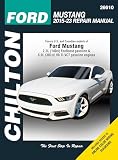
- Comprehensive Coverage: Designed for U.S. and Canadian models of Ford Mustang (2015-23) with 2.3L EcoBoost and 5.0L V8 Ti-VCT gasoline engines.
- Access to Online Resources: Includes access to color wiring diagrams, fuses/relays, troubleshooting guides, and a glossary to simplify complex repairs.
- Step-by-Step Instructions: Easy-to-follow guidance for routine maintenance, engine repair, transmission work, and more.
- Professional-Grade Detail: Features workshop-backed data, high-resolution images, and detailed diagrams for precise repairs and adjustments.
- Comprehensive Coverage: Designed for U.S. and Canadian models of Ford Mustang (2015-23) with 2.3L EcoBoost and 5.0L V8 Ti-VCT gasoline engines.
Product prices and availability are accurate as of the date/time indicated and are subject to change. Any price and availability information displayed on Amazon at the time of purchase will apply.




