What’s actually slowing this PC down?
Pick the symptom - the matching free tool is one click away.
For most eligible vehicles, E15 is the more practical all-around choice. E85 is appropriate only for flex-fuel vehicles (FFVs), and its lower price does not automatically mean lower fuel costs because it contains substantially less energy per gallon.
The right answer depends on what you are measuring: compatibility, convenience, miles per gallon, cost per mile, petroleum use, emissions, or performance. E15 generally wins on compatibility and availability. E85 can make sense for an FFV when its price is discounted enough to offset the roughly 17%–27% energy-related cost disadvantage compared with gasoline.
E15 vs. E85 at a glance
| Category | E15 | E85 |
|---|---|---|
| Typical composition | 15% ethanol and 85% gasoline | Approximately 51%–83% ethanol, depending on season and location |
| Who can use it? | Generally eligible model-year-2001-and-newer cars, light-duty trucks, and medium-duty passenger vehicles, subject to the manufacturer’s instructions | Flex-fuel vehicles only |
| Fuel economy | Usually only slightly lower than E10; the difference is often modest | Usually materially lower than gasoline, commonly around 25% lower according to a DOE rule of thumb |
| Availability | Growing, but not as universal as E10 | More geographically limited |
| Best use case | Everyday driving in an eligible vehicle | An FFV owner who finds a sufficiently large discount or prioritizes higher ethanol use |
Neither fuel is universally “better.” E15 is usually the better convenience and compatibility choice; E85 is a specialty option for FFVs that can be financially sensible when the local price is low enough.
What is E15 gasoline?
E15 is gasoline containing up to 15% ethanol by volume. The remaining portion is gasoline. In the United States, the EPA identifies E15 as approved for:
Windows Errors? Fix Them Before They Spread
Repair common Windows errors and clear accumulated junk for a smoother, more stable PC - no reinstall needed.Free scan · no reinstallCrashes, No Sound, or Screen Glitches?
Random freezes, missing sound and display glitches usually trace back to one bad driver. Find and replace yours safely.Free scan · under a minute#1 Best Overall
![[2-Pack] Reusable Ethanol Testing Kit - Wide Mouth Fuel Test Bottle for E85 and Ethanol Levels - Fewer Spills and Clear Results in Minutes - Test Hundreds of Times - Two Ethanol Test Bottles Included](https://m.media-amazon.com/images/I/51n+oPbsvaL._SL160_.jpg)
- Wide Mouth Design for Fewer Spills: Designed specifically with a wide mouth to easily pour gasoline and water into the bottle without spills and leaks. No more getting gas on your hands or searching for a funnel to fill and test your ethanol levels
- Reusable Over and Over: This fuel test bottle allows you to measure ethanol or E85 levels in your gasoline hundreds of times, with a screen-printed label made to last
- Quick and Clear Results: Test your gasoline levels in 5 minutes and three simple steps. Add water to the Water Fill Line. Then add gas to the Gasoline Fill Line. Shake well and wait five minutes. Gasoline and water will separate to provide clear results
- Easy to Read Label: With bright Water and Gasoline Fill lines and clear percentage levels, measuring gasohol, ethanol or E85 levels in your fuel has never been easier
- Protect Your Engine in Minutes: Ensure correct ethanol levels to protect and maintain your engine with our quick 5 minute test. Whether you are looking for an ethanol test kit or an E85 test kit, this bottle will correctly measure alcohol levels in both types of gasoline
- Model-year-2001-and-newer passenger cars
- Model-year-2001-and-newer light-duty trucks
- Model-year-2001-and-newer medium-duty passenger vehicles
- Flex-fuel vehicles
That approval is not a blanket instruction to ignore the vehicle manufacturer. Check the fuel-door label and the vehicle owner’s manual or the manufacturer’s documentation before using E15, particularly if the vehicle is unusual, modified, imported, or not clearly covered by the normal model-year guidance.
E15 is not approved for every gasoline engine. EPA guidance excludes motorcycles, boats, snowmobiles, lawn equipment, chainsaws, heavy-duty engines, and model-year-2000-and-older light-duty vehicles. Do not transfer passenger-car rules to generators, riding mowers, portable equipment, or other small engines.
What is E85?
E85 is a high-level ethanol blend intended only for flex-fuel vehicles. An FFV is designed and certified to run on gasoline or gasoline-ethanol blends ranging from E0 through E85. A conventional gasoline vehicle that is approved for E15 is not thereby approved for E85.
The name “E85” can be misleading. The fuel does not always contain exactly 85% ethanol. Depending on geography and seasonal requirements, the specification can range from approximately 51% to 83% ethanol. That variation affects energy content, miles per gallon, and the price discount needed to make E85 economical.
E85 is not simply “stronger E15.” FFVs use fuel-system materials, engine controls, calibration, and emissions certification designed for high-level ethanol blends. Putting E85 into a non-FFV can cause poor drivability, hard starting, malfunction-indicator warnings, or damage and emissions-compliance problems. If your vehicle is not explicitly identified as an FFV, do not use E85.
How to tell whether your vehicle is an FFV
- Check the fuel door. FFV labeling may appear on the fuel door, fuel filler, or capless filler area.
- Read the owner’s manual. Look for “flex-fuel,” “FFV,” or a statement that the vehicle accepts gasoline-ethanol blends up to E85.
- Check the manufacturer’s vehicle documentation. The VIN, original specifications, or a manufacturer support page may clarify the vehicle’s fuel capability.
- Do not rely on the fuel gauge, badge, or a tester alone. A fuel-content tester can identify ethanol concentration in a sample; it cannot make a non-FFV compatible with E85.
When the vehicle’s status is uncertain, treat it as a conventional gasoline vehicle until the manufacturer confirms otherwise.
Fuel economy: why E85 uses more gallons
Ethanol has a higher octane rating than ordinary gasoline, but it contains less chemical energy per gallon. DOE materials put E85 at approximately 73%–83% of the energy in a gasoline-gallon equivalent, depending largely on the actual ethanol content and fuel formulation. DOE’s handling handbook uses approximately 25% lower E85 fuel economy as a practical rule of thumb, although the result varies by vehicle and blend.
Rank #2
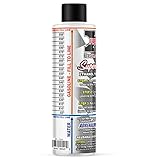
- Test your fuel for proper ethanol levels to ensure it does not damage your engine. Test kit also tests for e85.
- Simple test to discover the percentage of ethanol alcohol in gasoline. With readings of e10, e15, e20, e25, e80, e85 and e90
- High levels of ethanol could damage your fuel system and lower your fuel mileage.
- Ethanol can damage motors not equipped or designed to use it, test your gasoline first.
- Easy to read label and instructions that is laminated to prevent fading or the ink rubbing off. Testing bottle can be reused over and over.
E15’s fuel-economy penalty
Using ethanol at approximately 67% of the energy density of gasoline, a simple blend calculation suggests that E15 contains about 95% of the energy per gallon found in ethanol-free gasoline. Real-world fuel economy varies, but the more relevant comparison for many drivers is E15 versus ordinary E10 gasoline. On that comparison, the theoretical energy difference is only about 1%–2%.
The Tool Desk
Outbyte Driver Updater FREEFix the driver behind crashes, sound loss and screen glitchesFind Drivers →Outbyte PC Repair FREERepair Windows errors before they cause bigger problemsFix Now →That does not mean every vehicle will show exactly a 1%–2% change. Tire pressure, temperature, traffic, driving speed, winter fuel formulation, vehicle condition, and driving style can easily overwhelm a small fuel-composition difference.
E85’s fuel-economy penalty
E85’s lower energy content is large enough to be noticeable. An FFV may require more frequent refueling and show a substantial MPG decline compared with gasoline. The vehicle may still run normally, because the engine computer adjusts fueling for the blend, but normal operation does not eliminate the energy-content difference.
Some engines specifically optimized or tuned for ethanol can take better advantage of its octane and cooling properties. A stock FFV, however, is generally optimized more heavily for gasoline. Do not assume that E85 will make an unmodified FFV faster or more efficient.
Cost per mile matters more than price per gallon
The useful calculation is:
fuel cost per mile = price per gallon ÷ real-world miles per gallon
Free tools Windows power users keep installed
One-click scans. No signup required.
Comparing the numbers on the pump without accounting for MPG can make E85 look cheaper than it really is.
E85 break-even discount
If E85 provides roughly 73%–83% as much energy per gallon as gasoline, it generally needs to cost approximately 17%–27% less per gallon to match gasoline’s energy-adjusted cost. This is a range, not a universal rule: the exact result depends on the blend, the vehicle, and the actual MPG.
Rank #3

- 【Protect Your Engine】This ethanol tester E85 can get the ethanol level in gasoline and E85 pump gas in just 5 minutes, testing the fuel's ethanol content at peak levels to make sure it won't damage your engine.【Please note】The lid is designed with a self release safety point. Simply twist the lid until you feel slight resistance, then stop. This ensures a secure fit without loosening
- 【Reduce Spills】The wide mouth style of gasoline fuel test bottle is designed to reduce spills and prevent leaks by making it easy to pour gasoline and water into the bottle for testing without the use of a funnel, preventing gasoline from getting on your hands
- 【Test Procedure】Only three simple tests are required to find the percentage of ethanol in gasoline/E85 pump gas; First add water to the blue water line, then pour gasoline to the red gasoline line, then tighten the cap, shake the ethanol tester E85 for 5 seconds, and let it rest on a flat surface for 5 minutes; The gasoline and water will separate to provide a clear result
- 【Reusable and Durable】The E85 Fuel Test Kit is made of high density material, which is durable and corrosion resistant, allowing you to measure ethanol or E85 in gasoline hundreds of times
- 【Easy To Read Percentages】Fade and wipe proof instructions are screen printed for long lasting durability and legibility, and the transparent bottle helps to visualize the testing process
For example, if comparable gasoline costs $3.00 per gallon:
- At 83% of gasoline’s energy content, E85 would need to cost about $2.49 per gallon or less to reach an energy-equivalent price.
- At 73% of gasoline’s energy content, E85 would need to cost about $2.19 per gallon or less.
Those figures are illustrative calculations, not a claim about current national fuel prices. Taxes, local supply, pump octane, seasonal formulation, and your vehicle’s actual MPG can move the result.
Do these 3 things before closing this tab:
1Clear out junk files and repair common Windows errors2Scan for outdated or missing drivers - takes under a minute3Repair Windows errors before they cause bigger problemsE15 break-even discount
E15 has a much smaller energy penalty, especially when the alternative is E10 rather than ethanol-free gasoline. A small price discount may therefore be enough to offset its modest theoretical MPG difference. If E15 costs the same as E10, the financial outcome may be close; if E15 is cheaper, it may offer a small per-mile advantage. Measure it over several tanks rather than expecting a precise result from one trip.
Check the actual ethanol content when the calculation matters
Because E85 can range from roughly 51% to 83% ethanol, the pump label alone does not tell you the blend’s exact energy content. Drivers who are diagnosing an unexpected MPG result or comparing E85 prices closely may use an ethanol fuel tester to test a sample.
Testing is optional for ordinary driving and does not establish whether a vehicle is E85-compatible. Compatibility comes from the vehicle manufacturer; the tester only helps estimate what is in the fuel sample.
Performance and octane: is E85 more powerful?
High ethanol content can provide high octane and charge-cooling benefits. In an engine designed or tuned to exploit those properties, ethanol can support higher compression, more boost, or more aggressive ignition calibration. That is a specialized engine-calibration issue, not an automatic benefit for every FFV.
For a stock FFV, the most predictable everyday effects are lower MPG and more frequent fuel stops. E15’s higher ethanol content than E10 does not normally transform a standard passenger car into a higher-performance vehicle.
Environmental and petroleum considerations
Ethanol is renewable and domestically produced in the United States, and using more ethanol can displace some petroleum-derived gasoline. But “more ethanol” does not automatically mean “lower total environmental impact.”
Rank #4

- SPILL-PROOF WIDE MOUTH DESIGN: This e85 ethanol tester features an wide opening that eliminates messy spills when pouring gasoline/water, and no funnel required. The leak-resistant construction keeps hands clean while collecting fuel samples, making this ethanol tester for gasoline ideal for garage and field use.
- 3-STEP ACCURACY IN 5 MINS: Get laboratory-grade precision through this e85 fuel octane tester: First: fill to blue water line. Next: add gas to red fuel line. And then shake and wait 5 minutes. The e85 fuel test bottle clearer ethanol percentage readings than standard test kits.
- PROFESSIONAL-GRADE DURABILITY: This octane tester for gasoline constructed with chemical-resistant HDPE material that withstands 200+ test cycles. Heat-defying walls prevent warping in extreme temps, while the scratch-proof screen-printed markings stay legible through heavy use.
- SMART DUAL MEASUREMENT SYSTEM: The e85 octane tester color-coded fill lines (blue for water/red for gas) align with 5% increment scales on both front/back sides. The ultra-clear e85 fuel test bottle body allows 360° visual verification, ensuring precise E85 compatibility checks for any engine type.
- PORTABLE AND LIGHTWEIGHT: Measuring 5.9 inches with a 1-ounce featherweight profile, this e85 tester kit delivers professional-grade ethanol testing anywhere. Obtain precise readings within 5 minutes to verify fuel ethanol levels, safeguarding your engine's peak performance through optimal fuel quality control.
EPA lifecycle analysis considers factors including feedstock production and transport, fuel processing and distribution, vehicle use, and significant indirect emissions. The result depends on the ethanol pathway. Feedstock, agricultural practices, processing energy, transportation, land-use assumptions, the actual blend, and the petroleum fuel displaced all matter.
E85 contains more ethanol per gallon than E15, so each gallon sold can displace more petroleum gasoline. However, an FFV typically burns more gallons to cover the same distance. The meaningful comparison is therefore per mile or per trip, not only per gallon. A qualifying ethanol pathway may meet specified lifecycle greenhouse-gas thresholds, but ethanol pathways do not all have identical results.
Tailpipe emissions are also more complicated than the claim that ethanol is simply “cleaner.” Fuel formulation, weather, operating conditions, the vehicle’s emissions-control system, and the pollutant being measured affect the outcome. Ethanol blends can influence pollutants such as carbon monoxide, volatile organic compounds, nitrogen oxides, and air toxics in different ways.
Independent reader supportYour contribution helps us test, update, and keep practical guides available for everyone.Availability and U.S. rules
E10 remains more widely available than either E15 or E85. E15 availability is growing but varies by state and retailer. E85 is more geographically concentrated, often near ethanol-producing regions or stations serving FFV owners, fleets, and performance-oriented drivers.
Published station counts differ because agencies may use different dates, station-status definitions, or counting methods. DOE’s Alternative Fuels Data Center has reported more than 4,200 public E85 stations in 44 states, while an EPA consumer page has reported more than 2,300. Treat both as approximate, date-sensitive figures rather than a permanent national total.
EPA reported in March 2026 that E15 was offered at more than 3,000 stations and announced a temporary nationwide waiver beginning May 1, 2026, allowing E15 sales under specified conditions during the summer fuel-supply period. Waivers, state implementation, retailer participation, and local station availability can change. Check current EPA information and local listings before relying on E15 availability or the waiver at a particular station.
Retailers also face compatibility, storage, labeling, and misfueling-control requirements for E15 and E85. These rules are mainly station-infrastructure matters, but they help explain why higher-ethanol fuels are not available at every gasoline station.
Best Value

- Protect Your Engine: This precision e85 tester kit bottle provides accurate readings of ethanol percentages, simply and accurately check the percentage of ethanol content in your E85 pump gas. Empowering you to maintain peak engine performance and efficiency.
- User-Friendly Design: Wide Mouth Design ensures a hassle-free testing experience. Don't worry about spillage or leakage when pouring gasoline and water into the Fuel Test Bottle.
- Durable and Clear Label: The high-quality printed and laminated label is designed to resist fading or wiping off, allowing for easy visualization of the testing process. This e85 tester kit bottle made of shatterproof clear plastic can be reusable over and over.
- Simple Test Steps: Fill water to the blue water line, carefully pour gasoline up to the red gasoline line, screw the cap on tightly, shake the ethanol test bottles for 5 seconds, and sit upright for 5 minutes. Gas and water will separate to reveal the ethanol percentage.
- WARNINGS: This Ethanol Content Tester is intended for testing only, do not store gasoline in this bottle. Keep away from heat and open flame, flammable when in use.
Which fuel should you choose?
If your vehicle is not an FFV
Do not use E85. If the vehicle is model year 2001 or newer and the owner’s manual does not prohibit E15, E15 may be an approved option. Confirm the vehicle’s eligibility and follow the manufacturer’s instructions. For older vehicles and nonroad equipment, use only the fuel types expressly permitted by the manufacturer.
If your vehicle is an FFV and you want convenience
Gasoline or E15 will usually be easier to find and will generally deliver higher MPG than E85. E15 is often the practical everyday choice when it is approved for the vehicle and priced competitively.
If your vehicle is an FFV and you want to use more renewable fuel
E85 may be a reasonable choice if it is locally available and you accept the lower MPG. Its petroleum displacement and lifecycle emissions advantages cannot be judged from ethanol percentage alone; consider the actual blend, vehicle efficiency, and local fuel alternatives.
If your vehicle is an FFV and you want the lowest fuel cost
Compare cost per mile. As a starting point, look for an E85 discount of roughly 17%–27% against comparable gasoline, then verify the result using your vehicle’s real-world MPG. A smaller discount may not compensate for the extra gallons required.
If you notice a sudden MPG or drivability change
- Confirm that you selected the intended fuel and octane grade.
- Verify the vehicle’s E15 or FFV status using the fuel-door label and owner’s manual.
- Check tire pressure, weather, traffic, and recent maintenance before blaming the blend.
- Consider whether the station’s label, pump, or fuel quality may be involved.
- For an FFV, use a dedicated fuel-content tester only if measuring the sample will help diagnose the issue.
- If the problem continues, stop experimenting with fuel and have the vehicle inspected.
Bottom line: E15 is usually the better default, E85 the better specialty option
E15 is generally the better all-around fuel for an eligible conventional vehicle or FFV because it offers broad compatibility, modest energy loss, and better convenience than E85. E85 is not an upgrade for ordinary gasoline vehicles; it is a fuel for FFVs.
For an FFV, E85 can be worthwhile when its price is at least roughly 17%–27% below comparable gasoline, depending on the blend and vehicle. It may also appeal to drivers who want to use more ethanol, but neither lower petroleum use nor lower lifecycle emissions is guaranteed without considering the entire fuel-and-vehicle system.
Frequently Asked Questions
Can a regular gasoline car use E85 if it can use E15?
No. E15 approval does not make a conventional vehicle compatible with E85. E85 is intended only for flex-fuel vehicles. Check the fuel door and owner’s manual for explicit FFV identification.
Recommended Free Tools
Is E15 cheaper than E85 to use?
Usually, E15 has the more predictable cost because its MPG penalty is small. E85 can be cheaper per mile only when its pump-price discount is large enough to offset its lower energy content—often approximately 17%–27% below comparable gasoline.
Does E85 increase horsepower?
Not automatically. Its high octane can benefit an engine designed or tuned for ethanol, but a stock flex-fuel vehicle is generally optimized primarily for gasoline. Lower MPG is the more predictable everyday result.
Is E15 safe for lawn mowers, boats, motorcycles, or generators?
Do not assume it is. EPA’s E15 approval for certain model-year-2001-and-newer road vehicles does not extend generally to motorcycles, boats, snowmobiles, lawn equipment, chainsaws, generators, or other small and nonroad engines. Follow the equipment manufacturer’s fuel instructions.
Quick Recap
Product prices and availability are accurate as of the date/time indicated and are subject to change. Any price and availability information displayed on Amazon at the time of purchase will apply.
Quick wins for a faster PC:
Fix the driver behind crashes, sound loss and screen glitchesFind Drivers →Clear out junk files and repair common Windows errorsFree Scan →