What’s actually slowing this PC down?
Pick the symptom - the matching free tool is one click away.
Yes: the split-window Volkswagen Type 2 was built for family and leisure travel, and a well-maintained example can still tour. Taking it on a train is a separate matter. Motorail services accept only vehicles that meet that route’s current size, weight, configuration, condition and booking rules; a pop-top or other roof conversion can rule out some services.
What is a “splitty” VW camper?
“Splittie” is the British nickname for the first-generation Volkswagen Type 2, also called the T1, whose windscreen is divided into two panes. Volkswagen’s history says the Type 2 camper van and Samba minibus appeared in 1951; the T1 was produced from 1950 to 1967. (Volkswagen Group history; Volkswagen Commercial Vehicles history)
The period specifications illustrate why no single number describes every split-window bus. Volkswagen’s account gives an early T1 length of 4.10 metres, an 18 kW (25 PS) flat-four engine and a stated top speed of 80 km/h; it says later output reached 32 kW (44 PS) and top speed 105 km/h. Those are historical specifications, not guarantees about an individual vehicle’s model year, modifications or present performance.
Touring suits the model’s original family and leisure role, but age and history cannot establish whether a particular bus is safe or legal to drive now. Its mechanical condition, registration and any conversion need to be assessed individually.
#1 Best Overall

- Simply clicks together
- No glue required, Pre-coloured, Painting optional
- Extendable roof
- Multi-part body
- Highly detailed interior.Opening doors.Rotating wheels.Includes decals and stickers for decoration
Can a splitty go on a car-carrying train?
Sometimes—but there is no universal motorail rule, and “camper van” does not automatically mean eligible. Operators set different limits for different routes and services. Some accept camper vans within a specified vehicle envelope; others impose height limits or exclude camper roof types. The train, route, departure date and the actual bus all matter.
| Service or operator | Published example of eligibility | Important qualification |
|---|---|---|
| Amtrak Auto Train | For its Lorton, Virginia–Sanford, Florida service, Amtrak lists maximum standard-vehicle dimensions of 192 inches long, 85 inches high and 84 inches wide including mirrors, plus ground-clearance and check-in requirements. | These figures and procedures apply to this Auto Train service only. Check Amtrak’s current vehicle and check-in requirements. |
| Slovenian Railways motorail | On the Bohinjska Bistrica–Podbrdo–Most na Soči route, the operator lists cars, vans, pickups and camper vans up to 3 metres high, 2.4 metres wide and 10 tonnes gross vehicle weight. | Wagon and track capacity is limited, so a vehicle that meets the dimensions may still not be carried. See Slovenian Railways’ motorail information. |
| ÖBB international vehicle terms | The cited terms set a 196 cm maximum vehicle height and require registration and roadworthiness. | They exclude vehicles with lifting roofs, pop-up roofs or camper hardtops on covered services. Confirm the terms that apply to the exact train and trip in ÖBB’s international travel guide. |
| České dráhy automobile train | The operator requires valid registration and a roadworthy vehicle. | Its stated conditions prohibit damaged, inoperable or unaccompanied vehicles. Check the applicable České dráhy automobile-train rules. |
These examples show why a bus should not be booked against a generic “motorail” description. Even a standard-roof bus must fit the relevant service’s limits; a raised roof, roof rack or other fitting can change its measured height, while a camper conversion may fall into a restricted category.
Rank #2

- Brand new box. Real rubber tires. True-to-scale detail. Has opening rear gate. Detailed interior, exterior. Officially licensed product. Made of diecast with some plastic parts. Manufacturer's original unopened packaging. Dimensions approximately L-7.25, W-3.5, H-3 inches.
How to check whether your bus can travel on your chosen train
- Choose the exact route and departure date. Confirm that the operator carries vehicles on that segment on that date, and that space is available. Route schedules and vehicle capacity can constrain carriage.
- Measure the bus as it will be presented for loading. Check length, width, height—including mirrors and roof fittings where required—ground clearance and gross vehicle weight. Use the operator’s measurement method and limits, not another railway’s figures.
- Describe the roof and conversion accurately. State whether the bus has a pop-top, lifting roof, camper hardtop or other modification. Ask the operator whether that exact configuration is accepted; a height-compliant vehicle can still be barred by a configuration rule.
- Check eligibility and condition requirements. Confirm registration, roadworthiness and any restrictions on damaged or inoperable vehicles. For example, České dráhy’s stated rules require valid registration and roadworthiness and bar damaged or inoperable vehicles.
- Confirm the loading and passenger arrangements. Find out when the vehicle must arrive, whether passengers ride in a separate passenger carriage, and whether the vehicle booking is confirmed. Slovenian Railways says passengers travel in a passenger car and notes that capacity may be limited.
Get confirmation for the specific vehicle and departure before relying on the train as part of a touring itinerary. If the bus’s roof or dimensions sit close to a limit, ask the operator how it measures and classifies that configuration rather than assuming it will fit.
Independent reader supportYour contribution helps us test, update, and keep practical guides available for everyone.What rail carriage does—and does not—solve
A vehicle train can carry the bus over an eligible section of a journey; it does not establish that the bus is roadworthy for the drive to the terminal or onward at the destination. Nor does a train’s acceptance certify a vehicle’s restoration, conversion or mechanical reliability. Those questions remain specific to the individual bus.
Rank #3
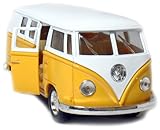
- AUTHENTIC DESIGN: Highly detailed 1:32 scale replica of the iconic 1962 Volkswagen Bus classic emblem
- INTERACTIVE FEATURES: Features pull-back motor action and opening side doors for enhanced play value and display options
- QUALITY CONSTRUCTION: Built with durable die-cast metal body, rubber tires, and detailed plastic components for lasting durability
- PERFECT SIZE: Measures approximately 5 inches in length, making it ideal for collectors and play
- REALISTIC DETAILS: Includes authentic interior detailing, chrome-look trim, and classic two-tone paint scheme characteristic of vintage VW buses
For a splitty owner, the practical decision is therefore two separate checks: assess the vehicle for the planned road tour, then verify that the chosen train accepts its measured dimensions and configuration on the chosen date. The historic camper role makes touring fitting; only the operator’s current terms can establish rail eligibility.
Quick Recap
Best Value

- Collect and build a range of Quickbuild models featuring legendary airplanes, classic cars, super cars and tanks! A great introduction into the world of modeling!
- Quick and simple, designed as a push-fit construction model kit that can be put together in minutes.
- Seamless fit construction that is hard to tell that it is push together kit!
- Compatible with other brick building manufacturers.
Rank #4

- Detailed model kits for advanced model builders.
- Experience in gluing and painting is required.
- Kit suitable for ages 12 to adult.
- Model number: RV07674
Product prices and availability are accurate as of the date/time indicated and are subject to change. Any price and availability information displayed on Amazon at the time of purchase will apply.