The best engine tube under $30 is the one matched to the system, fluid, dimensions and vehicle fitment—not the cheapest piece of rubber on a shelf. “Engine tube” can mean a small vacuum line, a PCV or catch-can hose, a molded coolant hose, or an original-equipment tube with quick-connect ends. Those parts are not interchangeable.
For a general vacuum repair, a 10-foot roll of 4 mm or 6 mm silicone vacuum tubing listed at $9.99 is a practical low-cost option. PCV hoses, molded coolant hoses and vehicle-specific OEM tubes can also fall below $30, but each has different temperature, fluid and connection requirements. Use the guide below to identify the job before ordering.
As an Amazon Associate I earn from qualifying purchases.
What “engine tube” means in a parts search
Automotive parts catalogs do not use “engine tube” as one universal specification. The phrase may describe tubing in several separate systems:
Quick wins for a faster PC:
Fix the driver behind crashes, sound loss and screen glitchesFind Drivers →Clear out junk files and repair common Windows errorsFree Scan →- Vacuum tubing: Small-diameter lines carry engine vacuum to controls, sensors and actuators. They are commonly sold by inside diameter and roll length.
- PCV or catch-can hose: Larger hose routes crankcase vapors between the engine, a separator or catch can, and the intake. It must tolerate oil mist and engine-bay heat.
- Coolant hose: EPDM or similarly specified hose carries pressurized coolant. Radiator, heater and air-bleed hoses are often molded for a particular vehicle.
- OEM PCV or air-bleed tubing: A manufacturer-specific assembly can use molded plastic, formed bends and quick-connect fittings that a straight universal hose cannot duplicate.
Before comparing prices, identify the hose location, the fluid or gas inside it, the engine and model year, the inside diameter, the length, and the style of each connection. A low price is irrelevant if the tube softens in oil, kinks at a bend, leaks at a fitting or does not fit your vehicle.
#1 Best Overall
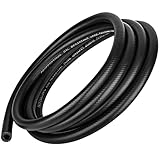
- 【Size】ID: 3/8" (10mm), OD: 2/3" (17mm), Length: 10FT
- 【Working Conditions】NBR Fuel Hose Working Temperature Range: -40°F to 257°F. Working Pressure: 300PSI. Burst Pressure: 1160PSI
- 【Premium Material】Made of premium NBR materials, long service life, wear resistance and high temperature resistance
- 【Applicable Medium】NBR Fuel line can work with diesel/biodiesel/gasoline/oil/grease/water and air, etc
- 【Wide Application】NBR Fuel Line Hose widely used in the fuel system, steam emission, oil cooling, please check the pressure of application before purchase
Quick comparison of sub-$30 examples
The products below illustrate different applications rather than a single quality ranking. Prices are listing snapshots and can change; confirm current price and stock before purchase.
| Example | System | Size and length | Material or specification | Compatibility limits | Listed price |
|---|---|---|---|---|---|
| Sakura Fuji Performance silicone tubing | Engine-bay vacuum lines | 4 mm or 6 mm inside diameter; 10-foot roll | Black silicone; seller-stated operating range of -65°F to +350°F (-54°C to +177°C) | Seller says it is not compatible with fuel or oil | $9.99 |
| Mishimoto PCV/catch-can hose | PCV and catch-can routing | 3/4-inch hose, 4 feet | SAE J30R7; four worm-gear clamps included | Listing says compatible with most PCV systems; verify your fittings | $24.95 |
| Mishimoto PCV/catch-can hose | PCV and catch-can routing | 1/2-inch hose, 6 feet | SAE J30R7; four worm-gear clamps included | Listing says compatible with most PCV systems; verify your fittings | $18.95 |
| GM part 12712005 | Vehicle-specific PCV tubing | Dimensions listed by the manufacturer; molded tube with quick-connect attachment | Molded plastic, GM-recommended PCV valve tubing | Application is limited to the vehicles shown on the manufacturer page | $24.20 MSRP |
| Duralast E72249 | Coolant circuit | Vehicle-specific; measure the removed hose and check catalog fitment | EPDM; SAE 20R4 Class D2 and DIN 73411 Class A (except tolerances) | -40°F to +257°F (-40°C to +125°C); not for fuel or oil transfer | $24.99 |
| GM part 96968694 | Coolant air-bleed circuit | 9.13 inches long; 0.31-inch inside diameter at each end | OEM molded air-bleed hose | Catalog lists Chevrolet Trax model years and trims; confirm your exact application | $12.01 MSRP |
Best under-$30 choices by job
For a simple vacuum-line replacement: 4 mm or 6 mm silicone tubing
The $9.99 10-foot roll is the most broadly useful option when the failed line is a small vacuum hose and the original uses a plain push-on connection. Select the inside diameter that matches the nipple; do not choose by outside diameter alone. A hose that is too loose can leak, while an undersized hose can split or pull a plastic port out of position.
The seller states a temperature range of -65°F to +350°F. That is a seller claim, not an independent laboratory result, so route the tubing away from exhaust components and sharp brackets. Most importantly, the listing excludes fuel and oil. Do not use this vacuum tubing as a fuel line, oil-return line or PCV hose simply because it fits a barb.
For PCV or catch-can plumbing: hose meeting SAE J30R7
The 1/2-inch, 6-foot hose at $18.95 suits a PCV installation that uses roughly half-inch barbs; the 3/4-inch, 4-foot version at $24.95 is for larger ports. Each listing includes four worm-gear clamps and states SAE J30R7 compliance. The pages describe the hose as compatible with most PCV systems, but “most” is not a vehicle-specific guarantee.
Measure the outside diameter of the fitting and compare it with the hose’s inside diameter. Check clearance around the throttle body, intake manifold, belts and hot surfaces. PCV vapor contains oil mist, so a generic vacuum tube that is explicitly restricted from oil service is not an acceptable substitute.
Rank #2

- [Complete Package]: This set includes 6 vacuum hose automotive, each with a length of 5 feet and inner diameters of 1/8 inch, 5/32 inch, 3/16 inch, 1/4 inch, 5/16 inch, and 3/8 inch. The set also includes 64 hose connectors. Please check the detailed description of the product for specific contents!
- [Premium Silicone Material]: Our vacuum line automotive is made from premium quality black silicone material, capable of functioning within a temperature range of -40°F to 392°F. The sturdy design allows them to withstand pressures up to 130 PSI, providing reliable performance and keeping the safety of your car.
- [Superior Performance]: These silicone hoses are meticulously crafted with a uniform wall thickness of 3mm, maintaining consistent pressure to transport air and water and come equipped with premium quality seals and connectors to avoid spills and guarantee optimal performance of the car's piping system.
- [Easy to install and use]: The vacuum hose is easy to install and use. Flexible silicone material can be easily cut to customized lengths as needed. Also equipped with 12 sizes of vacuum line connectors, using the vacuum line connection kit to connect and install various sizes of hoses simply.
- [Applicable Range]: The silicone hoses are only for transporting air and water, and are not suitable for transporting natural gas or oil, commonly used in engine vacuum systems, automotive air conditioning systems etc. We provide 6 inner diameters of silicone hoses in the package to meet your needs in various situations.
For a factory PCV connection: GM 12712005
GM lists part 12712005 as recommended PCV valve tubing with molded plastic construction, stated dimensions, quick-connect attachment and vehicle applications. The price shown is $24.20 MSRP. This type of assembly is appropriate when the original has a formed shape, an integrated connector or a locking quick-connect that cannot be reproduced with straight hose and a clamp.
Use the vehicle selector and compare the listed year, model, engine and connection details. A part number alone is not proof of fit; production changes can place different tubes on engines that look similar.
For a coolant leak: a catalog-matched EPDM hose
Duralast E72249 is listed at $24.99 and described as EPDM coolant hose with a -40°F to +257°F (-40°C to +125°C) range. The listing cites SAE 20R4 Class D2 and DIN 73411 Class A, except for tolerances. It also says the hose is not for fuel or oil transfer.
Coolant hoses operate in a pressurized, hot circuit. Match the molded bends, end diameters and routing; a straight length can collapse at a tight bend or rub through against a bracket. Verify catalog fitment for the vehicle rather than assuming the part is universal.
For a small, vehicle-specific air-bleed line: GM 96968694
GM lists part 96968694 at $12.01 MSRP, 9.13 inches long with a 0.31-inch inside diameter at each end. The catalog identifies Chevrolet Trax model years and trims. This is a useful example of an inexpensive hose that is only a bargain for the listed application. If your engine uses different end sizes, bends or mounting points, do not force this tube to fit.
Rank #3

- 5 Size Fuel Line Hose Kit: This kit includes the most common hose size, 3/8" 5/16" 1/4" 1/2" 3/16" 5FT with appropriate sized clamps 25pcs. A variety of fuel hose at the ready for times when you need them, enough variety and length for nearly any project
- High Performance: The tubing hose is made of premium NBR + braided Polyester Fibers material, 3mm wall to ensure thick and flexible,durability and resilience. Working Pressure: 300PSI. Burst Pressure: 1200PSI. Temperature range: -40°F to 257°F(-40°C to 125°C)
- Effort Saving And Time Saving: These fuel lines are a must-have addition to your toolbox. From vehicles to ATVs to small engines and everything in between, It is nice for having around the shop / barn for the multitude of equipment at the ready for times when you need them, Will making repair easier
- WIDELY USEFUL: The push lock reinforced rubber NBR fuel lines widely used in lawn mowers/cultivator/motorcyle/ATV's tractors and other small engine equipment, automotive fuel systems, steam emission, oil cooling. Please check the application pressure before purchase
- Reliable Customer Service: Shineyoo always focuses on product quality and service. If You Have Any questions, Please Contact With Us, We Are In 24 Hours Service
How to identify the tube you actually need
- Locate both ends. Trace the line from its source to its destination. A hose attached to an intake fitting may be vacuum or PCV; a hose attached to a radiator, thermostat housing or expansion tank is part of the coolant system.
- Identify the contents. Look for coolant residue, oily vapor deposits, fuel smell or a dry, clean vacuum line. Never rely on color alone.
- Read markings and part numbers. Printed SAE designations, molded arrows, quick-connect numbers and the vehicle’s service information are more reliable than appearance.
- Measure the original. Record inside diameter at each end, usable length, bend angles and any change in diameter. Photograph routing before removal.
- Check the vehicle application. Record year, make, model, engine size, drivetrain where relevant and the hose location. Two engines in the same model year can use different connections.
- Inspect the connectors. A hose with a spring clamp is different from one with a worm-gear clamp, crimped ferrule, molded quick-connect or retaining clip. Reuse a connector only if it is undamaged and designed for the replacement hose.
Material and compatibility: why interchangeable-looking hose can fail
Silicone vacuum tubing
Silicone can tolerate a wide stated temperature range and is flexible for small vacuum circuits. The cited seller lists -65°F to +350°F, but also expressly excludes fuel and oil. Vacuum service is a specific use; the same tube should not be promoted as a universal engine-fluid hose.
Recommended Free Tools
PCV hose built for vapor service
PCV hose sees crankcase vapor, oil mist, pressure pulses and heat. The cited 1/2-inch and 3/4-inch products state SAE J30R7 compliance and include worm-gear clamps. Confirm that the hose’s inside diameter seals on the engine and catch-can ports without overstretching.
EPDM coolant hose
EPDM is used for hot coolant circuits. The listed coolant example is rated from -40°F to +257°F and references SAE 20R4 Class D2 and DIN 73411 Class A, except tolerances. Those specifications do not authorize fuel or oil use; the listing specifically excludes both.
Molded plastic or formed OEM tubing
OEM tubes can incorporate bends, reducers, check valves, quick-connects and retainers. Their value is dimensional accuracy, not simply the amount of hose supplied. Substituting straight tubing may create a kink, alter crankcase ventilation flow or leave a connector unsecured.
Installation checklist for a safe replacement
- Let the engine cool. Cooling-system work on a hot engine can release pressurized coolant. Open a coolant cap only when the system is cold.
- Document routing. Photograph clips, brackets, arrows and the orientation of molded bends before disconnecting anything.
- Compare the new part beside the old one. Check every end diameter, total length, bend, connector and retaining feature. Do not cut until the comparison is complete.
- Prepare the sealing surfaces. Remove dirt and degraded rubber from barbs. Replace damaged O-rings or quick-connect retainers rather than trying to compensate with sealant.
- Cut universal hose squarely. Use a sharp hose cutter or blade. A diagonal cut reduces the sealing area and can expose a thin edge to abrasion.
- Install clamps behind the barb. Position a worm-gear or spring clamp on the section supported by the barb, not on the unsupported tip. Do not overtighten until the hose is cut.
- Keep the route clear. Maintain distance from exhaust heat, belts, pulleys and sharp sheet metal. Restore factory clips and sleeves.
- Reconnect quick-connects fully. Push until the retainer locks, then pull lightly to verify engagement. A connector that looks seated but is not locked can separate under pressure.
- Test the system. For a vacuum or PCV line, inspect for hissing, unstable idle or an illuminated fault code. For coolant, refill and bleed according to the vehicle procedure, warm the engine, and check for leaks after it cools.
Common mistakes and how to correct them
Calling every small hose a vacuum hose
Vacuum tubing may be unsuitable for oil vapor, fuel or coolant. Reidentify the circuit by tracing both ends and checking the service information before installing a replacement.
Free tools Windows power users keep installed
One-click scans. No signup required.
Rank #4

- Better Material-More Quantity: This kit includes the 6 most common silicone vacuum hose size 10ft, ID:1/8"+5/32"+3/16"+1/4"+5/16"+3/8". A variety of fuel hose at the ready for times when you need them, enough variety and length for nearly any project
- Upgraded Silicone Vacuum Tube: Prevent Collapsing! Prevent Kinking! The new upgraded vacuum hose has a wall thickiness of 3mm. As a great replacement for the original black vacuum hose without changing the ‘Look’ of the original
- High Performance: High-Temperature-Resistant! 130PSI Max Pressure, The Vacuum silicone hose is made of premium silicone material to ensure strength and durability. Working Pressure: 43PSI. Burst Pressure: 100PSI (high temperature), 130PSI (room temperature). Temperature range: -76°F to 392°F (-60°C to 200°C). Wall thickness: 3mm
- WIDELY USEFUL: It applies to general purpose air or water transportation in the engine bay, Great for automotive, marine and industrial use, custom turbo or intercooler piping fabrication, DIY intake or radiator cooling system
- Reliable Customer Service- Shineyoo always focuses on product quality and service. If You Have Any questions, Please Contact With Us, We Are In 24 Hours Service
Choosing by outside diameter
Hose is sized by inside diameter, while fittings are often described by outside diameter. Measure the fitting and the hose ID, and account for different sizes at each end.
Ignoring molded bends
A straight hose can kink when bent to follow a molded path. Use the specified molded replacement or select a hose with enough bend radius and secure it so it cannot collapse.
Assuming a “most vehicles” statement guarantees fit
The PCV listings use broad compatibility language. Verify year, engine, port size and routing; a generic category statement does not replace a catalog application check.
Reusing a damaged clamp or connector
Rusty worm-gear threads, weakened spring clamps and cracked quick-connect retainers can leak even when the hose is correct. Replace the hardware when it no longer holds consistent pressure.
What’s actually slowing this PC down?
Pick the symptom - the matching free tool is one click away.
Using coolant hose for oil or fuel
The cited coolant listing specifically excludes fuel and oil transfer. Match the hose to the fluid printed in the specification, not merely to its temperature range.
Best Value

- ◉Upgraded Silicone Vacuum Tube-Prevent kinking! The newly upgraded vacuum hose has a wall thickness of 3mm. As an excellent substitute for the original black vacuum rubber hose, it will not change the original "appearance".
- ◉Inner Diameter: 3/8 inch (10mm). Length: 5 feet (1.5m). Wall Thickness: 1/8 inch (3mm)
- ◉High Performance- Vacuum hose is made of high temperature resistant silicone material, which is only suitable for air and water. Not for gas or oil. Quality is tested to ensure lasting performance.
- ◉Working Pressure: 43PSI. Burst Pressure: 100PSI (high temperature),130PSI (room temperature). Temperature range: -40°F to 428°F (-40°C to 225°C)
- ◉Please choose the silica gel vacuum tube with appropriate size, especially the inner diameter and outer diameter of the tube.
Cost, quantity and value under a $30 limit
The vacuum roll provides 10 feet for $9.99, making it economical when several small vacuum lines use the same 4 mm or 6 mm size. That apparent value disappears if the system requires oil resistance, a molded path or a special connector.
The PCV options trade diameter against length: 6 feet of 1/2-inch hose is listed at $18.95, while 4 feet of 3/4-inch hose is $24.95. Both include four clamps, so include the supplied hardware when comparing total cost.
OEM examples show why price alone cannot rank parts. GM lists a small air-bleed hose at $12.01 MSRP and a molded PCV tube at $24.20 MSRP, but each is tied to specified applications and dimensions. A $24.99 catalog-matched coolant hose is a better value than a cheaper universal tube that cannot follow the original route.
Windows Errors? Fix Them Before They Spread
Repair common Windows errors and clear accumulated junk for a smoother, more stable PC - no reinstall needed.Free scan · no reinstallCrashes, No Sound, or Screen Glitches?
Random freezes, missing sound and display glitches usually trace back to one bad driver. Find and replace yours safely.Free scan · under a minuteAll listed prices are snapshots rather than guaranteed current prices. Shipping, taxes, core requirements, dealer pricing and availability can change the final amount.
Decision guide: which option should you buy?
- Choose the 4 mm or 6 mm vacuum roll when the line is a dry vacuum circuit, uses simple push-on ends, and the measured ID matches.
- Choose the 1/2-inch PCV hose when both ports accept approximately 1/2-inch hose and six feet gives enough routing length.
- Choose the 3/4-inch PCV hose when the ports are larger and the shorter four-foot length is sufficient.
- Choose the GM PCV tube when the vehicle catalog calls for the listed part, especially if the original uses molded plastic or quick-connect ends.
- Choose the Duralast coolant hose only after confirming vehicle fitment, coolant-service specifications and the required shape.
- Choose the GM air-bleed hose only for the listed application and matching 9.13-inch, 0.31-inch-end dimensions.
Checks after the repair
- Verify that no hose touches an exhaust manifold, turbocharger, belt or pulley through the full engine movement range.
- Look for collapsed sections, sharp kinks or a hose pulled sideways off a barb.
- For PCV work, check for an intake whistle, rough idle, oil seepage at clamps or a disconnected quick-connect.
- For coolant work, monitor the coolant level after the first heat cycle and inspect for wetness or dried residue once the engine is cold.
- Keep the old part until the repair is proven. Its length, markings and connectors can resolve a fitment dispute.
Bottom line for DIY mechanics
There is no universal “best engine tube” under $30. The $9.99 silicone roll is the sensible inexpensive choice for correctly sized vacuum lines; the SAE J30R7 PCV hoses address oil-vapor routing in two diameters; and the GM and coolant examples demonstrate when a molded, application-specific part is necessary. Identify the system first, match fluid and temperature requirements, measure both ends, and verify the exact vehicle before placing the order.
Quick Recap
Product prices and availability are accurate as of the date/time indicated and are subject to change. Any price and availability information displayed on Amazon at the time of purchase will apply.




