Free tools Windows power users keep installed
One-click scans. No signup required.
AIMotive’s December 2019 aiWare3P announcement concerned a licensable semiconductor IP core—not a finished vehicle computer or consumer accelerator. Delivered as synthesizable RTL, the neural-network (NN) inference engine was intended for integration into an automotive system-on-chip (SoC) or use in a standalone accelerator. Its job is to run already-trained models on incoming camera and other sensor data with low, predictable latency.
What an NN inference engine does in a car
Neural-network training creates a model’s topology and weights, usually using large datasets and substantial computing resources away from the vehicle. Inference applies those fixed, trained weights to new sensor inputs. In an automotive system, that can mean processing each camera frame or sensor event to detect objects, classify road features, estimate depth, or contribute data to a driving decision.
As an Amazon Associate I earn from qualifying purchases.
A vehicle normally does not retrain the production model during ordinary operation. Instead, the inference engine repeatedly executes the deployed network as new data arrives. AImotive’s edge-computing explanation emphasizes starting computation when a sensor input arrives rather than waiting to assemble a large datacenter-style batch. That operating pattern makes latency, deterministic timing, sustained throughput and power consumption central design concerns.
Windows Errors? Fix Them Before They Spread
Repair common Windows errors and clear accumulated junk for a smoother, more stable PC - no reinstall needed.Free scan · no reinstallCrashes, No Sound, or Screen Glitches?
Random freezes, missing sound and display glitches usually trace back to one bad driver. Find and replace yours safely.Free scan · under a minuteWhat AIMotive actually shipped in 2019
EE Times reported on December 24, 2019, that AIMotive had begun shipping its aiWare3 neural-network hardware inference IP to lead customers. The aiWare3P release was described as a synthesizable RTL block: chip companies could incorporate it into their own SoCs, or use it as the basis of a standalone neural-network accelerator. It was therefore a B2B semiconductor design product, not a retail module that a vehicle owner could install.
#1 Best Overall

- High-Performance AI Voice Interaction Development Board: Features a dual-core RISC-V processor (up to 160MHz), onboard dual microphone array, speakers, and an ES8311 audio codec chip, supporting noise reduction and echo cancellation. It can easily connect to large online models like DeepSeek for intelligent voice dialogue.
- Integrating Advanced Wireless Connectivity: ESP32-C6 supports Wi-Fi 6, Bluetooth 5.0, and Zigbee 3.0/Thread protocols, boasting excellent RF performance and multi-protocol compatibility, making it suitable for wireless communication development in IoT and wearable devices.
- Equipped with a 1.83-inch capacitive touchscreen LCD: (240×284 resolution, 65K colors), it offers high responsiveness and light transmittance. Combined with an onboard six-axis sensor (accelerometer + gyroscope) and RTC chip, it supports motion monitoring, step counting, and low-power real-time clock applications.
- Low Power Design: built-in Batt. recharge chip, a Type-C interface, and supports flexible clock and power control, enabling low-power operation in various scenarios, making it convenient for carrying around and long-term use.
- Rich Interfaces: It offers a wealth of expansion interfaces and customization features, including GPIO, I2C, and UART pads, two programmable side buttons, support for external sensors and debugging, and facilitates rapid prototyping and functional verification.
The report positioned aiWare3P for high-resolution automotive-vision workloads, including multi-camera and heterogeneous-sensor applications. It said the technology was being deployed in L2/L2+ solutions and was being studied for more advanced sensor applications. Those statements describe the launch-era programs; they do not establish that aiWare3P delivered a deployed Level 3 system or that the product remains available today.
How the core was intended to fit an automotive compute stack
AIMotive described a purpose-built accelerator microarchitecture intended to reduce dependence on a host CPU and shared-memory resources. The reported design elements included:
- Deterministic dataflow management for repeatable execution timing.
- A parallel, memory-centric organization aimed at moving data efficiently through the network.
- Tile-based implementation for large workloads.
- Real-time data compression to reduce data movement.
- Cross-coupling between convolution engines and other function engines.
These are architectural descriptions and company claims reported by EE Times, not independent test results. In a production SoC, the practical benefit would depend on the surrounding memory system, sensor pipeline, software stack, clocking, thermal design and the particular neural networks being run.
Rank #2
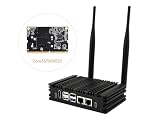
- Powered By Luckfox Core3576 Module To Enable AI Edge Computing, Making It Easy For You To Explore The World Of AI
- Equipped with high-performance RK3576 processor, integrated with quad-core Cortex-A72 and quad-core Cortex-A53, providing strong performance and high energy efficiency. Suitable for vision robotics, depth vision, stereo vision and other AI vision applications
- Supports 4K@120fps (H.265/HEVC, VP9, AVS2, AV1), 4K@60fps (H.264/AVC) decoding and 4K@60fps (H.265/HEVC, H.264/AVC) encoding, easy to deal with HD video tasks
- Different types of traffic can be distributed to different network interfaces: one for external Internet connection and another for internal LAN, which improves security and management flexibility
- Optional for customized Aluminum alloy case with fins for Omni3576 development board, increases the contact and heat dissipation area between the metal case and the air to make the heat dissipation more efficient, with no frequency dropout for 24 hours at full load. Adopts passive fanless cooling design to greatly reduce dust accumulation, thus minimizing malfunctions.
How models reach aiWare3P
The reported software development kit accepted Khronos NNEF and ONNX model inputs. It included direct compilation, FP32-to-INT8 quantization and tools for analyzing deep-neural-network (DNN) behavior. That flow matters because automotive models are often developed in mainstream machine-learning frameworks but must be transformed into a form that fits a fixed embedded accelerator.
Model conversion and quantization
Compilation maps the network’s operations onto the accelerator. Quantization converts 32-bit floating-point values to 8-bit integer representations, potentially reducing memory traffic and compute cost. Quantization can also affect accuracy, so an engineering team must validate the converted model on representative automotive data rather than assume that a successful compile guarantees equivalent results.
Batch size and real-time behavior
Automotive perception commonly favors batch-size-one processing: each frame or sensor event is handled as it arrives. A datacenter benchmark that processes many samples together can hide queueing and memory costs that matter in a car. For that reason, end-to-end frame latency and timing variance are more informative than a peak operations number alone.
Rank #3

- Stability: Can be used stably for a long time
- Design: Robust design, easy to maintain
- Easy to install: simple operation, easy to install
- Application Scenario:Widely used in many industrial environments
- Correct use:Correct use can extend the service life of the product
Reported performance figures—and their limits
The following numbers were attributed to AIMotive by EE Times in 2019. They are not independent, apples-to-apples benchmark results, and they should not be read as guaranteed performance for a particular vehicle or neural network.
The Tool Desk
Outbyte Driver Updater FREEFix the driver behind crashes, sound loss and screen glitchesFind Drivers →Outbyte PC Repair FREEClear out junk files and repair common Windows errorsFree Scan →| Claim reported in 2019 | Qualification |
|---|---|
| Up to 16 TMAC/s per core at 2 GHz, described as more than 32 TOPS | AIMotive’s figure as reported by EE Times; the applicable model, precision and measurement method are not established here. |
| More than 50 TMAC/s, described as more than 100 INT8 TOPS, in multi-core or multi-chip implementations | AIMotive’s scaling claim as reported by EE Times; it is not a measured result for a named production vehicle. |
| Up to 100 times more on-chip memory bandwidth than other hardware NN accelerators | AIMotive’s comparative claim; the comparison set and test conditions are not specified in the available report. |
| Up to 95% sustained efficiency for complex DNNs with large inputs | AIMotive’s stated result; the underlying workload and independent validation are not provided. |
The article said AIMotive planned a full update to its public benchmark results in the first quarter of 2020. The available evidence does not establish whether that update appeared or independently confirms any of these figures.
What L2, L2+ and L3 mean for this announcement
Level 2 systems can assist with steering and speed while the human driver remains responsible for monitoring the road. “L2+” is an industry term rather than a formal SAE automation level and generally describes more capable Level 2 assistance. Level 3 systems are designed for the automated system to perform the driving task within a defined operational domain, with a qualified handover process.
Rank #4

- Powered By Luckfox Core3576 Module To Enable AI Edge Computing, Making It Easy For You To Explore The World Of AI
- Equipped with high-performance RK3576 processor, integrated with quad-core Cortex-A72 and quad-core Cortex-A53, providing strong performance and high energy efficiency
- Equipped with 6 TOPS computing power, easy to convert a variety of neural network models based on TensorFlow, MXNet, PyTorch, and Caffe frameworks.
- Supports 4K@120fps (H.265/HEVC, VP9, AVS2, AV1), 4K@60fps (H.264/AVC) decoding and 4K@60fps (H.265/HEVC, H.264/AVC) encoding, easy to deal with HD video tasks
- Different types of traffic can be distributed to different network interfaces: one for external Internet connection and another for internal LAN, which improves security and management flexibility
aiWare3P’s reported use in L2/L2+ solutions shows that its target workloads were relevant to advanced driver assistance. The report’s reference to investigation of more advanced sensor applications does not prove a production L3 deployment, certification or operational capability. An inference accelerator is one component of a safety-critical system; sensors, perception software, planning, actuation, redundancy and the driver or fallback process all determine the final automation function.
Independent reader supportYour contribution helps us test, update, and keep practical guides available for everyone.Automotive temperature and functional-safety context
EE Times reported that aiWare3P was designed for AEC-Q100 extended-temperature operation and included features intended to help users pursue ASIL-B and higher certification. It also referred to component use within ISO 26262 ASIL A, B and above certified subsystems.
Those statements describe design intent and subsystem integration context. They do not mean that the accelerator itself was certified to a particular ASIL level. The SoC maker and vehicle program would still need to perform the applicable ISO 26262 safety analyses, verification and certification work for the complete item.
Best Value

- ESP32-P4-WIFI6 High-Performance Development Board with pre-soldered Header Based On ESP32-P4 And ESP32-C6.
- Highly Integrated And Powerful Performance.Adopts ESP32-P4 Module, Onboard ESP32-C6 And 32MB Nor Flash
- WiFi 6 And Bluetooth Module.Onboard ESP32-C6 Chip To Extend 2.4GHz Wi-Fi 6 And Bluetooth 5/BLE For ESP32-P4, Using SDIO Interface Protocol For Communication, Stable Connection And Efficient Transmission
- Supports AI Speech Interaction.Allows Access To Online Large Model Platforms Such As DeepSeek, Doubao, Etc.
- Features rich Human-Machine interfaces, including MIPI-CSI (with integrated Image Signal Processor), MIPI-DSI, SPI, I2S, I2C, LED PWM, MCPWM, RMT, ADC, UART, TWAI, etc.
Named programs and customers
Nextchip Apache5
The report identified Nextchip as a customer for its forthcoming Apache5 Imaging Edge Processor. “Forthcoming” reflected the status described in 2019; the report does not establish current availability, production volume or project outcome.
ON Semiconductor sensor-fusion demonstration
AIMotive was also reported to be collaborating with ON Semiconductor on an advanced heterogeneous sensor-fusion demonstration. This was a historical demonstration program, not evidence of a current retail product or a confirmed production vehicle system.
How to evaluate an automotive inference accelerator
Peak TOPS is only one screening metric. A serious comparison should examine the complete workload and integration path:
What’s actually slowing this PC down?
Pick the symptom - the matching free tool is one click away.
- Latency and determinism: end-to-end sensor-to-result time, worst-case timing and jitter at batch size one.
- Sustained throughput: performance on the actual high-resolution, multi-camera or fused-sensor networks, not only a synthetic peak.
- Power and memory: accelerator power, on-chip and external memory bandwidth, thermal limits and host-CPU loading.
- Software support: accepted model formats, compiler coverage, quantization behavior, unsupported operators and DNN analysis tools.
- Automotive qualification: temperature range, diagnostics, safety mechanisms and the evidence needed for integration into an ISO 26262 program.
- Form factor and ownership: licensed RTL inside an SoC has different costs, responsibilities and upgrade paths from a standalone accelerator chip.
On these axes, the 2019 report supplies AIMotive claims for some categories but no independent, apples-to-apples comparison with competing accelerators.
What the announcement does—and does not—establish today
The announcement establishes what AIMotive said it was shipping to lead customers in late 2019: an NN inference IP core aimed at embedded automotive vision, with an SDK for NNEF and ONNX models and support for quantization and analysis. It does not verify present-day licensing, support, ownership, benchmark status, certification, vehicle deployment or the current status of Nextchip and ON Semiconductor programs. Those points require current confirmation from the relevant companies.
Quick Recap
Product prices and availability are accurate as of the date/time indicated and are subject to change. Any price and availability information displayed on Amazon at the time of purchase will apply.




