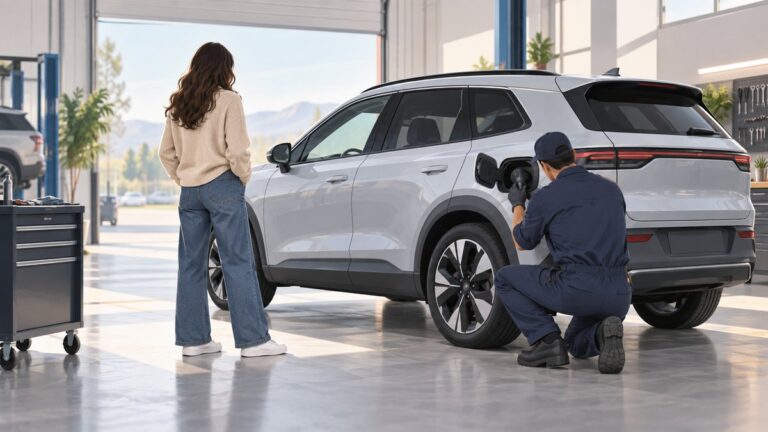
To get more electric driving from a plug-in hybrid (PHEV), charge it regularly and reduce avoidable energy use from driving style, speed, climate control, cargo and route conditions. No single habit guarantees extra miles: results depend on the vehicle, weather and trip. Use your owner’s manual for model-specific charging, drive-mode and regeneration instructions.
Why charging habits matter most
A PHEV stores electricity in a rechargeable battery and also has another propulsion source, typically an engine. The U.S. Department of Energy’s Alternative Fuels Data Center (AFDC) describes current-model PHEV electric ranges as broadly “about 15 to 60-plus miles”; that span is not a prediction for an individual car or journey. AFDC says, “Therefore, consistently charging the vehicle is the best way to maximize the electric benefits.” Read the AFDC overview of plug-in hybrids.
If you rarely charge, there is less stored electricity available for electric driving. Plugging in between trips, when practical, replenishes the battery from an external source. PHEVs can also recover some energy through regenerative braking, but that does not replace charging or return all the energy used to drive.
10 practical ways to preserve electric range
1. Plug in between trips
Make charging part of your routine so the battery is ready for the next drive. Follow the vehicle manual for the correct equipment, connection procedure and charging limits; a public charger or a particular charging level is not necessary for every owner.
PC Slower Than It Used to Be?
A free scan shows the junk files, broken settings and background clutter dragging Windows down - then fixes them in one click.Free scan · Windows 10 & 11Crashes, No Sound, or Screen Glitches?
Random freezes, missing sound and display glitches usually trace back to one bad driver. Find and replace yours safely.Free scan · under a minute#1 Best Overall

- LEVEL 1 CHARGING - The Lectron Level 1 Charger lets you quickly charge your EV with a standard 120V outlet; You get 15 amps and 1.65 kW of power for the standard full-charge time for your car, at home or at wor
- CONVENIENT OVERNIGHT CHARGING - The Lectron 15 Amp EV Charger is a more affordable and faster charging option compared to other Level 2 EV chargers, delivering an extra 40-50 miles of overnight charge at home — without breaking the bank
- J1772 COMPATIBILITY - This J1772 charger is compatible with all electric vehicles that use the J1772 standard, including BMW, Ford, Honda, Hyundai, Kia, Porsche, Nissan, and Chevy
- SAFE AND RELIABLE - FCC and ETL certified (UL2594 standard) for safety with overvoltage, overcurrent, and short circuit protection; Energy Star certified for efficiency; IP65 rated for dust and water resistance
- PORTABLE CONVENIENCE - Whether you're on a road trip or visiting a friend, you can easily plug in your EV and charge with our portable EV charger. Please refer to the included User Manual for complete operating instructions and compatibility requirements
2. Accelerate smoothly
Rapid acceleration and deceleration use more energy than smooth driving. Start gradually and look ahead so you can anticipate traffic and avoid abrupt changes in speed when conditions allow. The U.S. Department of Energy recommends smooth driving to improve efficiency. See the Department of Energy’s efficient-driving guidance.
3. Keep highway speed moderate
Driving faster takes more energy because the vehicle must overcome greater air resistance. Follow posted speed limits and avoid unnecessary speed; there is no single speed threshold that maximizes electric range for every PHEV, road or trip.
Rank #2

- SAE J1772 Standard Charger: Compatible with all North American electric vehicles and plug-in hybrids, including Ford, Chevrolet, Nissan, BMW, Volkswagen, Hyundai, Kia, Audi, Mercedes-Benz, Rivian, Porsche, Toyota, Honda, Jeep, and GMC. Tesla vehicles can be charged with a separate SAE J1772 adapter (sold separately).
- Adjustable Current: Choose from 8A, 10A, 13A, or 16A to match your vehicle’s charging needs.Dual Plug Compatibility,NEMA 6-20 Plug (220/240V): Delivers up to 3.84 kW/h, providing approximately 15.36 MPH charging speed at 16A.NEMA 5-15 Plug (110/120V): Supports 10A charging at 120V, offering 1.2 kW/h (around 4.4 MPH). Customizable Charging: Easily adjust current to suit different charging scenarios, giving you maximum flexibility at home or on the go
- Hassle-Free Installation: Forget complicated setups—just plug in and go. Equipped with NEMA 5-15 and NEMA 6-20 (220V/240V) connectors, it works with any standard 110V–240V outlet. The 25-foot cable gives you the freedom to reach vehicles parked at a distance, making charging convenient anywhere.
- Intelligent Charging: Featuring a 2.8-inch touch display, you can easily select the charging current (8A / 10A / 13A / 16A) and schedule charging with a 1–12 hour delayed start. Perfect for maximizing off-peak hours and cutting electricity costs. (Example: Set a 2-hour delay, and charging begins automatically after 2 hours.)
- Comprehensive Safety: Designed to meet CE and FCC safety standards, this charger offers multiple layers of protection, including overvoltage, overload, short-circuit, grounding, and leakage safeguards. The durable IP65-rated waterproof housing and reinforced cable ensure reliable charging in all weather conditions, keeping your vehicle safe year-round.
4. Use heating and cooling thoughtfully
Very hot or cold conditions and cabin climate demands can reduce electric range. Choose comfortable, moderate settings rather than running climate control harder than needed. If your vehicle supports preconditioning while plugged in, check the manual for how it works; the effect varies, and no particular setting guarantees a specific range gain. The Department of Energy describes research on vehicle thermal management; its stated goal to increase range by 10% during climate-control operation is a research objective, not a measured result for consumers.
5. Travel light
Take out cargo you do not need. Extra weight can reduce efficiency, while roof-mounted cargo can add aerodynamic drag. The Department of Energy lists vehicle load and accessories among factors that affect fuel economy. See its summer-driving efficiency tips.
Free tools Windows power users keep installed
One-click scans. No signup required.
Rank #3

- FAST CHARGING - Charge your J1772 EVs quickly and effortlessly with this Level 2 charger. up to 240V and 40 Amps of input power and 9.6 kW charging rate for fast charging at home or on the go. Ensure your outlet matches a standard NEMA 14-50 household plug
- SAFE AND RELIABLE - FCC and ETL certified (UL2594 standard) for safety with overvoltage, overcurrent, and short circuit protection; Energy Star certified for efficiency; IP65 rated for dust and water resistance
- NEMA 14-50 PLUG - Skip the hardwiring as our 40A EV charger uses a NEMA 14-50 plug to connect directly to your 240V outlet, providing high charging rates for faster EV charging
- PORTABLE EV CHARGER - Enjoy Level 2 charging anytime, anywhere with this portable EV charger. With its long 16-foot cable ( not 25 ft), you no longer need to worry about parking right up close to an outlet as it fits most driveways or garages.
- J1772 COMPATIBILITY - This J1772 charger is compatible with all electric vehicles that use the J1772 standard, including Mercedes, BMW, Ford, Honda, Hyundai, Kia, Porsche, Nissan, and Chevy. NOT natively compatible with Tesla without an adapter.
6. Keep tires at the pressure on the vehicle placard
Check tire pressure when the tires are cold and use the pressure specified on the driver-door placard or in the manual—not the maximum pressure printed on the tire sidewall. Correct inflation is sound maintenance, but the Department of Energy’s published tire-pressure benefit figures concern average gasoline mileage, not a measured increase in PHEV electric range. A basic tire-pressure gauge can help you check the reading.
7. Brake smoothly and understand regeneration
Regenerative braking can capture some energy that would otherwise be lost while slowing down. Anticipate stops and use the vehicle’s regeneration controls as the manual describes. Settings and behavior differ between models, and regeneration cannot recover all the energy used to accelerate or guarantee extra miles.
Rank #4

- 【Dual-Plug EV Charger】Faster Charging (NEMA 6-20, 240V, 3.8 kW): Adds approximately 11–15 mi/hr (vehicle-dependent), significantly reducing wait time. Convenient Charging (NEMA 5-15, 120V, 1.4 kW): Adds approximately 4–6 mi/hr (automatically limited to ~12A on 15A outlets for safety), compatible with standard household outlets. It is a portable electric car charger for flexible home and travel use, solving the problem of incompatible sockets.
- 【Weatherproof and Extended Reach】This car charger is engineered with a NEMA TYPE 3R (IP65) rating; this outdoor unit is strictly waterproof and dust-proof for reliable outdoor charging in rain, snow, and various weather conditions. With its ample 25 feet length, this charging cable easily connects to your EV's charge port—no matter if you're parked deep in a garage, in a tight driveway, or using a public roadside outlet. Say goodbye to cable reach anxiety.
- 【ETL Listed & FCC Compliant】Romaa level 1 and level 2 charger meets stringent electrical safety standards for the United States and Canada. It has passed rigorous independent testing and is equipped with six-layer safety protection, including over-voltage, under-voltage, over-current, over-temperature, grounding, and leakage protection — ensuring safe and reliable charging every time.
- 【J1772 Connector for EVs】Equipped with the standard J1772 connector, our electric vehicle charger ensures broad compatibility across the vast majority of BEVs and PHEVs, including the Toyota Prius Prime and RAV4 Prime, Mitsubishi Outlander PHEV, Jeep Wrangler 4xe and Grand Cherokee 4xe, Ford Escape PHEV, Chrysler Pacifica Hybrid, Kia Niro and Sportage PHEV, Hyundai Tucson PHEV, Volvo XC60/XC90 Recharge, BMW 330e/530e/X5 45e, Audi Q5 TFSI e, Mini Countryman SE, and more. *Not compatible with Tesla EVs unless used with a separate J1772-to-NACS adapter.*
- 【Reliable Support and Accessories】If you encounter any issues with the portable charger, please let us know. We are here to provide technical support and ensure everything works smoothly. Packing List: an EV charger (including a magic strap for preventing tangle), a handbag, and a user manual. It is truly plug-and-play, no complicated setup required.
8. Account for hills and demanding trips
Uphill driving and heavy loads can reduce range. When convenient, avoid unnecessary climbs and detours, and leave a buffer if the route or weather is demanding. There is no universal route-planning feature or calculation that can predict the effect for every PHEV.
9. Choose drive modes according to the manual
PHEVs differ in how their engines and electric motors deliver power. High acceleration demand, steep grades or other conditions may bring the engine on even when you want to drive electrically. If your vehicle offers electric or efficiency modes, use them as described in its manual and keep power demand within what the electric system can supply when electric driving is the goal. Mode names and operating rules are not universal.
Quick wins for a faster PC:
Fix the driver behind crashes, sound loss and screen glitchesFind Drivers →Repair Windows errors before they cause bigger problemsFix Now →Best Value

- WORKS WITH EVERY TESLA + OTHER EVs: Built-in Tesla-style plug (NACS standard) connects directly to Tesla Model S, 3, X and Y - and any EV with a NACS port - no adapter needed. The plug even has a button to pop open your Tesla’s charge port. Non-Tesla J1772 vehicles can charge with a NACS-to-J1772 adapter (not included).
- PLUG IN, NO HARDWIRING: Level 2 charger delivers up to 40A to fully charge most EVs overnight. Plugs into a 240V, 4-prong NEMA 14-50 outlet (the RV/range type - NOT a dryer outlet) on a dedicated 50A circuit. The extra-long 25 ft cable easily reaches across a garage or driveway. Before ordering, check your car’s port type and that you have the right outlet.
- CONTROL & SAVE FROM YOUR PHONE: A stronger built-in antenna keeps the charger online even in a garage or basement. Use the free app to start/stop charging, set speed (6-40A), get reminders, and track energy use and cost. Schedule off-peak overnight charging to cut your electric bill. Requires 2.4 GHz WiFi.
- SAFETY-CERTIFIED & WEATHERPROOF: Independently tested and certified (UL, ETL, FCC, Energy Star). A fully sealed IP66 / NEMA 4 housing stands up to rain, snow, heat and dust indoors or out, and internal steel shielding protects the electronics for years of reliable use.
- GLOW-IN-THE-DARK HOLSTER: The included high-visibility holster glows in the dark so you can find and dock the plug easily at night. Holds the connector securely when not in use.
10. Match your charging routine to the vehicle and household
Choose a charging schedule and equipment that suit your PHEV’s supported charging rate and your home electrical setup. Check the manual and vehicle-specific compatibility guidance before choosing equipment or arranging an installation. A charged battery gives you the opportunity to use electric range; the equipment or charging schedule that makes sense depends on the car and your circumstances.
Independent reader supportYour contribution helps us test, update, and keep practical guides available for everyone.What these habits can—and cannot—do
Speed, driving style, temperature, climate-control use, cargo and terrain all affect energy use. These habits reduce avoidable demands or help make stored electricity available when you drive, but they do not promise a fixed number of extra miles. The Department of Energy’s figures for aggressive driving and tire pressure are gasoline-mileage estimates, not PHEV electric-range measurements, so they should not be converted into electric-range claims.
Quick Recap
Product prices and availability are accurate as of the date/time indicated and are subject to change. Any price and availability information displayed on Amazon at the time of purchase will apply.