The 2026 Yangwang U7 is a giant Chinese-market luxury sedan with four electric motors, up to 1,360 Ps of claimed peak power, and a starting guide price of RMB 658,000. It is available as either a pure EV or a plug-in hybrid, reaches a claimed 300 km/h, and can be specified with four individual luxury seats. The flagship EV quotes up to 1,006 km of CLTC range, while the PHEV combines 300 km of claimed electric range with a listed 1,100 km combined range.
Those numbers make the U7 fascinating, but they need context: the prices and range figures are for China, CLTC is a laboratory test cycle, the acceleration claims come from manufacturer configuration data, and no U.S. retail price or official U.S. sales and warranty program is established in the sources reviewed.
As an Amazon Associate I earn from qualifying purchases.
What is the Yangwang U7?
The Yangwang U7 is the flagship sedan from BYD’s Yangwang luxury-energy brand. In Yangwang’s lineup, it is the sedan counterpart to the U8 luxury SUV and the U9 performance car. BYD positions the brand at the high-end, million-yuan-class end of China’s new-energy market, and the U7 is intended to be a D-class flagship sedan rather than an ordinary family EV.
Its unusual combination is the point. The U7 has the footprint and rear-seat mission of a chauffeur-oriented luxury car, but its four independently controlled electric motors, advanced suspension systems, rear-wheel steering, and claimed 2.9-second acceleration give it the hardware profile of an extreme performance sedan.
#1 Best Overall
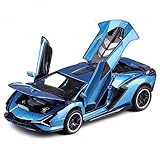
- Material:This model car is made of zinc alloy body,rubber tires and plastic parts.With Detailed interior and exterior trim, It is very sturdy.Car gets multiple processing, grinding sharp corners to prevent cuts child.
- Sound and light:Car doors,hood and trunk can be opened, accompanied with lights&sounds.Press the car body and open the doors can trigger the lights and real sounds.
- Pull back Cars:Place the car on the ground,just pull it back ,the model car will drive forward.Your kids can use it to play a chasing game with their friends.
- Size:Lamborghini Sian FKP37 is 1 /32 scale,Approx.6.3 * 2.7 * 1.6 inches.The size is similar with adult hands.It is very suitable for little boys and girls to grip.
- Gift:Fine workmanship,exquisite box with a display base,ideal birthday gift and holiday gift for kids boys and men who like collect model car.
“Yangwang” is a transliteration of the Chinese brand name 仰望, while “U7” follows the brand’s U-series naming. The name may be unfamiliar to English-speaking buyers, but the car itself is intended to sit at the top of BYD’s technology and luxury hierarchy.
2026 Yangwang U7 price in China
The 2026 U7 launched in China on March 5, 2026. Its verified Chinese guide-price range is RMB 658,000 to RMB 888,000.
| 2026 version | Powertrain and seating | China guide price |
|---|---|---|
| U7 PHEV 5-seat Luxury | Plug-in hybrid, five seats | RMB 658,000 |
| U7 EV 5-seat Luxury | Battery electric, five seats | RMB 658,000 |
| U7 PHEV 4-seat Flagship | Plug-in hybrid, four seats | RMB 738,000 |
| U7 EV 4-seat Flagship | Battery electric, four seats | RMB 738,000 |
| U7 EV Super 4WD | Battery electric, four seats | RMB 888,000 |
At the guide-price level, the equivalent five-seat EV and PHEV versions cost the same, as do the equivalent four-seat Flagship versions. The range-topping EV Super 4WD is the only version listed at RMB 888,000.
These are Chinese-market guide prices, not U.S. MSRP figures. A direct currency conversion would not produce a realistic U.S. purchase price because it would exclude possible import duties, certification, transportation, taxes, warranty support, charging compatibility, and dealer or specialist-import costs.
Yangwang U7 EV vs. PHEV: key specifications
| Specification | 2026 U7 EV | 2026 U7 PHEV |
|---|---|---|
| Drive system | Four independently controlled electric motors | Four independently controlled electric motors plus a 2.0-liter horizontally opposed gasoline engine |
| Listed power output | 960 kW total motor power | 1,000 kW listed four-motor output |
| Peak power | 1,306 Ps | 1,360 Ps |
| Maximum torque | 1,680 N·m | 1,680 N·m |
| 0–100 km/h | 2.9 seconds, manufacturer/configuration claim | 2.9 seconds, manufacturer/configuration claim |
| Top speed | 300 km/h | 300 km/h |
| Battery | 150.01-kWh second-generation Blade Battery | 52.4-kWh second-generation Blade Battery |
| Electric range | Up to 1,006 km CLTC | 300 km CLTC |
| Combined range | Not applicable | 1,100 km listed combined range |
| DC charging listing | 10–97% in 24 minutes at a listed maximum 640-kW charging rate | Not specified in the reviewed configuration data |
Power figures are quoted in Ps, the metric horsepower unit commonly used in Chinese vehicle specifications. They should not be casually presented as U.S. SAE horsepower figures. More importantly, a number such as 1,306 Ps or 1,360 Ps is a manufacturer-listed configuration figure, not an independent road-test result.
2026 U7 EV
The battery-electric U7 uses BYD’s e⁴ four-motor intelligent all-wheel-drive architecture and a 150.01-kWh second-generation Blade Battery. Official configuration data lists 960 kW of total motor power, 1,306 Ps of peak power, 1,680 N·m of maximum torque, a 300 km/h top speed, and a 2.9-second 0–100 km/h time.
Its headline range is up to 1,006 km on the CLTC cycle. That is an important qualifier. CLTC is a Chinese laboratory test cycle and should not be treated as a guaranteed highway distance or directly converted into an EPA range estimate. Actual range would depend on speed, temperature, traffic, terrain, tires, climate control, payload, and driving style.
Free tools Windows power users keep installed
One-click scans. No signup required.
The 2026 configuration page lists DC charging from 10% to 97% in 24 minutes with a maximum charging rate of 640 kW. That is an unusually high quoted rate, but achieving it depends on compatible charging hardware and conditions. It should not be read as a promise that an imported U7 could use every high-power charger in another country.
2026 U7 PHEV
The plug-in hybrid uses the same basic four-motor concept but adds a dedicated 2.0-liter high-output horizontally opposed gasoline engine. The combination is listed at 1,000 kW of four-motor output, 1,360 Ps of peak power, and 1,680 N·m of maximum torque. The listed top speed is 300 km/h, and the headline 0–100 km/h claim is also 2.9 seconds.
The PHEV has a smaller 52.4-kWh second-generation Blade Battery. It is listed with 300 km of CLTC electric range and a 1,100 km combined range. For someone who wants to drive electrically for most local trips but retain a gasoline engine for longer journeys, that is the PHEV’s central appeal.
There is a second acceleration number worth understanding. The official product material claims 4.1 seconds from 0–100 km/h when the battery is depleted, or when the car is operating in an “out of electricity” condition. That does not conflict with the 2.9-second headline figure; they describe different operating conditions. The 2.9-second figure is the fully enabled performance claim, while 4.1 seconds describes the depleted-battery condition.
The Tool Desk
Outbyte Driver Updater FREEFix the driver behind crashes, sound loss and screen glitchesFind Drivers →Outbyte PC Repair FREEClear out junk files and repair common Windows errorsFree Scan →Why the U7 has four electric motors
The U7’s e⁴ architecture gives each wheel its own electric motor and control strategy. That is more than a simple way to increase peak output. Independent wheel control can be used for torque vectoring, stability management, acceleration, and low-speed maneuvering.
Yangwang and BYD associate the system with unusual movement functions including:
- In-place U-turns or pivot-style turns.
- Sideways or “crab” movement.
- Specialized parking maneuvers.
- Individual wheel torque control for stability and cornering behavior.
These functions help distinguish the U7 from a conventional dual-motor all-wheel-drive sedan. They are also best understood as manufacturer-described capabilities. The existence of four motors does not, by itself, prove that the car will be quicker, safer, or easier to drive in every real-world situation.
DiSus-Z and DiSus-A+: the U7’s unusual suspension hardware
The most expensive EV Super 4WD trim uses DiSus-Z, which Yangwang describes as an intelligent levitated-body-control system. It replaces conventional hydraulic dampers with electromagnetic or magnetic-levitation motor-based control. The objective is rapid, highly precise control of body movement rather than simply adding a firmer suspension setting.
What’s actually slowing this PC down?
Pick the symptom - the matching free tool is one click away.
Other 2026 EV and PHEV trims use DiSus-A+, an intelligent air-body-control system with dual-chamber air suspension and dual-valve hydraulic dampers. That gives the less expensive versions a more familiar air-suspension layout, while the Super 4WD is the technology showcase.
BYD lists a wide range of functions for these chassis systems, including:
- Pitch suppression during acceleration and braking.
- Road preview and proactive body control.
- Vertical-energy recovery.
- Stability assistance after a high-speed tire blowout.
- Obstacle avoidance support.
- Curb assistance.
- Single-side lifting.
Those are claimed system functions, not independent test findings. They should not be turned into a blanket claim that every U7 rides better or is safer than every competing sedan.
Rear-wheel steering and tank-turn maneuvering
The U7 also has bidirectional intelligent rear-wheel steering. BYD’s corporate description cites up to 20 degrees of rear-wheel steering, a substantial amount intended to improve low-speed maneuverability as well as high-speed stability.
2026 launch coverage reports a 4.85-meter turning radius and a 15-second tank-turn function. The wording matters: different descriptions use “turning radius” and “turning circle” differently, so it is not appropriate to double 4.85 meters and present the result as an official turning-circle diameter.
In practical terms, the U7 is trying to make a very large sedan easier to position in tight spaces while also using rear steering and four-wheel torque control for performance-oriented handling. Whether those systems feel natural or deliver a measurable advantage requires independent testing; the available specifications establish the technology, not a verified driving verdict.
Rank #2

- 【AC Input /Output 】Input : 100V -240VAC 50/60Hz. /Output:24V DC 1000mA / 5 Ft Power Cable / 2.1mm * 5.5mm Center Positive Barrel Plug
- 【LED DISPLAY】Red Charging /Green Fully Charged
- 【Compatible Models】Compatible with the majority of 24V Children Ride On Car ( for Ferrari Lamborghini Mercedes BMX X6 Kid TRAX Disney GMC JEEP Hello Kitty SUV RC Car and so on )
- 【Safety certification】Our products have passed Safety certified. Fast charging and provide overcharge protection system/short circuit/overload protection/overheat protection/ Exceed 10 years Lifespan
- 【Notice】A:that wether the charger's charging hole is compatible. B:the input voltage is 100-240V for this charger. Please confirm insert correctly. C:Please do not overcharge. When the ligth is green, please remove the charge. Please contact us with any questions or concerns.
God’s Eye A driver assistance
The U7 uses BYD’s God’s Eye A driver-assistance system, also referred to in coverage as DiPilot 600. The 2026 product material describes a 5.0 end-to-end large model, high-speed and city navigation assistance, active-safety functions, and all-scenario parking assistance. It lists 32 sensing elements.
Earlier launch coverage described a sensor package including three long-range lidars, five millimeter-wave radars, high-definition cameras, and ultrasonic radars. Equipment and software descriptions can vary by model year, trim, market, and publication date, so the 2026 configuration should be checked before treating any one sensor list as universal to every U7.
Quick wins for a faster PC:
Clear out junk files and repair common Windows errorsFree Scan →Fix the driver behind crashes, sound loss and screen glitchesFind Drivers →God’s Eye A is advanced driver assistance, not autonomous driving. The defensible description is driver assistance, navigation assistance, or an L2+ system. The driver remains responsible for monitoring the road, supervising the system, and taking control when required.
Dimensions: this is a genuinely large sedan
| Dimension | 2026 U7 EV | 2026 U7 PHEV |
|---|---|---|
| Length | 5,265 mm | 5,360 mm |
| Width | 1,998 mm | 2,000 mm |
| Height | 1,517 mm | 1,515 mm |
| Wheelbase | 3,160 mm | 3,200 mm |
The PHEV is 95 mm longer than the EV and has a 40-mm-longer wheelbase, while both versions are approximately two meters wide. The 2025 launch material listed a 0.195 drag coefficient for the model, contributing to the U7’s efficiency-focused design, but that figure should not be confused with a real-world range result.
These dimensions put the U7 closer to a full-size executive flagship than to a compact sports sedan. The size supports generous rear-seat space and road presence, but it also matters for parking, narrow roads, garage fit, tire costs, and maneuvering in cities that were not designed around large luxury cars.
Independent reader supportYour contribution helps us test, update, and keep practical guides available for everyone.Four-seat or five-seat: the cabin’s real choice
The 2026 U7 is offered in both five-seat and four-seat configurations. The five-seat versions make more sense as high-performance executive sedans that retain normal passenger flexibility. The four-seat versions make the car’s luxury mission much clearer.
Do these 3 things before closing this tab:
1Fix the driver behind crashes, sound loss and screen glitches2Repair Windows errors before they cause bigger problems3Scan for outdated or missing drivers - takes under a minuteLaunch coverage describes Nappa leather, up to 20-way front-seat adjustment, heating, ventilation, lumbar support, and hot-stone massage. The four-seat Flagship versions add individual rear seats, a central-armrest control screen, powered leg, head, and foot rests, and a recline-oriented comfort function.
That layout is not merely a lower-capacity version of the five-seat car. It is aimed at owners who expect to be driven, with rear-seat comfort and personal space taking priority over carrying a fifth passenger. The EV Super 4WD is also a four-seat model, combining the most elaborate chassis technology with the chauffeur-focused cabin.
2025 versus 2026 Yangwang U7: do not mix the specifications
The 2026 car materially changes the U7’s headline battery and range story, so older launch figures should be labeled clearly rather than blended into the current specification sheet.
| Specification | 2025 launch U7 | 2026 U7 |
|---|---|---|
| 2025 launch price range | RMB 628,000–708,000 | RMB 658,000–888,000 guide price |
| EV battery | 135.5 kWh Blade Battery | 150.01 kWh second-generation Blade Battery |
| EV range | 720 km CLTC | Up to 1,006 km CLTC |
| Listed EV output | 960 kW / 1,287 hp as reported at launch | 960 kW / 1,306 Ps |
| EV maximum speed | 270 km/h | 300 km/h |
| EV acceleration | 2.9 seconds, claimed | 2.9 seconds, claimed |
The original U7 went on sale in China on March 27, 2025, with deliveries beginning in June 2025. Its 2025 EV used a 135.5-kWh battery and quoted 720 km of CLTC range. The 2026 EV’s 150.01-kWh battery and 1,006-km CLTC maximum are therefore 2026 figures, not specifications that should automatically be applied to an earlier car.
Recommended Free Tools
Can Americans buy a Yangwang U7?
The safest answer is that the U7 is currently a China-market flagship sedan, and no U.S. retail price is established in the reviewed material.
The official Yangwang purchase route directs shoppers to a Chinese Yangwang purchase mini-program for the 2026 U7. Yangwang’s global website lists the U7 among the brand’s vehicles, and the brand has an official UAE brand-center presence. Those facts show that Yangwang has international ambitions and at least some regional presence, but they do not establish U.S. certification, U.S. inventory, U.S. warranty coverage, or a U.S. dealer network for the U7.
A private import would require country-specific verification of several separate issues:
- Whether the vehicle can legally be registered in the destination market.
- Emissions, crash, lighting, and other certification requirements.
- Charging connector, voltage, software, and network compatibility.
- Parts supply, diagnostics, servicing, and warranty support.
- Insurance availability and the final landed cost.
Until those details are confirmed for a specific country and vehicle, RMB 658,000 should not be described as the U7’s American price. It is the Chinese guide price for the relevant 2026 version.
Outdated Drivers Are Slowing You Down
One free scan finds every outdated or missing driver and matches the right update for your exact hardware.Free scan · exact hardware matchPC Slower Than It Used to Be?
A free scan shows the junk files, broken settings and background clutter dragging Windows down - then fixes them in one click.Free scan · Windows 10 & 11What the Yangwang U7 is—and is not
The U7 is not simply a large EV with a huge battery. Its strongest point of distinction is the combination of four-wheel independent electric drive, high-output EV and PHEV powertrains, active suspension control, rear-wheel steering, advanced driver assistance, and a four-seat executive cabin.
It is also not a car for which the available information supports claims about independent road-test superiority, real-world highway range, ride quality, braking performance, reliability, or safety leadership. No independent test or first-hand driving evaluation is part of the available research. The 2.9-second acceleration time, 300 km/h top speed, 1,006-km range, suspension functions, and maneuvering features should therefore be presented as manufacturer or configuration claims.
Who is the U7 for?
- Choose the EV conceptually if maximum electric range and the quietest, simplest powertrain are the priority. The 2026 EV offers the 150.01-kWh battery and up to 1,006 km CLTC claim.
- Choose the PHEV conceptually if long-distance flexibility matters more than maximum battery range. It offers 300 km of claimed CLTC electric range and a listed 1,100 km combined range, but its 2.9-second performance claim assumes a different condition than its 4.1-second depleted-battery figure.
- Choose a five-seat version if the U7 needs to function as a conventional executive sedan with more flexible passenger capacity.
- Choose a four-seat version if rear-seat comfort, powered leg and foot supports, and chauffeur-style travel are more important than carrying five people.
- Look at the EV Super 4WD if the headline chassis technology matters most. It is the only listed version with DiSus-Z and carries the highest RMB 888,000 guide price.
Frequently Asked Questions
What is the current Yangwang U7 price?
For the 2026 model in China, guide prices range from RMB 658,000 to RMB 888,000. The five-seat Luxury versions start at RMB 658,000, the four-seat Flagship versions cost RMB 738,000, and the four-seat EV Super 4WD costs RMB 888,000.
Which Yangwang U7 has 1,006 km of range?
The 2026 battery-electric U7 is listed with up to 1,006 km of CLTC range. That is a laboratory-cycle figure and should not be treated as guaranteed real-world highway range or directly converted into an EPA estimate.
Is the Yangwang U7 fully electric or a hybrid?
Both versions are available. The EV uses four electric motors and a 150.01-kWh battery. The PHEV adds a 2.0-liter horizontally opposed gasoline engine and uses a 52.4-kWh battery, with 300 km of listed CLTC electric range and 1,100 km of listed combined range.
Is the Yangwang U7 self-driving?
No. Its God’s Eye A, also called DiPilot 600 in some coverage, is an advanced driver-assistance system with navigation assistance, active safety, and parking functions. It should be described as driver assistance or L2+, not autonomous driving.
The Bottom Line
Bottom line: The Yangwang U7 is a technically ambitious and genuinely unusual flagship sedan: four electric motors, up to 1,360 Ps of claimed power, advanced suspension and rear-wheel steering, plus a chauffeur-style four-seat cabin. The 2026 China guide price is RMB 658,000–888,000. For U.S. readers, however, it remains a China-market curiosity rather than a normally purchasable sedan, because no U.S. MSRP, certification, warranty, or retail launch is established here.
Quick Recap
Product prices and availability are accurate as of the date/time indicated and are subject to change. Any price and availability information displayed on Amazon at the time of purchase will apply.
Do these 3 things before closing this tab:
1Scan for outdated or missing drivers - takes under a minute2Clear out junk files and repair common Windows errors3Fix the driver behind crashes, sound loss and screen glitches



