Plug-in charging is the easier benchmark today; wireless charging is primarily a convenience and site-design choice. A wireless system can avoid handling a cable, but the available evidence does not establish a universal installed-price premium, charging-speed advantage, or fixed efficiency penalty compared with plugging in. The result for your car depends on its charging limits, the equipment rating, installation work, alignment, battery condition, and how efficiency is measured.
For a fair decision, compare the same vehicle, the same usable energy added, the same electrical service, and grid-input-to-battery-output measurements. SAE J2954_202408 defines stationary wireless charging for light-duty vehicles at power levels up to 11 kVA, but that ceiling is not a guaranteed rate at the battery.
As an Amazon Associate I earn from qualifying purchases.
What “wireless” and “plug-in” charging mean
Plug-in (conductive) charging
A plug-in system makes a physical electrical connection between the vehicle inlet and charging equipment. The cable, connector, vehicle inlet, onboard charger, and electrical circuit all have ratings that limit power. A higher-rated wall unit cannot force a vehicle to accept more power than its onboard charger or battery-management system allows.
Conductive charging remains the reference method for most parked charging because the interface is familiar, the connection is visible, and compatibility can be checked from the vehicle inlet and charger specifications. A cable or wall unit still has to match the vehicle’s connector, current rating, voltage, and local electrical requirements.
#1 Best Overall

- 【17FT EV CHARGER EXTENSION CABLE】Extend the reach of your SAE J1772 EV charger with this 17-foot heavy-duty extension cable. Designed for Level 1 and Level 2 charging, it offers greater flexibility for home or travel use, allowing easier access to your electric vehicle or plug-in hybrid.
- 【50Amp RATED SAFE CHARGING】This J1772 extension cord supports up to 50 amps, delivering efficient and safe charging for compatible EVs. Fully uncoil the cable before use to maintain optimal thermal performance. Do not use while coiled to avoid potential overheating.
- 【DURABLE & WEATHER-RESISTANT】Made with high-quality TPE coating and 100% pure copper wiring, this EV extension cable offers superior durability and flexibility. Featuring an IP67 waterproof rating, it performs reliably in rain, snow, or sunlight.
- 【ENHANCED CONNECTIVITY & SAFETY】UL and ETL Certificated equipped with silver-plated conductive terminals to improve charging efficiency and minimize energy loss. The connectors are corrosion-resistant and designed to provide a secure, stable connection every time.
- 【3-YEAR WARRANTY & SUPPORT】Backed by a 36-month manufacturer’s warranty and dedicated customer service. If you have any questions or issues, feel free to reach out to our support team at any time.
Wireless (inductive) charging
A stationary wireless system transfers energy across an air gap. A ground assembly is installed on or near the parking surface, and a receiver is mounted beneath the vehicle. Coils create a magnetic field that induces current in the receiver; power electronics then condition that energy for the vehicle battery.
There is no physical charging connector to handle, but the system adds vehicle-side and ground-side hardware. Parking position, coil spacing, foreign-object detection, electromagnetic compatibility, and communications all matter. Wireless charging is not the same as charging while driving: a pad used in a parking space is a stationary system, while coils embedded in a roadway are a dynamic-charging concept with different engineering and economics.
Quick comparison
| Question | Wireless, stationary | Plug-in, conductive | What the evidence supports |
|---|---|---|---|
| Physical connection | Ground assembly and underbody receiver transfer power across an air gap. | Cable and connector make a direct electrical connection. | These are different power-transfer paths; neither description by itself determines cost or efficiency. |
| Light-duty standard covered here | SAE J2954_202408, for parked vehicles and up to three levels reaching 11 kVA. | SAE J1772 conductive charging is the compatibility reference named by SAE. | SAE says a vehicle capable of wireless charging under J2954 should also be capable of J1772 conductive charging, subject to the individual vehicle and market. |
| Maximum stated power | Up to 11 kVA in J2954_202408. | Not a single universal value; vehicle inlet, onboard charger, circuit, and charger rating set the limit. | A standards maximum is not a delivered-charge guarantee. |
| Comparable consumer installed cost | Not stated in the reviewed evidence (SAE standards material; U.S. Department of Energy dynamic-charging work). | Not stated in the reviewed evidence for the same site, vehicle, and power. | Obtain dated, location-specific quotes rather than applying a universal premium. |
| Matched stationary grid-to-battery efficiency | Not stated in the reviewed evidence. | Not stated in the reviewed evidence. | Dynamic simulations cannot substitute for a same-vehicle stationary test. |
| Typical user interaction | Park over the assembly and verify alignment; charging starts according to the system’s controls. | Position the car, connect the cable, and confirm the charging session. | Convenience depends on parking geometry, alignment aids, cable storage, and reliability. |
Standards and compatibility you must verify
What SAE J2954_202408 covers
SAE J2954_202408 is the current light-duty stationary wireless-charging scope identified in the supplied technical material. It addresses safety, performance, interoperability, electromagnetic compatibility, electromagnetic-field exposure, minimum performance, and testing. This version covers above-ground, surface-mounted installations for parked vehicles and specifies three power levels up to 11 kVA.
Outdated Drivers Are Slowing You Down
One free scan finds every outdated or missing driver and matches the right update for your exact hardware.Free scan · exact hardware matchPC Slower Than It Used to Be?
A free scan shows the junk files, broken settings and background clutter dragging Windows down - then fixes them in one click.Free scan · Windows 10 & 11The 11 kVA figure is a rating in the standard, not a promise that every compatible car will receive 11 kVA. Vehicle acceptance, the installed equipment, alignment, battery state, temperature, and electrical-service limits determine actual delivered power. A model may accept substantially less than the system’s nameplate maximum.
Wireless capability does not eliminate conductive compatibility
SAE’s August 2024 description says: “In the near term, vehicles that are able to be charged wirelessly under SAE J2954 should also be able to be charged conductively by SAE J1772 plug-in chargers.” This describes intended interoperability, not permission to assume that every retrofit, connector, or regional version will fit. Check the exact vehicle model and market, the inlet and onboard-charger limits, and whether a receiver is factory-installed or approved as a retrofit.
Rank #2

- [40A Level 2 J1772 Compatibility] Works with all standard Type 1 EV chargers and J1772 vehicles in North America; Tesla owners can use their adapter for seamless charging.
- [Full-Power 40A Charging] Rated for 40 amps at 240 V to support Level 2 charging without derating.
- [Service-Ready Replacement] Open-wire ends with clearly labeled leads simplify installation into existing EV charging stations.
- [IP67 Waterproof & Rugged Design] A heavy-duty flexible jacket resists abrasion, impacts, and weather for reliable indoor and outdoor charging.
- [UL-Listed Safety Assurance] Built with quality materials and independently tested to UL safety standards for dependable performance.
Stationary, heavy-duty, and dynamic scopes are different
The light-duty J2954 document is not a specification for every bus or truck installation. Heavy-duty work is considered in SAE J2954/2, while dynamic applications are to be specified in SAE J2954/3. The current light-duty scope explicitly specifies one-way grid-to-vehicle power; bidirectional testing and communications are planned for a later revision. Do not treat vehicle-to-grid or reverse power flow as an established J2954 feature.
Cost: why no universal winner can be stated
A reliable cost comparison needs two quotes for the same property, vehicle, charging power, and date. The reviewed sources do not provide a current, directly comparable consumer installed price for a J2954 wireless system versus a plug-in home charger. They also do not support a universal wireless percentage premium, payback period, or lifetime-cost claim.
The Tool Desk
Outbyte PC Repair FREEClear out junk files and repair common Windows errorsFree Scan →Outbyte Driver Updater FREEScan for outdated or missing drivers - takes under a minuteDriver Scan →What belongs in a plug-in quote
- Wall unit or other conductive charging equipment and its cable.
- Vehicle connector compatibility and any required adapter approved for that vehicle.
- Electrical-panel capacity, breaker, conduit, wiring length, disconnects, and permits.
- Trenching, wall penetration, weather protection, and parking-space distance from the service equipment.
- Inspection, commissioning, software or communications requirements, maintenance, and available local incentives.
What belongs in a wireless quote
- Ground assembly, power electronics, controls, and the vehicle receiver.
- Receiver installation or an approved retrofit, including underbody clearance and warranty implications.
- Electrical service work, concrete or surface preparation, drainage, protection from impact, and alignment markings or sensors.
- Commissioning, interoperability and safety testing, maintenance access, and replacement-part support.
- Any incentive that specifically applies to wireless equipment rather than conductive equipment.
For a fair total-cost-of-ownership calculation, request each item as a separate line, record taxes and recurring charges, and state whether an incentive is a one-time credit or an ongoing program. A wireless system can be financially sensible where civil work, fleet utilization, or cable handling dominates the decision, but the available evidence does not establish that outcome for every home.
A quote worksheet
- Write down the vehicle’s maximum AC charging power, battery usable capacity, inlet, and whether it has factory wireless hardware.
- Ask both installers to price the same target power and the same parking location.
- Require separate amounts for equipment, vehicle receiver or cable, electrical work, civil work, permits, commissioning, and maintenance.
- Record the quote date, currency, tax treatment, warranty term, service response, and incentive assumptions.
- Compare cost per usable kilowatt-hour delivered over the period you expect to own the vehicle, using your actual electricity tariff and charging schedule.
Speed: rated power is only the starting point
Charging time is governed by the lower of the vehicle’s acceptance limit and the system’s delivered output, then reduced by charging losses and the battery’s tapering behavior near a high state of charge. A simple planning relationship is:
time ≈ energy added ÷ average power delivered to the battery
Rank #3

- 【17FT EV CHARGER EXTENSION CABLE】 This 17-foot heavy-duty J1772 extension cable is the perfect solution for extending the reach of your SAE J1772 EV charger. Designed for both Level 1 and Level 2 charging, it offers enhanced flexibility for home or travel use. Whether at home or on the go, you can easily access your electric vehicle or plug-in hybrid. The extra length ensures you can reach charging stations with ease, even in various parking setups, making it a hassle-free charging experience.
- 【50Amp Rated Safe Charging】 This J1772 extension cord supports up to 50 amps, delivering efficient and safe charging for compatible EVs. The stable current output ensures that your vehicle charges quickly and safely, protecting the battery from overheating. Always uncoil the cable before use to maintain optimal thermal performance and prevent overheating. This simple step ensures safe charging and prolongs the lifespan of both the cable and your vehicle's battery.
- 【Durable & Weather-Resistant】 Built with a high-quality TPE coating and 100% pure copper wiring, this extension cable offers superior durability and flexibility. Featuring an IP67 waterproof rating, it performs reliably in all weather conditions—rain, snow, or intense sunlight. This cable is designed to withstand extreme temperatures and harsh environmental conditions, making it ideal for both indoor and outdoor use.
- 【Enhanced Connectivity & Safety】 Certified by UL and ETL, this extension cord features silver-plated conductive terminals and corrosion-resistant connectors that minimize energy loss and improve charging efficiency. These high-quality components ensure secure, stable connections every time, providing a reliable and safe charging experience. Extensive testing proves this cable's efficiency, ensuring that your EV charges safely and without interruptions.
- 【3-Year Warranty & Support】 This extension cable is backed by a 36-month manufacturer’s warranty and comes with 24/7 customer support. Enjoy peace of mind with your purchase, knowing that expert support is available whenever you need it. If you have any questions or concerns, our dedicated support team is here to assist you, ensuring hassle-free ownership and reliable service.
“Average” matters. A session that begins at a high power may slow as the battery fills, and cold or hot conditions can reduce acceptance. Compare the time to add a defined amount of energy, such as 20 kWh or a stated percentage, rather than comparing nameplate kVA alone.
Quick wins for a faster PC:
Repair Windows errors before they cause bigger problemsFix Now →Fix the driver behind crashes, sound loss and screen glitchesFind Drivers →How to compare a wireless and plug-in session
- Use the same vehicle, battery state of charge, ambient temperature, and target state of charge.
- Set both systems to comparable current and voltage limits that the vehicle can actually accept.
- Measure grid input and battery energy, or use the vehicle and charger logs with the measurement boundary documented.
- Record initial alignment, connection time, interruptions, and any power reduction caused by temperature or communications.
- Repeat at least enough times to distinguish a repeatable difference from a single-session anomaly.
The reviewed evidence contains no controlled, same-vehicle stationary test that declares wireless or plug-in charging faster. J2954’s three levels and 11 kVA ceiling therefore should not be presented as a head-to-head speed result.
Transit dwell time is not a passenger-car rule
The Federal Transit Administration’s 2024 report discusses battery-electric bus deployments and states that, under the deployments and recommendations it addresses, buses need a minimum dwell time of 15 minutes to receive sufficient energy. That finding helps explain why a fleet might consider on-route wireless charging, but it is not a charging-time requirement for private cars and should not be used to predict a home session.
Efficiency: define the boundary before comparing percentages
For a consumer comparison, the useful definition is grid-input-to-battery-output efficiency: energy drawn from the meter divided by energy stored in the battery for the same charging task. A result can change if it includes or excludes standby electronics, vehicle charging controls, cable losses, thermal management, or the battery’s own losses. Any published percentage should state the vehicle, power, alignment, temperature, state-of-charge range, and measurement points.
Why wireless may have additional loss mechanisms
An inductive system has an air gap and two power-conversion paths, so coil alignment, separation, shielding, switching electronics, and thermal control affect losses. A conductive system has cable, connector, and conversion losses. The existence of an air gap does not provide a fixed loss percentage, and a well-aligned installation can perform differently from a poorly aligned one.
Free tools Windows power users keep installed
One-click scans. No signup required.
Rank #4
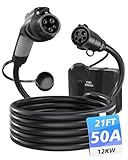
- 【Extend Your Charging Range】-EVDANCE J1772 EV Charger Extension Cord is the perfect accessory for electric vehicle owners looking to extend their charging range. Designed to be compatible with Level 1 and Level 2 chargers featuring J1772 connectors, this extension cord provides flexibility for various charging setups. Please note that Tesla vehicles require a J1772 adapter (not included) for compatibility.
- 【Powerful 50Amp Charging with 21FT Cable】-With support for up to 50 amps charging, this extension cord offers a powerful charging solution for your electric vehicle. It comes with a heavy-duty 21FT outdoor cable, providing both ample power and reach to efficiently charge your EV.
- 【Enhanced Conductivity for Optimal Performance】-The inlet of this extension cord features silver plating, ensuring excellent conductivity during charging sessions. This enhanced conductivity not only improves charging efficiency but also prevents overheating, guaranteeing a safe and reliable charging experience.
- 【Built to Last with High-Strength Polycarbonate PC Material】-Crafted from high-strength Polycarbonate PC Material, this extension cord is built to last. Its durable construction offers exceptional longevity for long-term use. Additionally, its waterproof design (IP66 rated) provides peace of mind, allowing you to confidently use it in any weather condition.
- 【EVDANCE 12 Months Warranty: Your Trusted Partner】-At EVDANCE, we stand behind the quality of our products. That's why we offer a 12-month warranty from the date of purchase. If you encounter any issues with your charger due to manufacturing defects or workmanship during this period, our dedicated team will promptly assist you in resolving the matter.
Do not reuse dynamic-charging simulations as home-charging results
U.S. Department of Energy Vehicle Technologies Office material from 2019 reports simulated dynamic energy-transfer efficiencies of 80.5%, 82.8%, and 82.3% for specified reference-pad cases at 75 mph. These are modeled roadway configurations, not measured stationary consumer systems and not a matched comparison with J1772 charging. They show the type of engineering trade-off studied in dynamic charging; they do not establish that every wireless home charger is 17% to 19.5% less efficient than plugging in.
No directly comparable stationary grid-to-battery efficiency figure was identified for a consumer wireless installation versus a plug-in installation. If efficiency affects your decision, ask the installer or manufacturer for independently measured results with a stated boundary and matched conditions. Without that documentation, treat percentage claims as non-comparable.
Independent reader supportYour contribution helps us test, update, and keep practical guides available for everyone.Convenience, alignment, and everyday use
Parking accuracy matters
A wireless pad has to couple effectively with the receiver. Markings, visual guides, audible alerts, cameras, or automatic positioning assistance can make the process easier, but the exact features vary by system. Ask what happens when the vehicle is offset, whether charging derates or stops, and how the driver is notified.
What recent alignment research does—and does not—show
A 2024 SAE technical paper describes tests of differential inductive positioning (DIPS) in Stuttgart in September 2023 and ultra-wideband (UWB) ranging in Switzerland in October 2023. The paper evaluates them as candidates for a future harmonized methodology. It does not show that all current consumer chargers use DIPS or UWB, nor that alignment is universally solved. Ask which sensing method a proposed system uses and what tolerance the vehicle-pad pair supports.
Cable convenience has trade-offs
Wireless charging removes cable handling during routine parking, which may help drivers who charge in a fixed space or fleets that need frequent short sessions. Plug-in charging gives a visible physical connection and can be moved between compatible vehicles when the cable and equipment allow it. Consider who parks the vehicle, whether several vehicles share the space, snow or debris exposure, and how a failed component would be serviced.
Best Value

- 【3.84KW Fast Charging】The KHONS level 2 EV charger is equipped with NEMA 6-20 Plug, offers 240V, 16A, 3.84kW output current, approximately 4x faster than 8A level 1 ev chargers, reducing the time required to charge an electric vehicle
- 【Level 1/2 EV Charger】This portable ev charger is equipped with NEMA 6-20 plug (240V, 16A) and attached a NEMA 5-15 adapter (120V, 12A), Whether you have access to a standard household outlet or a dedicated EV charging station, our electric car charger adapts to your charging needs
- 【Smart Charging Features】Feature with built-in advanced chipset, KHONS ev charger provides extensive protection against lightning, leakage, grounding issues, over and under voltage, over load, short circuit, and overheating. TIPS: The circuit breaker is required for safety
- 【23FT Charging Cable】This portable EV charger is lightweight, compact, and easy to carry. With the 23-foot cable, you can conveniently charge your EV at home or using public charging stations. Its internal copper wires ensure top conductivity, while the TPE flame-retardant jacket adds durability. This portable charger is IP54 waterproof and dustproof, enduring temperatures from -25°C to 50°C
- 【2 Year Support】 Comes with a 24-month support. If our products do not meet your expectations, please feel free contact us or send message to our after-sale email and we will work to resolve the issue
How to make a vehicle-specific decision
- Confirm the vehicle configuration. Check the model year and market, AC charging limit, inlet type, onboard charger, battery warranty, and whether a factory receiver is installed or an approved retrofit exists.
- Define the charging task. State how many kilowatt-hours you add per day, the available parking duration, and whether charging is overnight, opportunistic, or tied to a fleet route.
- Check electrical capacity. Have a qualified electrician verify panel capacity, circuit length, protection, grounding, permits, and local code requirements for either system.
- Obtain comparable quotes. Use the same target power and parking location, and request the line items listed in the cost section.
- Ask for measured performance. Request delivered power, efficiency boundary, alignment tolerance, operating-temperature limits, standby consumption, and test conditions.
- Review support and warranty. Confirm who services the ground unit and receiver, expected parts availability, software support, and whether installation affects the vehicle warranty.
- Test the routine if possible. For wireless, try repeated parking approaches and deliberate offsets. For plug-in, check cable reach, connector ergonomics, and weather handling.
- Choose on the actual constraint. Select wireless when hands-free operation or a constrained fleet layout justifies its additional hardware; select plug-in when straightforward compatibility, portability, or a transparent installation is the priority.
Where wireless charging is most defensible
Dedicated home parking
A fixed garage or driveway can make alignment predictable and eliminate daily cable handling. The case is strongest when the receiver and pad are factory-supported, the installation surface is suitable, and the owner values convenience enough to justify the quoted equipment and civil work.
Public spaces with repeat users
Wireless equipment may reduce visible cables and connector handling in a dedicated bay. Before installation, verify vandalism protection, snow and water management, accessibility, payment or authorization controls, interoperability, and maintenance access. The standard’s existence does not guarantee that every public station or vehicle combination is interoperable.
Transit and commercial fleets
The FTA’s 2024 report identifies potential value for on-route bus charging and depots where plug-in equipment space is constrained. It also identifies standards, interoperability, funding, and operational data as barriers, and notes that high-power bus wireless charging has not been broadly deployed in the United States. Those findings apply to transit operations, not to retail passenger-car availability or a home owner’s expected payback.
Dynamic roadway charging
Charging while moving could reduce the battery size needed for some routes, but it requires roadway construction, grid equipment, vehicle receivers, control systems, and a different business case. Dynamic research and its simulated efficiencies should not be used to price or rate a stationary pad in a garage.
Common mistakes and how to avoid them
- Treating 11 kVA as your car’s charging speed: check the vehicle acceptance limit and actual delivered power.
- Assuming every wireless-capable car uses the same hardware: verify the exact receiver, pad, market, and retrofit approval.
- Quoting a universal wireless premium: compare complete, dated, geographically scoped installations; civil work can dominate either option.
- Using a dynamic 80.5%, 82.8%, or 82.3% simulation as a home efficiency result: those figures are modeled 75-mph roadway cases.
- Comparing charger nameplates instead of energy added: measure the same battery-energy increment under matched conditions.
- Ignoring alignment: ask for tolerance, guidance, derating behavior, and fault messages when the vehicle is offset.
- Assuming wireless replaces a cable: SAE’s compatibility direction means conductive J1772 capability should remain available for vehicles covered by the near-term J2954 intent, but individual compatibility still must be confirmed.
- Generalizing bus findings to cars: keep the FTA’s 15-minute dwell observation and deployment barriers within its transit context.
- Assuming bidirectional operation: current J2954 light-duty scope specifies one-way grid-to-vehicle power; reverse-power testing and communications are planned for a later revision.
Bottom line
There is no evidence-backed universal winner on cost, speed, or efficiency for wireless versus plug-in EV charging. Plug-in charging offers the clearest compatibility path and a directly visible connection. Stationary wireless charging can be worthwhile when hands-free parking, fleet workflow, or constrained equipment space has real value. Choose only after matching the vehicle, power level, installation, measurement boundary, and service support—and do not turn a standards ceiling or a dynamic simulation into a promise about your car at home.
Quick Recap
Product prices and availability are accurate as of the date/time indicated and are subject to change. Any price and availability information displayed on Amazon at the time of purchase will apply.




