Start by identifying exactly what happens when you press the starter: silence, a single click, slow cranking, or normal cranking without ignition. That observation determines whether you should inspect controls and interlocks, battery and cables, fuel, ignition, flooding, or compression. Put the engine stop switch in the correct position, confirm the ignition is on, and use the owner’s manual for your exact make, model, and year before disconnecting parts or replacing fuses.
First, classify the starting symptom
Do not begin by replacing the battery or spark plug at random. Press the starter once while observing and listening. The starter motor’s behavior narrows the fault considerably, although sounds alone cannot identify a universal cause on every model.
As an Amazon Associate I earn from qualifying purchases.
| What you observe | What it usually means to check first |
|---|---|
| No sound and no engine movement | Engine-stop switch, ignition position, side-stand or other safety interlock, fuse, battery cables, battery, then starter circuit |
| A click but no useful cranking | Battery state, battery-terminal connections, ground connection, starter relay and starter motor; consult the model manual before testing high-current wiring |
| Starter turns slowly | Weak battery or poor battery-lead connection; charging may be required |
| Engine turns at normal speed but does not fire | Fuel supply, stop switch, flooding, spark-plug cap and ignition, then compression |
This split is supported by troubleshooting sections in Yamaha and Honda scooter manuals, but their interlocks, fuse locations and procedures are model-specific. A motorcycle with a clutch switch, for example, may require a different starting condition than a scooter with a side-stand switch.
Quick wins for a faster PC:
Clear out junk files and repair common Windows errorsFree Scan →Scan for outdated or missing drivers - takes under a minuteDriver Scan →Repair Windows errors before they cause bigger problemsFix Now →Before troubleshooting: make the situation safe
- Move the vehicle outdoors or into a well-ventilated area. Do not run an engine in an enclosed garage.
- Put the transmission in neutral where applicable, apply the parking brake, and keep the rear wheel clear of loose clothing or tools.
- Do not hold the starter continuously. Use the cranking interval and rest period specified in your manual.
- Stop if you smell a strong fuel odor, see a fuel leak, find damaged wiring, or notice a hot cable or smoking component.
- Use only a replacement fuse with the same rating. A higher-rated fuse can allow wiring to overheat.
If the starter motor does not operate
A 2009 American Honda FSC600 owner’s manual lists several possible causes: the engine stop switch is off, the ignition switch is off, the side stand is down, a fuse is blown, a battery lead is loose, the battery is low or dead, or the starter motor is faulty. Those are examples for that particular scooter, not a universal layout. Check your own manual’s “engine quits” or “won’t start” section for the equivalent controls.
#1 Best Overall
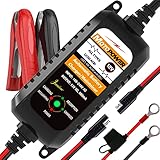
- Charger, Maintainer & Desulfator - An all-weather battery charger, battery maintainer, trickle charger, and battery desulfator. Perfect for charging and maintaining all 12-volt lead-acid, flooded or sealed maintenance free batteries (AGM and gel cell).
- Automatic Desulfation & Optimization - Automatic detection of battery sulfation problem. Applying with pulse current technology to desulfate the batteries effectively. Optimize the battery performance during charging without any manual operation.
- Energy Saving & Spark Free - Zero output in standby mode. No battery drain when connecting with the battery. Spark proof during lead connection for safety.
- Multi-level Safety Protection & Timer Set Up - Overcharge, short circuit and reverse polarity protected. Charge the battery up to 14.4V and Maintain the battery at 13.6V for long time to avoid gasing and to extend the battery life. 24-hour Timer is set up in the program to terminate the charge and enter the maintaining mode once the voltage is above 14V to ensure safety.
- Easy Operation -Just plug-in, connect to the battery and start charging or maintaining your battery. The desulfation is working automatically during the charing. No manual operation.
1. Confirm the basic controls
- Turn the ignition switch to the ON position.
- Set the engine stop switch to RUN or ON. Honda’s manual gives the explicit instruction: “Turn the engine stop switch to RUN.”
- Raise the side stand if your vehicle uses a side-stand interlock. If it has a clutch or brake-lever starting requirement, hold the specified lever while pressing the starter.
- Make sure the transmission is in neutral if the model requires neutral for starting.
Do not bypass an interlock as a permanent repair. A switch that fails intermittently needs diagnosis and replacement according to the manufacturer’s procedure.
2. Inspect the fuse and battery connections
- Switch the ignition off before opening the fuse or battery compartment.
- Locate the starter or ignition fuse using the model manual. Replace a blown fuse only with the identical amperage rating.
- Check that the positive and negative battery leads are tight at the battery and that the negative cable’s frame or engine ground is secure where accessible.
- Look for corrosion, looseness, broken insulation or a cable that moves at the terminal. Correct a poor connection only as the manual permits.
If the replacement fuse fails again, stop searching for larger fuses. A repeated failure indicates an electrical fault that requires professional testing.
3. Consider battery condition and the starter motor
A low or dead battery can leave the starter silent, especially after the vehicle has been stored or lights were left on. Honda lists charging as a possible remedy and directs owners to dealer service if charging does not help. If the battery and connections are in good condition but the starter still does not operate, the starter circuit or motor may be faulty; those tests involve high current and should follow the exact manual or be performed by a qualified mechanic.
What’s actually slowing this PC down?
Pick the symptom - the matching free tool is one click away.
If the starter clicks or turns slowly
A click with little or no engine movement often means the starter circuit is attempting to engage but available voltage or current is insufficient. A slowly turning engine likewise points first toward the battery or its connections, but the click itself is not a definitive diagnosis.
Check the battery leads before condemning the battery
Inspect both terminals and the ground lead for looseness or corrosion. Yamaha’s troubleshooting chart specifically says: “Check the battery lead connections, and have a Yamaha dealer charge the battery if necessary.” Follow the equivalent instruction in your manual. A charger is appropriate only after you verify the battery’s chemistry, voltage, charger compatibility and charging procedure for that vehicle; no single charger setting fits every battery.
Rank #2
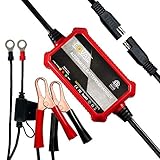
- Automatic Battery Charger & Maintainer: 1A 12V smart battery charger perfect for SLA / VRLA / GEL CELL / AGM / WET lead acid batteries. It is a battery maintainer, trickle charger, float charger, and battery desulfator, also complete 4-step charging program (Initialization, Bulk Charge, Absorption Mode, Float Mode).
- Ultra Compact & Practical: The battery charger is compact and lightweight like the phone, long enough ac cable+ dc cable 102inch long, two types of dc output cable with either the ring or alligator connectors to use. 3.9 x 2.4 x 1.25inchs, 10.5oz.
- Widely Compatible: Perfect suitable for cars, golf cars, motorcycles, scooters, lawn mowers, ATVs, UTVs, tractors, trucks, SUVs, RVs, boats, PWCs, jet skis, snowmobiles, classic cars, children's toys and more. automatically switches to float, maintenance voltage after fully charging the battery.
- Intuitive led indicators provide visual state-of-charge feedback and diagnostic information, green is power light; green with red means charging; green with yellow means fully charged.
- Multi Safety Protections: Safely charged avoid overcharge in hot climates and under-charging in cold climates. Built in circuit protection guards against reverse polarity, over-current, overload protection, over-voltage and more protection. Adopt ABS flame-retardant shell, fireproof, electric shock. Our safe and advanced charging technology automatically
Recognize when charging is not enough
If the engine remains slow after a correct charge and clean, tight connections, the battery may no longer hold a charge, or the starter circuit may have excessive resistance or a faulty relay or motor. Do not infer a failed starter solely from one click. A shop can test battery voltage under load and inspect the high-current circuit using the manufacturer’s specifications.
If the engine cranks normally but will not start
Once the starter turns the engine at a normal speed, shift attention away from the starter motor. Yamaha’s chart orders the main checks as fuel, battery, ignition and compression. A 2007 Honda FSC600 manual separately lists the engine stop switch, no fuel, a flooded engine, loose or disconnected spark-plug caps, loose battery cables and a weak battery. These lists apply to those manuals’ models; use them as a logical sequence, not as proof that every scooter has identical components.
Do these 3 things before closing this tab:
1Repair Windows errors before they cause bigger problems2Scan for outdated or missing drivers - takes under a minute3Clear out junk files and repair common Windows errors1. Verify fuel and fuel delivery
- Check the fuel level using the method specified for your model. If the tank is empty, add the correct fuel and attempt the manufacturer’s normal starting procedure.
- Confirm that any fuel valve, key-operated fuel control or required ignition position is set correctly.
- Look for a wet fuel leak or a strong raw-fuel smell. If present, stop cranking and arrange a repair rather than adding more fuel.
An empty tank is simple to correct; a blocked or failed fuel-delivery component requires model-specific testing. Do not assume that fuel visible in the tank has reached the engine.
2. Rule out a flooded engine
Repeated starting attempts can leave excess fuel in the cylinder. Honda’s 2007 manual directs owners to its flooding procedure rather than giving a universal method. Follow your exact manual: throttle position, injector controls and permitted cranking time differ between engines. If you cannot find the procedure, stop repeated attempts and ask a dealer or mechanic; indiscriminate cranking can discharge the battery and worsen the condition.
3. Check the spark-plug cap and ignition items you can safely reach
With the ignition off, verify that each spark-plug cap is fully seated and that no ignition lead is visibly disconnected or damaged. Yamaha’s chart directs owners to inspect the spark-plug electrodes. If a plug is wet, the chart says it may be wiped dry, its gap corrected or the plug replaced, while further ignition checks should go to a Yamaha dealer. Use the plug type and gap specified for your engine; do not substitute a guessed gap or test high-voltage ignition parts in a way the manual does not authorize.
Rank #3

- Stay Charged: Battery Tender battery chargers and maintainers provide a full charge to your powersport vehicle’s battery before switching to float mode to maintain proper voltage levels for safe, long-term storage
- Extend Battery Life: Compatible with all 12V lead-acid, flooded, AGM, and gel cell batteries. Complete 4-step charging program (Initialization, Bulk Charge, Absorption Mode, Float Mode) allows for optimization of battery power, without overcharging or battery damage. Smarter than a trickle charger.
- Includes: 12V, 750mA battery charger and battery maintainer with 12-foot output cord, fused-ring terminal harness for hard-to-reach batteries and alligator clip accessory cables, 5-year warranty, and lifetime customer support
- Simple & Safe: Low maintenance, easy-to-use, universal battery charger is just 3.3 x 1.3 x 2.4 inches, 1 lb (charger only). Spark-proof circuitry ensures no-spark connections, and automatic reversed hook-up detection verifies correct connection
- Monitor Power Levels: Two-color charge status LED light indicates the state of the charge and if the battery voltage drops too far under load, adaptive charging will resume full charger output power. Automatic charge cycle functionality switches to float mode after fully charging the battery
4. Recheck battery cables even when cranking sounds normal
Loose battery leads can allow the starter to turn while preventing reliable ignition operation, and a weak battery can produce apparently normal cranking that collapses under load. Confirm the connections before moving to less accessible electrical diagnosis.
5. Treat missing compression as a professional diagnosis
Yamaha’s chart sends an owner to a dealer if compression is absent. Compression testing, valve-timing checks and internal-engine work require the correct tools and specifications. If fuel and ignition checks do not resolve the problem, stop replacing parts and obtain qualified service.
Independent reader supportYour contribution helps us test, update, and keep practical guides available for everyone.A practical decision sequence you can follow
- Observe: press the starter briefly and classify the result as silent, click-only, slow, or normal cranking.
- Check controls: ignition ON, engine stop switch RUN/ON, and the required stand, brake, clutch or neutral condition.
- Inspect power: battery terminals, ground lead and the relevant fuse; replace a fuse only with the same rating.
- For slow cranking: follow the manual’s battery-charging procedure or have the battery charged and tested by a qualified shop.
- For normal cranking: check fuel level and supply, then the model’s flooding procedure, spark-plug cap and plug condition.
- Escalate: unresolved ignition, compression, starter-motor or repeated-fuse problems belong with a dealer or motorcycle technician.
When to stop and get professional help
- The engine-stop switch, stand switch, fuse and battery connections are correct, but the starter remains silent.
- A battery charge does not restore cranking, or the battery repeatedly goes flat.
- A fuse blows again immediately or wiring becomes hot.
- The engine cranks but there is no result after the manual’s fuel, flooding and spark checks.
- You suspect absent compression, internal damage, a failed ignition system or a starter motor fault.
- There is a fuel leak, strong fuel odor, damaged wiring or any sign of fire risk.
Honda’s 2009 and 2007 FSC600 manuals and Yamaha’s scooter troubleshooting chart all direct owners toward dealer assistance when the listed basic checks do not solve the fault. Bring the vehicle’s make, model, year and a precise description of what the starter does; that information is more useful than simply reporting that it “won’t start.”
Use the owner’s manual as the final authority
The manuals cited here cover particular Honda FSC600 model years and a Yamaha scooter manual. They do not establish one procedure for every motorcycle or scooter. Your manual determines the location and rating of fuses, interlock conditions, flooding method, spark-plug specification, battery type and safe charging instructions. If its instructions conflict with a generic checklist, follow the vehicle-specific manual.
Quick Recap
Product prices and availability are accurate as of the date/time indicated and are subject to change. Any price and availability information displayed on Amazon at the time of purchase will apply.




