A hybrid SUV can deliver less fuel economy than its EPA estimate—or less than you expected—when your trips, weather, speed, load, or vehicle setup differ from the conditions behind that estimate. Hybrids often have an advantage in stop-and-go driving, where they can recapture some braking energy and reduce idling; sustained highway speeds and repeated cold, short trips can work against that advantage. Check your actual mileage over several fill-ups before deciding there is a problem.
Why can a hybrid SUV get worse gas mileage than expected?
EPA fuel-economy figures are estimates based on standardized tests, not guarantees for every route or driver. The EPA’s current real-world estimate method, described in its 2025 Automotive Trends Report, uses five-cycle testing that adds higher-speed driving, cold-start conditions, and air-conditioning use to basic city and highway test schedules. Your speed, temperature, trip length, traffic, terrain, and use of heating or cooling may differ.
As an Amazon Associate I earn from qualifying purchases.
Even the combined figure on a fuel-economy label is a weighted estimate, not a prediction of the exact mix of driving you do. The EPA’s report gives the 2024 Toyota Prius as an illustration: its combined label figure is 57 mpg, while the report’s estimated real-world combined figure is 56 mpg, reflecting different city/highway weighting. That example explains how estimates can differ; it is not an expected result for an SUV.
Do these 3 things before closing this tab:
1Repair Windows errors before they cause bigger problems2Scan for outdated or missing drivers - takes under a minute3Clear out junk files and repair common Windows errorsWhy does a hybrid get better mileage in town than on the highway?
In stop-and-go traffic, regenerative braking lets a hybrid recapture some energy that would otherwise be lost as heat while slowing. Hybrids can also reduce idling. Those features can help in-town fuel economy, as the EPA explains in Your Mileage May Vary.
#1 Best Overall

- Programmable 3-In-1 Automotive Trip Computer: Diagnostic Scan Tool, And Up To 37 Digital Gauges In One (Vehicle Dependent)
- Real-Time Monitoring Capabilities: Watch Fuel Consumption, Cost-Per-Mile, Coolant Temperature, Engine Speed, Horsepower, And Much More In Real Time. Simple 5-button operation allows you to quickly and easily access the powerful features of the ScanGauge
- Wide Vehicle Compatibility: Works On All 1996 Or Newer Obd2 Cars, Including Gas, Diesel, Propane And Hybrid Vehicles with 16pin OBD2 port
- Diagnostic Trouble Code Functions: Checks For Diagnostic Trouble Codes (Dtcs), Clears The Codes, And Can Turn Off The Check Engine Light
- Simple Power Connection: No Batteries Required - The single connection to the diagnostic connector under the dashboard is all that is needed
On a highway, a vehicle may spend long stretches at sustained speed, with fewer braking opportunities to recapture energy. Driving fast, accelerating rapidly, climbing hills, and running the heater or air conditioner can also raise fuel use. A hybrid badge alone does not mean the SUV will be more efficient on every highway route than in town.
How much can cold weather reduce hybrid SUV mileage?
Cold weather can lower fuel economy in hybrids as well as conventional vehicles. The U.S. Department of Energy reports that hybrid fuel economy can decrease around 30% at 20°F in controlled laboratory testing. The agency cautions that real-world results vary by vehicle, driving conditions, and other factors, so this is not a forecast for every SUV or winter trip. Repeated short drives can compound the effect because the vehicle and cabin may need to warm up more often.
Rank #2

- [Vehicle Compatibility]: Only compatible with American car brands produced after 2008 as shown in the product image, and Japanese cars and European car brands produced after 2005 (not compatible with all pure electric vehicles)
- [Important]: (Not all car brands support reading oil temperature and transmission temperature and pressure data), a few car brands can display these data using custom PIDs with the assistance of our engineers. Please keep in mind that due to the variation of car brands and production dates, we cannot guarantee that all vehicles can be successfully upgraded
- [Working Principle]: The obd2 meter is connected to the car's 16-pin OBD2 interface via the OBD2 line, and can monitor in real time (water temperature, boost pressure, fuel consumption, speed and other car ECU data). The displayed data is related to the corresponding sensor. Without the corresponding sensor, no data can be read
- [Visual/auditory alarm]: When important ECU data such as water temperature, turbo pressure, exhaust temperature, etc. exceed dangerous values, the driver will be reminded through pop-up windows and sound alarms to prevent greater damage to the vehicle. It also has common fault code clearing and reminder functions
- [Ultimate Customization]:You can upgrade the instrument program, customize different display data combinations, display the data you want on various work interfaces, change the display color, and even personalize your car logo
Hot weather can also affect mileage, particularly when the air conditioner is running. EPA’s fuel-economy guidance lists weather and accessory use among the factors that can change results.
What driving habits and vehicle setup affect MPG?
- Speed and acceleration: Speeding and quick acceleration can use more fuel. Hard braking also sheds energy that a hybrid might otherwise partly recover.
- Idling and remote start: Letting the engine run while parked consumes fuel without covering distance.
- Terrain, traffic, and roads: Hills, congestion, and rough road conditions can change how much energy the SUV needs.
- Heating, air conditioning, and accessories: High accessory use can reduce fuel economy, especially in extreme temperatures.
- Weight and roof equipment: Unneeded cargo and roof racks add weight or aerodynamic drag.
- Tires and maintenance: Incorrect inflation, tire type, wear, or maintenance condition can affect fuel economy.
Check tire pressure against the figure on the vehicle’s door placard or in its owner’s manual, and use the specified tire fitment. Do not overinflate tires to chase better MPG. When replacement is due, low-rolling-resistance tires may be an option, but weigh their suitability for your vehicle, climate, traction needs, and typical load.
Quick Recap
Rank #4
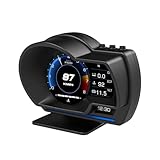
- P6 Speedometer Product Introduction: This heads up display for cars is a brand new upgraded version of the OBD+GPS intelligent instrument panel, with a very beautiful LCD display screen that looks great on your vehicle. Ordinary instruments only have OBD mode, while P6 is an OBD+GPS dual-mode system, which is more stable, smoother, and has richer data display
- Please Note: This obd2 gauge display head up display has dual modes of GPS and OBD, and comes with an OBD cable and USB cable. However, it is worth noting that the OBD system is only applicable to some gasoline vehicles manufactured after 2009; If your car is a diesel or pre-2008 model, you can only use GPS mode. If the OBD system is not compatible, please switch to the GPS system
- Speedometer Function: The functions of the heads up display for cars OBD system include vehicle speed, water temperature, voltage, fuel consumption, speed, single mileage, total mileage, driving time, driving direction, search for stars, altitude time, intake pressure, oil temperature, air-fuel ratio, turbine pressure, intake pressure, acceleration test, brake test, clearing fault codes, reading data flow alarm function; The functions of the heads up display GPS system include vehicle speed, voltage, satellite time, altitude, satellite quantity, driving direction, single mileage, driving time, acceleration test, brake test, and alarm function
- Automatic alarm function: The car head up display has multiple alarm functions that can improve driving safety, such as overspeed alarm, speed alarm, water temperature alarm, and voltage alarm. During normal driving, the ambient light appears blue (automatically adjusts brightness to adapt to the environment); When driving abnormally (such as speeding), the ambient light will turn into a red warning, which better enhances driving safety and safeguards your driving journey
- Product features: This tablet monitor has multiple functions to meet your various needs. HUD has 12 different screens that can be freely switched, bringing you a brand new driving experience; Multiple installation methods allow for easy placement, ensuring clear and natural installation in any corner without obstructing your line of sight
Rank #3

- PROFESSIONAL ALL-IN-ONE OBD2 GAUGE: ➤This All-In-One Car HUD with Obd Scanner is specially designed for cars without speedometer/tachometer installed. The professional LCD display can not only help you monitor the speedometer, RPM, water temperature, fuel consumption, turbo pressure in your car, but also read and clear engine fault codes.
- SAFETY FIRST: ➤ More than 30 driving data (such as speed, RPM, water temperature, voltage, turbo pressure, etc.) will be displayed on the HUD display, and you can easily view every detailed data without looking down at the dashboard while driving, so as to prevent engine overload damage and protect vehicle and personnel safety
- PROFESSIONAL CUSTOMIZATION: ➤Committed to solving OBD2 instrument (incompatible with frequent crashes, black screen, pixel bottom, inaccurate data, etc.), the system has its own data fine-tuning function, suitable for Honda, for Toyota, for Volkswagen, and for Mazda models. It is born for them.
- ALARM FUNCTION: ➤ The OBD2 meter displays detailed real-time data to ensure safe driving on the road. It can alert you in the event of turbo pressure, high water temperature, overspeed, RPM alarm, engine trouble codes, etc., to prevent the car from overloading and let you drive safely.
- ADDITIONAL FEATURES: ➤ It can read vehicle data flow information, support unit switching from metric to imperial, and automatically adjust screen brightness, fast data transfer rate. With 1/4 mile, 0-60MPH, 0-100MPH acceleration test, it has automatic sleep mode, so you can leave this OBD meter in the car without unplugging it.
How to check whether your hybrid SUV’s mileage is actually low
- Make the comparison specific. Check the rating for your SUV’s model year, trim, drivetrain, and rating type. “Hybrid SUV” is not enough information to establish one expected MPG.
- Measure over multiple fill-ups. EPA’s fuel-economy FAQ suggests starting with a full tank, recording the odometer, and driving at least half a tank—preferably three-quarters to seven-eighths—before refueling to estimate MPG. Repeat over several tanks rather than judging from one short trip or the dashboard display alone.
- Record the conditions. Note outside temperature, trip length, highway speed, terrain, traffic, remote-start or other idling, cabin heat or A/C, cargo, and roof equipment. These details help show whether a change in use may account for the result.
- Check the tires and recent changes. Measure pressure against the vehicle specification. Consider whether a tire replacement, change in tire type, unusual wear, added cargo, or roof rack coincided with the lower reading.
- Seek model-specific help if the decline persists. If mileage remains substantially lower under comparable conditions after basic checks, consult the owner’s manual or a qualified service professional. Without the make, model, year, route, and service history, mileage alone cannot establish a hybrid-system fault.
Product prices and availability are accurate as of the date/time indicated and are subject to change. Any price and availability information displayed on Amazon at the time of purchase will apply.




