Outdated Drivers Are Slowing You Down
One free scan finds every outdated or missing driver and matches the right update for your exact hardware.Free scan · exact hardware matchPC Slower Than It Used to Be?
A free scan shows the junk files, broken settings and background clutter dragging Windows down - then fixes them in one click.Free scan · Windows 10 & 11A wheel can separate from a car when the clamping force holding it to the hub is lost, when wheel studs break, when the wheel and hub no longer mate correctly, or when a hub or bearing assembly fails. Loose or incorrectly torqued lug nuts are a common starting point, but a wheel can also loosen after a manufacturing or assembly defect even if it was initially tightened correctly.
If you feel wobbling or unusual vibration, hear rattling, find a missing or backed-off lug nut, or see damage around a wheel, slow down and stop somewhere safe as soon as you can. Arrange a proper wheel-end inspection or recovery. Tightening an accessible nut may not correct damaged studs, a distorted wheel or hub, or a failing bearing.
As an Amazon Associate I earn from qualifying purchases.
How a wheel is held on—and how that holding force is lost
Wheel fasteners do more than keep a wheel from falling off. When each nut is tightened to the vehicle maker’s specified torque, the studs and nuts create a precise clamping force that presses the wheel’s mounting face against the hub. The wheel, hub and fasteners then share driving, braking and cornering loads as one assembly.
That system depends on the correct wheel, nuts, studs, seat geometry, clean mating faces and an undamaged thread. Undertightening, overtightening, contamination, settling between the faces, incompatible parts or a defect in the hub can reduce the clamp. Once the wheel can move, movement enlarges or damages the wheel and hub contact areas and places abnormal bending loads on the studs. Continued driving can end in fractured studs and wheel separation.
#1 Best Overall

- Durable Ratchet Head: Made from Hardened treated Chrome Vanadium steel alloy (Cr-V) Corrosion-Retardant: Satin Finish. Made in Taiwan
- Easy Storage: A sturdy plastic storage case is included. Non-Slip Grip: Knurled handle
- Easy to Read: High Contrast & Dual Range Scale. Accurate: Pre-Calibrated to ± 4%
- Accessories included: 1/2" Drive 5" long Extension Bar
- Simple and Reliable: “Click” sound tells the preset torque value is reached. Stop applying force when you hear and feel it.
A 2023-06-08 Stoughton Trailers inspection instruction summarizes the hazard plainly: “Loose lug nuts can lead to major failures of chassis components.” Its procedure treats missing or suspect fasteners as a reason to remove the wheel and inspect the hub and studs, not merely to tighten the visible nuts.
The main wheel-separation pathways
1. Lug nuts lose clamping force
A nut that was never tightened enough may not hold the wheel firmly. Foreign material, paint, rust, debris or a poor fit between the nut and wheel seat can produce a false torque reading or allow the joint to settle after installation. The resulting micro-movement works the fasteners loose and damages the mating surfaces.
In a NHTSA-hosted Daimler report, the documented sequence is loss of clamping force followed by greater load on the studs; the studs can then snap. The report’s warning says, “The wheel may wobble and cause a vibration if the wheel is loose.” That wording applies to the specified vehicle and wheel configuration in that report, not to every car.
Overtightening is also unsafe. Excessive torque can stretch or weaken a stud, distort a wheel, damage threads or make later service difficult. The correct value and tightening sequence are vehicle-specific; there is no universal safe torque number for all cars.
Rank #2
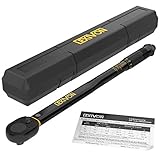
- PRECISE & HIGH QUALITY - Manufactured in Taiwan, our torque wrench is engineered for superior precision. It ships pre-calibrated to +/- 4% accuracy, ensuring dependable results every time. Includes a calibration certificate with a trackable serial number for your assurance.
- DURABLE - Built to last, featuring a reinforced ratchet gear head made from hardened, heat-treated Chrome Vanadium alloy steel for maximum strength and durability.
- LONGEVITY - Protect your investment with our proprietary Electro-Black finish, providing advanced rust and corrosion resistance for extended tool life.
- PERFORMANCE - Easily read and set torque levels with our patent-pending dual-range scale. The high-contrast, yellow-on-black markings are designed for easy visibility, even in low-light conditions.
- OMFORT - Equipped with a reversible ratchet head that drives in both directions and measures torque in a clockwise direction. The ergonomic, knurled handle ensures a non-slip, comfortable grip, reducing hand fatigue.
2. Studs are damaged, stretched or fatigued
Studs can be harmed by cross-threaded nuts, impact-gun misuse, over-torque, corrosion, repeated movement of a loose wheel or a wheel that does not seat correctly. A stud may break at the hub, at the thread or in the shank. One broken stud increases the load carried by the remaining studs, so a seemingly small defect can progress rapidly.
Visible threads do not tell you whether a stud is sound. A stud can be bent, necked down, cracked or pulled from the hub while the nut still appears tight. If a nut is missing, backed off, or shows movement relative to a paint mark, the wheel should be removed for an internal inspection.
3. The wheel-to-hub interface is compromised
The wheel must sit flat and concentrically on the hub. Rust scale, dirt, old adhesive, damaged center-bore surfaces, a bent wheel face or an incorrect nut seat can leave a gap. As the wheel rotates, that gap allows rocking and changes the load on every fastener.
The Stoughton instruction warns that insufficient torque can wear the wheel, hub and studs and eventually lead to stud or hub failure. Its inspection guidance also notes that paint marks or alignment marks may reveal movement even when a nut appears tight. A brief look at the outside of the wheel cannot rule out an elongated stud hole, a cracked mounting face or damage hidden behind the wheel.
Rank #3

- 【9-in-1 Torque Solution】Complete set includes 1/4", 3/8", and 1/2" drive click torque wrenches plus 6 essential adapters (extension bars, universal joint, drive adapters) securely stored in a sturdy portable case.
- 【High Precision & Dual Scales】Factory-calibrated to ±3% accuracy with included certificate; features dual-range scales (1/4": 10-220 in.lb, 3/8": 5-45 ft.lb, 1/2": 10-170 ft.lb) for versatile application coverage.
- 【Clear & Safe Audible Click】Upgraded loud "Click" sound provides a distinct, reliable signal (strong over 5 N.m, subtle under) when preset torque is reached, preventing overtightening and ensuring safety.
- 【Smooth 72-Tooth Ratchet & Quick Release】Reversible 72-tooth ratchet head offers a low 5° arc swing for use in tight spaces and smooth operation in both directions. Quick-release button ensures secure socket changes.
- 【Durable Construction & Wide Use】Hardened Cr-V steel ratchet heads and phosphated adapters resist wear; aerospace aluminum handles ensure lightweight strength and corrosion resistance. Ideal for precise torque on bikes, motorcycles, cars, trucks, wheels, and industrial applications. Backed by 24-month support.
4. A manufacturing or assembly defect loosens the joint
Not every wheel separation starts with a careless tire change. In a 2019 Mazda3 recall report, a partial gap between a hub-bolt head and the hub flange could develop during assembly. The gap allowed torque to be lost and the wheel nuts to loosen even though they had initially been tightened to specification. The report identifies a warning for that affected population: “Rattling noise occurs prior to a wheel falling off the vehicle.” It is a recall-specific warning, not a universal symptom.
This type of defect is why a correct installation on the day of service does not eliminate the need to check the vehicle’s recall status by VIN and to investigate new noises or movement.
5. Hub or bearing failure
A hub assembly carries the wheel bearing and provides the mounting surface for the wheel. A damaged hub, loose bearing, failed bearing, or failed hub fastener can create play that resembles a loose wheel. In severe cases the wheel-end assembly can no longer keep the wheel aligned.
Lubrication and seal problems are a separate pathway from lug-nut clamping. Ontario’s official truck handbook flags low oil in oil-lubricated hubs and leaking wheel seals as inspection concerns; it notes that a leaking seal can lead to bearing failure. The National Transportation Safety Board’s historical truck review also discusses bearing lubrication and bearing adjustment as contributors. Those examples concern truck wheel-end designs and historical truck data, not passenger-car probabilities. Passenger cars commonly use different, sealed hub-bearing arrangements, so the inspection method must follow the specific vehicle’s service information.
Rank #4

- 【8-in-1 Torque Wrench Set】 Includes 1/4, 3/8, 1/2 inch drive torque wrenches that meet your different needs. 5Pcs Adapter: 1/4"Extension bar(4''), 3/8"Extension bar(6''), 1/2"Extension bar(5''), 3/8" Universal Joint, 1/2" to 3/8" Adapter with a sturdy plastic case for storage and portability
- 【Dual range scale & High Precision】 1/4 inch 10-230in.lb/1.1-26.0Nm with 1 in.lb micro-adjustment, 3/8 inch 5-50ft.lb/6.8-67.8Nm with 0.25 ft.lb micro-adjustment, 1/2 inch 10-180ft.lb/13.6-244.1Nm with 1 ft. lb micro-adjustment. Each wrench undergoes strict and specialized instrument testing before leaving the factory to ensure accuracy within ±3% and is provided with a formal calibration certificate
- 【Safe & Reliable】 This torque wrench set has been upgraded to have a louder "Click" sound, ensuring a clear and stronger click sound when the torque value exceeds 5 Nm, subtler click at lower than 5 Nm. The distinct click sound indicates that the preset torque has been reached, signaling you to stop applying force
- 【Releasable & Dual Direction】These torque wrenches has a quick release button with which accessories can easily be installed and removed, the accessories can grip and is not easy to fall down. With 72-tooth reversible ratchet head, it can be used in both clockwise and counterclockwise directions
- 【High Quality and Durable】 The torque wrench ratchet head is made from hardened treated Cr-Mo Steel for longevity. Handle crafted from high-grade aerospace aluminum for durability, and corrosion resistance. All adapters are treated with phosphating, with stronger wear resistance and a longer lifespan
Warning signs and what they mean
| Sign | What it can indicate | What it cannot prove |
|---|---|---|
| Vibration or wobble that changes with speed | A loose wheel, damaged mating surface, bent component or hub/bearing play. The Daimler report documents wobble and vibration in its specified recall context. | It does not identify which part is loose or damaged. |
| Rattling or metallic knocking | Possible movement of a wheel, nut, stud or hub. Mazda’s recall report identified rattling before possible wheel loss in the affected vehicles. | It is not a diagnosis for every vehicle or every noise. |
| Missing or backed-off lug nuts | Loss of clamp and possible damage to the wheel, hub, threads or studs. | Replacing or tightening the nut alone may leave hidden damage. |
| Paint or alignment marks no longer line up | Fastener movement or settling at the joint, even when the nut feels tight. | Marks cannot verify the specified torque or the condition of the stud. |
| Hub-oil loss or a leaking wheel seal on an applicable truck hub | Possible loss of bearing lubrication and eventual bearing damage. | These are not universal warnings for passenger cars. |
None of these signs proves a particular part has failed, and the absence of a sign does not certify the wheel end as safe. Damaged threads, a cracked hub, an elongated wheel hole or bearing play may not be visible during a roadside glance.
What to do when a wheel feels loose or sounds wrong
- Reduce speed smoothly. Avoid hard braking, abrupt steering and continuing at highway speed while the wheel end may be moving.
- Stop in the safest available place. Use a shoulder, parking area or other location away from traffic when possible. Turn on hazard lights and follow local roadside-safety practices.
- Do not crawl under the vehicle or place hands near a suspended wheel. A jack supplied for a spare-tire change is not a substitute for a stable repair setup.
- Make only a visual check from a safe position. Look for a missing nut, a visibly backed-off nut, a wheel sitting crooked, fresh metal dust, cracks or fluid leakage. Do not assume that a nut that looks present is correctly clamped.
- Arrange recovery or a qualified inspection. Tell the technician exactly what you felt or heard and whether the wheel was recently removed.
- Do not resume normal driving merely because a nut can be tightened. The wheel should be removed when the inspection procedure calls for hub, wheel and stud checks, and any damaged part must be assessed against the vehicle maker’s repair procedure.
How a proper inspection separates the possible causes
Fasteners and studs
The technician should verify the correct nuts and studs, inspect thread condition and look for stretching, bending, corrosion, cracks or pulled threads. A torque wrench can check a specified value, but torque alone cannot reveal a cracked stud or a fatigued one that has already been overloaded.
Wheel and hub faces
With the wheel removed, the mating faces should be clean, flat and free of scale, burrs, paint or other contamination that prevents full contact. The wheel’s bolt holes, center bore and nut seats must match the vehicle specification. Any distortion, cracking or fretting marks requires a vehicle-specific repair decision rather than a generic replacement.
The Tool Desk
Outbyte Driver Updater FREEScan for outdated or missing drivers - takes under a minuteDriver Scan →Outbyte PC Repair FREERepair Windows errors before they cause bigger problemsFix Now →Hub and bearing
The hub should be checked for looseness, damage and correct attachment. Bearing play, roughness, noise or seal problems require the inspection and measurement method specified for that model. On truck hubs that use an oil sight glass, the handbook’s low-oil and leaking-seal checks are relevant; they should not be applied indiscriminately to sealed passenger-car units.
Best Value

- ±3% HIGH PRECISION AND COOL APPEARANCE: 1/2 inch drive torque wrench (10-170ft.-lb/13.6-230.5Nm)has a calibration error range of ±3%, high precision, and comes with a corresponding serial number, which is easy to trace the original data, and you can use it with confidence.Hairich torque wrench not only has superior quality but also has a superior appearance. The classic combination of black and red is fashionable and textured, allowing you to enjoy a visual feast during use.
- PREMIUM MATERIAL AND DURABLE: Experience the ultimate durability and antiskid with the torque wrench. The main body of Hairich torque wrench set is made of chrome vanadium steel alloy, which is more strong and more durable. The head of the inch-pound torque wrench adopts a ratchet design with a reversing device to improve work efficiency. The square knurled handle is made of aluminum titanium alloy, which is ergonomic and comfortable to hold for long-time use.
- DUAL SCALE AND QUICK SETTING: Laser Printed by dual-range(ft-lb and Nm). Our professional torque wrench is easy to read and provides direct unit conversion, When the set torque value is reached, the torque wrench will make an audible and felt click to remind you to stop applying force. Pull down the lock knob and hold it until the torque setting is completed. Release the hand, and the lock knob will automatically rebound back to lock the value.
- ERGONOMIC DESIGN AND POWERFUL: Every design of our industrial torque wrench conforms to ergonomic, easy to handle.72-tooth ratchet, 5° ratcheting arc head, a quick-release button for easy loading and unloading, and an aluminum non-slip handle for excellent grip and control. A recent research review that, 72-tooth ratchets are very professional tooth ratchets, you just only rotate 5 degrees to finish it. Not easy to slip and wear, can be used in small spaces, and is more durable and powerful.
- EASY OPERATION AND SAFETY: Thanks to its bidirectional drive ratchet head, our torque wrench can be measured both clockwise and counterclockwise. When the set torque value is reached, a "click" sound will remind you to stop applying force to prevent damage to the item due to excessive torque. Notice: At low Nm settings under 5 Nm the "click" sound can be too light to hear.
Runout and related causes
If the wheel is secure but vibration remains, the inspection may need to consider wheel or tire damage, runout, brake components or suspension parts. These can cause vibration without being the reason a wheel is about to separate, so the technician should establish whether the wheel-end joint itself was compromised.
Correct installation and prevention
- Use wheels, nuts and studs with the vehicle’s specified dimensions and seat geometry. A nut that threads on is not necessarily the correct nut.
- Clean the wheel and hub mating surfaces as required by the manufacturer’s procedure. Do not add lubricant, anti-seize or thread-locking compound unless the service information specifically permits it; such products change the torque-to-clamp relationship.
- Inspect threads and studs before installation. Replace damaged components rather than forcing a nut onto a compromised thread.
- Tighten in the specified sequence and with a torque wrench that covers the vehicle’s required range and is in suitable condition. The owner’s or service manual controls the value.
- Follow any manufacturer-specified recheck interval after wheel service. Some vehicles or service procedures require a retorque after driving; others specify a different process.
- Investigate recurring loosening instead of repeatedly tightening the nuts. Recurrence can indicate a distorted wheel, damaged hub, incorrect hardware or a recall condition.
A torque wrench is a task-enabling tool, not a diagnostic device. It applies or verifies a number supplied by the vehicle maker; it cannot determine whether a stud, hub, wheel or bearing has been damaged.
Recalls and vehicle-specific information
Recall reports describe particular vehicles, production ranges and defects. Check the vehicle identification number (VIN) in the applicable national recall database. In the United States, NHTSA advises owners with an open safety recall to contact the vehicle brand’s local dealer for the free remedy. A recall search does not replace an inspection when symptoms are already present, and a clear result does not prove that a damaged wheel end is safe.
What’s actually slowing this PC down?
Pick the symptom - the matching free tool is one click away.
Use the owner’s manual or service information for wheel compatibility, torque, tightening order, retightening instructions, lifting points and bearing checks. These details vary by model, wheel design and market.
What historical truck data can—and cannot—tell car owners
The NTSB’s 1992 safety-recommendation letter cited records from one large carrier in which 65 percent of wheel separations were attributed to undertightening and 20 percent to overtightening. It also cited state commercial-vehicle inspection data in which 40 percent of wheel violations involved loose or missing nuts or studs. Those figures describe a historical truck fleet and commercial-vehicle inspections; they are not current, nationally representative statistics for passenger cars.
The same NTSB letter cautioned that no single data source was sufficient by itself to determine the leading causes of wheel separations. The useful lesson for a car owner is the mechanism—clamping, hardware, mating surfaces, hubs and bearings all matter—not a probability estimate transferred from trucks to cars.
Quick Recap
Choosing the repair path
| Inspection finding | Likely action basis | Why symptom-only repair is risky |
|---|---|---|
| Loose or missing nut with undamaged components | Restore the correct hardware and torque using the vehicle procedure, then check for movement or secondary damage. | The wheel may already have worn the hub, wheel holes or studs. |
| Damaged, stretched or broken stud | Replace the stud or hub assembly as specified for that vehicle and inspect all neighboring fasteners. | A new nut cannot restore the strength of a compromised stud. |
| Distorted or cracked wheel or hub face | Replace the affected vehicle-specific component and correct the cause of poor seating. | Repeated tightening leaves the misalignment and abnormal loads in place. |
| Hub or bearing play, roughness or seal failure | Repair the hub or bearing system according to the model’s service procedure. | A torque check does not evaluate internal bearing condition. |
| Open safety recall | Have the dealer perform the recall remedy without charge where the applicable authority provides that remedy. | Temporary tightening does not correct a design or assembly defect. |
Product prices and availability are accurate as of the date/time indicated and are subject to change. Any price and availability information displayed on Amazon at the time of purchase will apply.
Recommended Free Tools




