Free tools Windows power users keep installed
One-click scans. No signup required.
At a public retail gasoline station in New Jersey, you generally must wait for an attendant to fuel your vehicle. That is not merely a station tradition or a customer-service policy. New Jersey law requires gasoline to be dispensed by a trained attendant and prohibits a non-attendant from pumping it into a vehicle or container.
The rule dates to 1949 and is primarily justified in state law as a fire-safety measure. It remains in effect as of August 11, 2026, although a 2026 bill could change the system if lawmakers enact it. For now, motorists cannot legally choose self-service at an ordinary public gasoline station.
As an Amazon Associate I earn from qualifying purchases.
The short answer: New Jersey requires full service
New Jersey’s Retail Gasoline Dispensing Safety Act and its implementing regulations prohibit customer self-service at public retail gasoline stations. The state’s Department of Labor and Workforce Development summarizes the rule this way: fuel at a gasoline station may be dispensed only by an attendant who has received the required instruction.
Quick wins for a faster PC:
Scan for outdated or missing drivers - takes under a minuteDriver Scan →Clear out junk files and repair common Windows errorsFree Scan →Fix the driver behind crashes, sound loss and screen glitchesFind Drivers →In practical terms, pull up to the pump, leave the vehicle in place, and wait for the attendant. You should turn off the engine and refrain from smoking while the vehicle is being fueled, but the attendant—not the customer—operates the gasoline nozzle.
#1 Best Overall

- Auto Shut-Off : The 3/4"-13/16" automatic fuel nozzle can automatically stop refueling when the tank is full. It prevents leakage and avoids oil waste
- Variable Flow Control : 16 GPM max flow rate with 3 adjustable settings for customized control. The one-click lock clip holds the trigger in place, keeping your hand relaxed throughout the entire fill-up. No more fatigue on longer pumping sessions
- Durable Nozzle : This 3/4 inch fuel nozzle is made of high-quality aluminum alloy, and has undergone hundreds of testing procedures to ensure that the fuel nozzle can be used for a long time and is safe
- Easy To Use : The handle is ergonomically designed for long-term grip to make your fuel job easier. A hook is available for convenient hanging. Working pressure: 15-30 PSI (1-2 Bar), cannot be used for gravity tanks
- Wide Applications : The 3/4-inch fuel nozzle can be filled with diesel, gasoline, or kerosene. Widely used in gas stations, oil tankers, tractors, construction sites, farms, ships, cars, diesel generators, oil pumps, etc
The law is narrower than the popular slogan “you can never pump your own fuel in New Jersey.” Regulatory exclusions apply to certain types of fueling, including marine service stations, aircraft-fueling stations, diesel dispensing, and some employer-only gasoline stations that are not open to the public.
What New Jersey law actually says
Several provisions work together:
- N.J.S.A. 34:3A-6 prohibits an attendant from allowing a non-attendant to dispense fuel into a vehicle tank or container. It also sets basic safety rules, including prohibitions on fueling while the engine is running, dispensing while someone is smoking, and using a noncompliant portable container.
- N.J.S.A. 34:3A-7 requires anyone who dispenses fuel to qualify as an attendant. The person must receive the required instructions, complete at least one full working day of supervised practical experience, and demonstrate an understanding of the instructions through an examination.
- The implementing regulations require stations to maintain attendant certification records, keep fire-control equipment available, provide a remote emergency shutoff switch or circuit breaker, and post specified safety signs.
One required warning is especially direct: “It is unlawful to serve yourself. Wait for an attendant.”
These rules make the station operator responsible for maintaining a controlled fueling process. A customer who starts pumping is not simply violating a private house rule; the act conflicts with the state’s retail gasoline dispensing requirements.
Why was self-service banned?
The prohibition began in 1949. The official rationale is primarily fire prevention and operational control.
New Jersey’s statutory findings describe gasoline dispensing as an activity involving direct fire hazards. The Legislature reasoned that station operators need control over fueling so they can enforce precautions such as shutting off vehicle engines, preventing smoking, and responding to unsafe conduct. The findings also express concern that a cashier serving a self-service station might not have a clear view of customers or be able to give undivided attention to dangerous activity.
The modern statutory framework is associated with the Retail Gasoline Dispensing Safety Act, enacted through P.L. 1989, c. 263. That law preserved and organized the state’s full-service model rather than creating a new practice from scratch.
Other reasons appear in the legislative findings
The statute also mentions concerns involving crime, falls, exposure to gasoline fumes, service for people with physical infirmities, insurance costs, and vehicle-maintenance checks. It further states that the Legislature did not consider the evidence conclusive that self-service would produce a sustained reduction in gasoline prices.
The Tool Desk
Outbyte PC Repair FREERepair Windows errors before they cause bigger problemsFix Now →Outbyte Driver Updater FREEScan for outdated or missing drivers - takes under a minuteDriver Scan →Those statements should be understood as legislative findings and policy judgments from the law’s enactment—not automatically as settled conclusions of modern scientific research. The strongest official record supports describing the original ban as a safety-based measure. It would be misleading to present every additional finding as an uncontested present-day fact.
Rank #2

- Flow Rate: 15 GPM; Maximum Working Pressure: up to 50 PSI
- Manual Flow Control: Continuous flow switch for unattended distribution.
- All metal construction: Aluminum shroud, spout, trigger and shroud.
- Recommended Use: Diesel, gasoline, kerosene.
What safety controls does full service provide?
Full service gives the station a designated person whose job includes controlling the fueling operation. New Jersey’s rules support that arrangement with several specific requirements.
Trained attendants
An attendant must receive fuel-dispensing instruction, complete supervised practical experience lasting at least one full working day, and pass an examination showing that the instructions are understood. Stations must retain records documenting attendant certification.
Engine-off and no-smoking rules
The law prohibits fueling a vehicle while its engine is running. Smoking while fuel is being dispensed is also prohibited. The attendant has a direct role in enforcing these precautions rather than relying solely on a customer to follow them.
Recommended Free Tools
Emergency shutoffs and fire equipment
Stations must provide a remote emergency shutoff switch or circuit breaker and maintain required fire-control equipment. These measures are intended to let station personnel stop dispensing quickly and respond to a fire or other dangerous event.
Portable containers
Gasoline cannot be dispensed into just any container. The regulations impose requirements for portable fuel containers, and the statute prohibits dispensing into a noncompliant container. If you need to transport gasoline, use a container that meets the applicable safety requirements and follow the station’s instructions.
Required signs
Stations must display specified safety warnings, including the instruction to wait for an attendant. The signs are part of the regulatory system, not merely suggestions from individual businesses.
Is it illegal for the customer, or for the station to allow it?
The statutory structure primarily regulates attendants, station operators, and the dispensing operation. It makes it unlawful for an attendant to permit a non-attendant to dispense fuel and provides administrative or civil penalties for violations.
That does not mean a customer should treat self-service as permissible if an attendant is busy or tells the customer to begin pumping. The station remains responsible for following the law, and the customer should wait for the attendant rather than taking the nozzle.
Rank #3
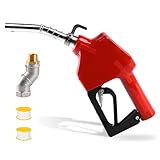
- Auto Shut-Off: This 3/4" automatic fuel nozzle prevents spillage and fuel waste by automatically stopping when the tank is full.
- 360°Fuel Swivel: The 360°Fuel hose swivel prevents the hose from kinking, tangling, or getting damaged during operation, enabling smooth and uninterrupted fueling.
- High-Efficiency Flow: Featuring a 3/4" inlet and 13/16" spout, this nozzle delivers a flow rate of up to 16 GPM (60 L/min). It offers 3 flow settings and a padlock function for hands-free refueling.
- Rugged Construction: Constructed from durable aluminum alloy and PVC, it features a comfortable grip for extended use and an integrated hook for easy storage.
- Wide Applications: Suitable for diesel, gasoline, kerosene, and biodiesel. It is perfect for gas stations, tankers, tractors, construction sites, farms, ships, and diesel generators.
Ordinary customers are not generally given a special New Jersey traffic ticket for pumping gas, nor does the cited enforcement framework create a routine arrest scenario for a customer who touches the nozzle. The relevant provisions establish administrative or civil penalties rather than a special criminal offense aimed at ordinary motorists. The practical legal rule is still simple: at a covered public gasoline station, do not pump your own gas.
What are the penalties?
The statute provides a first-offense penalty of $50 to $250. A subsequent offense may carry a penalty of up to $500. The regulations repeat these ranges and treat each day of certain station violations as a separate offense.
These penalties are directed at violations of the gasoline-dispensing requirements and the businesses or responsible parties operating under them. They should not be confused with an ordinary motor-vehicle citation or a claim that every customer who reaches for a nozzle will be arrested.
Does full service make gasoline more expensive?
That is the central economic criticism of the rule, but the answer is not as simple as “full service always costs more” or “self-service would automatically lower every price.”
An attendant adds labor to the station’s operating costs. The Federal Trade Commission’s 1988 staff comment argued that improvements in technology had weakened the safety case for a blanket prohibition and that requiring consumers to purchase attendant labor along with gasoline imposed significant costs. A later FTC statement likewise said that self-service bans can raise gasoline prices because motorists must buy gasoline bundled with attendant service, while recognizing that the size of the effect varies.
New Jersey’s statute takes the opposing position in its formal findings. It states that there was no conclusive evidence self-service would create a sustained price reduction and that the full-service requirement could promote safety and convenience without economic harm.
These are competing policy positions. The likely effect of self-service depends on factors such as labor costs, station competition, fuel volume, property costs, taxes, operating hours, and whether a station offers both service models. Eliminating the legal requirement could create opportunities for lower prices at some stations, but it would not guarantee that every station would pass all labor savings to customers.
Was the ban created to protect gas-station owners?
Economic and industry interests may have influenced the political history of gasoline regulation, and the policy has repeatedly been challenged. However, the best-supported official explanation for the 1949 prohibition is fire safety.
Rank #4

- The nozzle with NPT threads, 3-notch hold open clip, full grip guard
- Auto Shut-Off Nozzle,can be used for kerosene, diesel, biodiesel refuelling, and all kinds of gasoline services.
- Item Package Weight: 2.6lb
- Sensor built into discharge spout outlet automatically shuts off supply once fuel level in tank reaches the level of outlet discharge spout
- Heavy duty cast Aluminium Body. Trigger and guard made from thermoplastic
A Federal Trade Commission staff comment on proposed New Jersey legislation described the statutory prohibition as having been adopted in 1949 explicitly for fire-safety reasons. New Jersey legislative materials also identify 1949 as the beginning of the state’s full-service model. It is therefore too strong to state, without reliable supporting evidence, that the ban was enacted solely to protect incumbent station owners or suppress a particular competitor.
Has New Jersey legalized self-service in 2026?
No—not as of August 11, 2026. The current Department of Labor guidance and regulations still require trained attendants to dispense gasoline. The current regulatory chapter identifies prohibiting self-service as one of its purposes and lists an expiration date of October 10, 2032, subject to later statutory or regulatory changes.
There is, however, an active proposal that could change the policy. New Jersey Senate bill S1047, titled the Motorist Fueling Choice and Convenience Act, is listed as pre-filed for introduction and “Introduced Pending Technical Review by Legislative Counsel.” The proposal describes a voluntary hybrid system under which motorists could pump their own gasoline while larger stations would retain full-service availability during specified daytime hours.
S1047 is only a proposal. A bill’s title, findings, or introduction does not change the law. Unless and until the Legislature passes it and it becomes law, motorists at covered public gasoline stations must continue to wait for an attendant.
Where can self-service still be possible?
The full-service rule does not cover every fuel dispenser in every setting. The regulatory exclusions include:
- Diesel dispensing, which is treated differently from gasoline under the current regulatory scope.
- Marine service stations, such as facilities serving boats.
- Aircraft-fueling stations.
- Certain employer-only gasoline stations that are not open to the public.
S1047’s proposed findings also refer to self-service dispensing for diesel, battery-electric vehicles, and other non-gasoline fuels. That language belongs to the bill’s proposal and should not be read as proof that the gasoline law has already changed.
Electric-vehicle charging is not gasoline dispensing, so the traditional full-service gasoline rule does not require an attendant to plug in an electric vehicle. Other fuels and specialized fueling facilities may be governed by different rules.
Windows Errors? Fix Them Before They Spread
Repair common Windows errors and clear accumulated junk for a smoother, more stable PC - no reinstall needed.Free scan · no reinstallCrashes, No Sound, or Screen Glitches?
Random freezes, missing sound and display glitches usually trace back to one bad driver. Find and replace yours safely.Free scan · under a minuteWhat should you do at a New Jersey gas station?
- Pull up to the pump and stop in the position indicated by the station.
- Turn off the engine.
- Do not smoke or use an open flame near the pump.
- Remain in or near the vehicle while waiting for the attendant, as appropriate for the station’s instructions.
- Tell the attendant the fuel type and amount, or request a fill-up.
- If using a portable container, make sure it complies with the applicable safety requirements and ask the attendant before dispensing.
- Pay when the station’s process requires it and check that the fuel door and cap are secured before leaving.
If an attendant asks you to pump gasoline yourself, the safest response is to wait and ask the station manager how the fueling will be handled. The station’s staffing problem does not, by itself, suspend the statewide rule.
Best Value

- 【Automatic Shut-Off Feature】This 3/4" fuel nozzle is equipped with a high-sensitivity port that halts fuel flow automatically upon reaching full tank capacity. This feature ensures precise fuel management, enhances safety, and prevents fuel spillage.
- 【Product Features】Inlet thread size: 3/4" NPT. Outlet size: 13/16".Max flow rate: 16GPM(60L/min)
- 【High-Quality Materials】This fuel transfer nozzle is made of high-quality materials: aluminum alloy and PVC, ensuring durability even under extreme conditions.
- 【3/4" NPT Fuel Hose Swivel】The 3/4" NPT fuel swivel has a 360-degree rotation function to prevent the hose from twisting during refueling, ensuring that the fuel nozzle does not move and is less likely to leak.With this swivel,you can adjust the nozzle direction as needed.
- 【Wide Applications】This 3/4" auto shut-off fuel nozzle is designed to handle a diverse range of fuels,including gasoline,diesel,kerosene and biodiesel. It is widely used in gas stations, oil tankers, tractors, construction sites, farms, ships, passenger cars, diesel generators and oil pumps.
Why does the rule survive?
The rule persists because New Jersey lawmakers have continued to balance two different policy goals: centralized control of a flammable activity and consumer choice at the pump. Supporters emphasize safety, convenience for customers who cannot easily fuel their vehicles, and the ability to supervise fueling. Critics emphasize labor costs, consumer choice, technological changes, and the possibility of lower prices.
Repeal proposals have returned periodically, including a 2018 bill that would have repealed the 1989 act and allowed self-service. That proposal was not enactment. The 2026 S1047 proposal shows that the question remains politically active, but it likewise does not alter the current rule.
Frequently Asked Questions
Can I pump my own gasoline at a New Jersey gas station?
At a covered public retail gasoline station, no. New Jersey law requires a trained attendant to dispense the gasoline. Wait for the attendant, even if the station appears understaffed.
Do these 3 things before closing this tab:
1Clear out junk files and repair common Windows errors2Scan for outdated or missing drivers - takes under a minute3Repair Windows errors before they cause bigger problemsCan I pump my own diesel in New Jersey?
The gasoline self-service rule excludes diesel dispensing from its regulatory scope. Diesel facilities can have different operating rules, so follow the signs and instructions at the specific station.
Will I be arrested for pumping my own gas?
The cited enforcement provisions establish administrative or civil penalties rather than a special criminal offense or routine traffic ticket for ordinary customers. You should still not pump your own gasoline because the station is required to control the dispensing operation.
Did New Jersey ban self-service only to protect gas stations from competition?
The official legal history identifies fire safety as the primary rationale, beginning with the 1949 prohibition. Economic and industry interests may have been part of the broader political debate, but a claim that the ban was enacted solely to protect station owners is not established by the cited primary sources.
Has Senate Bill S1047 legalized self-service?
No. As of August 11, 2026, S1047 is a pre-filed proposal, not enacted law. The existing full-service requirement remains in effect unless the Legislature changes it through an enacted statute.
What’s actually slowing this PC down?
Pick the symptom - the matching free tool is one click away.
The Bottom Line
New Jersey requires attendants to pump gasoline at covered public retail stations because state law treats gasoline dispensing as a controlled fire-safety operation. The requirement began in 1949 and remains in force as of August 11, 2026. Diesel, marine, aircraft, certain employer-only, electric-vehicle, and other excluded fueling situations may follow different rules, but a proposed law is not enough to let customers self-serve gasoline at ordinary New Jersey stations.
Quick Recap
Product prices and availability are accurate as of the date/time indicated and are subject to change. Any price and availability information displayed on Amazon at the time of purchase will apply.




