Windows Errors? Fix Them Before They Spread
Repair common Windows errors and clear accumulated junk for a smoother, more stable PC - no reinstall needed.Free scan · no reinstallCrashes, No Sound, or Screen Glitches?
Random freezes, missing sound and display glitches usually trace back to one bad driver. Find and replace yours safely.Free scan · under a minuteA car A/C system should not normally need refrigerant added as routine maintenance. If the air is no longer cold, the system may be low because refrigerant has leaked or because refrigerant was lost during earlier service—but poor cooling can also come from a failed compressor, condenser fan, electrical fault, airflow restriction, or blend-door problem.
A proper recharge is more than connecting a can and watching a gauge. The correct process identifies the refrigerant, diagnoses the fault, recovers any existing refrigerant, checks for leaks, evacuates air and moisture, and charges the system by the vehicle’s specified mass. Adding refrigerant without repairing a leak may restore cooling briefly, but it is not a durable repair and can release refrigerant into the atmosphere.
As an Amazon Associate I earn from qualifying purchases.
What does recharging a car A/C system mean?
In everyday language, recharging often means adding refrigerant to a system that seems low. In professional automotive service, however, a recharge normally refers to recovering the existing refrigerant, testing and repairing the system as needed, evacuating it with a vacuum pump, and installing the specified amount of refrigerant and lubricant.
Refrigerant is not consumed during normal operation. A low charge generally points to a leak, an earlier service-related loss, or an incorrect previous charge. Topping off the system can make the vents colder temporarily, but the same refrigerant may escape again if the underlying leak is still present.
#1 Best Overall

- GREEN REFRIGERATION SOLUTION: ZeroR AC Refrigerant is a 100% natural hydrocarbon gas, offering a more eco-friendly alternative to traditional AC recharge like R134a. It helps reduce environmental impact while providing reliable cooling performance
- R134A READY INSTALLATION: Designed to fit R134a systems, ZeroR AC Refrigerant installs just like any standard refrigerant. The cans feature R134a-compatible threads, ensuring easy and seamless installation with your existing R 134a refrigerant can taps
- SMALLER CAN BIGGER IMPACT: Each can of our car AC refrigerant holds 6oz of refrigerant, but its performance is equivalent to 16oz of R134a. This makes it a highly efficient and cost-effective option, requiring less product while maintaining excellent performance
- BUILT FOR SAFE USAGE: ZeroR AC Car Refrigerant is rated with a class 2.1 rating, similar to newer refrigerants. When used in systems designed for refrigerants, it’s safe and poses no danger to users under normal operating conditions
- REGULATED FOR LEGAL SAFETY: ZeroR AC Recharge Can is approved for use in R134a systems only, in compliance with EPA regulations. It ensures proper functionality without the risk of mixing refrigerant types, providing peace of mind and legal safety
Short answer: You can consider a carefully matched DIY top-up only when the vehicle label confirms the refrigerant, the system is not empty, there is no sign of a serious leak, and you understand that a basic kit cannot recover refrigerant, evacuate the system, or repair a component. If the system is empty, has been opened, contains an unknown refrigerant, or uses R-1234yf and you lack compatible equipment, use a qualified automotive A/C shop.
First, determine whether low refrigerant is actually the problem
Warm air from the vents is not proof that the system needs refrigerant. Before buying a recharge product, consider the pattern of the fault.
| What you notice | Possible causes | What it means for a recharge |
|---|---|---|
| The air became gradually warmer, and cooling returns briefly after adding refrigerant | A refrigerant leak is likely, although an incorrect earlier charge is also possible | Find and repair the leak before treating the next charge as a final repair |
| The compressor does not operate | Low-pressure protection, an electrical fault, failed clutch or compressor, fuse, relay, pressure sensor, or control problem | Do not bypass a safety switch just to force the compressor on; diagnose the cause |
| Cooling is acceptable while driving but weak at idle | Condenser airflow or fan trouble, charge problems, or compressor performance issues | A pressure reading and fan inspection may be more useful than adding refrigerant blindly |
| The air volume is weak, even though the air is somewhat cool | Cabin filter, blower, evaporator airflow, or duct restriction | Refrigerant may not be the problem |
| One side is warmer than the other, or temperature changes unpredictably | Blend-door, actuator, control, or dual-zone issue; some refrigerant faults can also produce uneven cooling | Diagnose the HVAC controls and system performance before charging |
| There is oily residue or fluorescent dye around a hose, condenser, compressor, service port, or evaporator drain | A refrigerant-and-oil leak is possible | Leak testing and repair should come before a final recharge |
A system that loses its cooling soon after a top-up, is completely empty, or has visible oil or dye evidence deserves leak diagnosis rather than another can of refrigerant. Common leak locations include the condenser, evaporator, hoses, compressor shaft seal, service-port core, and connections. A service-port cap can also be part of the seal, not merely a dust cover, so missing or damaged caps should not be ignored.
Recommended Free Tools
Check the refrigerant type before connecting anything
Use the refrigerant label under the hood and the exact vehicle service information. Do not select a product from the vehicle’s age, the can color, a generic online listing, or the shape of a service hose alone.
| Refrigerant | Where it is commonly encountered | Important compatibility point |
|---|---|---|
| R-12 | Older vehicles, particularly systems designed before the mid-1990s | It is not interchangeable with R-134a or R-1234yf. A vehicle-specific retrofit requires the correct parts, procedures, and service information. |
| R-134a | The most common refrigerant in U.S. MVAC systems from approximately 1994 onward | Use only when the vehicle label and service information specify R-134a. |
| R-1234yf | Specified newer passenger vehicles and light-duty trucks | It is a mildly flammable A2L refrigerant with dedicated fittings, labels, compatible equipment, and additional safety requirements. |
R-134a and R-1234yf are not interchangeable. U.S. requirements use unique fitting arrangements for approved MVAC refrigerants to reduce the risk of cross-contamination. Do not use an adapter to defeat that protection, mix refrigerants, or substitute a hydrocarbon product because it appears cheaper or is advertised as universal. EPA identifies various flammable refrigerants as unacceptable for new or retrofit MVAC use, and using an unacceptable refrigerant can be illegal.
Why the charge must be measured by mass
The correct charge is vehicle-specific. The under-hood label may list the amount in grams, kilograms, ounces, or pounds. If the label is missing, use manufacturer service information for the exact year, model, engine, and A/C configuration. Do not copy the capacity from a similar vehicle.
As an illustration of why guessing is unsafe, one manufacturer service bulletin specifies a charge of 0.92 kg for a particular vehicle and warns that either undercharging or overcharging can impair operation. That number is not a general capacity and must not be applied to another vehicle.
Rank #2
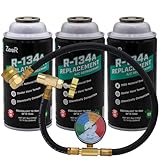
- R134a Replacement - Hydrocarbon blend that is 100% natural, safe for the ozone and non global warming. Chemically compatible with R134a systems.
- 6oz (11.7 fl oz) Cans - Compressed gas is measured by weight. This gas is light weight compared to others, but has the same "volume". Guaranteed that you will use no more than normal!
- SSV Cans - Self Sealing Valve allows for the storage of unused gas. Requires SSV compatible tool. Avoid "piercing" style tools or the gas may come out slowly or not at all.
- Disclosures - Product is flammable like many other modern refrigerants. Observe all precautions on the product lablel when handling and storing. Follow all legal requirements when charging your system. Hydrocarbon blend refrigerant for NON MVAC use in 6oz SSV Cans.
A low-side gauge is useful for diagnosis, but it cannot determine the correct charge by itself. Pressure changes with:
- ambient temperature;
- engine speed;
- condenser airflow;
- refrigerant type;
- compressor design and operating condition;
- expansion-device or airflow restrictions; and
- the amount of refrigerant already in the system.
Overcharging can raise system pressures and reduce cooling. Undercharging can reduce cooling, limit oil circulation, and leave the compressor inadequately protected. The safe target is the manufacturer’s specified refrigerant mass, measured with suitable equipment—not a pressure number copied from a chart without considering the entire system.
Leak testing comes before a final recharge
A leak may not reveal itself immediately. Refrigerant can escape from a small connection leak, an evaporator hidden inside the HVAC case, or a component that leaks only when the system is operating and pressurized. That is why a quick visual inspection or a single gauge reading is not always conclusive.
Common leak-detection methods
- Visual inspection: Look for oily dirt, damaged condenser fins or tubes, wet-looking fittings, and residue around service ports. Refrigerant itself may evaporate without leaving an obvious wet mark, while the lubricant it carries can leave evidence.
- Electronic detection: An electronic sensor can detect refrigerant escaping from accessible fittings and components. It must be used according to its instructions and with the correct refrigerant setting.
- UV dye: Compatible dye and a UV light can help locate a leak after the system has operated long enough to circulate the dye. Dye is not automatically appropriate for every vehicle or lubricant, and it should not replace proper repair.
- Vacuum-hold testing: After recovery and evacuation, a technician can turn off the pump and monitor whether the system holds vacuum. MACS service guidance describes a hold of at least 10 minutes as one diagnostic approach.
- Pressure-based testing: A vacuum test is useful but not infallible. Some leaks can temporarily seal when the system is pulled into a vacuum, so a pressure-based check may also be necessary, using the approved procedure and equipment.
An automotive AC leak detector can be a useful diagnostic tool for locating an accessible leak, but it does not recover refrigerant, confirm the exact charge, or repair the leaking part. A leak detector should support—not replace—a complete diagnosis.
Do these 3 things before closing this tab:
1Clear out junk files and repair common Windows errors2Fix the driver behind crashes, sound loss and screen glitches3Repair Windows errors before they cause bigger problemsWhat a professional recharge procedure includes
A qualified technician generally follows a sequence similar to this:
- Identify the refrigerant and specification. The technician confirms the label, fitting type, specified charge mass, and required lubricant information.
- Diagnose the cooling complaint. This includes checking system operation, compressor or clutch behavior, condenser airflow, electrical controls, pressure-sensor inputs, cabin airflow, and likely leak points.
- Recover the refrigerant. Existing refrigerant is removed with approved recovery equipment. It should not be deliberately released. In the United States, EPA states that recovered refrigerant must be recycled or reclaimed before it is reused, even if it will be returned to the same vehicle.
- Test for leaks. The method depends on whether the system still contains refrigerant, whether it is empty, and whether a component has been replaced. An empty system may need a controlled partial pressure charge for leak detection rather than relying only on a vacuum test.
- Repair the cause. This may involve replacing a condenser, hose, service-port core, compressor, evaporator, seal, or other failed component. Refrigerant should not be used as a substitute for that repair.
- Evacuate the system. A vacuum pump removes air and moisture after the system has been opened or recovered. Moisture and non-condensable gases can impair operation and contribute to corrosion or abnormal pressures.
- Charge by measured mass. The technician adds the exact refrigerant quantity specified for the vehicle and adds or restores lubricant only according to the service procedure. Extra refrigerant or oil is not a performance upgrade.
- Verify operation and leaks. The finished system is checked for compressor operation, vent temperature, system pressures, airflow, and signs of leakage under operating conditions.
A vacuum hold is not the same thing as proving that every leak has been repaired. The system must also be charged correctly and checked while operating.
Can you use a DIY recharge kit?
A basic kit may include a hose, pressure gauge, and a small refrigerant container. It can be appropriate only for a narrow situation: the vehicle label clearly confirms the refrigerant, the product matches it, the system is not empty, there is no unknown material in the system, and the owner is making an informed top-up rather than pretending to complete a repair.
Rank #3

- ENGINEERED R134a REPLACEMENT - HIGH-EFFICIENCY FORMULATION - Hydrocarbon-based A/C refrigerant engineered to replace R134a cooling performance when used correctly. Designed for A/C systems originally charged with R134a and serviced by informed DIY users
- PREMIUM HIGH-PURITY SPECIFICATION (99.5%+) - Manufactured to a tightly controlled formula with purity exceeding common refrigerant standards (AHRI 700). No mystery fillers, moisture contamination, or inconsistent blends found in low-grade alternatives
- SIGNIFICANTLY LOWER CHARGE WEIGHT REQUIRED- Hydrocarbon refrigerants absorb more heat per ounce than traditional R134a. As a result, substantially less refrigerant is required to achieve comparable cooling performance. Do not charge by R134a weight
- DESIGNED FOR CONSISTENT, EFFICIENT COOLING PERFORMANCE- Higher heat absorption per unit mass can deliver equal or colder vent temperatures than R134a in many systems when properly charged. Reduced compressor load and efficient evaporator heat transfer contribute to fast pull-down and stable cooling
- PROFESSIONAL-STYLE SELF-SEALING VALVE- 6 oz net cans feature a self-sealing female valve with standard ½″ ACME threads, compatible with common R134a charging hoses. No puncture cans, no special adapters required
If those conditions apply, an automotive AC recharge kit can be convenient for a confirmed-compatible vehicle. Read the label carefully and verify all of the following before opening the package:
- the exact refrigerant is specified, such as R-134a or R-1234yf;
- the fittings match the vehicle without adapters;
- the product does not contain an unapproved substitute or an unnecessary stop-leak additive;
- the kit instructions are appropriate for the vehicle’s system; and
- you have a way to control the amount added rather than charging until a gauge reaches a generic pressure.
A basic recharge kit does not provide full recovery, refrigerant reclamation, vacuum evacuation, reliable leak repair, or a definitive method for determining the amount already in the system. A gauge attached to the low side cannot tell you whether the system is correctly charged when engine speed, ambient temperature, airflow, and system condition are changing.
Do not continue adding refrigerant if the compressor will not engage, the system is empty, the pressure behaves abnormally, or the air does not improve. Do not bypass a pressure switch, inject an unknown product, or keep charging in the hope that more refrigerant will solve a mechanical or electrical fault.
Advanced equipment is not automatically safer
An automotive AC vacuum pump and an automotive AC manifold gauge set are legitimate service tools for an experienced DIY user or technician, but they do not make an unfamiliar repair risk-free. They must be compatible with the refrigerant, connected to the correct service ports, and used with recovery, evacuation, leak-testing, and weighing procedures appropriate to the vehicle.
Those tools are not a substitute for approved recovery equipment. A vacuum pump does not recover refrigerant, and a manifold gauge set does not identify the refrigerant or measure the total charge by itself. An incorrect connection can contaminate equipment, release refrigerant, damage the system, or create a dangerous pressure situation. For an R-1234yf system, equipment must also be designed for the refrigerant’s A2L classification and applicable service requirements.
What’s actually slowing this PC down?
Pick the symptom - the matching free tool is one click away.
Safety and U.S. legal requirements
Refrigerant and A/C lubricant can injure the eyes and skin, and their vapor or mist should not be inhaled. Wear appropriate eye protection, keep your face away from service ports and connections, and ventilate the work area after an accidental discharge. Keep ignition sources away from R-1234yf service work because it is mildly flammable. Follow the refrigerant and equipment manufacturer’s safety instructions.
In the United States, EPA Section 609 requires anyone who repairs or services an MVAC system for consideration—including payment or barter—to be trained and certified through an EPA-approved Section 609 program. Covered professional service also requires refrigerant-handling equipment that meets the applicable approval requirements. EPA prohibits intentional venting of refrigerant during maintenance, service, repair, or disposal.
The payment-based certification rule is different from a person working on their own vehicle without compensation, but DIY work still carries environmental, equipment-compatibility, and injury risks. EPA allows certain small cans—generally products under the applicable two-pound threshold and subject to the specific exception and product requirements—to be sold for DIY MVAC servicing. That exception does not authorize venting, mixing refrigerants, bypassing fittings, or using a refrigerant that is unsuitable for the vehicle. Laws outside the United States differ, so check the rules where the vehicle is serviced.
Rank #4

- R134a Replacement - Hydrocarbon blend that is 100% natural, safe for the ozone and non global warming. Chemically compatible with R134a systems.
- 6oz (11.7 fl oz) Cans - Compressed gas is measured by weight. This gas is light weight compared to others, but has the same "volume". Guaranteed that you will use no more than normal
- SSV Cans - Self Sealing Valve allows for the storage of unused gas. Requires SSV compatible tool. Avoid "piercing" style tools or the gas may come out slowly or not at all.
- Disclosures - Product is flammable like many other modern refrigerants. Observe all precautions on the product lablel when handling and storing. Follow all legal requirements when charging your system. Hydrocarbon blend refrigerant for NON MVAC use in 6oz SSV Cans.
When to stop and use an A/C shop
Professional service is the sensible choice when:
- the system is empty or loses cooling quickly;
- the refrigerant type is unknown, the label is missing, or the system may contain mixed refrigerants;
- the system has been opened or a component has been removed;
- the vehicle uses R-1234yf and you do not have compatible equipment and training;
- the compressor does not operate or a pressure-control fault is suspected;
- there is oil or dye residue indicating a leak;
- a condenser, evaporator, hose, compressor, service-port core, or seal needs replacement;
- the system requires recovery, evacuation, or recovery of contaminated refrigerant; or
- you cannot determine the correct charge mass from vehicle-specific information.
Ask the shop what it found, not just how much refrigerant it added. A useful invoice should identify the refrigerant, the amount recovered and installed where relevant, the leak or fault discovered, the repair performed, and the final operating checks.
The Tool Desk
Outbyte PC Repair FREERepair Windows errors before they cause bigger problemsFix Now →Outbyte Driver Updater FREEFix the driver behind crashes, sound loss and screen glitchesFind Drivers →A practical decision checklist
- Confirm the complaint: Check that the problem is genuinely poor cooling rather than weak airflow or a control issue.
- Read the label: Record the exact refrigerant and specified charge amount.
- Look for evidence: Inspect accessible lines, condenser areas, service ports, and connections for damage or oily residue. Keep hands and clothing clear of moving parts.
- Decide whether the system is a candidate for a top-up: If it is empty, unknown, leaking rapidly, or opened, it is not a simple top-up.
- Match the equipment: Never use an adapter or generic substitute to overcome incompatible fittings.
- Measure, do not guess: Use the specified mass and do not treat low-side pressure as the charge target.
- Stop if the result is abnormal: No compressor operation, unusual pressure, no cooling improvement, or rapid loss means diagnosis and repair are needed.
What not to do
- Do not assume every vehicle uses R-134a.
- Do not charge an R-1234yf system with R-134a, or vice versa.
- Do not select refrigerant by can color or a generic product listing.
- Do not vent refrigerant into the atmosphere.
- Do not charge until a low-side gauge reaches a universal number.
- Do not add refrigerant repeatedly instead of repairing a leak.
- Do not assume stop-leak additives are safe for every compressor, hose, lubricant, or recovery machine.
- Do not bypass pressure controls to make a non-operating compressor run.
- Do not use a vacuum pump as a refrigerant-recovery device.
Technical basis: The service distinctions and handling points above reflect U.S. EPA MVAC guidance and MACS service guidance. EPA requirements are U.S.-specific; vehicle specifications and legal requirements in other countries may differ.
Frequently Asked Questions
Can I recharge my car A/C without fixing a leak?
You can sometimes restore cooling temporarily, but adding refrigerant does not repair the leak. If the system loses cooling quickly, is empty, or shows oil or dye residue, have the leak located and repaired before the final recharge.
How do I know whether my car uses R-134a or R-1234yf?
Read the under-hood refrigerant label and confirm it with vehicle-specific service information. Do not rely on the vehicle’s age, can color, or an online listing. R-134a and R-1234yf are not interchangeable.
Can a low-side pressure gauge tell me how much refrigerant to add?
No. Low-side pressure varies with ambient temperature, engine speed, condenser airflow, refrigerant type, and system condition. The correct charge is the vehicle’s specified mass, measured with suitable equipment.
Free tools Windows power users keep installed
One-click scans. No signup required.
How long should an A/C system hold vacuum?
MACS guidance describes switching off the vacuum pump and checking whether the system holds vacuum for at least 10 minutes as one diagnostic approach. A vacuum test can temporarily seal some leaks, so pressure-based testing may also be necessary. Follow the vehicle and equipment service procedure.
Is R-1234yf dangerous to service?
R-1234yf is classified as mildly flammable, so it requires compatible fittings, labels, pressure protection, and appropriate equipment and procedures. If you lack R-1234yf-compatible equipment and training, use a qualified A/C shop.
The Bottom Line
Bottom line: Treat a recharge as part of an A/C diagnosis, not as routine maintenance. Identify the exact refrigerant, find out why the charge is low, recover refrigerant instead of venting it, evacuate and charge by the specified mass, and verify the repair. A compatible DIY kit may suit a limited top-up, but an empty, leaking, opened, contaminated, or R-1234yf system belongs with properly equipped professional service.
Quick Recap
Product prices and availability are accurate as of the date/time indicated and are subject to change. Any price and availability information displayed on Amazon at the time of purchase will apply.




