A high-performance V8 overheats when the cooling system cannot move enough heat from the cylinders and oil to the coolant, circulate that heat to the heat exchangers, and reject it through airflow. The cause may be as simple as low coolant or a blocked radiator, or as serious as a failed water pump, thermostat, fan, belt, head gasket, or an engine whose heat load exceeds the vehicle’s cooling capacity.
Temperature rise by itself does not identify the failed part. Diagnose the complete chain—coolant level and condition, leaks, circulation, airflow, fan and belt operation, thermostat control, radiator capacity, and operating load—before replacing parts or choosing upgrades.
As an Amazon Associate I earn from qualifying purchases.
What overheating means in a performance V8
Combustion converts only part of fuel energy into useful power. The rest becomes heat in the cylinder heads, block, exhaust, lubricating oil, and surrounding components. Coolant absorbs heat in passages around the combustion chambers, flows through the radiator or other heat exchanger, and releases that heat to air. Oil also carries heat away from bearings, piston undersides, valve-train parts, and turbocharger components where fitted.
Recommended Free Tools
An engine overheats when heat generation persistently exceeds heat rejection. That imbalance can result from too little coolant, poor coolant circulation, insufficient airflow, a restricted heat exchanger, a control fault, unusually high load, or internal engine damage. A V8’s performance label does not identify which of those conditions exists, and it does not establish one universal safe temperature.
#1 Best Overall
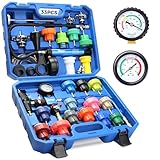
- 🔧【COMPLETE 33-PIECE MASTER KIT】This all-in-one coolant pressure tester and vacuum refill kit includes 23 radiator adapters (22 specific + 1 universal), a vacuum pump, a vacuum purge & refill tool, a probe thermometer, a wrench, EU & US air intake joints, O-rings, and hoses. Everything you need to diagnose cooling system leaks and refill without air pockets—all in one rugged carrying case.
- 🚗【WIDE COMPATIBILITY – 23 ADAPTERS FOR MOST CARS】With 23 different radiator adapters, this cooling system pressure tester works on most passenger vehicles, including Japanese, German, American, Korean, and European makes. Covers sedans, SUVs, trucks, and many light-duty vehicles. No more guessing which adapter fits—we‘ve got you covered.
- 🔍【DUAL FUNCTION: PRESSURE TESTING & VACUUM REFILL】Identify leaks quickly with the pressure testing function—check header tanks, expansion tanks, head gaskets, radiator cores, heater matrix, water pumps, and pipes. Then use the vacuum refill tool to purge air and refill coolant without any trapped air pockets. This two-in-one system saves time and prevents engine overheating.
- 📦【EASY ORGANIZATION & QUICK IDENTIFICATION】Color-coded adapters and molded size markings let you grab the right adapter instantly. The custom-molded carrying case keeps every component securely in its place, so you never lose a part. Hassle-free storage and transport for professional mechanics and DIYers alike.
- 💪【BUILT FOR DAILY USE – DURABLE MATERIALS】Constructed with quality aluminum alloy, nylon, rubber, and brass, this coolant pressure tester is engineered to withstand frequent use in busy workshops. The robust build ensures consistent performance and long-term reliability—year after year.
High output can narrow the margin because more power means more fuel burned and more waste heat. Towing, sustained high speed, low vehicle speed on a circuit, hot ambient air, altitude, added boost, altered ignition timing, lean operation, or blocked ducting can increase the heat load. A correctly maintained, factory-matched system should still be evaluated against the exact vehicle and engine specification rather than against a generic “performance V8” rule.
Why does my high-performance V8 overheat?
Low coolant or an external leak
Low coolant reduces the liquid available to absorb and transport heat. Air entering the system can also interrupt circulation and create local hot spots. Check the level only with the engine cool and on level ground, using the reservoir marks and procedure in the vehicle manual. Inspect the radiator, hoses, hose joints, water-pump area, thermostat housing, heater connections, freeze plugs, and visible gaskets for wetness, crusted residue, or staining.
A level that repeatedly drops is a fault, not a maintenance interval. Repeated top-offs can mask a pressure leak, allow air into the system, and dilute the specified coolant mixture. Have the leak located and repaired before extended driving.
Restricted airflow through the radiator and coolers
The radiator can reject heat only when air can pass through clean fins. Mud, leaves, insects, bent fins, bodywork, auxiliary coolers, or debris trapped between stacked heat exchangers reduce airflow. Check the path from the grille through the condenser, intercooler or transmission cooler where fitted, and radiator. A surface that looks clean from the front can be blocked between layers.
Air must also travel through the intended path rather than around the radiator. Missing seals, damaged ducting, or an incorrectly fitted fan shroud allow air to bypass the fins. Caterpillar’s truck-engine guidance warns that removing a shroud can contribute to overheating in those applications; the same aerodynamic principle applies generally, but the exact shroud design is vehicle-specific.
Rank #2

- 【TROUBLESHOOTING & SAVING MONEY】28pcs universal radiator pressure tester and vacuum refill kit with functions of leak detection, temperature measurement, liquid filling, etc. If you use the coolant pressure tester, the tester can quickly and easily solve any problems related to radiator pressure, making your job easier and faster.Note: Please select the corresponding adapter according to the user manual; otherwise, leakage may occur. If a suitable adapter is not available, please use a universal adapter, which is suitable for all vehicle models.
- 【ALL-IN-ONE TOOL KIT】1 x Radiator manual pressure tester(0-35psi/0-2.5 bar); 1 x Pneumatic vacuum coolant refiller(-30 to 0inHg/ -76 to 0cmHg); 1 x 19" Rubber nylon resin hose; 1 x Thermometer(32 - 400 ℉); 3 x Radiator cap test adapters; 1 x Universal tapered rubber adapter; 17 x Adapters; 1 x Adapter handle; 2 x Connectors; 1 x Storage case.
- 【TOP QUALITY MATERIAL】Radiator manual pump pressure detector adopts a premium aluminum cylinder and accurate shock-proof gauge design. A vacuum-type coolant refiller uses reliable brass and plastic material—a rubber hose with brass parts, anti-corrosive and waterproof. American & European style air plugs are provided for various air hoses.
- 【KEY EASE-OF-USE FEATURES】Color-coded caps help you quickly choose the right adapter without confusion.All-in-one design eliminates need for multiple separate tools.Clear instructions guide you through pressure testing and vacuum filling.Quality gauge provides accurate, easy-to-read pressure measurements,that even if you're new to cooling system work, the comprehensive kit and straightforward process make it accessible for DIY mechanics.
- 【APPLICATION】The kit includes 3 radiator cap test adapters for common cap styles.Look at your expansion tank: Most adapters are designed for expansion tank necks.Color-coded system: Each adapter has a colored cap to help you quickly identify the right fit.Universal tapered adapter: Included as a backup option for unusual fittings.Compatible with: Mercedes-Benz, BMW, Audi, VW, Ford, GM, Toyota, Honda, Nissan, Mazda, Subaru, and many more brands.The comprehensive adapter selection means you'll likely have the right fit, and if one doesn't work perfectly, you can try others in the set.
Fan or fan-control failure
At road speed, ram air may provide most of the airflow. In traffic, during idling, or on a track’s slow corners, the fan becomes critical. An electric fan may have a failed fuse, relay, motor, wiring connection, control module, or temperature input. A viscous or mechanically driven fan may have a worn clutch, damaged blades, or insufficient engagement. A fan that spins is not necessarily moving its rated air volume.
Verify operation using the exact service procedure. Do not assume a fan should run continuously or at one fixed temperature; control strategies differ. Keep hands, clothing, and tools clear of rotating parts, and never test a fan around an unsecured vehicle.
Loose belt, failing pump, or another circulation fault
A loose, glazed, contaminated, or damaged drive belt can let a belt-driven water pump or fan slip. A deteriorated pump impeller, worn bearing, damaged seal, or incorrect replacement pump can reduce flow or cause a leak. Some failures are worst at high rpm; others appear at idle. Belt condition and tension must be checked according to the engine’s specification rather than by feel alone.
A circulation fault may produce a temperature difference between hoses, erratic gauge movement, poor cabin heat, or coolant boiling after shutdown, but those symptoms are not conclusive by themselves. Use the manufacturer’s diagnostic sequence before condemning the pump.
Thermostat stuck closed or opening partially
The thermostat controls when coolant is allowed to flow through the radiator. If it sticks closed or opens only partially, hot coolant cannot reach the heat exchanger fast enough. A thermostat that is stuck open can cause slow warm-up and poor temperature control; it is not an automatic cure for an overheating complaint.
Rank #3

- MULTIFUNCTION: The 14 pcs radiator pressure tester kit allows detecting for leakage in radiator system, especially head gasket failure detection, and help you to change coolant more efficiently.
- WELL MADE KIT: The adapters are made of high quality aluminum, and treated with rust and corrosion protection. High tenacity rubber and high-impact plastic for longer service life.
- COLOR CODED SET : Color coded radiator adapters are convenient to select the suitable one according to different colors without messy. 124pcs radiator adapters are perfect to test cooling systems on most vehicles.
- EASY TO CARRY: The thickened carrying case keeps all accessories in place and protects the gauges during storage and transportation.
- 100% Satisfaction: We are responsible for every product. If you have any problems with our products or services, please contact us immediately and we will provide you with exceptional responses to your every concern.
Application-specific figures must not be generalized. The service description for the 2007 Chevrolet Corvette 7.0L states that its thermostat begins opening at 87 °C (187 °F). That value describes that particular application, not every Chevrolet engine or every high-performance V8.
Coolant condition, trapped air, or an incorrectly serviced system
Use the coolant type, concentration, and bleeding procedure specified for the exact engine. Different metals, seals, water-pump materials, and corrosion packages require different formulations. An incorrect mixture, contaminated coolant, or trapped air pocket can reduce heat transfer and circulation. A coolant test strip can screen condition when it is compatible with the coolant in the vehicle; it cannot replace the manufacturer’s concentration, pressure, or service procedure.
Heat load greater than the system’s capacity
Heavy towing, sustained high rpm, high ambient temperature, low-speed track driving, forced induction, increased compression, altered calibration, or a restricted replacement radiator can push a marginal system over its limit. A modified engine may need more cooling capacity, but the correct remedy depends on measured temperatures, airflow, packaging, and duty cycle. “High performance” alone is not a diagnosis for a larger radiator, electric fan, oil cooler, or additive.
Internal engine damage
Continued overheating can warp or crack heads, damage head gaskets, and harm bearings. Caterpillar’s truck-engine discussion lists cracked heads, blown gaskets, and bearing failure as possible consequences in its applications. These are potential outcomes, not a prediction that every hot V8 has suffered them. If coolant is pressurized immediately from a cold start, exhaust gas enters the cooling system, coolant and oil mix, or the engine misfires after overheating, stop driving and obtain a vehicle-specific internal-leak diagnosis.
How the cooling system should be checked
Use this sequence to separate a coolant-loss problem from an airflow, circulation, or control problem. Work only on a cool engine unless a service procedure explicitly requires otherwise.
What’s actually slowing this PC down?
Pick the symptom - the matching free tool is one click away.
Rank #4

- Radiator Leak down Tester Kit: The radiator pressure tester kit helps you change coolant and test for leaks in your vehicle's cooling system, including the radiator, heater core and radiator cap, in a simple and straightforward manner. Self-locking quick coupler for easy adapter installation, and thumb-operated relief valve allows for repeated pressure tests and pressure release while testing the cooling system. Stainless steel thermometer(0-200℃ / 32-400℉) measures coolant temperature.
- Build to Last: Our coolant pressure tester kit is made of high-quality materials, which is sturdy, durable, high strength, good toughness and has a long service life.
- Easy to Operate: First,remove the original radiator cap, choose an available radiator cap from the test kit and install it on radiator opening. Then,work the handpump till the pressure up to 10-15psi (Avoid up to 35psi). Check the gauge reading, if the reading drops automatically, it means that the leakage might occur in radiator. Please inspect the radiator system and repair it if necessary. Normally, it takes around 10mins to test leak, very easy and fast to operate.
- Various Water Tank Adapters: You will receive 13pcs dedicated radiator adapters with quick plugs, used to replace the original radiator opening cap with any suitable one of them for radiator airtightness test, and there is a black adapter assembly tool for labor-saving adapter installation and removal. Each color-coded radiator adapter has its own number mark for quick vehicle model reference and right position placement in the case.
- Package Content: 1 x Pressure testing pump with gauge, 1 x Thermometer, 3 x Chromed Steel Cap Adapters,10 x Anodized Cap Adapters; 2 x Connector;1 x Adapter Handle;1 x Carrying Case
- Record the conditions. Note ambient temperature, road speed, engine load, rpm, A/C use, coolant level, warning lights, gauge behavior, and whether the problem occurs at idle, in traffic, on hills, or during sustained high speed. A fault that appears only at idle points toward airflow or fan control; one that worsens with load can indicate insufficient capacity, circulation, or an internal fault.
- Inspect the cold system. Check the reservoir and radiator level only where the manual permits, then inspect hoses, clamps, radiator seams, pump area, thermostat housing, heater lines, and the underside for leaks. Look for collapsed, swollen, soft, cracked, rubbing, or oil-contaminated hoses. Check belt condition, routing, and specified tension.
- Inspect the airflow path. Remove safe-to-access debris, examine fins between heat exchangers, and verify that shrouds, seals, ducts, and grille openings are present and correctly fitted. Do not straighten delicate fins aggressively or pressure-wash them from a distance that bends them.
- Confirm fan operation. Follow the vehicle’s electrical or mechanical fan test. Check the relevant fuse, relay, wiring, clutch, and control inputs. A diagnostic scan tool may reveal fan-command or temperature-sensor faults on electronically controlled systems.
- Pressure-test for leaks. A cooling-system pressure tester can reveal a slow external leak that is invisible at operating temperature. Use a tester and adapter rated for the vehicle, follow the specified pressure and time limits, and test the pressure cap where the procedure calls for it. Never exceed the system’s stated pressure.
- Check coolant condition. Use a compatible test method, such as appropriate coolant strips, to screen freeze protection or condition. Replace or flush coolant only with the exact approved product and procedure; do not mix unknown formulations casually.
- Evaluate thermostat and circulation. Compare hose temperatures and flow indications only as directed by the service information. A thermostat may require removal and bench testing, while pump diagnosis may involve flow, belt, bearing, or leak checks.
- Check for internal leakage if warranted. A combustion-gas test, cooling-system pressure behavior, compression or leak-down testing, and inspection of oil and coolant can help identify head-gasket or head damage. These tests require correct equipment and interpretation for the engine.
- Verify the repair under the original conditions. After repair and correct bleeding, repeat the idle, traffic, load, or track condition that produced the complaint while monitoring the vehicle’s approved temperature data.
Temperature readings: why there is no universal “too hot” number
Gauge markings, warning thresholds, thermostat ratings, fan commands, coolant pressure, sensor location, and engine calibration differ by vehicle. The source material does not establish a single maximum temperature for all high-performance V8s. Caterpillar notes that its truck engines may run hotter than average passenger cars and that a fan not switching on at 195–200 °F can be normal for those engines. That observation cannot be transferred to a Corvette, muscle car, swapped engine, or racing application.
| Reference | Number or behavior | How to interpret it |
|---|---|---|
| 2007 Chevrolet Corvette 7.0L service description | Thermostat begins opening at 87 °C (187 °F) | One application-specific thermostat specification, not a universal V8 limit. |
| Caterpillar truck-engine guidance | Fan not switching on at 195–200 °F may be normal for those engines | Truck-engine control behavior; do not use it as a passenger-car target. |
| Any other vehicle | Not stated here | Use the exact owner’s manual and service information. |
Do not diagnose from an aftermarket gauge alone. Compare the reading with the original sensor data, warning strategy, and service specification, and consider whether the sensor or wiring is faulty.
Independent reader supportYour contribution helps us test, update, and keep practical guides available for everyone.How to prevent a performance V8 from overheating
Use the specified coolant and service interval
Check the level when cold, investigate any loss, and use only the coolant and water quality specified for the engine. Follow the approved drain, fill, bleeding, and disposal procedure. A generic “performance coolant” or additive is not automatically compatible or beneficial.
Keep hoses, belts, and connections healthy
- Replace hoses with cracks, soft spots, swelling, collapse, abrasion, or hardened ends.
- Inspect clamps and joints for seepage and verify that hoses cannot rub on belts, pulleys, or brackets.
- Check belt wear, alignment, tension, and contamination at every service appropriate to the vehicle.
- Inspect the pump and thermostat housing for leaks or residue.
Maintain unrestricted airflow
- Clean radiator and condenser fins with a method that does not bend them.
- Clear debris from the grille and the gaps between stacked heat exchangers.
- Keep factory shrouds, seals, ducts, and underbody airflow panels installed.
- After bodywork or accessory installation, confirm that the radiator is not masked or bypassed by new openings.
Verify fan and thermostat function before severe duty
Test electric fan commands, relays, sensors, and wiring according to the manual. For mechanical fans, inspect clutch engagement and blade condition. Confirm thermostat operation using the prescribed test rather than installing a colder thermostat as a precaution.
Do these 3 things before closing this tab:
1Repair Windows errors before they cause bigger problems2Scan for outdated or missing drivers - takes under a minute3Clear out junk files and repair common Windows errorsMatch maintenance to the duty cycle
Track use, towing, desert heat, and repeated high-load operation deserve shorter inspection intervals and documented temperature monitoring. Establish acceptable coolant, oil, transmission, and intake-air temperatures for the exact engine builder and chassis. The available guidance does not provide a universal track-preparation parts list or temperature ceiling.
Best Value

- A comprehensive coolant system pressure test & refill kit locates system leaks from header and expansion tanks and fittings, head gasket, radiator core, heater matrix, water pump, hoses and pipes, and is designed for refilling radiators with coolant without introducing air pockets.
- The hand operated pressure pump and vacuum refiller is fitted with an accurate and easy to read gauge marked in both psi and bar. A add on thermometer is designed to aid diagnostics and also ensure the system is cool before removing the cap.
- Features a upgraded metal valve, offering much better durability and performance over traditional rubber valves. This innovative design ensures a quick, efficient refill process, preventing engine overheating and maximizing vehicle performance.
- The different colors on each test cap will help operators working much more efficiently to choose suitable cap and work.
- 17 Pieces color coded test caps are designed for testing cooling systems on most domestic and import vehicles. Is compatible with Mercedes-Benz, GM, Jeep, Peugeot, Subaru, Chrysler, Acura, Mitsubishi, Nissan, Mazda, Toyota, Infiniti, Geo, Suzuki, Isuzu, Honda, Lexus, Volvo, Saab, Citroen, Renault, Fiat, Alfa, Mini Cooper, VW, BMW, Ford, Opel, Porsche, Audi, etc.
What to do when the temperature rises
Reduce heat production and get to a safe place without opening the pressurized system. The 2022 Ram 2500/3500 owner’s manual provides one model-specific example: as the gauge approaches HOT, slow down on highways, turn off the A/C, and use the cabin heater as a supplemental heat exchanger. It says that the A/C system adds heat to the engine cooling system and turning it off can help remove that heat.
Those instructions are not a substitute for the manual of another vehicle. If the gauge reaches HOT, pull over and stop. If it remains at HOT, turn the engine off and seek service. The Ram manual states: “Never try to open a cooling system pressure cap when the radiator or coolant bottle is hot.” Steam and pressurized coolant can cause severe burns. Wait for the vehicle-specific safe procedure and temperature condition before inspecting or adding coolant.
- Do not continue driving while the warning remains on merely because the engine still runs.
- Do not remove the pressure cap, disconnect a hose, or pour cold water into a hot engine.
- Do not assume a heater at full temperature proves the system is healthy; it may only be removing some heat temporarily.
- If coolant is visibly leaking, the belt has failed, steam is present, or the engine is misfiring, arrange recovery rather than attempting a long drive.
Choosing an upgrade without guessing
Replacement parts should follow a measured fault and the vehicle’s operating mission. Compare any proposed remedy on four axes:
Outdated Drivers Are Slowing You Down
One free scan finds every outdated or missing driver and matches the right update for your exact hardware.Free scan · exact hardware matchPC Slower Than It Used to Be?
A free scan shows the junk files, broken settings and background clutter dragging Windows down - then fixes them in one click.Free scan · Windows 10 & 11- Diagnosed fault: repair a leak, failed fan, blocked radiator, belt, pump, thermostat, sensor, or duct before adding capacity.
- Heat-rejection and airflow capacity: assess core area, fin design, coolant volume, fan airflow, shroud sealing, and the ability to pass air through the complete stack of heat exchangers.
- Compatibility: confirm mounting, hose routing, cap pressure, sensor locations, electrical load, clearance, coolant chemistry, and interaction with the engine, transmission, A/C, and oil systems.
- Duty cycle: a solution for street traffic may differ from one for towing or sustained track use. Validate it under the condition that causes the temperature rise.
A larger radiator, electric fan, different thermostat, coolant additive, or oil cooler can be useful in a documented application, but none is universally required because an engine is labeled high performance. An oversized core with poor ducting, an undersized fan, or an incorrectly controlled thermostat can fail to solve the actual problem.
When overheating becomes an engine-damage event
One brief gauge excursion does not prove catastrophic damage, but every overheating event deserves investigation. Repeated operation at HOT can distort sealing surfaces, damage head gaskets, crack heads, degrade oil, and harm bearings. After a severe event, check for coolant loss, oil contamination, persistent bubbles, white exhaust after warm-up, rough running, reduced compression, and unexplained pressure in the cooling system. Stop operating the engine if those signs appear and obtain a qualified diagnosis.
Quick Recap
A practical prevention checklist
- Cold-engine coolant level is correct and stable.
- No unexplained residue, wetness, or pressure loss is present.
- Hoses, clamps, belt, pump, and thermostat housing pass inspection.
- Radiator, condenser, and adjacent coolers are clean and unobstructed.
- Shroud, seals, ducts, and grille openings are intact.
- Fan operation and control inputs meet the vehicle’s service procedure.
- Coolant type, concentration, and bleeding method match the exact engine.
- Pressure testing is used for suspected leaks with compatible equipment.
- Temperature limits and maintenance intervals are documented for the actual street, towing, or track duty cycle.
Product prices and availability are accurate as of the date/time indicated and are subject to change. Any price and availability information displayed on Amazon at the time of purchase will apply.




