A wheel can look as if it is turning backwards when its motion is seen in separate samples—such as the frames of a video or brief flashes from a strobe. If the wheel advances almost a full turn, or nearly one spoke spacing, between samples, the next visible spoke pattern may seem slightly behind the last one. The brain can read that smaller apparent movement as reverse rotation. A similar illusion has also been reported under steady light, but its explanation is less settled.
Why a wheel can look stationary or reverse in a video
A video camera does not record every instant of a wheel’s movement. It captures separate frames. Between two frames, a rotating wheel may turn so far that a repeated spoke pattern appears nearly where it started—or just behind its previous position. The apparent movement between those samples can therefore be mistaken for slow forward rotation, no movement, or backward rotation.
This is temporal aliasing: the samples do not uniquely reveal the motion that happened between them. The effect depends on the timing of the frames in relation to the wheel’s rotation and its repeated spoke pattern, so changing either can change what the viewer sees. The same basic ambiguity can make wheels in film or video seem to slow down, stop, or reverse. VanRullen, Reddy, and Koch’s study and the cited explanation of the wagon-wheel effect describe this discrete-sampling account.
Why spoke spacing matters
Spokes make a wheel’s pattern repeat. If the wheel has several similar-looking spokes, a frame may not make it obvious which spoke is which. A small apparent shift in the repeated pattern can then be read as motion in the opposite direction.
The Tool Desk
Outbyte Driver Updater FREEFix the driver behind crashes, sound loss and screen glitchesFind Drivers →Outbyte PC Repair FREERepair Windows errors before they cause bigger problemsFix Now →#1 Best Overall
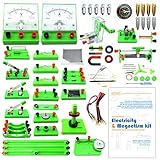
- Learn basic Electricity and Magnetism experiments through full-color manuals, understand the basic principles, and help Students learn, think and explore.
- The basic Electricity and Magnetism experiments kit includes everything that you need to get started,provides a hands-on opportunity for students in grades 9-11 to build simple electrical and magnetic models
- Includes 56 items for Electricity,21 items for Magnetism,2 pcs repair tool,Color page manual,All in the storage bag.(Notice:Batteries Not Included.Need 3 AA Batteries to work.)
- This Electricity and Magnetism Experiment STEM kit can build many projects::Series Circuits,Parallel Circuits,Fruit Battery,Measure unknown resistor with Ohm's law,Oersted Experiment,Electromagnet,Amper's Force Investigation,Electric Bell Making and Hand Crank Generator
- Please feel free to contact us if you have new ideas for EUDAX Product, we will provide Best After-sales service
A 2014 study of the discrete illusion found that reversal strength depended on angular displacement between frames and on the perceived number of spokes. That means rotation frequency alone is not a complete explanation. The study reported reversal effects up to 100% under its specific experimental conditions; that figure is not the share of people who experience the illusion or a general rate for wheels on the road. The study’s findings concern those tested conditions.
Why an adjacent car’s wheels may seem to turn backwards
The familiar roadside example is the same kind of visual puzzle when it is recorded or displayed as video: the camera samples the wheel at intervals, and its rotation relative to those samples can make the spokes appear to move the wrong way. A viewer watching the actual car directly is not watching a sequence of camera frames, however. The video explanation should not be treated as proof that the eye works like a camera with a fixed frame rate.
Rank #2

- AC/DC Comparison Model: The Eisco Demonstration Motor Generator Activity Model lets students explore AC and DC generators side by side in a single model. Ideal for physics labs, this hand-powered device makes understanding electricity concepts intuitive
- Visible Output Display: Bulb holders on the model showcase the AC and DC voltage produced, offering a clear, visual demonstration of output. This allows students to grasp the real-world application of generators during low-amp experiments
- Low-Current Experimentation: Designed for experiments requiring less than 1 amp of current, this model is perfect for safely conducting low-current demonstrations. Its steady output makes it a valuable tool for teaching core electricity concepts
- Comprehensive Guide Included: An included instruction manual, complete with an experiment guide and maintenance tips, ensures smooth operation and care of the model. This makes it accessible for students, physicists, and hobbyists alike
- Interactive Learning Experience: Hand-powered operation allows users to generate electricity manually, actively engaging them in the learning process. This feature enhances understanding of power generation without the need for batteries
How a strobe can create the same effect
A strobe illuminates a wheel in brief flashes rather than continuously. Each flash gives the viewer a separate glimpse of the spoke pattern. If the wheel advances by nearly a full revolution or a repeat interval between flashes, the next glimpse can make it appear stationary or moving backwards. This is another discrete-sampling case, similar in principle to a camera recording separate frames. The cited account discusses stroboscopic presentation as a way the effect can occur.
A strobe can serve as an optional demonstration aid, but no particular device is needed to understand the effect, and no product is endorsed here.
Rank #3

- HANDS-ON STEM TOY FOR KIDS: Turn science into play with an interactive ferrofluid toy that lets kids see magnetic forces in action while experimenting, observing, and discovering how magnets affect the fluid.
- WATCH MAGNETISM COME TO LIFE: Move the included magnets around the display and watch the ferrofluid form incredible spikes, shapes, and patterns. Every movement creates a new reaction for kids to explore.
- LEARN SCIENCE THROUGH PLAY: A fun introduction to magnetism, magnetic fields, physics, and cause-and-effect learning. Great for curious kids who love science experiments, STEM activities, and discovering how things work.
- SEALED, MESS-FREE & READY TO PLAY: The ferrofluid stays securely contained inside the clear display with no pouring, mixing, refilling, or cleanup. Designed for repeated hands-on play and tested to applicable toy safety requirements.
- UNIQUE STEM GIFT FOR KIDS: A memorable science gift for boys and girls who love magnets, experiments, and educational toys. Great for birthdays, Christmas, classrooms, homeschool learning, and young scientists.
What is different about the illusion under steady light?
Researchers have also reported a continuous wagon-wheel illusion: a wheel or repeated pattern appears to reverse while viewed under continuous illumination. Because there are no video frames or strobe flashes creating discrete samples, the camera explanation does not by itself account for this case. Experiments and interpretations remain contested, and the perceptual mechanism is not settled. VanRullen, Reddy, and Koch’s paper reports the continuous-light phenomenon; the cited discussion reflects that its interpretation remains an open question.
What the attention and frequency findings do—and do not—mean
VanRullen, Reddy, and Koch reported that in their experiments the continuous illusion was “almost abolished in the absence of focused attention.” In the tested stimuli, the illusion was strongest around 10 Hz. Their proposed model used attention-dependent temporal subsampling rates between 10 and 20 Hz, with a modeled mean of 15 Hz. These are findings and parameters tied to that paper’s experiments and model—not evidence that human vision has a universal frame rate. The paper gives the attention result, and the study’s reported figures give the experimental and modeled frequencies.
Quick Recap
Best Value
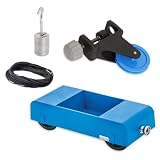
- COMPLETE PHYSICS KIT || Includes Hall's physics demonstration car, pulley, physics string, and weights, providing a comprehensive tool for motion and force experiments
- IDEAL FOR CLASSROOM || Perfect for educators to demonstrate Newton’s laws, friction, and acceleration, encouraging hands-on learning and exploration
- HALL’S PHYSICS CAR WITH ATTACHMENT POINT || 5.5" long plastic car features a removable thumbscrew, providing easy attachment of cords for various experimental setups
- FORCE TABLE PULLEY || 2” low-friction pulley with plastic clamp for smooth, precise movement in force and friction demonstrations
- WEIGHTS & STRING INCLUDED || Comes with 8 meters of polyester-cotton string and a 250g mass set, allowing for a variety of experiments with mass, force, and motion
Rank #4

- Visualize Abstract Concepts: Hands teaching tools allow students to observe reflection, dispersion, and focusing principles directly, turning complex physical theories into engaging lab activities
- Comprehensive Optical Setup: This physics optics experiment kit includes a linear light source, triangular prism, reflector, and multiple lenses to support various geometric light pathway demonstrations
- Multiple Lens Configurations: The refraction set features both concave and convex lenses alongside a precision dial, enabling precise measurement and direct observation of varying light path alterations
- Simple Assembly Design: Crafted for straightforward setup in any classroom, the compact geometric components fit together easily so educators can focus entirely on delivering their lesson plan to learners
- Versatile Laboratory Application: Designed specifically for middle school, high school, and homeschooling environments, this demonstration equipment supports fundamental STEM education requirements and projects
How the viewing conditions compare
| Viewing condition | What creates separate samples? | How well established is the explanation? |
|---|---|---|
| Film or video | The camera records distinct frames. | Temporal aliasing directly explains how the wheel can appear still or reversed. |
| Stroboscopic light | Brief flashes illuminate the wheel at separate instants. | Discrete sampling provides a similar direct explanation. |
| Continuous illumination | No camera frames or strobe flashes are required. | The reversal has been reported, but its perceptual mechanism remains debated. |
Product prices and availability are accurate as of the date/time indicated and are subject to change. Any price and availability information displayed on Amazon at the time of purchase will apply.




