The Tool Desk
Outbyte PC Repair FREERepair Windows errors before they cause bigger problemsFix Now →Outbyte Driver Updater FREEFix the driver behind crashes, sound loss and screen glitchesFind Drivers →The familiar green-and-white German police car came from a mid-1970s effort to standardize patrol-car appearance across West Germany. Before that, state and local forces could look quite different from one another. The green was never a single, permanent national choice, and today it is largely a historical look: many German police vehicles now use silver bases and blue markings. The historical accounts document the standardization, but they do not show that green was picked for a measurable visibility or safety advantage.
What the standard actually specified
The common scheme was not simply “green cars.” It was a two-color pattern with a defined layout:

| Element | Pre-standard practice | Standardized scheme |
|---|---|---|
| Base body color | Varied by state and local force | White (RAL 9001 or RAL 9010, or the manufacturer’s equivalent white) |
| Moving body panels | Varied by state and local force | Mint green (RAL 6029), including doors, hood, and trunk lid |
| Older green reference | Fir green (RAL 6009), described by the Stuttgart Police Museum as the earlier base color | Replaced as the common appearance |
The Stuttgart Police Museum dates the nationwide agreement on a common vehicle appearance to 1974. A second specialist historical account dates the interior ministers’ working-group decision and its technical-rule implementation to 1975. These are best read as stages in one process rather than conflicting dates. The RAL numbers are paint-color identifiers that let the scheme be specified precisely; they say nothing about how many vehicles used it or how well it performed.
Why the standard was introduced
The livery belongs to a wider reorganization of German policing. According to the Stuttgart museum, the post-1972 police reform brought common uniforms, insignia, and vehicle appearance, and the new look shaped the public image of German police for decades. Standardization is the documented reason the scheme spread. Baden-Württemberg, for example, completed its uniform transition in 1979, according to the same museum’s account of that state.
What’s actually slowing this PC down?
Pick the symptom - the matching free tool is one click away.
#1 Best Overall

- Matchbox BMW i4 Police Berlin
- Model number 2/5 of the European series 2026
- 1:64 Scale
Readers often assume the color was chosen for conspicuity. The historical material available does not record a visibility study, a safety test, or a named official explaining the choice of mint green. Anyone repeating a specific visibility rationale for the 1970s color is going beyond the evidence.
Why older photos show different colors
Before the common rule, appearances were not uniform. The Stuttgart museum notes fir-green vehicles in the pre-standard period, and specialist accounts mention regional variation that included blue vehicles. A photograph of a green car, a blue car, or a car in an unfamiliar scheme from the 1960s or early 1970s is therefore not necessarily a mistake or a different country’s car. It may simply reflect a state or city that had not yet adopted the common appearance.
Rank #2

- SCALE: Precision-crafted 1:38 scale die-cast metal model of the 2006 Ford Mustang GT, measuring approximately 5 inches in length
- AUTHENTIC DESIGN: Detailed exterior features including realistic headlights, grille, and wheels that mirror the iconic 2006 Mustang GT styling
- FUNCTIONAL FEATURES: Working doors that open and close, plus pull-back action motor for interactive play
- CONSTRUCTION: Durable die-cast metal body with plastic components and premium paint finish
- REALISTIC DETAILS: Features accurate wheel design, distinctive Mustang grille, and authentic body styling of the GT model
How the look changed after the 1970s
The change happened in stages and had more than one driver. Each stage is best dated to a specific state or agency rather than to Germany as a whole.
Silver bodies and removable film
A police-model reference account describes silver becoming common as agencies leased vehicles. Silver cars could be fitted with removable colored film, and an unmarked silver body could be more attractive for resale when the lease ended. This is a reported economic explanation for the shift, not evidence that every state used the same procurement arrangement, so treat it as one documented factor among several.
Rank #3
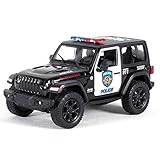
- AUTHENTIC DESIGN: Highly detailed 1:34 scale die-cast model of the Jeep Wrangler Rubicon, featuring the iconic front grille and off-road styling
- DIMENSIONS: 5-inch length makes this model perfect for collectors and display purposes while maintaining impressive detail
- QUALITY CONSTRUCTION: Die-cast metal body with plastic components, featuring opening doors and realistic black off-road wheels
- REALISTIC FEATURES: Detailed interior, textured off-road tires, and accurate Rubicon badging make this a true-to-life replica
- DISPLAY READY: Vibrant exterior finish with contrasting black trim design captures the essence of the real Jeep Wrangler
The move toward blue
Separately, German police organizations moved toward blue uniforms and vehicle identity, part of a broader European trend toward a shared blue police look. Brandenburg Police states that its uniform transition was complete by the end of 2010, and describes Berlin as adopting the Brandenburg clothing concept. Bavaria’s official state portal describes its blue police vehicles and says they carry conspicuous neon-yellow warning markings. These examples show the direction of change in individual states. They do not show that every vehicle in Germany has identical markings today.
How to date a German police car image
Use this rough chronology when you see an older photo or a model reference. Match the decade, the state, and whether the color is the base paint or an applied film.
Rank #4
- Before about 1974: regional liveries were common; green, blue, and other base colors could appear depending on the state or city.
- From the mid-1970s: the white base with mint-green moving panels became the standard appearance in many forces.
- Later decades: silver bodies appeared, sometimes with removable colored film, and many agencies moved to blue identity elements.
- Current fleets: appearance varies by state, agency, and replacement schedule, so a current vehicle should be checked against the local force rather than assumed from the historical scheme.
The short answer to “are German police cars still green?” is therefore: the green-and-white standard is historical, and any green seen today is more likely a legacy image or a model than the current norm.
Independent reader supportYour contribution helps us test, update, and keep practical guides available for everyone.Where to verify details
- The Stuttgart Police Museum’s historical account for the 1974 agreement and the RAL colors.
- Brandenburg Police’s account of its uniform transition, including the end-2010 completion date.
- Bavaria’s official state portal for the current blue vehicles and neon-yellow markings.
For a specific car in a photo, the reliable check is the vehicle’s own markings and the force that operates it, since state and agency practice differs.
Quick Recap
Best Value

- Realistic Design: Features authentic details of the 2021 Dodge Charger Police Pursuit, capturing the sleek lines and powerful presence of the original vehicle.
- High-Quality Kit: 1:25 scale model with precision-molded parts for a highly detailed and accurate build.
- Customizable Features: Includes police-specific accessories like light bars, spotlights, and detailed decals for a true-to-life patrol car.
- Skill-Building Fun: Ideal for hobbyists and collectors seeking an engaging, hands-on modeling experience.
- Display-Ready: Perfect for showcasing in your collection or gifting to law enforcement enthusiasts.
Product prices and availability are accurate as of the date/time indicated and are subject to change. Any price and availability information displayed on Amazon at the time of purchase will apply.




