The Tool Desk
Outbyte PC Repair FREERepair Windows errors before they cause bigger problemsFix Now →Outbyte Driver Updater FREEFix the driver behind crashes, sound loss and screen glitchesFind Drivers →In the United States, no single rule makes a self-driving vehicle or its manufacturer automatically liable whenever it crashes. Federal policy leaves liability rules to the states, so the answer depends on the law where the crash happened, which automation was actually engaged, what any human or remote operator was doing, what caused the collision, and what the evidence shows.
Start with what was actually driving
“Self-driving” is the phrase most people use, but NHTSA separates two very different categories. Identify which one was operating before asking who is liable.
| Category | What NHTSA says | Role of the human | Crash reporting |
|---|---|---|---|
| Driver-assistance (Level 2 ADAS) | Can provide steering and speed input | Driver must remain fully engaged | Reportability criteria differ from the ADS criteria |
| Automated driving system (ADS, Levels 3–5) | Intended to perform the driving task within a defined operational design domain | No driver involvement while the system operates within that domain | Reportability criteria differ from the Level 2 ADAS criteria |
A Level 2 crash is not a driverless-car crash just because the feature name sounds autonomous. Because the driver must stay engaged, that driver’s conduct is usually the first thing to examine. The reporting criteria for each category are set out on NHTSA’s Standing General Order crash-reporting page.
Federal policy hands liability to the states
NHTSA’s Federal Automated Vehicles Policy, a 2016 document issued by NHTSA and the U.S. Department of Transportation, is policy guidance rather than a statute. On the core question it says:
#1 Best Overall

- The Road Guardian- The portable roadside assistance kit is designed and hand picked by a group of experienced veterans and experts to provide every essential tools you need in roadside emergencies. The automotive safety bag contains accessories such as repair cable ties, bungee cords, electrical tape, space blanket, rain poncho, reflective warning triangle, glass breaker, seatbelt cutter, safety gloves, tow rope and more to get your vehicle back on the road and continue your travel.
- Top-Notch Digital Auto Tire Inflator- lightweight and compact air compressor can inflate your standard vehicles tire in seconds. With auto shutoff function, simply plug it into the 12v power outlet and attach the stem to the tire valve, preset the tire pressure and press the power button. The compressor starts the inflating process and stop once your tire reaches at your preset level. This cool gadget also has led light for winter nighttime and three extra nozzles for inflammable bed, others
- Copper-Clad Aluminum 12 Feet 8 Gauge Jumper Cable- A durable battery starter cable is a must-have for your trip. Unlike other kits on the market, our jumper cable has reasonable length to get your cars connected. 8 gauge wires and 300 amp output is more than enough to get your standard vehicle started. UL listed heavy-duty battery jumper cables make you physically and environmentally safer and more reliable.
- Completed 108 Pieces First Aid Kit- By having a completed first aid kit, provide you and your family proper basic wound/hygiene treatment before it possibly get worsened during your road trip. Our kit includes alcohol pads, bandages, cotton tips, knuckle bandages, butterfly bandages, wound pad, sting relief pads, gloves, tape, dressing, PBT bandage, CPR mask, tweezer, safety pins, soap wipe, disinfect wipe, adhesive wound pad, triangular bandage, finger bandage.
- Veteran Owned Company 5-Star Customer Support- Everlit is committed into providing the most comprehensive customer service. We proudly offer the exclusive 60-days hassle-free return among all products. We stand behind the quality of our inventory; all original Everlit products are covered with a 1-year satisfaction warranty.
“States are responsible for determining liability rules for HAVs.”
HAV is NHTSA’s term for highly automated vehicle. The same policy adds: “Determination of who or what is the ‘driver’ of an HAV in a given circumstance does not necessarily determine liability for crashes involving that HAV.” States are also expected to consider how to allocate liability among owners, operators, passengers, manufacturers, and others. The policy itself is available at NHTSA’s Federal Automated Vehicles Policy PDF.
Rank #2
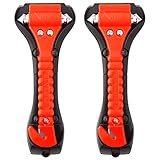
- Car Essential - An invaluable addition to your vehicle safety kit. 2 in 1 window breaker and seatbelt cutter, allowing you to quickly escape in emergency.
- High Quality - High-grade carbon steel double-headed makes the hammer extremely sturdy, easy to break windows and save lives. The Razor-sharp blade mounted in a safe curved hook is made of high quality steel that can cut the seat belt quite easily.
- Well Designed - The bright orange color makes it easy to find in the dark or in a state of panic. It combines a protective bracket for safe storage. Anti-slip handle and light weight make it easy to control.
- Extra Security - Multi-pack safety hammers that can be placed in different parts of your car, ready to be picked up by drivers and passengers in case of emergency. You can also share it as a gift to your family and friends.
- Excellent Service - We offer 90-day returns and free lifetime customer service. If you have any questions, please feel free to contact us, we will try our best to provide you with satisfactory service.
There is no comprehensive federal liability statute to look up instead. A May 2026 advisory from Greenberg Traurig describes the U.S. framework as relying on state law and conventional tort theories. It is secondary legal analysis, so confirm any point against the statutes and case law of the state where the crash occurred. The advisory is available at Greenberg Traurig’s May 2026 advisory on self-driving vehicle liability.
Legal theories that can apply
These crashes are usually analyzed through ordinary tort theories. More than one can apply to the same collision, and each must be supported by facts specific to that crash. They are possible theories, not presumptions of fault.
Rank #3

- 2-in-1 emergency-escape tool provides a window hammer and seat-belt cutter; 2-pack
- Tungsten double-head hammer: 1800HV hardness, 3 times stronger than common carbon steel – for instant car-door window breakage
- Sharp blade for easily cutting through a seat belt; bright-orange plastic handle provides a secure grip
- Designed to help escape from a sinking, over-turned, crashed, or burning car
- Protective bracket included for safe storage; store in center console or driver-side door pocket
Driver or operator negligence
If a human driver’s conduct caused or contributed to the crash, negligence is the most familiar theory. In a Level 2 crash, the central question is often whether the driver was monitoring the road and ready to intervene. Where a fleet or remote operator had a monitoring or takeover role, the same negligence analysis may reach that operator, depending on the circumstances.
Product liability: design, manufacturing, and warning defects
If evidence supports a defect in the vehicle or its automation, an injured party may explore product-liability claims against the manufacturer, the automated driving system developer, or a relevant supplier. These claims can rest on alleged design defects, manufacturing defects, or warning defects. The plaintiff must show that a defect existed and was connected to the crash; the crash itself does not establish one.
Rank #4

- ①Durable and Reliable: These triangle warning signs are made of high-quality plastic, not easy to break, and have a long service life. The reflective film has a good reflective effect and is waterproof and dustproof.
- ②Visibility and Safety: This reflective road safety triangle has a large reflective surface, a wide viewing angle, and a high visibility design, which can effectively warn vehicles and improve personal safety.
- ③Portable and Convenient: This road safety triangle is small and light in size, and comes with a durable storage bag, making it easy to store in the trunk, car, or backpack. The handle design makes it easy to carry and hang.
- ④Wide Application: This reflective warning triangle is suitable for various vehicles, including cars, trucks, bicycles, motorcycles, RVs, and more. It is an essential safety accessory for emergencies and outdoor activities.
- ⑤Multiple Uses: This reflective warning triangle can be used in various situations, such as roadside emergencies, traffic accidents, breakdown, flat tire, changing tire, and more.
How to analyze a specific crash
A general article cannot name the liable party. These steps show which facts decide the question, and the order matters because each answer narrows the next.
- Confirm the crash location and the law in force on that date. Liability rules are set by each state, and the version that governs is the one in effect when the crash occurred.
- Identify the system and whether it was engaged. Establish whether the vehicle had a driver-assistance feature or an automated driving system, and whether that system was active at the moment of the crash. Feature status is a factual question the evidence must answer.
- Check the operating conditions. For an automated driving system, ask whether the vehicle was inside the operational design domain the system was built for. A vehicle operating outside that domain raises different questions.
- Define the human’s role. Establish whether a driver had monitoring or takeover duties, and whether a fleet or remote operator was supervising the vehicle.
- Test causation against the evidence. Examine vehicle and system records, scene evidence, witness accounts, maintenance and modification history, and any applicable regulatory report. Not every category of evidence exists in every crash, and access to vehicle data varies, so an investigation may have to work with what can be obtained.
- Assess each theory against the causal evidence. Negligence, product defect, and operator theories can point at different parties, and more than one may be relevant to the same crash.
Insurance: Florida is one state’s example
NHTSA’s automated vehicle FAQ asks the public question directly: “If a vehicle is driving itself, who is liable if the vehicle crashes? How is the vehicle insured?” (NHTSA, Automated Vehicle Safety). Insurance requirements vary by state. Florida’s statute shows what one state can require:
Best Value

- 【MULTI-PURPOSE】 : Perfect for the home, workplace, cars, it also includes preparedness survival tools for outdoor activities like camping, hiking, hunting. Manufactured in a modern facility that provides products for lifeguard agencies, hospitals, and schools
- 【MULTI-FUNCTION KIT】-Great kit for most auto emergencies, such as winter weather, road trips, minor breakdown and other driving accidents.A wise man always prepares, it is a necessary product to keep in your car.
- 【WELL-ORGANIZED】 : Fully well-organized interior compartments provides quick access. The name of all the tools and accessories are listed on the bag, helping you find what you need easily and quickly. And you can still put some small items that you deemed necessary into its extra space.
- 【HIGH QUALITY】- All packed with top quality competent. All of the competent and tools were hand picked to ensure quality and that you will be prepared in most crisis situations.
- 【General Medi Product】 - You need outdoor gear that's as tough as you are, which is why we sell only the highest quality products that are built to last.Providing you with the best in the industry.
- Florida Statutes § 627.749 (2026) applies to a fully autonomous vehicle with its automated driving system engaged, operating on an on-demand network or as a prearranged ride.
- It requires at least $1 million in primary liability coverage for death, bodily injury, and property damage.
- Owner insurance, network insurance, or a combination may satisfy that requirement.
- The statute contains other coverage requirements beyond the one described here.
The $1 million minimum is limited to that ride context. It does not carry over to driver-assistance vehicles or to crashes in other states. The statute is available at the Florida Legislature’s statute page for § 627.749.
What crash reports can and cannot show
NHTSA’s Standing General Order applies to identified manufacturers, developers, and operators, not to individual consumers. It was first issued in 2021, and NHTSA’s page records amendments in 2021, 2023, and 2025. Reportability criteria differ for automated driving systems and Level 2 ADAS.
Read the reporting database as a safety oversight source, not a verdict:
Quick Recap
- It is not a direct measure of fault or a complete census of crashes.
- Initial reports may be incomplete or unverified.
- Reporting and telemetry access differ, so the data should not be assumed to represent all crashes.
- Report totals cannot be turned into comparative crash rates without accounting for reporting coverage, data quality, exposure, and how representative the reports are.
Product prices and availability are accurate as of the date/time indicated and are subject to change. Any price and availability information displayed on Amazon at the time of purchase will apply.




