A DC fast-charging station needs an AC-DC converter because the utility supplies alternating current, while the vehicle’s traction battery charges with direct current. The station’s power electronics convert and control the electricity, then deliver DC to the vehicle—bypassing the lower-power on-board charger used for AC charging. That conversion stage helps determine how quickly a station can charge, how much energy it loses as heat, which vehicles it can serve, and what demands it places on the site’s electrical connection.
Where AC-DC conversion happens
With AC Level 1 and Level 2 charging, the charging equipment supplies AC to the vehicle. The vehicle’s on-board charger converts that power to DC before it reaches the traction battery. In a DC fast-charging station, conversion takes place in the station instead: its power stage rectifies the utility’s AC, shapes the input current, and regulates a high-voltage DC bus. Controlled DC then flows through the vehicle connector directly to the battery, bypassing the on-board charger. The U.S. Department of Energy describes this distinction in its Federal Fleet Training material.
As an Amazon Associate I earn from qualifying purchases.
| Charging approach | Where AC is converted to DC | Power information in the cited DOE material |
|---|---|---|
| AC Level 1 and Level 2 | Inside the vehicle’s on-board charger | Not stated for these levels in the DOE material cited here (2021). |
| DC fast charging | In the charging station; DC is delivered to the vehicle battery | Common DC fast chargers are described as delivering about 50 kW, with 480 V three-phase input (DOE, 2021). |
| Extreme-fast charging | In the charging station | DOE anticipated systems at 250–350 kW (2021); this is an anticipated power range, not a claim about every station available today. |
The connector and vehicle must support the charging method. DOE notes that the CCS connector adds pins that allow DC to flow directly to the traction battery. A station’s rated power alone does not determine how quickly any particular vehicle charges: the vehicle’s voltage and current limits also matter.
Outdated Drivers Are Slowing You Down
One free scan finds every outdated or missing driver and matches the right update for your exact hardware.Free scan · exact hardware matchWindows Errors? Fix Them Before They Spread
Repair common Windows errors and clear accumulated junk for a smoother, more stable PC - no reinstall needed.Free scan · no reinstallHow the converter affects charging speed
The converter sets the station’s usable DC power and must regulate its output to suit the vehicle. Moving conversion from the vehicle to the station makes it possible to use a much higher-power conversion system than the vehicle’s on-board AC charger. That is why DC fast charging can deliver power much faster than AC Level 1 or Level 2 charging when the station, vehicle, and battery conditions allow it.
#1 Best Overall
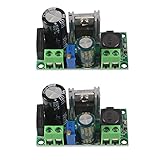
- AC/DC to DC Buck Step Down Converter Module: AC Voltage Input : AC 5V- 30V or DC 5V-50V;Output Range: DC 3.3V-33V
- LM2596HV Buck Converter: Output Current Range: Up to 2.2A (Regulator Chip Can Withstand a Maximum Current of 3A, Can Work at 3A Output Current for a Short Time)
- High Current: AC/DC to DC Buck Step Down Converter Module with External Heat Sink can Withstand High Current Operation
- High Voltage Version:Power Module Adopts the Plug-in LM2596HV, High Voltage Version of the LM2596. The Maximum Input Voltage is 50V (Limited by the Filter Capacitor Withstand Voltage)
- Input Terminal of Step Down Converter Module Uses a 4A Rectifier Bridge Stack to Input AC Power, and Has a Dedicated DC Input Port, Which is Commonly Used for AC and DC Input. The Output Voltage Can Be Adjusted from 3.3V to 33V, and the Output Voltage Will Vary with Different Input Voltage Ranges
More station power is not automatically more power at the battery throughout a charging session. The station must stay within the vehicle’s voltage and current limits, and the vehicle controls what it can accept. DOE’s figures of about 50 kW for common DC fast chargers and an anticipated 250–350 kW for extreme-fast systems describe station capability, not a guaranteed charging rate for every vehicle.
Why efficiency and cooling matter
Conversion is not lossless. Electrical losses in semiconductor devices, magnetics, busbars, and other components become heat, which the station must remove. Lower conversion losses can reduce wasted electricity and cooling demands; the thermal design must also handle the heat produced at the station’s operating power.
Rank #2

- Isolated Precision Buck Power Supply Module ,Wide voltage range input with overload, short circuit, over temperature protection. Ultra-small size and high efficiency.
- Input voltage range: AC 120V 100- 264V. Frequency range: 47-63Hz.
- Output voltage: 12V ±1%. Output current: 2A 2000mA .
- Ripple: less than 60mVp-p. Output accuracy: +/-1%. Voltage regulation rate: +/-1%.
- Size: 87 x 46 x 25 mm (LWH).
An IEEE Access paper published in 2024 reported 97.15% peak efficiency for an 8.4 kW laboratory prototype of a reconfigurable bidirectional single-stage converter designed for 400 V and 800 V battery classes. This is a peak result for that prototype, not a universal efficiency rating for commercial fast-charging stations. Efficiency changes with operating point, temperature, and control mode, and a complete station has additional conversion stages, filtering, cables, cooling, controls, and auxiliary loads.
For scale only, if a converter were operating at 97.15% efficiency while delivering 50 kW, the conversion loss would be about 1.47 kW. That is an illustration based on applying the prototype’s stated peak efficiency to a 50 kW output; it is not a measured loss for a 50 kW station. Real equipment needs efficiency data across its load range, not just a peak figure.
Rank #3

- ✔HLK-PM01:Hi-Link latest power supply module, suitable for smart home switch control device, small volume, low current, input voltage range, is the best choice of smart home.
- ✔AC-DC isolated power module: meet UL, CE requirements, ultra-thin, ultra-small; full voltage input (90~245Vac); low ripple, low noise; product design meets EMC and safety test requirements; low power consumption, environmental protection , no-load loss <0.1W; 100% load aging and testing
- ✔HLK-PM01: 3W ultra-small series module power supply is a small volume, high-efficiency module power supply. It has the advantages of global input voltage range, low temperature rise, low power consumption, high efficiency, high reliability, and high safety isolation. Has been widely used in smart home, automation control, communication equipment, instrumentation and other industries.
- ✔AC-DC isolated power module: has good output short-circuit and over-current protection and self-recovery, high efficiency and high power density.
- ✔Pacakge include :3pcs power module.(AC-DC Isolated Power Module)
What power quality and voltage flexibility do
Manage the station’s effect on the grid
Power-factor correction and switching control help shape the current drawn from the grid and stabilize the DC bus. Converter designers also work to reduce switching and conduction losses and limit grid-current total harmonic distortion (THD), design objectives identified in the 2024 IEEE paper. These characteristics matter alongside output power: a station must convert energy while meeting the requirements of its electrical supply.
Serve different battery-voltage classes
Vehicles do not all use the same battery voltage. A converter with a wide, regulated output range can serve both 400 V and 800 V vehicle classes while maintaining stable control. The IEEE prototype addresses those two classes, but the cited result does not establish a commercial station’s exact output-voltage range. For a real installation, check the converter and charger specifications for the supported voltage range and the power available across it.
Rank #4

- This module is an AC-DC low ripple switching power supply module. The 5W ultra small series module power supply is a small volume, high-efficiency module power supply.
- It has advantages such as global input voltage range, low temperature rise, low power consumption, high efficiency, high reliability, and high safety isolation. Widely used in industries such as intelligent home automation control, communication equipment, instruments and meters.
- Global universal input voltage (90 ^ 245Vac) low power consumption, green environmental protection, and no-load loss<0 1W4. Low ripple, low noise, good output short circuit and overcurrent protection, and self recovery. High efficiency, high power density, isolation and withstand voltage of 3000Vac for input and output.
- 100% full load aging and testing. High reliability, long life design, with a continuous working time of up to 100000 hours. Meets UL and CE requirements
- The product design meets EMC and safety testing requirements. Adopting high-quality environmentally friendly waterproof and thermal conductive adhesive for sealing, P is moisture-proof and vibration resistant, meeting the waterproof and dustproof IP65 standard. Economical solution with high cost-effectiveness.
Why the site connection can become a constraint
A group of high-power chargers can demand more electricity than a local service connection can provide. In that case, the challenge is not simply selecting a larger converter: the site may need a different grid connection, staged charging, storage, or coordinated energy management.
The DOE has studied medium-voltage-connected AC-DC conversion for a modular, interoperable extreme-fast-charging architecture. Separately, a National Laboratory of the Rockies/NREL project described a target scale above 1 MW for a multiport system aimed at travel plazas and fleet depots, combining medium-voltage interconnection, DC protection, power electronics, and site energy management. That is a project target, not a rating for a typical public charger.
Best Value

- Input voltage: AC110-220V Output voltage: DC5V/12V
- Output current: 100mA/500mA Output power: 0.5W/6W
- Product size: 35*25*15mm Pad pitch: input 15.24 / output 5.08 (mm)
- Power input connection: AC110V-220V Dual outputs, 5V and 12V, respectively, can be connected to the output voltage matching load.
- Note: distinguish between the positive and negative poles of the power supply (as shown in the connection diagram)
Modular converter blocks can help a site add capacity over time or share power among charging ports. Coordinating conversion with on-site storage or solar can also help address constrained grid capacity. A California Energy Commission project in 2026 integrated an advanced power-electronics module with the grid, solar, storage, and DC charging for that purpose; it demonstrates a project approach, not a guarantee that every site can avoid a grid upgrade.
How converter choice affects the business case
Electrical performance is only part of a charging site’s economics. The number and power of chargers, grid impacts, reliability, storage sizing, utilization, electricity prices, demand charges, and infrastructure costs all influence the business case. NREL’s EVI-X tools evaluate these factors.
Higher efficiency reduces energy lost as heat. Modularity may let a site add capacity in stages rather than build for its eventual peak at the outset, while storage-coupled conversion can help shave demand peaks where utility capacity is limited. Whether those approaches pay off depends on the site’s load, utility terms, equipment, and operating plan; converter efficiency alone cannot establish project economics.
What to compare when selecting a fast-charging converter
Rated kilowatts and a peak-efficiency percentage are not enough to compare systems. For a site or charger specification, evaluate the following together:
- AC input: Required voltage, phase, and connection arrangement, including whether a medium-voltage interface is part of the design.
- DC output: Maximum power and the supported voltage range, including performance with both 400 V and 800 V vehicles.
- Efficiency: Peak and part-load efficiency, operating conditions behind the figures, and whether reported values cover the converter alone or the complete charging system.
- Grid behavior: Power factor and harmonic performance, including the conditions under which those figures were measured or specified.
- Thermal design: Cooling requirements and cabinet density at the intended power level.
- Operating modes: Whether the converter supports bidirectional power flow, if the site requires it.
- Expansion and integration: Modularity, power sharing between ports, and compatibility with storage, solar, or site energy management.
These specifications are not interchangeable: for example, a peak laboratory efficiency does not show how efficiently a charger operates at low load, and a broad output-voltage range does not by itself establish the maximum power available to every vehicle.
Quick Recap
Product prices and availability are accurate as of the date/time indicated and are subject to change. Any price and availability information displayed on Amazon at the time of purchase will apply.




