Recommended Free Tools
A turbocharged four-cylinder is not better than a naturally aspirated V-6 in every case, but it can be the better engine for a specific vehicle and a specific way of driving. When the turbo four is well matched to the car, it can deliver V-6-class power when you ask for it, use less fuel during ordinary lighter-load driving, and weigh less at the front of the car. Those advantages depend on the application. Heavy towing, high altitude, sustained hard use, and the exact calibration of the engine can all reverse the result.
This guide explains where the turbo four’s advantages come from, where the evidence for them is weaker than marketing suggests, and how to judge a particular model rather than an engine layout.
How boost lets a smaller engine do a bigger engine’s work
A naturally aspirated engine draws air in at atmospheric pressure. A turbocharger uses energy from the exhaust gas to spin a turbine, which drives a compressor that forces more air into the cylinders. Denser air lets the engine burn more fuel per cycle, so a smaller-displacement engine can produce the output of a larger one when the driver demands it. The U.S. Environmental Protection Agency describes the trade plainly: “Turbocharging saves fuel by allowing a smaller, more fuel-efficient engine to be used in place of a larger one without giving up power.”
The National Highway Traffic Safety Administration (NHTSA) makes a second point that is easy to miss. A boosted engine running at light load can operate with its throttle more open, which reduces pumping losses, the energy an engine spends drawing air past a partly closed throttle. A larger naturally aspirated engine at the same light load has to pull air through a more restricted intake, so it wastes more energy doing so. Friction is also lower at smaller displacement. These are real mechanical reasons for downsizing, but they only pay off when the car spends much of its time at light or moderate load.
The Tool Desk
Outbyte PC Repair FREERepair Windows errors before they cause bigger problemsFix Now →Outbyte Driver Updater FREEScan for outdated or missing drivers - takes under a minuteDriver Scan →#1 Best Overall

- TURBOCHARGED FOUR-CYLINDER DESIGN: The DM111 represents the layout of a turbocharged four-cylinder automotive engine. The turbocharger assembly and exposed engine structure show how forced-induction hardware is arranged with the main engine components.
- METAL CONSTRUCTION AND FINISHING: Made from aluminum alloy and stainless steel components, the model uses precision casting and CNC machining in its manufacturing process. Anodized surfaces provide a consistent finish for assembly and display.
- MOTORIZED MECHANICAL OPERATION: After assembly, the motor drives the engine mechanism to demonstrate coordinated mechanical movement. The exposed structure allows the transmission process and relationships between moving components to be observed during operation.
- 360+ PART ASSEMBLY PROJECT: Build the engine step by step from more than 360 components. The manufacturer estimates approximately four hours of assembly time. The multi-step construction is intended for model builders who are comfortable working with small mechanical components.
- DIMENSIONS AND DISPLAY USE: The completed DM111 measures approximately 7.68 × 5.12 × 7.32 inches and weighs about 5.80 pounds. It can be displayed in a home, office, studio, workshop, classroom, or automotive-themed collection.
Power density is the figure that explains why manufacturers chase this design. In an NHTSA analysis prepared for the Corporate Average Fuel Economy (CAFE) rules, boosted engines were shown at more than 100 horsepower per liter, compared with roughly 70 horsepower per liter for the average naturally aspirated engine. That is a useful design benchmark, not a promise about any engine you can buy. It describes engineering targets in a historical regulatory document and says nothing about a specific engine’s durability or fuel use.
Where the fuel-economy case holds, and where it weakens
Lighter-load driving
Commuting, highway cruising at steady speed and light stop-and-go traffic are the conditions where a well-calibrated turbo four has the clearest efficiency edge, because the engine is not being asked for boost most of the time. A family crossover that is driven mostly this way is the classic case for downsizing.
Boost demand and knock
The efficiency case weakens when the driver or the load keeps calling for boost. The National Academies’ assessment of efficiency technologies notes that boosted engines face knock limits, the uncontrolled combustion that can damage an engine when the fuel-air mixture ignites early. To stay below knock, calibrators often retard ignition timing or enrich the fuel mixture, and both reduce efficiency. The National Academies also cautions that boosted engines can have lower peak efficiency than modern naturally aspirated engines, even though they spend more time in an efficient operating region. In other words, a turbo four can be more efficient on average while still being less efficient at its best point.
Rank #2

- Realistic Simulation: This electric car engine model is meticulously crafted, inspired by significant and iconic industrial technological advancements. Designed to emulate historical inventions, it features a precise scale and detailed construction that highlight core mechanical principles and practical value. Showcasing classic mechanical mechanisms with a clear transmission process, the model demonstrates a logical and powerful aesthetic.
- Immersive Experience: Constructed from metal using CNC technology, featuring anodized aluminum for a collector-grade finish. Start an exciting DIY assembly project with this meticulously crafted car engine model kit, exploring automotive engineering and gaining mechanical insights.
- Creative Gift: Surprise automotive model enthusiasts or mechanical engineering students and teachers in your life with this unique gift, launching them into the fascinating world of automotive engineering.
- Educational Value: Contains everything needed to build an engine, with over 300 parts and electronic components, each precisely machined, reflecting the industrial eras ingenuity and aspirations, offering a hands-on learning experience that fosters curiosity and explorative skills. While functioning independently, the engine set can be upgraded or modified through specified kits or DIY changes.
- Edutainment: Requires user to assemble components, mimicking professional assembly line processes for a challenging and engaging experience. Enjoy hours of entertainment and inspiration for both experienced model builders and beginners, attracting other mechanical enthusiasts and sparking engaging discussions.
Enrichment is the most important practical detail. In a Mazda release, engineer Kaz Hiraishi put the problem bluntly: “Most turbocharged gasoline engines use enrichment very early on, leading to fuel economy that rarely meets the EPA-estimated numbers.” The quote is a manufacturer’s claim about competitors, carried in Mazda’s own announcement, so treat it as the company’s position rather than an independent measurement.
PC Slower Than It Used to Be?
A free scan shows the junk files, broken settings and background clutter dragging Windows down - then fixes them in one click.Free scan · Windows 10 & 11Outdated Drivers Are Slowing You Down
One free scan finds every outdated or missing driver and matches the right update for your exact hardware.Free scan · exact hardware matchWhat the agency estimate does and does not mean
NHTSA’s CAFE analysis estimated a 1.8% to 4.8% incremental fuel-consumption improvement for turbocharged and downsized engines. That range compares them with an equivalent-performance naturally aspirated gasoline direct-injection engine that also used other technologies in the same analysis. It is an agency estimate from a historical regulatory document, not a current head-to-head test, and it is not a figure you should apply to a V-6 in general. Small percentage gains like these show that the advantage is modest in many cases, which is why the vehicle matters more than the engine label.
Torque, towing and altitude
Turbo fours are often praised for strong low-end torque, and some are. NHTSA notes, however, that low-speed torque improvements from boosting are more limited than the gains at mid and high engine speeds. The same analysis points out that vehicle mass, grades and altitude can all limit how far an engine can be downsized. A turbo’s boost depends on air density, so at high elevation a turbo engine has less oxygen to work with unless it compensates, and the car may feel weaker than its rating suggests.
Rank #3

- 【Military Helicopter Turboshaft Engine Kit】Experience the thrill of aerospace engineering! thisT700 Turboshaft engine mimics the dynamic rotation of a real turboshaft engine, making it a true marvel of engineering
- 【Turboshaft Engine Model Kit That Works】Driven by motor, it can simulate real engine operation.
- 【DIY Metal Mechanical Assembly Engine】11.5 x 4.69 x 7.8 Inches in size, 470+Pieces metal parts, assembly tools and a printed English manual
- [Build Your Own Engine】T700 DIY Turboshaft Engine Model Build Your Own Military Engine Kit for Adults DM136
- 【Complete & Precision-Engineered Kit】Turboshaft Engine engine packaged in a luxurious and exquisite gift box, immersing you in the wonderful world of miniature industrial machinery
Drew Winter, senior content director at WardsAuto, praised the low-end torque of Mazda’s 2.5-liter turbo as “smooth and abundant” for “V-6-like performance” in a sizable crossover, a comment carried in Mazda’s release. That is a reviewer’s opinion about one engine, but it illustrates the right question: how the torque is delivered, at what engine speed, and through what transmission.
For towing, the question is not the engine layout but the model’s rating. Check the tow rating, payload, cooling equipment and the rated load for the exact trim and drivetrain. A turbo four and a V-6 can share a tow rating or differ in it, and a higher number on one vehicle says nothing about the other. Sustained towing on long grades generates heat, so radiator size, transmission cooling and any factory towing package matter more than cylinder count.
Free tools Windows power users keep installed
One-click scans. No signup required.
What the Mazda CX-9 example shows
Mazda’s best-documented example comes from the 2016 CX-9 crossover. According to Mazda North American Operations, the vehicle’s turbocharged 2.5-liter SKYACTIV-G four-cylinder (the 2.5T) replaced the previous-generation V-6, removed more than 250 pounds and improved EPA-estimated fuel efficiency by 25 percent compared with the predecessor. These are manufacturer-reported figures for that vehicle and model year. They show what the change achieved for one crossover; they do not establish a general rule that every turbo four beats every V-6 in economy or weight.
Rank #4

- [Born from a Rally Legend] Inspired by one of the most iconic turbocharged 4-cylinder engines in performance history, this engine model kit features moving pistons and a functional crankshaft. A tribute built for those who understand what real driving passion means.
- [Feel the Pulse of Power] Turn the gear and activate a synchronized crankshaft and piston system, engineered to mirror real engine motion. A mechanical rhythm that captures both the precision, echoing the force and intensity of a true performance engine.
- [Build the Heart of a Machine] With 918 pieces, this building kit offers a focused, hands-on experience for adults and teens. Great for anyone who enjoys model kits, mechanical builds, or detailed assembly projects.
- [For Those Who Live Cars] Our mechanical building kit that blends education, challenge, and passion into one experience. It makes an excellent gift for birthdays, holidays, or any special occasion. Ideal for car enthusiasts, hobbyists, and anyone interested in engines, models, or building kits.
- [A Tribute Worth Displaying] Once assembled, this model car engine will make for a sleek and eye-catching display piece. Whether placed on a desk, in an office, or in a workshop, it serves both decorative and educational purposes. A conversation starter that reflects your passion for performance and design.
Engine-level numbers: what the Honda V-6 paper does and does not show
A 2023 SAE International paper by Honda authors compared two V-6 engines, one turbocharged and one naturally aspirated. It is useful because it separates two design choices that buyers often confuse: aspiration (boosted or not) and cylinder count. It does not compare a four-cylinder with a V-6, so it cannot answer the question in the title on its own.
| Engine in the SAE paper | Power | Torque | Torque peak speed |
|---|---|---|---|
| Turbocharged V-6 | 265 kW | 480 Nm | 1,400 rpm |
| Naturally aspirated V-6 | 213 kW | 355 Nm | Not stated in the source |
The gap in that table shows how much boost can change a V-6’s output, which is a point about aspiration rather than cylinder count. Whether a turbo four can match the turbo V-6 in the same vehicle is a separate question that requires a four-cylinder with its own figures.
Independent reader supportYour contribution helps us test, update, and keep practical guides available for everyone.Reliability and ownership cost
The evidence does not establish a universal winner on reliability or lifetime repair costs. There is no current controlled comparison of a turbo four and a naturally aspirated V-6 in the same vehicle that settles the matter. A 2019 Autoweb review of several models offered historical examples of how towing, fuel economy and reliability caveats varied by vehicle, and those examples differ by application. They should be read as snapshots of specific models from that time, not a verdict on turbo fours or V-6s as categories.
Best Value
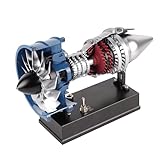
- Realistic & Authentic: The lifelike & visually stunning model provides a realistic depiction of a full-sized engine with main components including a first-stage fan, high-pressure rotor assembly, combustion chamber, high-pressure turbine assembly, low-pressure turbine assembly, and exhaust nozzle.
- High-Quality Construction: Made of high-quality metal, the meticulous model, full of detail and features, undergoes precision casting and CNC machining, along with sandblasting and anodized coloring treatment on the surface, ensuring durability and accuracy the same as the real model.
- Dynamic Display: Featuring a semi-transparent magnetic casing, this model offers a clear view of the engine's internal mechanics in motion when powered by the electric motor. The quick-release magnetic cover allows for effortless assembly and disassembly, making it ideal for demonstrations while protecting delicate components. Equipped with a sturdy mounting bracket and throttle control lever, this kit delivers an immersive hands-on experience with aviation engineering.
- DIY Assembly: Consists of 170+PCS (including screws & nuts) and comes with tools and paper-based English instructions. You will personally experience the entire assembly process, from small parts to the final completed model, constructing an awe-inspiring turbofan engine model.
- STEM Education: As an educational tool, this model unravels the internal workings of a turbofan engine, imparts knowledge about aerospace engineering, and stimulates interest, creativity, and awe for industrial technological achievements
Do not assume that a turbo engine is inherently less durable or that a V-6 always lasts longer. Both claims are common and neither is supported by the general evidence. Ownership cost depends on the specific engine, the maintenance it requires and the warranty that covers it.
Choosing between them for a specific vehicle
The table below sets out where each design tends to fit. It describes typical patterns in the evidence, not guaranteed outcomes for a given car.
| Driving need | Turbo four is more likely to suit | Naturally aspirated V-6 is more likely to suit |
|---|---|---|
| Mostly commuting and light highway use | Yes, when the calibration keeps boost demand low | Acceptable, but larger displacement is less efficient at light load |
| Frequent heavy towing | Only with a model-specific rating that matches the load and cooling equipment | Often preferred when the rating and cooling package are stronger for the load |
| High-altitude driving | Check whether the boost system compensates for thinner air in the owner documentation | Naturally aspirated power falls with altitude, so the same caution applies |
| Long hills or mountain grades at sustained load | Requires checking cooling and sustained-load ratings | Requires checking cooling and sustained-load ratings |
Before you decide on a particular model, check these items for the exact model year, trim and drivetrain:
- EPA combined, city and highway fuel economy, read against the fuel economy listing for that model year rather than a general engine claim.
- Horsepower and torque, including the engine speed at which peak torque is available and how the transmission uses it.
- Tow rating, payload, cooling equipment and any factory towing package.
- Curb weight, packaging, cargo space and cabin tradeoffs.
- Required fuel grade, since some boosted engines call for premium fuel and others do not.
- Scheduled maintenance, warranty coverage and the model’s reliability record from owner documentation.
If a dealer or review cites peak horsepower, displacement or cylinder count as proof of superiority, ask for the fuel economy, towing and maintenance figures for that exact vehicle. Those are the numbers that determine whether the engine suits your driving.
Quick Recap
Product prices and availability are accurate as of the date/time indicated and are subject to change. Any price and availability information displayed on Amazon at the time of purchase will apply.




