The Tool Desk
Outbyte PC Repair FREEClear out junk files and repair common Windows errorsFree Scan →Outbyte Driver Updater FREEFix the driver behind crashes, sound loss and screen glitchesFind Drivers →No. Pulling a vacuum on a car’s A/C system does not normally remove a meaningful amount of compressor oil. The oil that leaves the system does so during refrigerant recovery, which is a separate step that comes before evacuation. Service procedures measure that recovered oil, and the amount is accounted for when the system is recharged. Evacuation itself is only meant to pull air and moisture out of the lines.
Why recovery removes oil and evacuation does not
Automotive A/C service is normally done in two distinct stages, and the oil question depends on which stage you are looking at.
- Refrigerant recovery. Refrigerant is removed from the system using recovery equipment. Refrigerant carries a small amount of compressor oil with it as it circulates, so some oil comes out with the refrigerant. This is the stage where oil is removed and measured.
- Evacuation. A vacuum pump lowers the pressure inside the empty system to pull out air and moisture. The vacuum pump is not refrigerant recovery equipment, and it does not collect or measure oil.
Because oil leaves during recovery rather than during the vacuum pull, the practical rule is simple: the oil that was removed is the amount that was measured during recovery, plus any oil drained from parts that were replaced. Evacuating the system afterward does not change that accounting.
What the manufacturer procedures say
Three vehicle-specific procedures were reviewed for this question. Each one treats oil and evacuation as separate operations, but the details differ by vehicle, so they should not be read as universal specifications.
Recommended Free Tools
#1 Best Overall
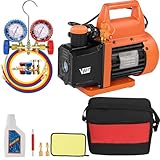
- HVAC Vacuum Pump Kit: This AC vacuum pump and gauge set includes a 110V 1/3 HP 4.5 CFM Single Stage vacuum pump, a three-way manifold gauge, three hoses, a low-pressure quick coupler, a high-pressure quick coupler, two R410a adapters( from1/4'' male to 5/16'' female),2 R134a can taps( puncture-style and self-sealing ),a bottle of vacuum oil,a valve core wrench,a user manual and a cleaning cloth ;the vacuum pump,gauge and all other accessories can be packed into the storage bag for easy carry
- AC Vacuum Pump: With a flow rate of 4.5 cfm(0.13 m³/m), the motor of this Vacuum Pump And Gauge Set durable construction ensures dependable service;the aluminum alloy casing dissipates operational heat and resists chemical corrosion for years of use
- Manifold Gauge Set: Professional dial provides direct readings of temperature(℉), pressure(psi), and refrigerant flow, enhancing diagnostic efficiency;With a top hook for easy hanging, freeing up hands for additional tasks
- Rubber Hoses:The three 4 feet long color-coded rubber hoses (red for high-pressure, blue for low-pressure, yellow for filling) are flexible and durable, designed to withstand long-term use with a working pressure of 600 psi and burst pressure of 3000 psi
- Wide Compatibility: The provided hoses and manifold gauge are suitable for various refrigerants like R134a, R12, R22, and R502, and this AC vacuum pump versatile for Mini Split,HVAC and AUTO AC repair;Note:The pump must be operated at 110V,and before using the pump, add pump oil to prevent overheating
Tesla Model S
Tesla’s Model S service information tells technicians to record the oil removed during refrigerant recovery and use that amount in recharge calculations when no components are being replaced. When defective components are replaced, the oil drained from those components is measured separately and included in the oil accounting.
2012 Honda CR-V
The 2012 Honda CR-V procedure lists refrigerant recovery, measuring the oil removed after recovery, and system evacuation as separate operations. It uses a recovery/recycling/charging station for recovery and a vacuum pump for evacuation. The same procedure describes a compact electronic vacuum gauge for monitoring vacuum and moisture removal during evacuation. The vacuum levels and durations given in that procedure belong to that model and are not general requirements.
Rank #2

- HIGH-PERFORMANCE 4 CFM VACUUM PUMP: Single-stage rotary vane pump delivers fast, deep evacuation for automotive and home HVAC systems; Removes moisture before refrigerant charging; Die-cast aluminum body with anti-slip base ensures long-lasting use
- ENHANCED COOLING & EASY OIL MANAGEMENT: Built-in high-volume cooling fan supports extended continuous operation; Clear oil sight glass allows quick checks; Bottom drain port enables clean, mess-free oil changes; Includes 0.35 qt/330 ml pump oil
- ACCURATE MANIFOLD GAUGE SET: High-quality manifold gauges provide precise readings; Large viewing glass ensures clear refrigerant flow; Shock-resistant core maintains accuracy during transport or daily use
- DURABLE COLOR-CODED HOSES: Three 5 ft reinforced hoses provide flexible, leak-proof connections; Red for high, blue for low, yellow for service; Compatible with R134a, R12, R22, R502, and R410a systems using included 1/4"-to-5/16" adapter for R410a connections
- COMPLETE HVAC ACCESSORY KIT: Includes 4 CFM vacuum pump, manifold gauge set, three color-coded hoses, leak detector, R410a adapters, R134a can taps, quick couplers, and carry bag; All essential tools in one kit for convenient HVAC servicing
2011 Ford Explorer
The 2011 Ford Explorer procedure tells the technician to note the oil removed during refrigerant recovery and add that same amount back after the repair. Evacuation is documented as its own step, with no instruction to add oil because the system was pulled into vacuum.
| Vehicle procedure | Where oil is measured | Role of evacuation | Oil added back |
|---|---|---|---|
| Tesla Model S | During refrigerant recovery; replaced components measured separately | Separate step; not an oil removal step | Recovered amount used in recharge calculations; drained amount from replaced parts included |
| 2012 Honda CR-V | Measured after refrigerant recovery | Separate step using a vacuum pump; gauge monitors vacuum and moisture removal | Per the model’s procedure; oil type and quantity not stated in the source reviewed |
| 2011 Ford Explorer | Noted during refrigerant recovery | Documented separately from recovery | Recovered amount added back after repair |
When oil does need to be adjusted
Oil adjustments are driven by what was measured or replaced, not by the vacuum step. Follow this order:
What’s actually slowing this PC down?
Pick the symptom - the matching free tool is one click away.
Rank #3

- Universal Refrigerant Compatibility: Compatible with a variety of refrigerants, including R134a, R22, R12, R502, R410A, R404A, and R407C. This AC vacuum pump and manifold gauge set is ideal for automotive A/C systems, HVAC maintenance, refrigeration tasks, and industrial applications requiring high vacuum levels from a compact pump.
- Powerful & Efficient Vacuum Pump: This 3.5 CFM single-stage vacuum pump, powered by a durable 4-stage pure copper motor, delivers an ultimate vacuum of 5 Pa. With a 0.27 qt. (260 ml) oil capacity, it ensures efficient and reliable performance for maintaining refrigeration systems.
- Precise Pressure Monitoring: The upgraded PRO manifold gauge features an impressive ±1.6% accuracy and enhanced pressure resistance. It allows you to precisely monitor and adjust the pressure of your system in real time. The large viewing glass ensures clear, easy-to-read measurements every time.
- Secure & Easy Connection: The included three color-coded 3.94 ft (1200 mm) hoses in red, blue, and yellow for clear identification and secure connections. With a working pressure range of 800 PSI to 4000 PSI, these hoses are built to handle demanding jobs.
- Everything You Need in One Kit: This kit got you covered for HVAC system maintenance: 1 single-stage vacuum pump, 1 manifold gauge set, 3 color-coded hoses, 1 Leak Detector, 1 R410a Adapter, 1 set of R134a quick couplers, 1 1/4" SAE to 1/2" ACME Adapter, 2 can taps, 1 bottle of 0.35 qt. (330 ml) vacuum oil, and a convenient carrying bag for easy storage and transport.
- Recover the refrigerant with suitable recovery equipment and measure the oil that comes out.
- If a component is replaced, drain it and measure the oil it held.
- Add back the amount your vehicle’s service procedure specifies for the recovered oil and any replaced parts, using the oil type it calls for.
- Evacuate the system, then recharge.
The procedures reviewed do not support adding a fixed amount of oil simply because the system was evacuated. Oil type and quantity depend on the vehicle, the refrigerant, and the repair, and the correct figures are in the vehicle’s own service information.
Equipment and the vacuum pump’s role
A vacuum pump is a tool for evacuation. It is not a substitute for refrigerant recovery equipment, and it cannot tell you how much oil was removed. Recovery equipment that can measure recovered oil is the tool that gives you the number you need to restore the oil charge correctly. Venting refrigerant to the air is not an acceptable way to clear a system, and a standalone vacuum pump should not be used as recovery equipment.
Rank #4

- SIMPLE BUT POWERFUL - XtremepowerUS 1/4 HP 3 CFM 1-Stage Rotary Air Vacuum Pump is designed to have high efficiency and low noise output with internal high volume cooling fan for extended use (Include R-134A automotive air conditioning dispensing valve design with hand operated punch/valve control, connects all R-134a refrigerant cans with 1/4" Male threads)
- HEAVY DUTY VACUUM PUMP - Die-cast Aluminum Alloy Casing enables the vacuum pump be light and durable at the same time. Equipped with brass fitting tethered safety caps to prevent oil leaks during transportation and handling.
- HVAC GAUGE READING - The XtremepowerUS HVAC service gauge set is great for diagnosing and repairing AC systems. Ideal use for R12, R22, R134a and R410a
- EASY OIL CHANGE - The vacuum pump features a simple Oil Fill Port for a clean pour and Oil Drain Plug positioned beneath the oil reservoir to quickly drain when needed. Checking the spillage meter will help to ensure the proper level of oil.
- PACKAGE INCLUDED: Multicolored set of three 36” hoses, Manifold Gauge, R134 Can Tap, Vacuum Pump Oil Bottle, Accessories and Storage Bag to keep equipment clean and dust free
Where the limits are
- The three procedures cover a Tesla Model S, a 2012 Honda CR-V, and a 2011 Ford Explorer. Their instructions should not be generalized to other cars.
- The vehicle make, model, year, refrigerant type, and service history of your car determine the correct oil specification and quantity. Without those details, no exact oil figure can be given here.
- The general answer is that evacuation does not meaningfully remove compressor oil. It is not a guarantee that no trace of oil vapor can ever leave the system under every condition.
Choosing how to handle the service
Most people face one of two options: have a qualified automotive A/C service provider handle recovery, evacuation, and recharge, or do the work yourself with appropriate equipment and the exact service procedure for your vehicle. When comparing them, check these points:
- Whether the equipment supports the refrigerant your car uses and can recover it properly.
- Whether the technician or equipment can measure the oil removed during recovery.
- Whether the oil type and quantities follow your vehicle’s specifications.
- Whether the evacuation and leak-check steps in the procedure can be carried out completely and correctly.
If you are unsure whether oil needs to be added, ask the service provider to show the recovered oil measurement and the procedure they followed.
Quick Recap
Best Value

- Complete HVAC & Auto AC Toolkit for Beginners and Professionals — Everything Included, No Extra Tools Needed: 3.6cfm vacuum pump, 3-way manifold gauge, R134a self-sealing & puncture-style can taps, R134a car quick couplers, 3 color-coded 5ft hoses, 1/4" SAE Male to 5/16" SAE Female straight adapters x2(for R410a), 1/2 ACME to 1/4 adapter, vacuum pump oil, carry bag. Ready for standard R134a HVAC service right out of the box.
- 3.6CFM Vacuum Pump - Voltage:110v, 60HZ; Power:1/4HP; Pumping Speed: 3.6CFM; Inlet Port: 1/4 SAE. All-copper motor and alloy aluminum housing for reliable, long-life performance in both DIY and professional use. Built-in cooling fan keeps the pump running efficiently, monitor oil levels easily with the sight glass, and ensure swift oil emptying through the bottom drain valve.
- 3-Way Manifold Gauge - Our 3-way gauge delivers highly accurate and reliable pressure measurements of refrigeration equipment. Color-coded hoses help identify the high-pressure (red), low-pressure (blue), and refrigeration (yellow) ports; With a working pressure of 600psi and a burst pressure of 3000psi, the 5ft rubber hoses are flexible, durable, and not easy to damage; Built-in hanging hook keeps the gauge off the ground and within reach during service.
- Works for R134a Vehicle AC Systems — Service R134a car air conditioning with R134a quick couplers and R134a can taps(New R1234yf Refrigerant needs R1234f quick couplers & can tap). Compatible refrigerants: R134a, R410a, R22. The large-capacity tool bag can carry all the accessories needed at one time. This kit is easy to use for beginners.
- Note - If you want to use for mini split system, check the location of the outdoor unit and determine whether you need to purchase R410a additional curved connectors.
Product prices and availability are accurate as of the date/time indicated and are subject to change. Any price and availability information displayed on Amazon at the time of purchase will apply.




