Recommended Free Tools
The right full-suspension e-bike is determined first by your trails, climbing, descending and local access rules—not by the biggest battery or highest torque figure. Choose the bike category that matches your terrain, then verify motor behavior, route-specific range, fit, suspension setup, service support and legal classification before comparing component lists.
Decide whether full suspension fits your riding
A full-suspension electric mountain bike (e-MTB) has a suspension fork at the front and a rear shock linked to the frame. The two systems help the tires stay in contact with uneven ground, which can improve comfort, traction and control on technical trails and at speed. The tradeoff is extra weight, more moving parts and a less direct feel than a hardtail.
As an Amazon Associate I earn from qualifying purchases.
A hardtail uses a suspension fork but no rear shock. It is generally simpler, lighter and less expensive, and can feel efficient on smoother paths. If your rides are mostly gravel, fire roads, commuting or smooth cross-country trails, a hardtail may deliver the handling and maintenance you actually need. Full suspension becomes more compelling as roots, rocks, drops, repeated impacts and faster descents become a regular part of your routes.
Outdated Drivers Are Slowing You Down
One free scan finds every outdated or missing driver and matches the right update for your exact hardware.Free scan · exact hardware matchWindows Errors? Fix Them Before They Spread
Repair common Windows errors and clear accumulated junk for a smoother, more stable PC - no reinstall needed.Free scan · no reinstallThere is no universal “best” full-suspension e-MTB. A short-travel bike that feels lively over long distances can be a better choice than a heavier enduro model if your trails are mild. Conversely, a light trail bike may be out of its comfort zone on repeated steep descents. Start by describing the terrain you ride most often, not the specification you would like to own.
#1 Best Overall

- [48V Power & Peak 1000W] Unleash exceptional performance with a powerful 48V system and peak 1000W brushless motor. Experience rapid acceleration and enhanced power for all your commuting and adventure needs!
- [Full Suspension & Superior Riding Comfort] Experience unparalleled comfort with our e-bike's premium full suspension system, designed to absorb bumps and vibrations seamlessly. Coupled with 26" x 2.1" tires, it delivers a smooth, stable ride, whether you’re navigating city streets or tackling uneven terrain. Enjoy every journey with confidence and ease!
- [Versatile 21-Speed Gearing & 4 Riding Modes] Tackle any terrain with the professional 21-speed gearset of our e-bike. Select from four riding modes—manual, pedal-assist, pure electric, and walking-assist—perfect for hills, daily commutes, and leisurely sightseeing. Adapt to your surroundings and enjoy every ride!
- [Removable 48V Safe Battery with Extended Range] Experience worry-free journeys with our certified, waterproof 48V 7.8Ah battery. Designed for convenience and security, this easily removable battery is anti-theft equipped, allowing you to recharge in just 4 hours. Enjoy impressive ranges of up to 25 miles in throttle mode and up to 40 miles with pedal assist, ensuring you have the power you need for every ride.
- [Easy Assembly & 12-Month Warranty] Arrives 90% pre-assembled with all necessary tools and instructions. Backed by a reliable 12-month after-sales service, ensuring support and peace of mind long after your purchase.
Match suspension travel to the terrain
Travel is the amount the fork or rear wheel can move to absorb an impact. JE James Cycles’ buying guide, last reviewed in August 2026, gives these broad category bands:
| Category | Typical travel | Best suited to | What to weigh |
|---|---|---|---|
| XC/downcountry | About 100–130 mm | Distance riding, smoother trails and efficient climbing | Usually lighter and more responsive, but with less reserve for repeated large impacts |
| Trail | About 130–160 mm | Mixed climbs, descents and technical singletrack | A versatile compromise; geometry, tires and shock tune still determine how capable it feels |
| All-mountain | About 150–170 mm | Rougher terrain with substantial climbing and descending | More control margin on impacts, usually with additional weight and slower handling |
| Enduro | About 160–180 mm or more | Repeated steep, technical descents and aggressive riding | Built around descending control; may be unnecessary bulk for smoother, longer routes |
These are category guides, not engineering rules. JE James explicitly notes that “Travel figures are broad category guides, not rules.” Two bikes with the same travel can ride very differently because of frame geometry, wheel size, tire casing, wheel strength, suspension kinematics and shock tune. More travel alone does not guarantee better control, and it can make a bike heavier or less efficient on flatter trails.
Use your actual route as the test
- If most of your time is spent covering distance on flowing or relatively smooth trails, look first at XC, downcountry or shorter-travel trail bikes.
- If one bike must handle everyday trail rides, moderate climbs and occasional technical descents, a mid-travel trail model is usually the most balanced category to investigate.
- If your local terrain is rocky, steep and rough in both directions, all-mountain travel may provide useful margin.
- If the defining feature of your rides is repeated, steep downhill runs, enduro-oriented suspension and stronger wheels may matter more than low weight.
Understand motor character instead of chasing one number
Most full-suspension e-MTBs use a mid-drive motor mounted around the bottom bracket. This position keeps the motor’s mass low and central and lets the bicycle’s gears influence the assistance. The useful question is how naturally and controllably the system responds on your climbs, not simply which motor advertises the most torque.
What’s actually slowing this PC down?
Pick the symptom - the matching free tool is one click away.
In its June 25, 2026 guide, Canyon separates full-power and lighter mid-power e-MTBs. Full-power systems emphasize stronger assistance and commonly use larger batteries. Lighter mid-power systems reduce overall weight and preserve more of a conventional mountain-bike feel, but provide less assistance and generally less range potential for the same conditions.
Usable assistance depends on torque, software calibration, the gear you select, your cadence and the grip available from the rear tire. A high headline torque figure cannot compensate for poor traction, an unsuitable gear or a response that feels abrupt on a technical climb. Compare the modes, walk-assist behavior, control layout and support network as well as the rated output.
Canyon describes the motor’s purpose this way: “The goal of an e-MTB motor is to support the rider, not replace them, and the law requires that you need to pedal for the motor to work.” That distinction matters on narrow, technical trails where smooth input is more useful than maximum acceleration.
Full-power or lighter system?
| Priority | Likely better fit | Tradeoff |
|---|---|---|
| Long, steep climbs; carrying more gear; maximum assistance | Full-power system with a larger battery | More motor and battery mass, which can affect lifting, cornering and low-speed handling |
| Natural handling; lower weight; easier manual bike movement | Lighter mid-power system | Less assistance and potentially less route range under the same conditions |
| Technical climbing control | A system with predictable response and suitable low-speed modes | Specifications alone do not reveal software feel or traction management |
How far will a full-suspension e-bike go?
Battery capacity is measured in watt-hours (Wh), but there is no dependable fixed mileage. JE James Cycles uses that wording because range changes with rider and luggage weight, total climbing, surface and terrain, temperature, tire choice and pressure, cadence and assistance level. A heavier rider on soft tires, in cold weather and high assistance can use energy much faster than a lighter rider on firm tires in Eco mode, even on the same bike.
Quick wins for a faster PC:
Scan for outdated or missing drivers - takes under a minuteDriver Scan →Repair Windows errors before they cause bigger problemsFix Now →Rank #2

- All-Terrain Stability & Smooth Suspension - The combination of 27.5 inch tires and a front&rear full suspensions absorbs bumps and vibrations from uneven pavement, gravel, or cracks, with the powerful 1500W peak motor delivers exhilarating acceleration and support on hills, reaching speeds up to 31+ mph providing a noticeably smoother and more controlled ride on every journey.
- Powered by a high-capacity 48V/20.8Ah removable battery to 80Miles(PAS1) - this e-bike is built for extended commutes and weekend adventures. The bottom-mounted design ensures optimal weight distribution and riding stability. When it's time to recharge, simply remove the battery for convenient charging at your desk, in your apartment, or anywhere with an outlet.
- The athletic step-over frame - provides a confident, engaged riding position that optimizes pedaling efficiency and control. Coupled with fully adjustable handlebars and a performance saddle, it allows for precise micro-adjustments to achieve a custom, body-optimized fit that connects you directly to the bike's responsive handling.
- The intuitive central display - Clearly shows your speed, battery level, trip distance, and more at a glance. The advanced NFC card offers keyless convenience—just a tap to start your ride.
- Easy Setup & Reliable Support - Eskute ebike arrives 90% pre-assembled with all necessary tools and clear instructions. Backed by a 12-month warranty and responsive customer service, ensuring a dependable and worry-free ownership experience
Choose battery capacity for your longest realistic route and keep a reserve for unexpected climbs, navigation mistakes, weather changes or a slower companion. Do not plan to finish at the battery’s last bar. Ask whether the battery is removable, how it is charged, what replacement support exists and whether the frame accepts a compatible range extender.
A manufacturer example, not a mileage promise
Specialized states that a Levo 4 can provide up to 5.33 hours in a particular test configuration: an 80 kg rider, an 840 Wh downtube battery, a 280 Wh range extender, Eco mode and a test lap with significant elevation gain. This is a manufacturer-reported result for that bike and those conditions, not an independent comparison or a guarantee for every rider, temperature, trail or assistance setting.
When a seller quotes range, record the conditions beside the number. Confirm the battery size, rider and cargo assumptions, mode used, elevation, temperature, tires and whether a range extender was installed. A time or distance claim without those details is not a useful basis for comparing bikes.
Build a route-specific range estimate
- Write down the longest route you genuinely expect to ride, including the return trip and any detour options.
- Estimate how much climbing and how much technical, slow-speed riding it contains. These usually demand more assistance than steady, rolling terrain.
- Decide which assistance modes you would actually use. A bike that only reaches the advertised range in its lowest mode may not meet your needs if you routinely use higher support.
- Allow a reserve rather than treating the battery’s full rated capacity as usable on every ride.
- Check charging access at home, at work or at a riding destination, and verify the cost and availability of a replacement battery or approved extender.
Fit and handling can outweigh a headline specification
Use the manufacturer’s size chart and geometry information for the exact model and model year. Frame sizing is not interchangeable between brands, and even two bikes labeled “medium” can have different reach, stack, wheelbase and seat-tube dimensions. A local retailer test ride can reveal whether you can shift your weight, reach the controls and place your feet confidently at low speed.
Giant’s buying information directs riders to local retailers and highlights trying a bike for size. Treat that as a fit check rather than a short spin in a car park: ask to ride a representative climb, descend, turn and brake if the retailer and location permit.
What to check on a test ride
- With the saddle at your normal height, can you maintain a comfortable knee and hip position while pedaling?
- Can you move behind the saddle on a descent without the rear wheel feeling unpredictable?
- Does the front wheel track the line you choose at low speed, or does the bike feel cumbersome?
- Can you reach both brake levers and change assistance modes without changing your grip?
- Does the motor start and stop smoothly when you apply and release pressure?
- Can you lift, turn or load the bike safely? Total e-bike weight matters when negotiating stairs, racks and storage.
Set the suspension before judging the bike
Sag is how far the suspension compresses under your riding weight before you hit an obstacle. It establishes the starting position of the fork and shock. There is no single sag percentage that works for every design or rider, so follow the bicycle and suspension manufacturer’s instructions, as JE James and the retailer guidance recommend.
- Use the specified riding kit, including shoes, helmet and any pack you normally carry.
- Set the fork air pressure or spring rate and the rear-shock pressure or spring according to the maker’s starting procedure.
- Measure sag in the normal riding position, not while hanging over the bars or sitting unnaturally.
- Adjust rebound so the suspension returns quickly enough to follow repeated bumps without feeling bouncy or packing down.
- Set tire pressure for your weight, casing and terrain, then recheck it before each ride.
- Only after these settings are close should you decide whether the bike feels too firm, too soft, nervous or sluggish.
Incorrect pressure, rebound or tire pressure can make an otherwise suitable bike feel harsh, vague or difficult to control. Ask the retailer to record the settings so you can restore them after transport or servicing.
Rank #3
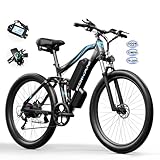
- CONQUER STEEP HILLS AND GRAVEL TRAILS WITH 2000W PEAK POWER — The 32MPH brushless motor delivers 55NM of torque for instant acceleration on rough roads and dirt paths, while 5 adjustable speed levels let you dial in the perfect power for daily commutes or weekend adventures
- ENJOY UP TO 80 MILES PER CHARGE AND BANISH RANGE ANXIETY — The 48V 19.2Ah removable battery offers 40-80 miles depending on PAS or pure electric mode, charges in just 7-8 hours, and features IP67 waterproofing with UL 2849 certification for safe, worry-free rides in any weather
- ABSORB 85% OF ROAD SHOCKS FOR A BUTTERY-SMOOTH RIDE — Full suspension with a lockable front fork and 800lbs rear shock absorbs potholes and bumps effortlessly, ensuring fatigue-free comfort whether you are descending rocky mountains or navigating rough city streets
- SWITCH BETWEEN 5 RIDING MODES FOR EVERY SCENARIO — Choose Pedal Assist for long-distance touring, Full Throttle for quick errands, Cruise for maintaining steady speeds on flat roads, or Walking Mode to easily push the 62lbs ebike up steep driveways and stairs
- STOP RELIABLY AND SET UP IN MINUTES WITH COMPLETE ACCESSORIES — Dual mechanical disc brakes provide smooth, secure stops even at high speeds in wet or dry conditions, supporting riders 5'7" to 6'8" and up to 330lbs, plus a pre-assembled kit with headlight, phone charger, and 12-month support
Compare the parts that affect control and ownership
Suspension travel and motor output do not tell the whole story. Brakes must control a heavier bicycle and repeated descents; tires determine a large part of available grip and puncture resistance; and wheels need enough strength for your terrain, rider weight and riding style. The sources establish these components as relevant decision points but do not support one universal brake, tire or wheel specification.
| Area | Questions to ask | Why it matters |
|---|---|---|
| Brakes | Are the rotors and calipers appropriate for your weight, gradients and repeated descents? Are replacement pads readily available? | Consistent braking is essential when a motorized, heavier bike gathers speed on rough terrain. |
| Tires | What casing and tread are fitted? Are pressures and inserts compatible with your trails? | Grip and puncture resistance can change climbing traction and descending confidence more than a small motor-output difference. |
| Wheels | Are rim width, spoke construction and wheel support suitable for your impacts and weight? | Wheel strength and repair access affect reliability and ownership cost. |
| Suspension hardware | What fork and shock are fitted, and can a local technician service them? | Adjustment range and service support determine whether the advertised travel is usable for you. |
| Service and parts | Who diagnoses the motor, battery and controls? How long are common wear parts and batteries supported? | An e-MTB is an integrated electrical and suspension system, so local support can matter as much as the initial specification. |
Do not assume that a higher component tier automatically makes a bike right for your route. A durable tire, familiar brake pad and nearby service technician may be more valuable than a lighter component that is difficult to replace locally.
Check classification and trail access before paying
E-bike rules vary by geography, vehicle class and the organization managing a trail. Confirm the rules for the exact place where you will ride, not only the country where the bike was sold.
Great Britain EAPC example
JE James Cycles’ August 2026 guide summarizes a standard Great Britain electrically assisted pedal cycle (EAPC) as requiring usable pedals, a motor with no more than 250 W maximum continuous rated power, and assistance that cuts off above 15.5 mph. Riders must be at least 14. These details apply to the Great Britain EAPC category; they are not a universal rule for every e-bike or jurisdiction.
United States Class 1 example
Specialized describes its Levo 4 example as a US Class 1 bike, with assistance up to 20 mph, and advises riders to check the entity managing their intended trails. A bike that is legal on a public road may still be restricted on a particular park, reserve or managed trail network.
Free tools Windows power users keep installed
One-click scans. No signup required.
Questions to settle locally
- Which e-bike class or technical definition applies to the bike you are considering?
- Does assistance cut off at the limit required where you ride?
- Are e-MTBs allowed on the specific trail, and are there seasonal or direction restrictions?
- Do you need registration, equipment or age compliance for that area?
- Will a local shop service a bike whose motor system was purchased elsewhere?
A practical buying process
- Map your riding. List your usual trail surfaces, longest route, total climbing, steepest descents, technical features and how often you carry gear.
- Select a category. Use the XC/downcountry, trail, all-mountain and enduro bands as starting points, then account for geometry, tires, wheel strength and suspension tune.
- Choose motor character. Decide whether stronger full-power assistance or a lighter, more conventional feel better matches your climbs, handling preferences and lifting needs.
- Set a range requirement. Compare Wh, charging arrangements and extender compatibility using the conditions of your real route. Keep a reserve.
- Shortlist by fit. Check the exact maker’s size chart and geometry. Eliminate bikes that cannot give you a stable climbing position and confident descending position.
- Verify local support. Ask who services the motor, battery, fork and shock, what parts are stocked and how warranty or diagnostic work is handled.
- Test ride meaningfully. Try assistance modes, braking, cornering, climbing and descending. Record the settings and note whether the bike remains composed when you shift your weight.
- Confirm access and classification. Check the relevant authority or trail manager before ordering, especially if the bike is imported or configured for another market.
- Price the complete ownership package. Include charger arrangements, protective equipment, spare pads and tires, suspension service, battery replacement planning and transport or storage needs. Current prices are not established by the cited buying guides and vary by market and configuration.
- Recheck the exact specification. Model-year changes can alter the motor, battery, suspension, brakes, wheels or included accessories. Confirm the delivered configuration in writing.
Common buying mistakes and how to avoid them
Buying the largest battery for every ride
A large battery can add weight and cost. If your routes are short and your priority is responsive handling, a smaller system with a realistic reserve may be more suitable. If your routes are long, steep or remote, capacity and charging options deserve higher priority.
Assuming more travel always means a better bike
Extra travel can help on severe terrain, but it may bring weight, slower steering or a setup that is unnecessary on smoother trails. Judge the complete chassis, not the millimeter figure alone.
Rank #4

- Unrivaled Power: This 26 inch electric bike for adults is equipped with a 350W peak high-speed brushless motor. Unlike standard e-bikes, you get instant torque for steep inclines and sandy trails. No more getting off to push.
- 7-speed Transmission & Satety: Fine-tune your ride with a professional 7-Speed drivetrain. Whether you’re accelerating from stoplights or grinding up loose gravel, you’ll maintain optimal cadence with crisp, reliable shifts. The dual disc brake system provides instantaneous stopping more stronger power from top speed, keeping you and your loved ones safe ride after ride.
- 48V Removable Battery: The adult electric bicycle is powered by a 48V large battery, the advanced pedal assist system lets you travel up to 15 miles per charge(varies by mode). The removable battery slides out in seconds for convenient charging at your desk or apartment.
- Precision On Every Terrain: This e bike for adults is combined with 5 riding modes (pedal assist, throttle, cruise, pedal only, and walk assist modes), you control exactly how much assistance you want, maximizing both fitness and battery life.
- Illuminate the Ride, Day or Night: This adult ebike features a bright front headlight and reflector. The reflector ensures drivers and pedestrians see you from behind, even in heavy fog or dusk. The LCD display shows your riding speed, battery level, pedal assist levels, mileage, making it easy for you to track your riding data.
Choosing by torque alone
Motor response, gear selection, cadence and tire grip determine whether assistance is controllable. Read the specifications, then ride the bike at low speed on a climb if possible.
Skipping setup because the bike is new
Factory settings are starting points. Rider weight, clothing, luggage, tire pressure and terrain all change the correct settings. Set sag, rebound and tires before deciding whether the suspension works.
Ignoring weight and service access
An e-MTB that is difficult to lift, store or transport can reduce how often you ride it. A distant service center can turn a small electrical or suspension issue into a long interruption. Check both before purchase.
Assuming road legality means trail permission
Classification and trail access are separate questions. Verify the local class requirement and the trail manager’s policy for the exact route.
How to compare two finalists
Make a side-by-side sheet and tie every row to a route decision:
| Comparison axis | Record | Decision question |
|---|---|---|
| Use and terrain | Category, travel, geometry and intended riding | Which bike matches the majority of your actual trails without unnecessary bulk? |
| Suspension | Fork and shock design, adjustment range, setup support | Can you obtain and maintain a correct setup for your weight and terrain? |
| Motor system | Full-power or lighter system, mode behavior, controls and service network | Does assistance feel predictable on your climbs and manageable in technical sections? |
| Battery and range | Wh, removable or integrated battery, extender compatibility and charging | Can it complete your longest route with a reserve under realistic conditions? |
| Fit and handling | Size, reach, stack, wheelbase, weight and test-ride notes | Can you climb, corner, descend, brake and move the bike confidently? |
| Components and ownership | Brakes, tires, wheels, wear parts, replacement support and service access | Will the bike remain usable and maintainable where you live? |
| Geography and access | Local classification, assistance limit and trail-manager permission | Can you legally and practically ride the routes you intend to use? |
For context, Cannondale’s Moterra family is an example of a full-suspension e-MTB line, while Specialized describes the Turbo Levo 4 as a full-suspension trail bike. Those examples illustrate categories, not endorsements; current equipment and regional configurations should be checked before purchase.
Do these 3 things before closing this tab:
1Scan for outdated or missing drivers - takes under a minute2Repair Windows errors before they cause bigger problems3Fix the driver behind crashes, sound loss and screen glitchesThe decision in one sentence
Buy the lightest, best-fitting full-suspension e-MTB that has enough travel, motor support, battery reserve, braking and wheel durability for your real terrain, then confirm its setup, service network and local trail classification before committing.
Quick Recap
Product prices and availability are accurate as of the date/time indicated and are subject to change. Any price and availability information displayed on Amazon at the time of purchase will apply.




